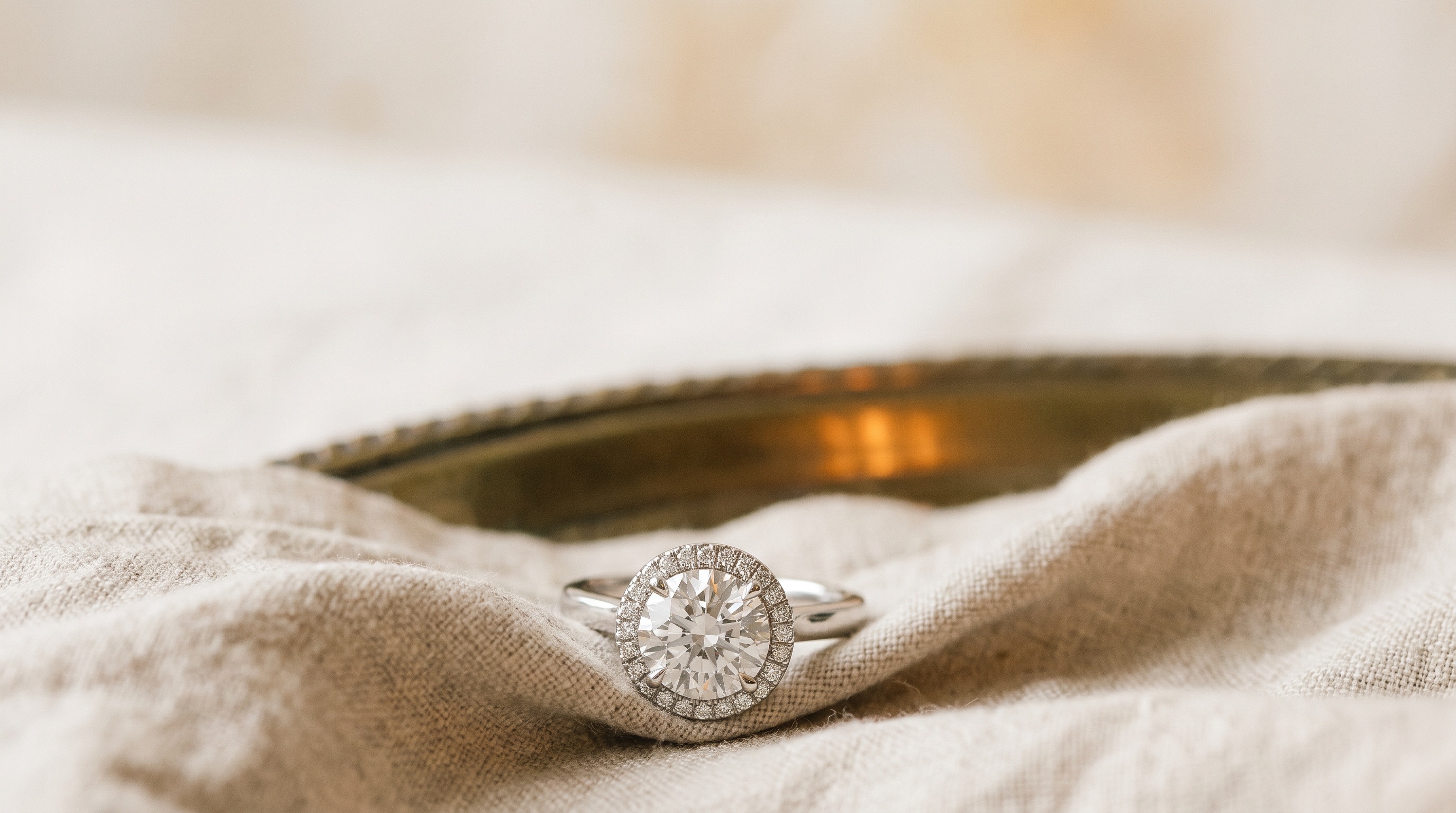
A halo setting is a jewelry mounting style in which a ring of small accent diamonds — the "halo" — is set closely around a center stone, framing it and increasing its apparent size and overall sparkle without increasing the center stone's actual carat weight. It's one of the most requested engagement ring styles in the trade, prized for letting a smaller, more affordable center stone read as visibly larger and more brilliant than it would in a plain solitaire mounting.
How a Halo Setting Works Mechanically
A halo setting starts with a standard prong or basket mounting for the center stone, the same structural approach used in a solitaire ring. Around that center mounting, a setter builds a continuous band of small accent diamonds — typically melee in the 1mm to 2mm range — set edge to edge using pavé beading, shared prongs, or a fine channel, so the metal holding each accent stone largely disappears behind the density of small stones. The result is a ring of continuous sparkle that sits flush against the outer edge of the center stone, with no visible gap between the two.
The accent diamonds themselves are usually round brilliants, since a round stone's symmetry makes it easiest to set in a tight, evenly spaced ring around center stones of any shape. The halo's total stone count and width scale with the center stone's diameter — a larger center stone needs a proportionally larger circumference of accent stones to encircle it cleanly, which is one reason halo settings on larger center stones use noticeably more melee than the same style built around a smaller stone.
Why a Halo Makes a Center Stone Look Bigger
The size boost is a genuine optical effect, not a marketing exaggeration. When small diamonds sit flush against a center stone's girdle with no visible metal gap, the eye reads the halo and the center stone together as one continuous field of sparkle rather than as two separate elements — effectively extending the stone's visual footprint outward to the halo's outer edge. Because the human eye judges a gem's apparent size largely by its outline and overall brilliance rather than by measuring the center facet alone, a well-built halo can make a center stone look meaningfully larger in face-up view than its actual millimeter diameter would suggest on its own.
This effect is strongest when the halo's accent stones are set tightly and at a matching height to the center stone's girdle, so there's no visible step or shadow line breaking up the outline. A poorly fitted halo — accent stones set noticeably lower than the center stone, or with visible gaps between beads — undercuts the size illusion considerably, since the eye then reads the halo as a separate ring of small stones rather than as a continuous extension of the center stone itself. This is one of the clearest cases in engagement ring construction where setting quality directly affects the finished look's core selling point, not just its durability.
Halo Settings Compared to Other Popular Styles
A halo isn't the only way to add perceived size or visual impact to a center stone, and it's worth seeing where it sits relative to the two styles it's most often compared against: a plain solitaire and a three-stone setting.
| Factor | Halo Setting | Solitaire | Three-Stone |
|---|---|---|---|
| Apparent size boost vs. actual carat weight | High — often reads noticeably larger than the center stone's actual diameter | None — reads at true size | Moderate — side stones add visual width but don't frame the center stone itself |
| Overall sparkle | Highest of the three, from the accent stone field | Lowest, sparkle comes only from the center stone | Higher than solitaire, concentrated in three distinct points |
| Relative cost for a given "visual size" | Lower — smaller center stone plus lower-cost melee | Highest — visual size depends entirely on center stone carat weight | Moderate — depends on side stone size and shape matching |
| Setting complexity / bench time | Higher — many small stones to set precisely | Lowest — one stone, standard prongs | Moderate — three stones to align and proportion |
| Everyday durability | Good, with more small contact points to monitor over time | Very good — fewest points of potential failure | Good — similar prong-based durability to a solitaire per stone |
| Best for | Buyers prioritizing maximum apparent size and sparkle per dollar | Buyers prioritizing a classic, low-maintenance look | Buyers wanting symmetry and a "past, present, future" design story |
The core tradeoff a halo setting makes is straightforward: it trades a small amount of added structural complexity and a modest increase in ongoing inspection needs for a substantial gain in perceived size and sparkle relative to cost. For a buyer working within a fixed budget, that tradeoff is often the entire reason a halo gets chosen over a comparably priced solitaire built around a larger but plainer-looking center stone.
A Note on Halo Variations
"Halo setting" describes the broad design principle — a ring of accent stones surrounding a center stone — but several distinct constructions fall under that same name in the trade. A single halo is the baseline version: one ring of accent stones set directly around the center stone. A double halo adds a second, slightly larger ring of stones outside the first for even more visual impact. A hidden halo sits beneath the center stone's girdle rather than around its visible outline, revealing itself only from a side angle. A floating halo sits at a slight distance from the center stone rather than flush against it, creating a visible gap of open metal or light between the two. Each of these variations changes the finished look, stone count, and cost in a meaningfully different way, and choosing between them is a separate conversation from understanding what a halo setting fundamentally is. GuruDiam covers that comparison — how single, double, hidden, and floating halo constructions differ side by side — in a dedicated guide; this piece focuses on the foundational style all four are built from.
History and Popularity of the Halo Setting
The halo setting's roots trace back to Edwardian and Art Deco jewelry of the early 20th century, when jewelers commonly surrounded a center stone — often an Old Mine or Old European cut — with a border of smaller diamonds, both to add sparkle and to visually stretch the design across more of the finger or the piece's surface. This era's halo work tended to use larger, less uniform melee than modern pieces do, set by hand without the precision calibration available to setters today, giving antique halo pieces a distinct, slightly softer look compared to a contemporary micro-pavé halo.
The style saw a major resurgence starting in the early 2010s, driven in large part by high-profile celebrity engagement rings and a broader shift in bridal jewelry demand toward maximizing perceived size and sparkle within a given budget. That resurgence has held steady rather than fading as a passing trend — halo settings remain one of the most consistently requested engagement ring styles across both retail and custom bridal jewelry today, spanning a wide range of price points from modest single-halo designs to elaborate double-halo statement pieces.
Durability and Everyday Wear
A well-built halo setting is durable for normal daily wear, but it carries a genuinely different risk profile than a solitaire. Instead of one center stone secured by a small number of larger, easily inspected prongs, a halo adds a ring of small accent stones each held by a smaller bead or shared prong — more total contact points, each individually carrying less structural margin than a solitaire's main prongs. The most common failure mode on a halo ring isn't a catastrophic loss of the center stone; it's a single worn or loosened accent stone in the halo itself, usually caught and repaired well before it's actually lost if the piece gets routine professional inspection.
The center stone's own security in a halo setting is generally comparable to an equivalent solitaire, since the center mounting is typically a standard prong or basket underneath the halo detail. What changes is the maintenance profile of the piece as a whole: a halo ring benefits from being checked by a jeweler somewhat more often than a plain solitaire, simply because there are more individual small stones that could work loose over years of wear, and catching a worn bead early is a much simpler and cheaper fix than replacing a stone that's already been lost.
Signs of Quality Halo Work
Not all halo settings are built to the same standard, and the difference shows up mainly in how tightly and evenly the accent stones sit against the center stone and against each other. Well-executed halo work shows evenly sized, evenly spaced accent stones set at a consistent height flush with the center stone's girdle, with no visible metal gap breaking up the outline and no stone sitting noticeably higher or lower than its neighbors. Under magnification, the beads or shared prongs holding each accent stone should look uniform in size and cleanly finished rather than crude or oversized relative to the stones they're holding.
Warning signs of lower-quality halo work include a visible step or shadow line between the center stone and the halo (which undercuts the size illusion the whole style depends on), accent stones that appear loose or rock slightly under gentle pressure, and noticeably inconsistent stone sizing around the ring, which reads as an uneven, lower-grade surface even to a buyer without a trained eye. Retailers evaluating incoming halo inventory, and buyers evaluating a piece before purchase, should check these details closely, since a halo's core value proposition is entirely dependent on the setting being executed well — an average center stone in an excellently set halo generally outperforms a better center stone in a poorly set one, at least in terms of how the finished piece actually looks on the hand.
Cleaning and Maintaining a Halo Ring
Debris, lotion residue, and soap buildup tend to accumulate in the small gaps between a halo's accent stones more than on a plain solitaire's open prongs, so a halo ring generally needs slightly more frequent cleaning attention to keep its sparkle looking its best day to day. A soft brush with mild solution handles most routine at-home cleaning, while a professional ultrasonic or steam clean — recommended periodically for any fine jewelry piece — reaches the finer buildup in a halo's tighter spacing more thoroughly than at-home cleaning alone. Because the accent stones sit close together, a halo ring is also somewhat more prone to visibly showing dulled sparkle when it's overdue for cleaning than a solitaire is, since the effect compounds across dozens of small stones rather than showing up on just one.
Cost Considerations
The core economic appeal of a halo setting is that it lets a buyer achieve a larger-looking, more sparkling ring for meaningfully less than the cost of a solitaire built around a center stone large enough to read the same size on its own. A center stone's price rises sharply with carat weight, while the melee used in a halo is priced per stone at a small fraction of a comparable-weight larger stone's per-carat cost — so shifting visual size onto a ring of small accent stones rather than the center stone itself is usually the more cost-efficient way to hit a given "looks like X carats" target.
That efficiency comes with an added labor cost on the setting side: a halo requires meaningfully more bench time to set than a plain prong solitaire, since each small accent stone has to be seated and secured individually and evenly around the center stone's full circumference. For most buyers, though, the combined savings on center stone carat weight still outweigh the added setting labor, which is why halo settings remain popular specifically among buyers optimizing for apparent size and sparkle within a defined budget rather than chasing carat weight for its own sake.
Which Center Stone Shapes Suit a Halo
Halo settings work with essentially any center stone shape, since the accent ring is built to follow the center stone's own outline rather than requiring a particular geometry. Round and cushion center stones are the most common pairing, since a halo's rounded or gently curved outer edge complements both shapes' softer silhouettes especially well. Oval, pear, emerald, and marquise center stones are also frequently halo-set, with the halo's shape following the center stone's outline — an elongated halo around a pear or marquise stone, for instance, rather than a simple circle — and the halo effect tends to be especially pronounced on elongated shapes, since it adds width along the stone's narrower dimension in a way that reads as a meaningful size increase.
Antique cuts like Old Mine, Old European, and Kite also pair naturally with a halo, echoing the style's own Edwardian and Art Deco origins, and a halo built around an antique center stone often uses a slightly softer, less densely calibrated melee spacing to stay visually consistent with the period-inspired look of the center stone itself, rather than the tightest possible modern micro-pavé spacing.
Buying and Sourcing Considerations
A few practical questions matter more for a halo build than for a simple solitaire. First, melee consistency: because a halo's accent stones sit close together in direct comparison with each other, any noticeable difference in color, clarity, or size between them stands out far more than it would in an isolated setting, so a halo build depends on sourcing melee against a consistent quality baseline rather than assorted individual stones. Second, center stone certification still matters independently of the halo — the halo adds visual size and sparkle, but a buyer evaluating the piece's actual value should still look at the center stone's own certified grading, since the halo doesn't change what the center stone itself actually is.
Buyers and retailers should also confirm how the halo is priced relative to the center stone in a quote — some quotes bundle the full stone-and-setting cost together, while others break out melee cost, labor, and the center stone separately — since understanding that breakdown makes it easier to compare a halo build's total cost against an equivalent solitaire or three-stone design apples to apples.
It's also worth confirming, before finalizing a custom halo build, whether the design calls for a single visible halo or one of the other constructions — hidden, double, or floating — since each changes both the melee quantity needed and the bench work involved. A buyer who says "halo" without qualification most often means the standard single, visible version described throughout this piece, but confirming that explicitly avoids a mismatch between what's quoted and what the customer actually pictures in the finished ring.
Sourcing Halo Setting Jewelry Through Guru Diam
Guru Diam supplies both sides of a halo build under one account: certified center stones and calibrated melee for the halo itself. Center stones are available as certified loose diamonds across standard, antique, and fancy shapes, graded by IGI, GIA, or GCAL depending on a buyer's preference, and Guru Diam's catalog covers CVD lab-grown diamonds as well as natural stones, so a halo build isn't limited to one growth type. Melee for the halo accent ring runs 0.8mm to 9.0mm in round brilliant and calibrated fancy shapes, held to a DEF+/VS+ quality baseline and sold as CVD lab-grown, uncertified parcel goods consistent with standard trade practice for stones at that scale — the kind of consistent, matched sizing a clean halo build depends on.
In-stock certified loose stones and melee ship same day when ordered before the New York location's 6pm EST cutoff or the Los Angeles location's 4pm PST cutoff. A finished custom halo ring — center stone, halo, and mounting built and set as one piece — is completed in 4-6 days and delivered unbranded by default, so a retailer can resell it under their own name.
Retailers can browse certified center stones suited to a halo build under certified diamonds, and fancy color center stones for a colored halo design under fancy color loose diamonds. Matched stone pairs for halo-set stud earrings or a matching pendant-and-earring set are available under matching pairs. Start a custom halo build through custom jewelry, browse full inventory through the wholesale hub, or set up a trade account through trade partner.
Frequently Asked Questions
What is a halo setting?
A halo setting is a mounting style where a ring of small accent diamonds surrounds a center stone, framing it to increase its apparent size and overall sparkle without adding to its actual carat weight. It's one of the most requested engagement ring styles because it lets a smaller center stone read as visibly larger and more brilliant than it would alone.
Does a halo setting really make a diamond look bigger?
Yes, genuinely — when the halo's accent stones sit flush against the center stone with no visible gap, the eye reads the two as one continuous field of sparkle rather than a smaller stone with a separate ring around it. A well-fitted halo can meaningfully increase a stone's apparent face-up size, though a poorly set halo with visible gaps or height mismatches undercuts the effect.
Is a halo setting more expensive than a solitaire?
For the same center stone carat weight, a halo costs somewhat more due to the added labor of setting many small accent stones. But because a halo lets a buyer use a smaller, less expensive center stone to achieve a similar apparent size, a halo design is often the more cost-efficient way to hit a given "looks like X carats" target compared to a solitaire built around a larger center stone.
Are halo settings durable for everyday wear?
Generally yes, though a halo has more individual small contact points than a solitaire's main prongs, each carrying less structural margin on its own. The most common issue is a single worn or loosened accent stone rather than a failure of the center stone's mounting, which is why routine professional inspection matters somewhat more for a halo than for a plain solitaire.
What's the difference between a halo setting and the different types of halo rings?
"Halo setting" is the broad style — a ring of accent stones around a center stone. Single, double, hidden, and floating halo are specific constructions within that broad style, differing in stone count, whether the halo is visible from above, and how far it sits from the center stone. GuruDiam covers that comparison in a separate, dedicated guide to halo subtypes.
Which diamond shapes work best in a halo setting?
Round and cushion center stones are the most common pairing, but oval, pear, emerald, marquise, and antique cuts like Old Mine or Old European all work well in a halo, since the accent ring is built to follow the center stone's own outline. Elongated shapes like oval, pear, and marquise often show a particularly pronounced size effect from a halo along their narrower dimension.