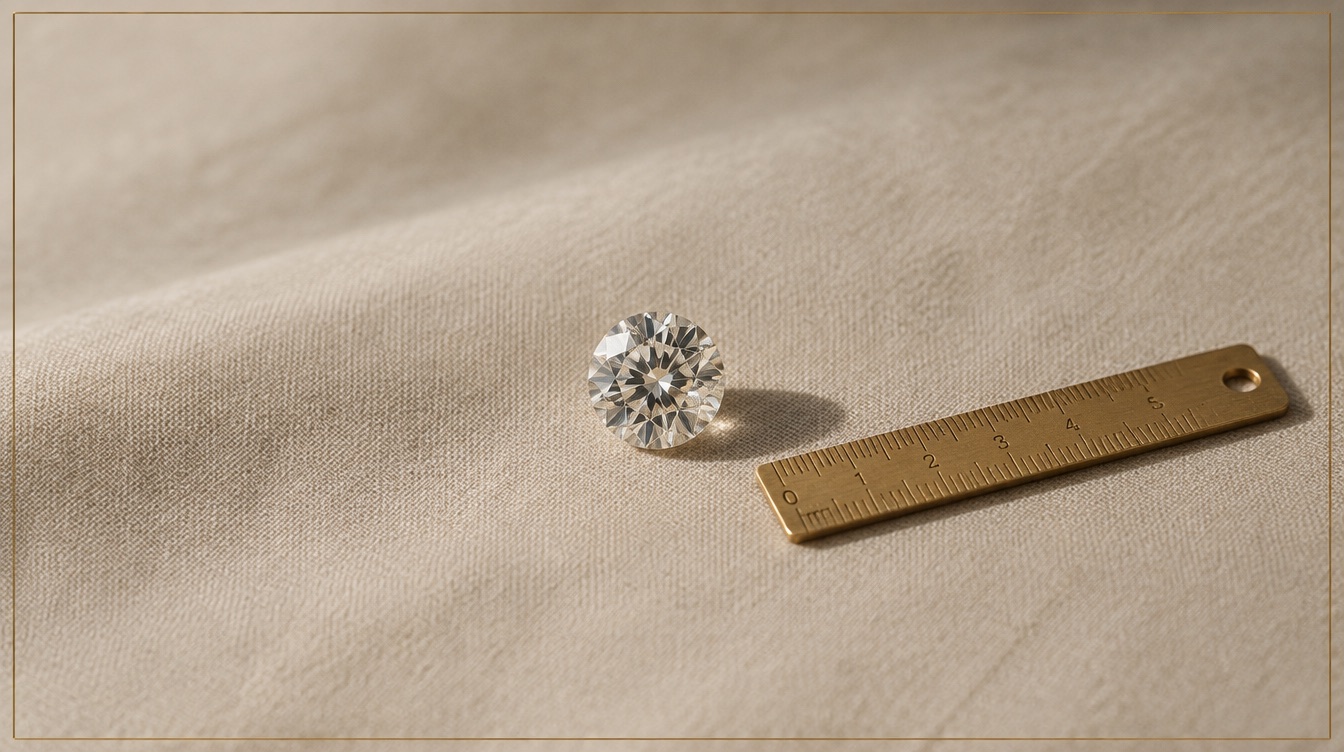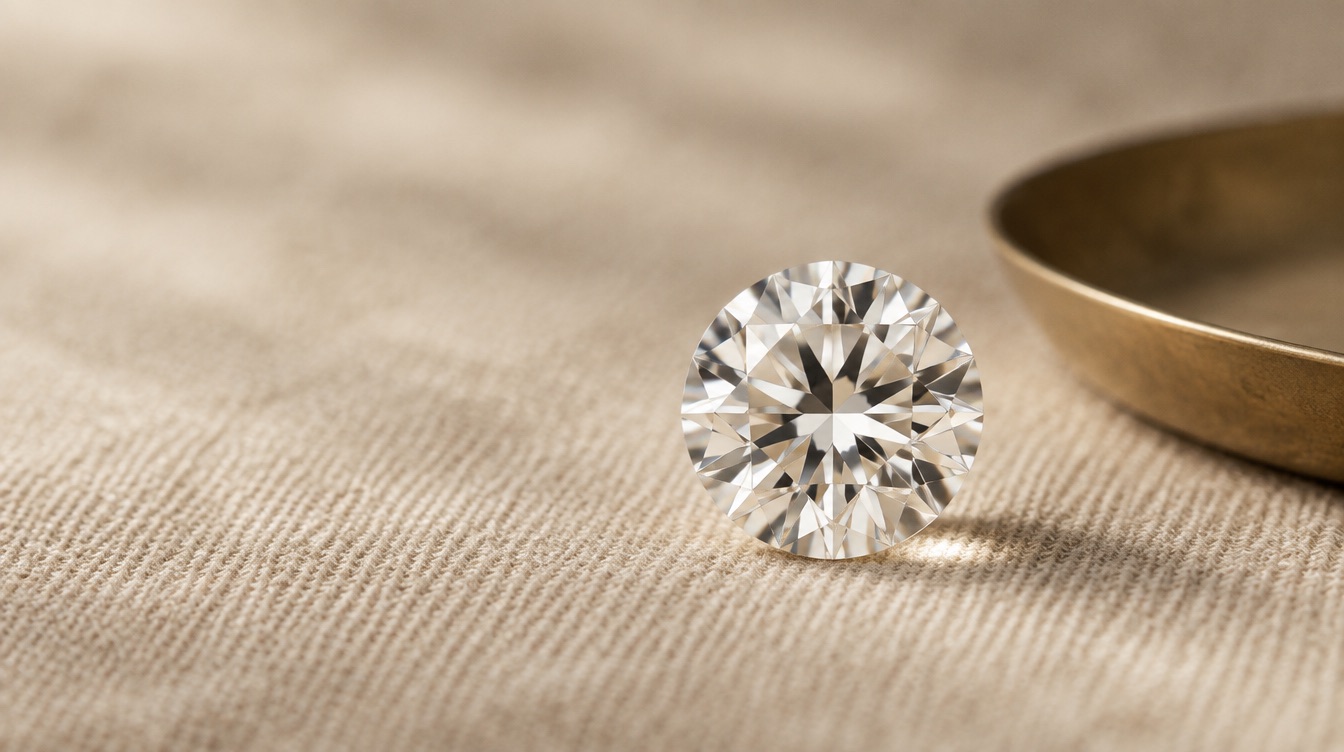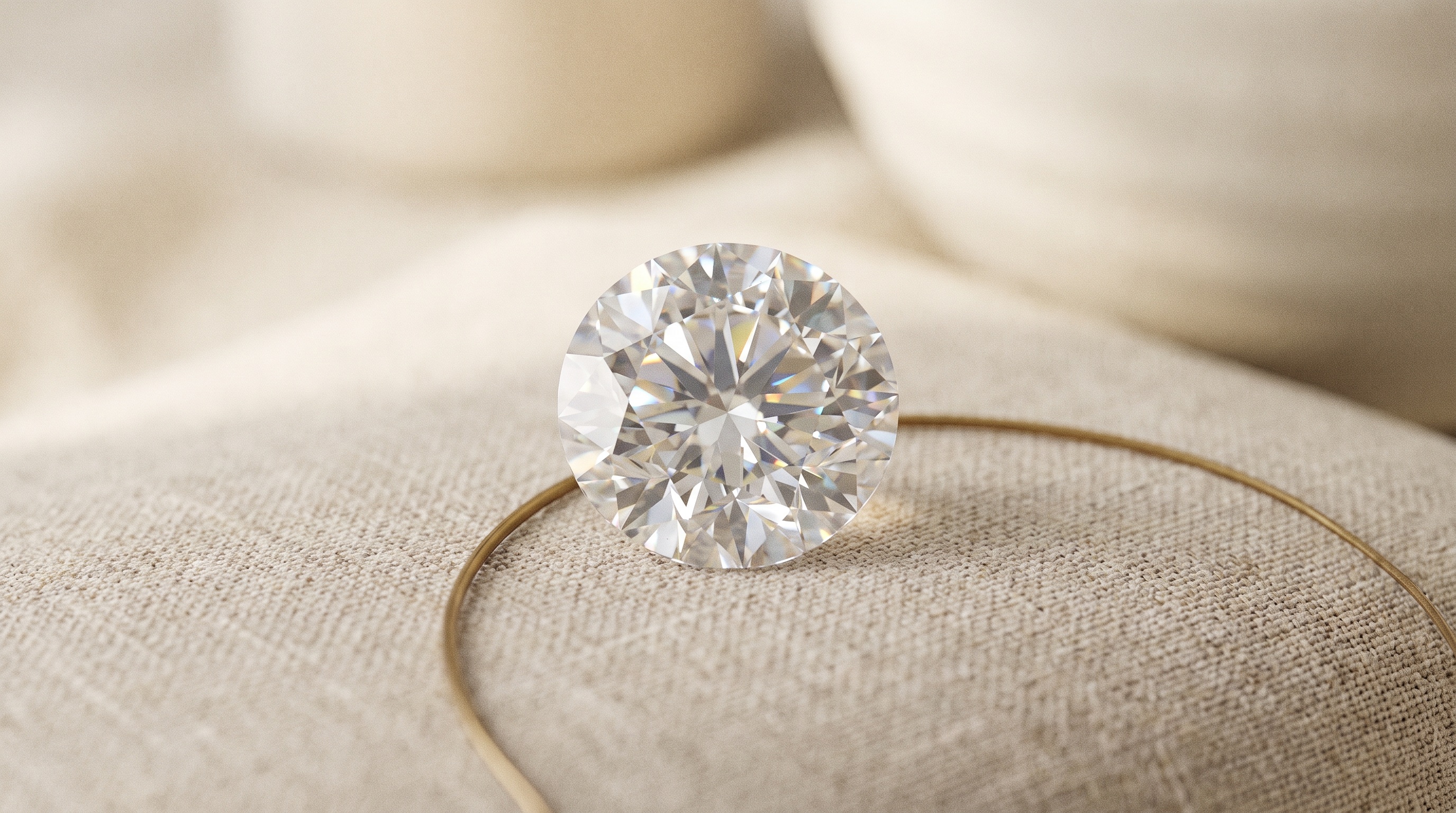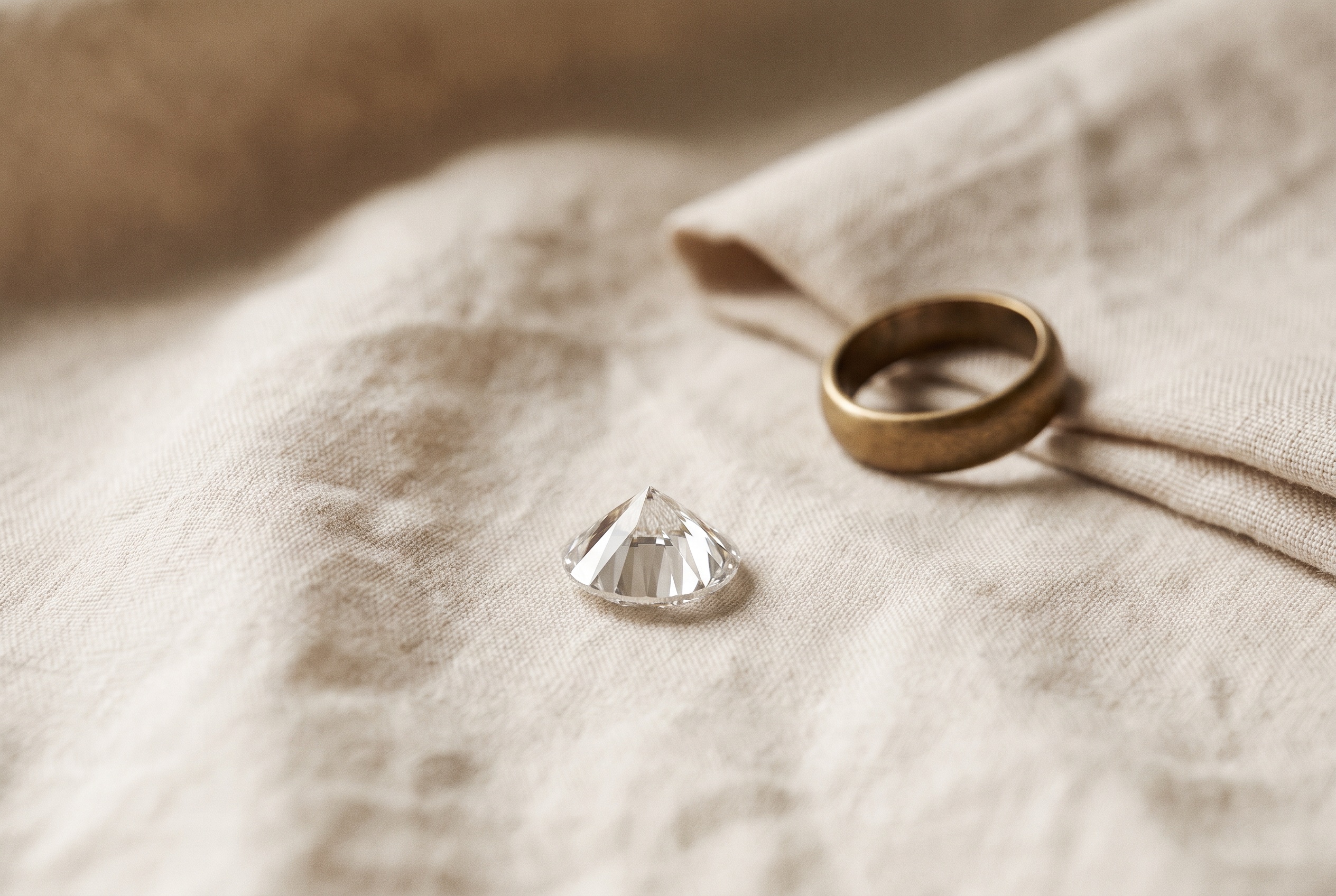
A diamond's culet is the tiny facet — or, on modern cuts, the point — located at the very bottom of the stone, where the pavilion's facets converge below the girdle. On most modern diamonds it's cut to a sharp point and effectively invisible face-up; on many antique cuts it's a small flat facet, added deliberately to reduce chip risk at the stone's most fragile spot. Culet size is graded from "none" or "pointed" up through "very large," and it appears on every standard diamond grading report.
Where the Culet Sits on a Diamond
A faceted diamond is built from three structural zones: the crown (the upper, visible portion above the girdle), the girdle itself (the narrow band at the stone's widest point), and the pavilion (the cone-shaped lower portion). The pavilion's facets all angle downward and meet at a single point at the very bottom of the stone — that meeting point is the culet. On a modern round brilliant cut to contemporary standards, the pavilion facets are cut to converge at a true point, leaving no separate flat facet at all. On many other diamonds, past and present, the cutter leaves a small flat facet at that meeting point instead of a sharp point, and that flat facet is what's specifically called "the culet" on a grading report. For a fuller picture of how the culet relates to the crown, girdle, table, and pavilion, see GD's diamond anatomy guide.
Why the Culet Exists at All
The culet's original, practical purpose was durability. A diamond's pavilion facets converging to a perfectly sharp point creates the single most fragile spot on the entire stone — a sharp point of hard, brittle material with no flat surface to distribute impact. Historically, cutters deliberately left a small flat facet at that point specifically to reduce the risk of the tip chipping during setting, wear, or handling. Modern cutting technology and setting techniques have reduced how necessary this precaution is for most contemporary cuts, which is why a "none" or "pointed" culet is now the standard, preferred grade on most new stones rather than a defect to avoid.
Culet Size Grades
Grading labs describe culet size on a standardized scale, typically noted on the report even when — as is common on modern round brilliants — there's effectively nothing there to see:
- None (or Pointed) — no visible flat facet; the pavilion facets meet at a true point. This is the target grade on the overwhelming majority of modern diamonds.
- Very Small — a barely perceptible flat facet, invisible without magnification.
- Small — a small flat facet, generally still invisible face-up to the naked eye.
- Medium — a more noticeable flat facet, sometimes visible face-up on close inspection through the table.
- Slightly Large to Large — a clearly visible flat facet, often appearing as a small dark or reflective dot when viewed through the table.
- Very Large to Extremely Large — a prominent flat facet that noticeably affects the stone's face-up appearance, uncommon on modern cut stones and mostly seen on older or lower-cut-quality goods.
A stone graded "none" through "small" is considered fine for virtually any use; grades from "medium" upward are worth a closer look, particularly on a stone intended as a center stone in a setting that exposes the pavilion, like a bezel with an open back or a stone displayed loose.
How Culet Size Affects Face-Up Appearance
A larger culet can create a small dark or reflective spot visible through the table when the stone is viewed face-up, sometimes described in the trade as looking like a tiny dot or "hole" at the center of the stone. This effect happens because light traveling down through the crown and pavilion facets hits the flat culet facet at a different angle than it would hit a true point, and depending on lighting conditions, that flat surface can either fail to return light the way the surrounding facets do, or reflect it in a way that reads visually distinct from the rest of the stone. On a stone graded "none" through "small," this effect is generally negligible or invisible to the naked eye. On a stone graded "medium" or larger, it becomes worth checking in person or via detailed video before finalizing a purchase, since photographs alone don't always make the effect obvious.
How Culet Size Affects Durability
This is the culet's original functional role, and it still matters today. A pointed culet with zero flat facet is more vulnerable to chipping under direct impact than a stone with a small protective flat facet at that same point, because there's no flat surface to distribute the force of a knock. In practice, this risk is fairly low for a properly set stone under normal wear, since a well-designed setting (particularly a prong setting with adequate pavilion clearance) protects the pavilion tip from direct contact. The risk becomes more relevant for loose stones being handled frequently, for settings with minimal pavilion clearance, or for larger stones where a chip at the culet — however small — removes proportionally more visible material. Buyers sourcing stones for settings with tight pavilion clearance, or for pieces expected to see heavy daily wear, may reasonably prefer a very small culet grade over an absolute point for this reason, even though "none" remains the standard target grade industry-wide.
Culet Visibility and Setting Style
How much the culet actually matters in practice depends heavily on how the stone will be set. A prong setting typically exposes the pavilion tip to some degree, meaning both light performance and physical vulnerability at the culet are relevant considerations. A closed-back bezel setting fully encloses the pavilion in metal, meaning culet size becomes almost entirely a non-issue for both appearance and durability, since the culet is neither visible nor exposed to impact. This is one reason antique-cut stones — many of which carry a deliberately larger culet than modern grading preferences would suggest — have historically been set in closed-back or partially closed settings: the setting style itself manages the very tradeoff the larger culet exists to address. See GD's bezel setting guide for more on how a closed-back mounting changes what proportions actually matter for a given stone.
Culet Grading on a Diamond Report
Culet size is listed on every reputable diamond grading report — GIA, IGI, and GCAL all include it as one of the standard proportion fields, alongside table percentage, depth percentage, girdle thickness, and crown and pavilion angles. Unlike cut grade, which GIA only assigns as an overall summary grade to round brilliants, culet size is reported individually for both round and fancy shapes across all major labs. Buyers evaluating a stone from its report alone should check culet grade specifically when the stone is a fancy shape (where no summary cut grade exists) or when sourcing antique-cut inventory, where a larger-than-modern culet is common and expected rather than a red flag. See GD's GIA diamond report guide for a full walkthrough of where each proportion appears on a standard certificate.
Culet Size on Antique and Vintage-Style Cuts
This is where culet grading matters most for a wholesale buyer working outside plain modern round brilliants. Old Mine and Old European cuts — genuine antique styles cut largely by hand before precision modern cutting equipment existed — were routinely cut with a visible, sometimes fairly large, flat culet facet as standard practice, not as an error. This reflects both the hand-cutting techniques available at the time and a deliberate durability choice appropriate to how those stones were typically set. A grading report on a genuine antique-cut stone showing a "medium" or "slightly large" culet is describing a normal, period-accurate characteristic rather than a quality problem, and buyers evaluating antique-cut inventory against modern round-brilliant culet expectations will misjudge otherwise excellent antique stones. Guru Diam's antique-cut catalog — Old Mine, Old European, Hexagonal, Moval, Lozenge, Kite, Trillion, Criss-Cut, and other true antique-style cuts — reflects this directly in how each stone is graded and represented, distinguishing genuine period-appropriate proportions from actual cut-quality issues.
Culet Size and Diamond Shape
Culet considerations vary somewhat by shape, largely tied to how many pavilion facets converge at the base and how that convergence point behaves optically:
Round Brilliant
Modern round brilliants are almost universally cut to a "none" or "pointed" culet as standard practice; anything larger is generally treated as a cut-quality shortfall on a contemporary stone rather than an intentional feature.
Old Mine and Old European Cut
As covered above, a visible culet is standard and expected on genuine antique-style cuts, reflecting period cutting technique rather than a flaw.
Emerald and Asscher (Step Cuts)
Step-cut pavilions are built from broader, more open facets than a brilliant cut, and the culet on a well-cut step-cut stone is typically small to none, though the more open faceting pattern can occasionally make even a small culet slightly more noticeable through the large, unbroken table than it would be on a brilliant-cut stone.
Marquise, Pear, and Heart
These shapes have more complex pavilion facet arrangements due to their points and curves, and culet size can vary somewhat around a well-cut stone depending on how the cutter managed the transition near the pointed end versus the rounded portion.
Culet Size at a Glance
| Grade | Face-Up Visibility | Durability Impact | Typical Context |
|---|---|---|---|
| None / Pointed | Invisible | Standard risk, managed by setting | Modern round brilliants, most fancy shapes |
| Very Small / Small | Generally invisible | Slightly reduced tip risk | Common on many well-cut modern stones |
| Medium | Sometimes visible on inspection | Meaningfully reduced tip risk | Some modern goods, common on antique cuts |
| Slightly Large / Large | Often visible face-up | Low chip risk at the point | Genuine antique cuts, lower-cut-quality modern goods |
| Very Large / Extremely Large | Clearly visible face-up | Very low chip risk at the point | Uncommon; mostly older or commercial-grade goods |
Culet Size and Light Performance
Beyond the simple dark-dot effect described above, culet size interacts with a diamond's broader light performance in a more subtle way. A true point at the base of the pavilion allows light entering through the crown to reflect internally and exit back through the crown with minimal interruption — this is part of why a pointed culet is the modern preference for maximizing brilliance. A flat culet facet introduces a small, flat interruption in that internal reflection path. On a small culet this effect is negligible against the stone's overall light return; on a larger culet, particularly combined with other proportion issues like a poorly matched pavilion angle, the cumulative effect on brilliance becomes more noticeable. This is one of several reasons overall cut grade (which accounts for the combined effect of table, depth, crown angle, pavilion angle, and culet together) is a more reliable indicator of a stone's light performance than checking culet size in isolation.
How to Check Culet Size Before Buying
Culet size appears on every standard grading report and is also visible on the plotted diagram many labs include showing a stone's proportions in cross-section. For a modern round brilliant intended as a primary center stone, "none" through "small" is a reasonable target and rarely worth further scrutiny. For antique-cut stones, fancy shapes without a summary cut grade, or any stone graded "medium" or larger, it's worth reviewing the stone in person or via detailed video before finalizing a purchase, specifically checking whether a visible dot or flat spot is noticeable through the table under normal lighting. Buyers should evaluate culet size alongside the stone's overall proportions and intended setting style rather than as a standalone pass/fail criterion, since a larger culet that would be a concern on an open, exposed setting may be a complete non-issue in a closed-back bezel.
Culet Considerations in Custom Jewelry Design
When a stone is being set into a custom piece, culet size is one factor a bench jeweler or CAD designer may weigh alongside girdle thickness and overall pavilion depth when planning prong height, basket structure, and pavilion clearance. A stone with a larger culet generally needs less concern about tip protection than a sharply pointed stone in the same setting, since the flat facet itself provides some inherent protection at that exact point. This is a minor factor compared to the primary sizing measurements a designer works from, but it's part of the fuller picture a jeweler considers when a stone falls outside typical modern round-brilliant proportions — as many antique-cut and reset heirloom stones do.
The History Behind Culet Grading Standards
Culet grading as a formalized proportion field is a relatively modern addition to diamond documentation, emerging alongside the broader standardization of diamond grading in the mid-20th century. Before formal grading labs existed, a culet was simply a practical feature a cutter included at their own discretion, based on the tools and techniques available and the cutter's own judgment about a given stone's durability needs. As precision cutting equipment improved through the 20th century, cutters gained the ability to reliably cut pavilion facets to a true point without meaningfully increasing chip risk, which shifted the "ideal" culet from a small protective facet to no facet at all. This is why older stones — even those cut relatively recently by trade standards, not just genuine antiques — often carry a larger culet than a stone cut today, independent of whether the shape itself is antique or modern.
Common Misconceptions About the Culet
A few misunderstandings come up repeatedly when buyers first encounter culet grading on a report. The first is assuming any visible culet automatically signals a lower-quality stone — as covered above, this is only true for modern round brilliants cut to contemporary standards; on antique cuts, a visible culet is period-correct and expected. The second is assuming culet size alone predicts a stone's overall light performance — culet is one input among several (table, depth, crown angle, pavilion angle, symmetry) that together determine cut quality, and a small culet on a stone with otherwise poor proportions won't produce good light performance on its own. The third is confusing "culet" with "girdle" — the two are adjacent on a diamond's structure and both appear near the bottom of a proportions diagram, but they describe different parts of the stone entirely: the girdle is the widest band around the stone's middle, while the culet is the point (or small facet) at the very bottom, well below the girdle.
Culet Grading Is the Same for Lab-Grown and Natural Diamonds
Culet size is a purely structural, cut-related characteristic, and it's graded identically regardless of whether a diamond is natural or lab-grown (CVD). Since a lab-grown diamond is chemically, optically, and physically identical to a natural one — the difference is entirely origin, not composition — the same cutting decisions, the same durability tradeoffs, and the same grading scale apply equally to both. A buyer comparing a natural and a lab-grown stone of the same shape and similar proportions should expect culet grading to follow the same logic on both certificates, with no adjustment needed for origin. This is one of several proportion fields (alongside girdle thickness, table percentage, and symmetry) where origin simply isn't a relevant variable — cut quality is a function of how the rough or grown crystal was faceted, not what produced the crystal in the first place.
Sourcing Diamonds With Full Proportion Data Through Guru Diam
Guru Diam supplies certified loose diamonds — lab-grown CVD and natural — across round, fancy, and antique shapes, with complete proportion data, including culet size, available on every graded stone. IGI, GIA, and GCAL certification are all available depending on the stone. Because antique cuts are a core specialty for Guru Diam rather than a small side category, buyers sourcing Old Mine, Old European, or other true antique-style stones can get period-accurate proportion guidance directly, rather than having a modern round-brilliant's culet standards misapplied to a stone that was never meant to meet them.
Browse certified stones with full proportion reporting through certified diamonds, or set up a trade account through trade partner to review inventory directly. Stones intended for a specific custom setting can be sourced and built together through custom jewelry, and matched pairs for earrings can be browsed under matching pairs. For general wholesale sourcing, start at the wholesale hub.
Frequently Asked Questions
What is a diamond culet?
A diamond's culet is the small facet, or point, at the very bottom of the stone where the pavilion facets converge. On modern cuts it's typically cut to a sharp point with no visible flat facet; on many antique cuts it's a small flat facet left deliberately for durability.
Is a pointed culet better than a flat one?
For most modern diamonds, yes — "none" or "pointed" is the standard target grade because it maximizes light return and is invisible face-up. On genuine antique-cut stones, a visible flat culet is a normal, period-accurate feature rather than a defect.
Can a large culet be seen with the naked eye?
Culet grades of "medium" or larger can sometimes be seen as a small dark or reflective dot through the table under close inspection. Grades of "small" or smaller are generally invisible to the naked eye.
Does culet size affect a diamond's durability?
Yes. A sharply pointed culet is the single most fragile point on the stone, since there's no flat surface to distribute impact. A small flat culet facet reduces chip risk at that exact point, which is why antique cutters often left one deliberately.
Why do antique diamonds often have larger culets than modern diamonds?
Antique cuts like Old Mine and Old European were cut largely by hand before modern precision-cutting equipment existed, and cutters at the time commonly left a larger, deliberate flat culet facet both as a durability measure and as a natural outcome of the cutting techniques available.
Does a large culet lower a diamond's value?
On a modern round brilliant, a larger-than-standard culet is generally treated as a cut-quality shortfall and can affect price. On a genuine antique-cut stone, a period-appropriate culet size is expected and doesn't carry the same negative implication — it should be evaluated against antique cutting standards, not modern round-brilliant expectations.