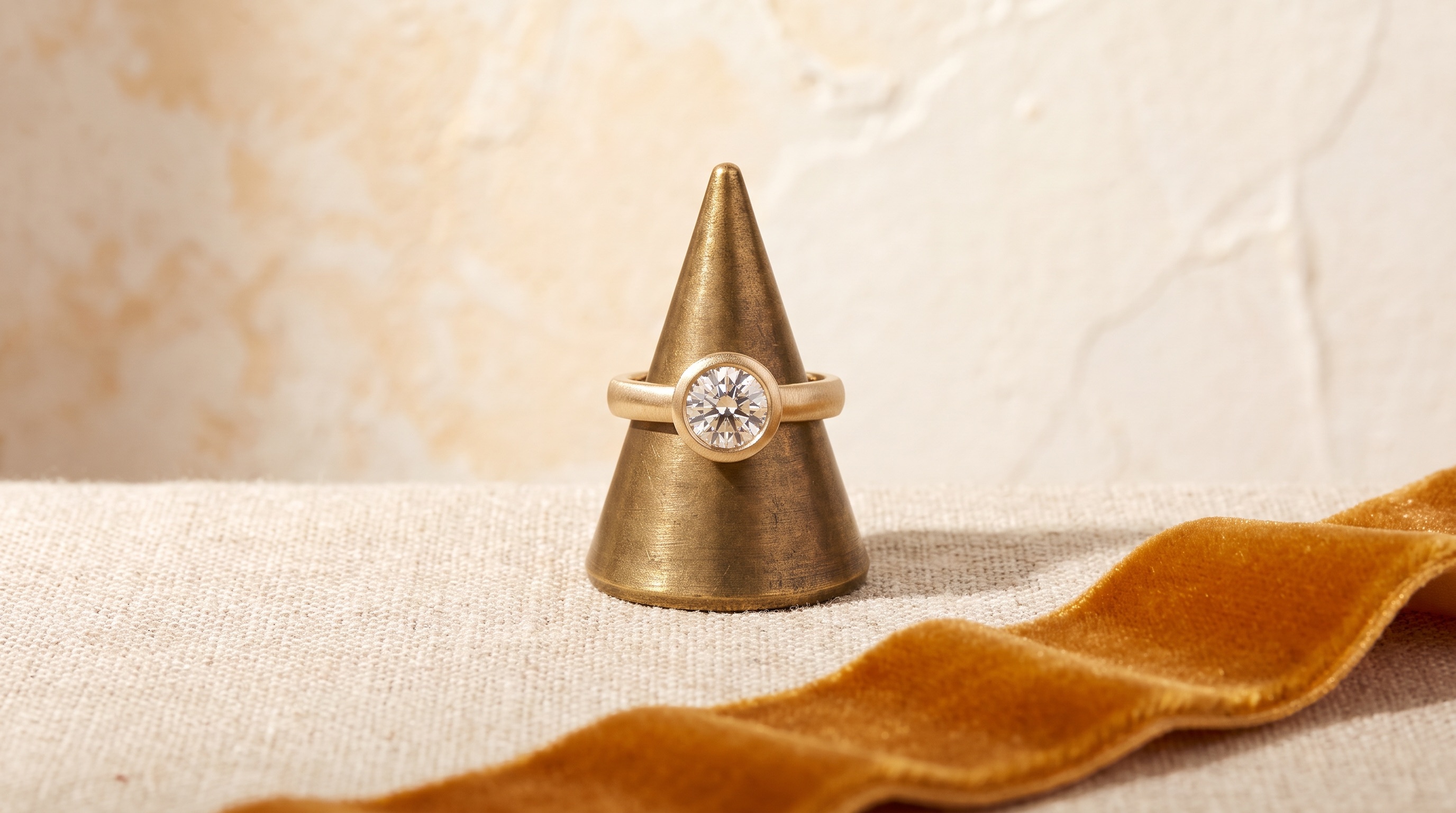
A bezel setting is a jewelry mounting style in which a thin, continuous rim of metal wraps fully or partially around a gemstone's girdle, holding it in place without visible prongs. Because the metal rim absorbs impacts that would otherwise strike the stone directly, a bezel setting is generally considered the most protective common setting style — the tradeoff being that the surrounding metal blocks some light from entering the stone's sides, slightly muting brilliance compared to an equivalent prong setting. It's one of the oldest setting techniques in jewelry-making and remains one of the most versatile, since it adapts to nearly any stone shape without requiring standardized claw geometry.
How a Bezel Setting Works Mechanically
A bezel is formed from a strip of metal shaped to the exact outline of the stone's girdle, then pushed or pressed over the stone's edge to secure it in place — a process that requires the metal to fit the stone's specific dimensions closely, unlike a prong setting's more universal claw mechanism. The metal makes continuous contact with the girdle around some or all of its circumference, distributing holding pressure evenly rather than concentrating it at a few discrete prong-tip points. This continuous contact is the source of both the style's main advantage (security) and its main tradeoff (reduced light entry from the sides).
Full Bezel vs. Partial Bezel
Full Bezel
A full bezel wraps completely around the stone's girdle with no gaps, offering the maximum protection of any common setting style. The entire vulnerable edge of the stone is shielded by metal, which makes a full bezel the standard recommendation for customers with active hands, manual jobs, or a general preference for minimal-maintenance jewelry. The visual tradeoff is the most pronounced version of bezel's brilliance reduction, since light is blocked from entering the stone's sides around its full circumference.
Partial (or Half) Bezel
A partial bezel covers only part of the stone's girdle — typically leaving the sides open while the rim covers the top and bottom, or vice versa — balancing some of full bezel's protection against some of prong setting's greater light exposure. Partial bezels are a common middle-ground choice for customers who like the clean, modern look of bezel styling but want more brilliance than a full bezel allows.
Bezel Setting Materials and Metal Considerations
Bezels are typically made in the same metal as the rest of the ring — platinum, white gold, yellow gold, or rose gold — and the metal choice interacts with the setting's durability in the same way it does for other continuous-contact settings like tension or channel. Platinum and higher-karat gold alloys hold a bezel's shape and pressure more reliably over years of wear than a softer, lower-karat alloy, since a bezel that deforms or thins from repeated contact can eventually loosen its grip on the stone. Rose gold, being a softer copper-blended alloy at a given karat, is worth flagging as a slightly less ideal choice for a full bezel intended for daily heavy wear, though it remains a popular and perfectly serviceable option for lighter-use pieces.
Which Diamond and Gemstone Shapes Suit a Bezel
Bezel settings adapt to essentially any shape, since the metal rim is custom-formed to the stone's specific outline rather than relying on a standardized claw geometry — round, oval, emerald, pear, marquise, and antique cuts like Old Mine or Kite can all be bezel-set. Pointed shapes (marquise, pear, kite) benefit particularly from a bezel's protection at the point, since that's typically the most vulnerable spot on the stone for chipping, and a bezel's continuous metal contact protects that point far more reliably than even a well-designed protective prong tip.
Bezel Setting in Earrings and Everyday Jewelry
Beyond engagement rings, bezel setting is one of the most common styles in stud earrings, everyday stackable rings, and minimalist pendant designs, largely because its low profile and lack of protruding prongs make it comfortable and snag-resistant for daily wear. A bezel-set stud earring, for instance, sits flatter against the ear and is less likely to catch on hair or clothing than a prong-set equivalent — a practical advantage that's driven much of bezel styling's growth in the everyday and minimalist jewelry categories in recent years.
Durability and Security Compared to Other Settings
A full bezel offers the highest day-to-day protection of any common setting style, since the metal rim absorbs impacts directly rather than letting them reach the stone. This makes bezel a strong recommendation over prong or halo settings for customers whose jobs or hobbies put jewelry at greater risk of impact — manual trades, frequent gym use, active parenting of young children, or any daily routine involving a lot of hand contact with hard surfaces. Prong settings, by contrast, offer easier visual inspection (a jeweler can see the stone and prongs clearly at a glance) and are simpler and less expensive to produce, but leave more of the stone's edge exposed to a direct impact.
Brilliance and Light Performance
Because a bezel's metal rim blocks light from entering the stone's sides, a bezel-set stone shows somewhat less brilliance from certain viewing angles than the same stone in an open prong setting, particularly on a full bezel. This effect is most noticeable on stones with a smaller table or shallower proportions that rely more on side-entering light for their overall sparkle; a well-cut stone with strong table and crown light performance shows a smaller relative brilliance difference between bezel and prong settings than a more marginally cut stone would. Choosing a well-proportioned stone (see GD's diamond anatomy guide for how table and depth percentage affect light return) becomes somewhat more important, not less, when the setting itself is already reducing side light entry.
Resizing and Repair Considerations
Bezel settings are more involved to resize than a standard prong setting, since resizing a ring band can affect the bezel's fit around the stone if the bezel itself needs adjustment as part of the process — a bench jeweler experienced specifically with bezel work should handle this rather than a generalist unfamiliar with the style's specific challenges. Repair is similarly more specialized: replacing or repairing a damaged bezel rim requires refitting metal precisely to the stone's exact dimensions, a more involved process than re-tipping a worn prong.
Bezel Setting in Current Retail Demand
Bezel setting has grown steadily as a share of overall setting demand in recent years, driven largely by the broader minimalist jewelry trend and by growing customer awareness of everyday-wear durability as a purchasing consideration rather than an afterthought. Stackable bezel-set rings worn several at a time, bezel-set huggie and stud earrings, and bezel-set pendant necklaces have all seen particularly strong growth, often among customers building a jewelry collection through smaller, more frequent purchases rather than a single large investment piece. This shift has made bezel setting a meaningful category for retailers to stock proactively rather than treating it as a request-only custom option.
Cost Considerations
Bezel settings generally cost somewhat more to produce than a simple prong setting of comparable size, since forming a rim of metal precisely to a specific stone's dimensions requires more bench time and skill than shaping standardized prongs. The difference is usually modest for a single center-stone bezel, but becomes more significant on designs using multiple bezel-set accent stones (a bezel-set halo or eternity band, for instance), where the labor cost compounds across each individually fitted stone.
Bezel Setting at a Glance
| Factor | Full Bezel | Partial Bezel | Standard Prong (for comparison) |
|---|---|---|---|
| Protection level | Highest | Moderate-high | Good, less than bezel |
| Brilliance/light entry | Most reduced | Moderately reduced | Minimal reduction |
| Best for | Active lifestyles, manual work, minimalist studs | Balance of protection and sparkle | Most shapes, especially round/square |
| Resizing difficulty | Moderate to difficult | Moderate | Easy |
| Relative production cost | Higher | Moderate | Lowest |
Bezel Setting vs. Flush (Gypsy) Setting
Bezel setting is sometimes confused with flush setting (also called gypsy setting), a related but distinct technique where the stone is set directly into a hole drilled into the metal, sitting flush with the surrounding surface rather than raised within a rim that sits above it. A bezel rim is a raised, distinct structural element visible around the stone; a flush setting has no raised rim at all, giving an even flatter, more minimalist profile than even a low-profile bezel. Both styles share bezel's core advantage — no protruding prongs to snag or chip — but flush setting sacrifices even more brilliance than a full bezel, since the stone is surrounded by solid metal on all sides at the surface level rather than an open rim. Retailers should be precise about which of the two a customer is describing when they say "no prongs," since the finished look and cost differ meaningfully between them. Asking a customer to point to a reference photo, rather than relying on terminology alone, is usually the fastest way to confirm which style they actually mean before quoting a build.
Bezel Setting for Fancy Color and Fancy Shape Diamonds
Bezel setting has a particular affinity with fancy color diamonds, since the enclosed metal rim can be chosen in a tone that either complements or deliberately contrasts with the stone's color — a warm rose gold bezel around a fancy yellow diamond, for instance, or a cooler white metal bezel to make a fancy pink or blue stone's color read as purely as possible against a neutral frame. Because bezel setting adapts to any outline, it's also a natural fit for fancy shapes and antique cuts where a standardized prong head either doesn't exist in a compatible profile or would require custom fabrication anyway — once custom prong work is already needed for an unusual outline, a bezel is often no more complex to produce and offers meaningfully better protection for a shape's more vulnerable points, such as a Kite or Trillion's sharp corners.
Bezel Setting in Men's Jewelry
Bezel setting has become a particularly common choice in men's jewelry — signet-style rings, men's wedding bands with a single accent stone, and men's stud earrings — largely because its low, snag-resistant profile suits a demographic more likely to wear jewelry during manual work, sports, or general daily activity without removing it. A bezel's clean, understated look also tends to read as more masculine to many customers than a more ornate prong or halo setting, independent of the practical durability argument, which has helped drive bezel's growth specifically within men's fine jewelry lines over recent years.
Cleaning and Maintaining a Bezel-Set Piece
Bezel settings are generally easier to keep visibly clean than prong settings, since there are no small crevices between prongs where lotion, soap residue, or debris tend to accumulate. That said, the underside of a bezel-set stone — the small open space beneath the stone within the rim, present in most bezel designs to allow light to pass through — can still collect debris over time and benefits from the same periodic professional ultrasonic or steam cleaning recommended for any fine jewelry piece. Customers should also be advised that, unlike a prong setting where a jeweler can visually confirm all contact points from multiple angles at a glance, a full bezel's grip on the stone is harder to inspect visually, so routine professional check-ins matter more for catching an early problem before it becomes a lost stone.
Origins and History of the Bezel Setting
Bezel setting predates the prong setting by a significant margin and was the dominant way of securing a gemstone in jewelry for most of recorded history, since early metalworking techniques were far better suited to shaping and pressing a metal rim around a stone than to fabricating and precisely positioning thin, delicate prongs. Ancient and medieval jewelry overwhelmingly used bezel or closed-back settings, and it remained the standard well into the Georgian and early Victorian eras before prong settings, enabled by more advanced metalworking and a growing preference for maximizing visible brilliance, gradually became the dominant style for center stones from the late 19th century onward. Bezel's recent resurgence in minimalist and everyday jewelry is, in that sense, less a new trend than a return to the oldest continuously used setting technique in the craft.
Bezel Setting and Stone Depth Compatibility
Not every stone cut sits equally well in a bezel. A stone with a very shallow pavilion can sit too high or too proud within a standard bezel height, while a stone with an unusually deep pavilion may require a taller bezel wall than a standard design accommodates, affecting both the piece's finished proportions and how much the setting needs to be custom-fit rather than built to a standard template. Confirming a specific stone's actual depth percentage and total height (see GD's diamond anatomy guide for how these proportions are measured and reported) before finalizing a bezel design avoids a mismatch that only becomes apparent once the setting is already fabricated.
Bezel Setting and Antique-Style Jewelry
Bezel setting has deep historical roots — many antique and vintage jewelry styles, particularly Georgian and Victorian-era pieces, relied on bezel or closed-back settings well before prong settings became the modern default. A "button-back" or Georgian-back closed bezel, in particular, gives an architectural, period-correct look that pairs well with antique-cut stones like Old Mine, Old European, or rose-cut diamonds, since the enclosed setting echoes the same era's craftsmanship as the cut itself rather than mounting a period stone in a distinctly modern claw-based setting.
Common Questions Customers Ask at the Counter
Retail staff fielding questions about bezel settings tend to hear a consistent handful of concerns worth being ready for: whether a bezel makes a stone look smaller (it doesn't inherently — the rim can actually add a small amount of visual width to the stone's outline), whether a bezel is harder to clean (generally easier, since there are no prong crevices to trap debris, though the underside still needs periodic cleaning), and whether a bezel can be converted to a different setting style later (technically possible in a remount, but it means building an essentially new setting rather than a simple adjustment, since the bezel's metal is fitted specifically to that stone).
Another question that comes up often is whether a bezel setting is a good match for a stone the customer considers especially valuable or sentimentally significant, such as an inherited stone being reset into a new piece. The answer is usually yes on the protection side, but it's worth confirming the stone's exact proportions before committing to a bezel design, since an inherited stone cut decades ago may not match the depth or girdle profile a standard modern bezel template assumes, and a custom-fit bezel may be needed rather than a stock setting.
Sourcing Bezel-Set Jewelry Through Guru Diam
Guru Diam builds custom bezel-set rings, earrings, and pendants across platinum, white gold, yellow gold, and rose gold, finished in 4-6 days and unbranded by default so retailers can resell as their own. Because setting style and diamond sourcing happen through the same account, jewelers building a bezel piece around a specific shape — including antique cuts like Old Mine, Old European, or Kite — can source the stone and the finished setting together rather than coordinating separately.
Start a custom bezel build through custom jewelry, or browse loose stones sized for bezel work through the wholesale hub. Trade accounts can be set up through trade partner. For how bezel compares to other setting styles in depth, see GD's engagement ring settings guide, and for antique-cut pairing considerations, see the tension setting ring guide for a comparison of how the two protective/architectural setting styles differ. Certified loose stones in any shape suited to bezel work are available under certified diamonds, and fancy color stones for a color-contrast or color-matched bezel build can be browsed under fancy color loose diamonds.
Frequently Asked Questions
What is a bezel setting?
A bezel setting is a mounting style where a thin, continuous rim of metal wraps fully or partially around a gemstone's girdle, holding it in place without visible prongs. It's generally the most protective common setting style, since the metal rim absorbs impacts that would otherwise reach the stone directly.
Does a bezel setting make a diamond look smaller?
Not inherently — the metal rim can actually add a small amount of visual width to the stone's outline rather than shrinking its apparent size. What it does reduce is brilliance from certain angles, since the rim blocks some light from entering the stone's sides.
Is a bezel setting more secure than a prong setting?
Yes, particularly a full bezel. The continuous metal contact around the stone's girdle absorbs impacts more effectively than a prong setting's discrete claw points, making bezel the standard recommendation for active lifestyles or manual work.
Can any diamond shape be bezel-set?
Yes — bezels are custom-formed to a specific stone's outline, so round, oval, emerald, pear, marquise, and antique shapes like Old Mine or Kite can all be bezel-set, unlike some setting styles that work better with certain outlines than others.
Is a bezel setting harder to resize?
Generally yes, more so than a standard prong setting. Resizing a bezel-set ring can affect the bezel's fit around the stone, so it should be handled by a bench jeweler experienced specifically with bezel work.
Does a bezel setting cost more than a prong setting?
Usually somewhat more, since forming a metal rim precisely to a specific stone's dimensions takes more bench time and skill than shaping standardized prongs. The difference is modest for a single center stone but compounds on designs with multiple bezel-set accent stones.
What's the difference between a bezel and a flush (gypsy) setting?
A bezel setting has a raised metal rim standing above the surrounding surface, wrapped around the stone's girdle. A flush setting has no raised rim at all — the stone sits directly in a hole drilled into the metal, sitting perfectly level with the surrounding surface, giving an even flatter profile than a bezel but reducing brilliance further.
Is bezel setting a good choice for men's jewelry?
Yes, it's one of the more popular choices — its low, snag-resistant profile suits jewelry worn during manual work or sports without removing it, and many customers find the clean, understated look well suited to men's rings, bands, and stud earrings.