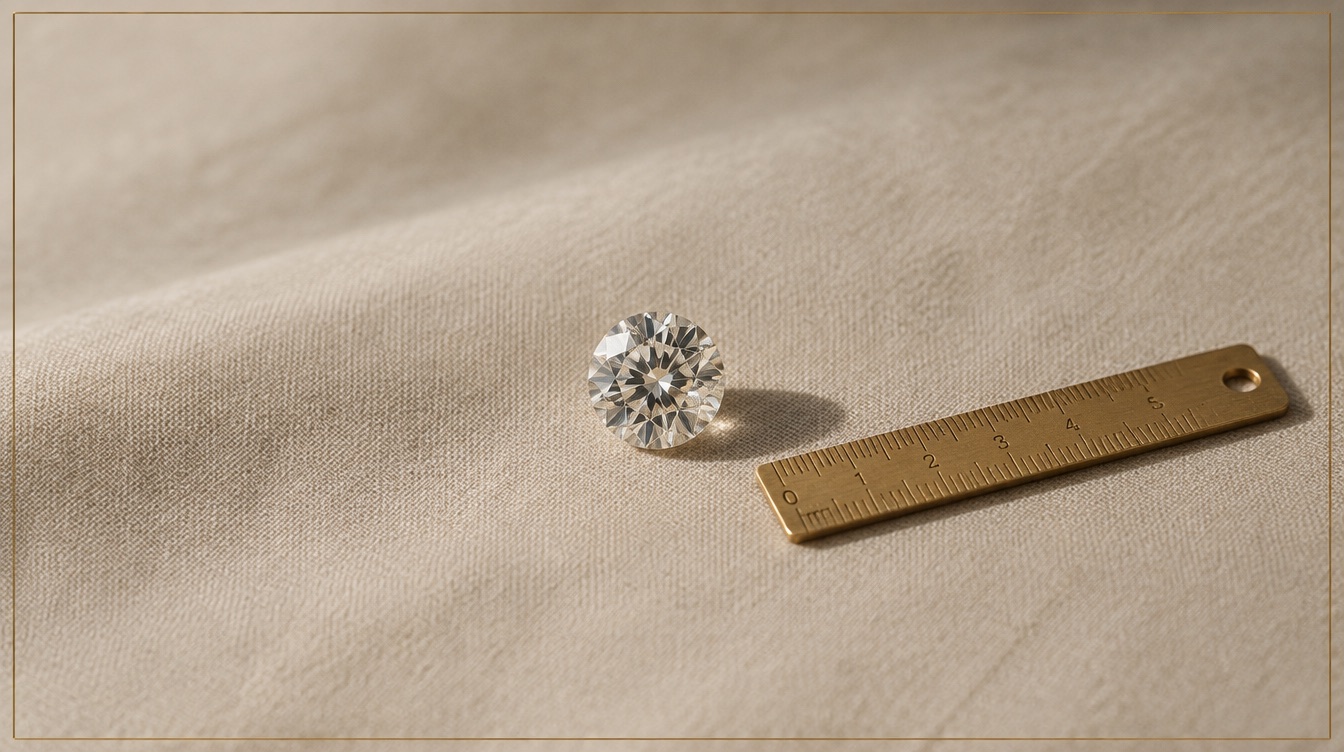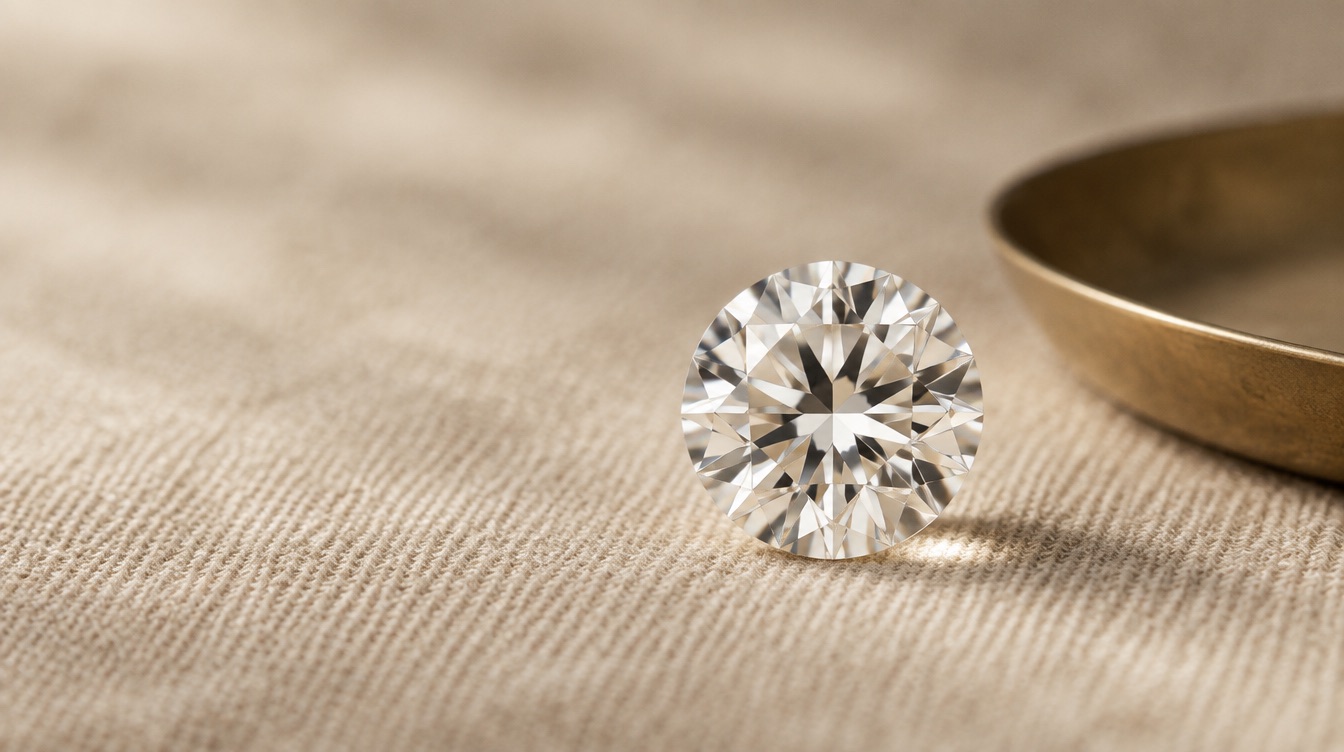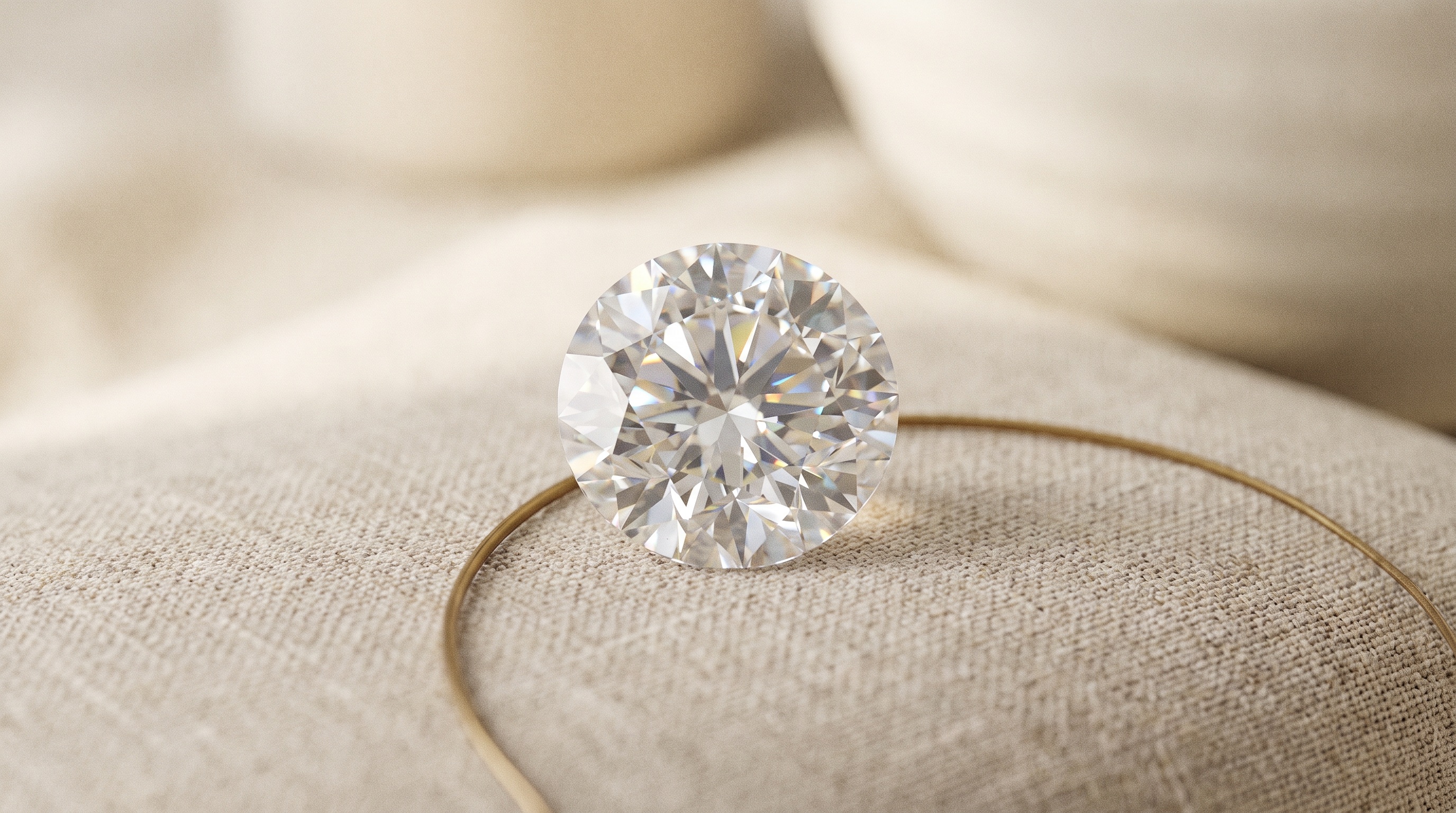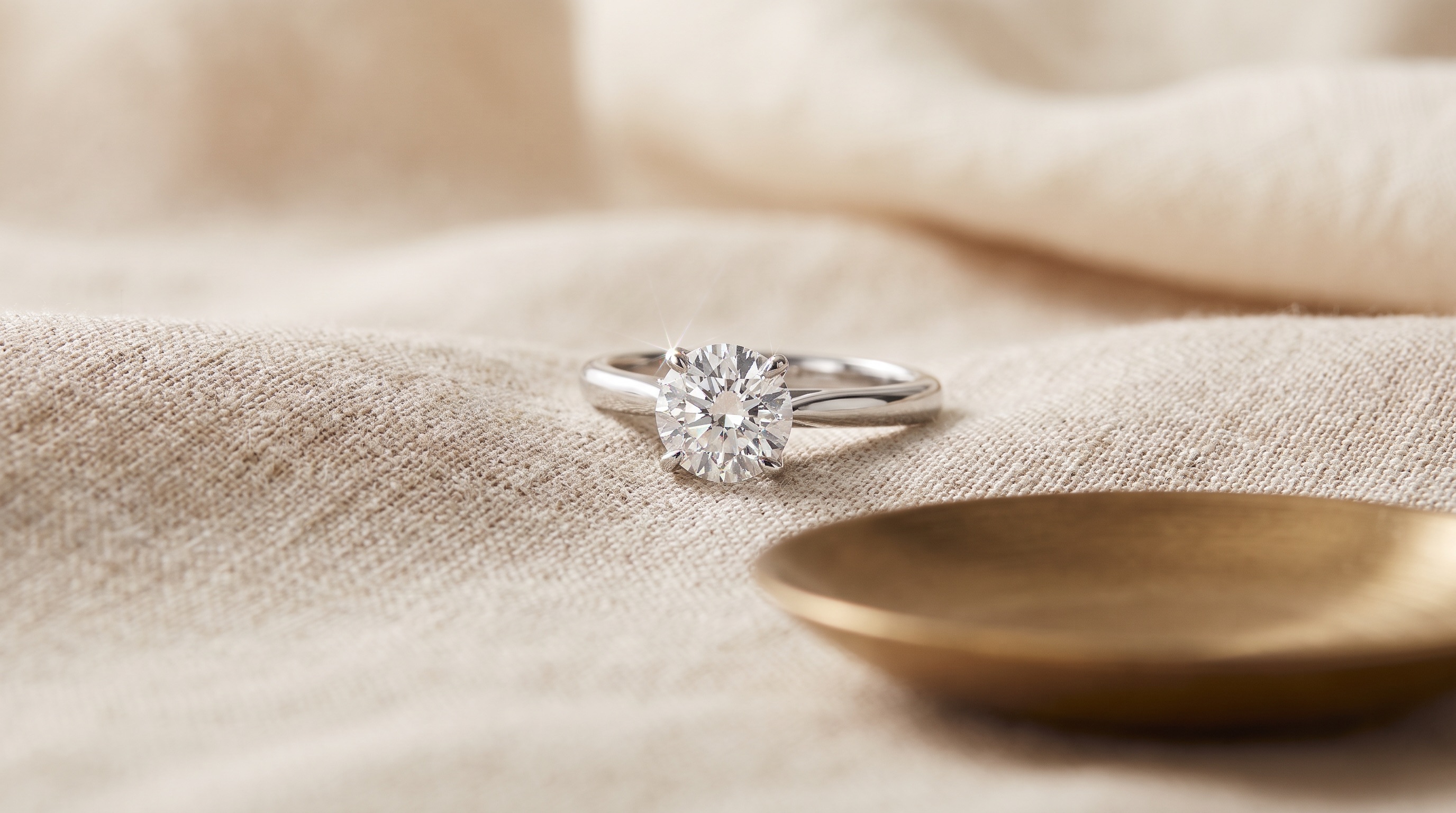
A prong setting is a method of mounting a diamond or other gemstone using small metal claws — typically four or six — that rise from the ring's shank and grip the stone at its girdle, holding it in place while leaving most of its surface exposed to light. It's the most common setting style for solitaire engagement rings and center stones generally, because more open stone surface means more light entry, and more light entry means more brilliance.
Prong setting is often confused with shared-prong setting, which is a related but distinct technique used to mount continuous rows of same-size stones on eternity bands and tennis bracelets, where each prong grips two neighboring stones instead of one. The setting covered in this guide is the classic, individual-stone version: the basket of four or six claws under a solitaire diamond that most people picture when they hear "prong setting" or "claw setting" at all. This guide covers how a standard prong setting is actually built, why 4-prong and 6-prong mountings exist as separate options with real tradeoffs, how prong tips are shaped for different stone shapes, how prong setting stacks up against bezel, channel, shared-prong, and pavé work, what durability and maintenance actually look like over years of wear, which stone shapes need extra prong protection, and what matters when sourcing diamonds and mountings built specifically for prong work.
How a Prong Setting Works
A prong setting starts with a basket — a small, cage-like structure of metal, usually cast or fabricated as part of the ring's head — from which individual prongs extend upward and inward. Each prong is a thin strand of metal, positioned around the stone's girdle (the narrow band where the stone's crown meets its pavilion), and bent or pushed over the stone's edge to hold it firmly in the basket. The number, spacing, and shape of the prongs are chosen before the stone is set, based on the stone's shape, size, and how much of its surface the designer wants exposed.
Setting the stone itself is a precise, largely manual operation. The jeweler seats the stone in the basket, checks that it sits level and centered, then uses a setting tool or pusher to bend each prong down over the stone's crown, one at a time, working opposite pairs of prongs so the stone doesn't shift off-center partway through. Once all the prongs are down, the setter files, shapes, and polishes each prong tip so it sits flush and smooth against the stone with no sharp edges, and checks the stone under magnification to confirm it's secure and doesn't move when pressed gently from multiple directions.
Because the prongs are the only points of contact holding the stone in place, their positioning matters as much as their number. Prongs are typically placed at the stone's structurally strongest points — for a round brilliant, that means evenly spaced around the girdle; for a stone with a defined outline like a princess or emerald cut, prongs are placed at or near the corners, where the stone is both most vulnerable to chipping and most naturally suited to being gripped.
4-Prong vs. 6-Prong Settings
The two most common prong counts for a solitaire center stone are four and six, and the choice between them is a genuine design tradeoff rather than a purely aesthetic one.
Why Choose a 4-Prong Setting
A 4-prong basket uses the fewest possible points of contact that can still securely hold a stone, which means less metal is visible around the stone's girdle and more of its surface — particularly its pavilion facets near the girdle — is exposed to light entering from the sides. This tends to produce a slightly more brilliant, more open look, and it's a common choice for round, princess, and cushion-cut center stones where the designer wants the cut itself to be the visual focus with minimal interruption from the mounting. The tradeoff is that each of the four prongs is doing more structural work than it would in a 6-prong setting, so the setting is somewhat more sensitive to a single prong wearing down or bending out of position.
Why Choose a 6-Prong Setting
A 6-prong basket spreads the same holding job across two additional points of contact, which distributes stress more evenly and gives the stone more support if any single prong wears, bends, or is knocked. Six prongs are especially common on larger center stones — where more total weight and a larger girdle circumference benefit from the added grip — and on round brilliants specifically, since the extra prongs sit naturally in the gaps between the stone's facets without disrupting its symmetry. The tradeoff is the reverse of the 4-prong case: more visible metal, slightly more light blocked at the girdle, and a marginally less open look, in exchange for a setting that's more forgiving of wear over time.
Neither count is objectively better — the right choice depends on the stone's size, shape, how it will be worn, and how much the buyer prioritizes maximum light exposure versus maximum long-term security. A jeweler recommending between the two should weigh the stone's carat weight and the wearer's lifestyle (a very active wearer benefits more from the added security of six prongs) alongside the visual preference for a more open or more supported look.
Prong Shapes and Finishes
Not all prong tips look the same, and the shape chosen affects both how the setting looks and how well it protects the stone.
Round Prongs
Round prongs are filed and polished into a smooth, rounded dome at the tip — the most common finish for round brilliant and other rounded stone shapes. They read as small, unobtrusive beads of metal and are the least likely prong shape to snag on fabric or hair.
Pointed (Claw) Prongs
Pointed or claw prongs taper to a finer point rather than a rounded dome, giving the setting a more delicate, vintage-inspired look. They cover slightly less of the stone's surface than a rounded prong of the same size, which can add a touch more visible brilliance, but a finer point also means slightly less metal holding the stone, so pointed prongs are usually reserved for smaller stones or designs where security margins allow it.
Flat Prongs
Flat prongs are filed to a broader, flattened tip rather than a rounded or pointed one, distributing pressure across a wider area of the stone's girdle. This is a common choice on wider or heavier stones, and on modern, minimalist-style mountings where a flat, architectural line reads as more contemporary than a rounded claw.
V-Tip Prongs
A V-tip prong is shaped into a shallow V that wraps around and cradles a stone's pointed corner instead of resting flat against a straight or curved edge. V-tip prongs are essential — not optional — for any stone shape with a vulnerable point, since a standard rounded or flat prong tip placed at a sharp corner leaves that corner exposed and at high risk of chipping.
Why Prong Setting Is the Standard for Solitaire Engagement Rings
Prong setting dominates the solitaire engagement ring category for a straightforward reason: it exposes more of the stone's surface to light than almost any other setting style, and a center stone's brilliance is the single biggest factor in how impressive it looks to the eye. Because the prongs only touch the stone at a handful of discrete points rather than enclosing its edges the way a bezel does or its sides the way a channel does, light can enter the stone from the crown, from between the prongs at the girdle, and reflect back out through the crown — which is exactly the light path a well-cut diamond is designed to maximize.
This matters more for a solitaire center stone than almost any other application, because a solitaire's entire visual job is to showcase one stone's cut, proportions, and brilliance with nothing competing for attention. A prong setting gets out of the way and lets the cut do the visual work, which is precisely why it has remained the default choice for engagement ring center stones even as other setting styles have grown in popularity for accent stones and secondary design elements. It's also a relatively efficient use of metal and labor compared to a fully enclosing setting, and it makes a stone easier to clean and inspect later, since most of its surface remains accessible rather than hidden behind metal.
Prong Setting Compared to Other Setting Types
Prong setting is one of several standard ways to mount a diamond, and understanding where it sits relative to the alternatives helps explain why it's chosen for some applications and not others.
Prong vs. Bezel Setting
A bezel setting encloses a stone's entire girdle in a continuous metal rim, offering the highest level of physical protection of any common setting style but blocking more side light than a prong setting does. Bezel setting is favored for active lifestyles and for stones that need maximum protection from daily knocks, while prong setting is favored when brilliance and light exposure matter more than absolute edge protection — which is why bezel setting is common on everyday stacking rings and prong setting is the default for the featured center stone of an engagement ring.
Prong vs. Channel Setting
A channel setting holds a row of stones between two parallel metal walls with no prongs visible at all, fully protecting the stones' girdle edges along both sides but limiting light entry from those sides. Channel setting is built for rows of same-size accent stones on a band, not for a single center stone, so it addresses a different design problem than prong setting does — it's rarely a direct substitute for a solitaire's basket.
Prong vs. Shared-Prong Setting
Shared-prong setting is a related but genuinely different technique, used to mount a continuous row of same-size stones — most commonly on eternity bands and tennis bracelets — where each prong grips two adjacent stones at once instead of one prong set fully belonging to a single stone. Standard prong setting, the subject of this guide, gives every stone its own independent basket of prongs; shared-prong setting is a metal-efficient adaptation of that idea built specifically for continuous multi-stone rows rather than a single featured stone. The two terms get conflated often enough that it's worth being precise: a solitaire engagement ring uses standard prong setting, not shared-prong setting.
Prong vs. Pavé Setting
Pavé setting covers a broad surface — a halo, a wide shank — with many small stones set closely together and secured with tiny beads or shared prongs, producing a dense, textured field of sparkle rather than a single showcased stone. Prong setting, by contrast, is built around one stone at a time, giving that stone room and light exposure that a pavé field, by design, doesn't give any single stone in it. The two techniques are frequently combined in one piece — a prong-set center stone surrounded by a pavé halo — rather than competing for the same job.
Setting Styles Compared
| Style | Light Exposure | Security | Typical Use Case |
|---|---|---|---|
| Prong (4 or 6) | Highest — stone exposed on nearly all sides | Moderate — depends on prong count and maintenance | Solitaire engagement rings, center stones |
| Bezel | Lower — metal rim encloses the girdle | Highest — no exposed prong tips to catch or bend | Everyday-wear rings, active lifestyles |
| Channel | Lower — light enters mainly from the top | High — no exposed prongs on the row | Accent stone rows on wedding bands |
| Shared-Prong | High — top and side light between prongs | Moderate — a worn prong affects two stones at once | Eternity bands, tennis bracelets |
| Pavé | High across a dense surface | Lower per point — small beads/prongs wear over time | Halos, wide shanks, dense surface coverage |
Durability and Maintenance Considerations
Prong tips are, generally speaking, the most common point of stone loss in jewelry across nearly every setting style that uses them, and a prong-set solitaire is no exception. A prong is a relatively thin piece of metal doing continuous structural work, and over years of daily wear it can gradually thin from repeated contact with clothing, countertops, and daily activity, bend slightly out of position from an accidental knock, or simply loosen its grip on the stone as the metal fatigues. None of this happens quickly under normal wear — a well-made prong setting can hold a stone securely for many years — but it happens gradually enough that it's often invisible to the wearer until a stone is already loose or, in the worst case, lost.
This is why periodic professional inspection matters more for prong-set jewelry than for some other setting styles. A jeweler checking a prong-set ring under magnification can spot a thinning or slightly bent prong well before it fails, and re-tipping a worn prong is a routine, inexpensive repair compared to sourcing and resetting a lost center stone. As a general guideline, a prong-set engagement ring or center-stone piece in regular daily wear benefits from a professional check roughly once a year, and sooner after any hard knock — a dropped ring, a catch on a doorframe, a fall — even if the stone still looks secure to the naked eye. Cleaning matters too: buildup of lotion, soap, or everyday grime around the prongs and under the stone can make a loose prong harder to spot visually, so routine cleaning alongside inspection helps a jeweler catch problems early rather than late.
Prong count plays into this maintenance picture directly. A 6-prong setting distributes wear across more points of contact, so the loss of grip strength from any single worn prong has a smaller relative effect on overall security than it would on a 4-prong setting, where every prong is carrying a larger share of the load. This doesn't make 4-prong settings unsafe for normal wear — millions of solitaire engagement rings use four prongs without incident — but it does mean a 4-prong ring benefits from slightly more attentive periodic inspection than an equivalent 6-prong piece, all else being equal.
Stone Shapes That Need Special Prong Treatment
Round, cushion, and other rounded or evenly curved stone shapes distribute stress fairly evenly around their girdle, so a standard round or flat prong tip works well almost anywhere along the edge. Pointed stone shapes are a different case entirely, and treating them like a round stone when it comes to prong placement is a common and costly mistake.
Marquise, Pear, and Heart Shapes
Marquise, pear, and heart-shaped diamonds each have at least one sharp point — two for a marquise, one for a pear, and the cleft plus two lobes for a heart — and those points are structurally the most vulnerable part of the stone. A sharp diamond point carries very little supporting material behind it, which makes it far more prone to chipping under an impact than a rounded edge would be at the same point of contact. Setting one of these shapes with a standard rounded prong resting against the point, rather than a prong specifically shaped to wrap and protect it, leaves that point essentially unguarded.
V-Tip and Double-Prong Protection
The standard solution is a V-tip prong at each point — a prong filed into a shallow V shape that cradles the point from both sides rather than resting against it from one direction. On larger or higher-value stones, some jewelers use a double-prong approach instead or in addition, placing two prongs close together near the point for extra reinforcement. Either approach adds real protection at minimal visual cost, since a well-made V-tip sits close against the stone's outline and doesn't read as a bulky addition to the setting. A pointed stone set without this protection is measurably more likely to chip at the tip over years of wear, particularly on an engagement ring worn daily and exposed to routine knocks — which makes V-tip protection a non-negotiable detail rather than an optional upgrade for these shapes.
Cut Quality and Prong Setting
Because a prong setting exposes far more of a stone's surface than an enclosing setting like a bezel or channel does, cut quality has an outsized effect on how the finished piece actually looks. A stone with strong proportions, symmetry, and polish reflects light efficiently through its crown and shows well from nearly every angle in a prong setting, since there's little metal to mask a weak cut. The same stone set into a bezel, where much of the pavilion and girdle are hidden behind a metal rim, would show a smaller share of its cut quality to the eye simply because less of the stone is visible in the first place.
This is a practical sourcing point, not just a technical one: a buyer choosing a center stone specifically for a prong-set solitaire should weight cut grade more heavily than they might for a stone destined for a more enclosing setting, since a prong setting's whole purpose is to let the cut carry the visual impact. A well-cut stone in a well-proportioned prong basket produces noticeably more fire and brilliance than a mediocre cut in the same mounting — a gap that's much easier to see in a prong setting than it would be hidden inside a bezel.
Sourcing Prong-Set Diamonds and Mountings Through Guru Diam
Guru Diam supplies certified CVD lab-grown diamonds as well as natural diamonds, across standard, antique, and exotic shapes, with IGI, GIA, and GCAL certification all available — a range that matters directly for prong-set work, since cut quality carries more visual weight in an open, exposed setting than it does in an enclosing one. Buyers building a prong-set center stone piece can source loose stones matched carefully on color, clarity, and cut consistency, then move directly into a finished custom mounting, with custom engagement rings — 4-prong and 6-prong solitaire builds included — finished in 4-6 days, unbranded by default for resale under a jeweler's own name.
Certified loose diamonds for a prong-set center stone are available under certified diamonds, and fancy color stones for a colored prong-set piece can be sourced under fancy color loose diamonds. Matched pairs for prong-set stud earrings or side-stone accents are available under matching pairs. Browse general inventory through the wholesale hub, start a custom prong-set build through custom jewelry, and set up a trade account through trade partner to place recurring orders.
Frequently Asked Questions
What is a prong setting?
A prong setting is a method of mounting a gemstone using small metal claws — typically four or six — that grip the stone at its girdle while leaving most of its surface exposed to light. It's the standard setting style for solitaire engagement rings and center stones because it maximizes brilliance by letting light enter and exit the stone with minimal obstruction from the mounting.
Is a 4-prong or 6-prong setting better?
Neither is universally better — it's a tradeoff. A 4-prong setting shows less metal and exposes slightly more of the stone to light, while a 6-prong setting distributes wear across more contact points and offers somewhat more long-term security, especially for larger center stones.
How long does a prong setting last before it needs repair?
A well-made prong setting can securely hold a stone for many years, but prongs gradually wear, thin, or bend from ordinary daily contact and knocks over time. Most jewelers recommend a professional inspection roughly once a year for a piece in regular wear, since a worn prong is easy and inexpensive to repair before it fails, but harder and costlier to fix once a stone is actually lost.
Is prong setting the same as shared-prong setting?
No. Standard prong setting gives each stone its own independent basket of prongs, and is the technique used for solitaire center stones. Shared-prong setting is a different, related technique where each prong grips two adjacent stones at once, used for continuous rows of same-size stones on eternity bands and tennis bracelets.
Which diamond shapes need extra prong protection?
Pointed shapes — marquise, pear, and heart cuts — have vulnerable corners or points with little supporting material behind them, making them prone to chipping under impact. These shapes need V-tip prongs, or sometimes double-prong reinforcement, specifically placed to cradle and protect each point rather than the standard rounded or flat prong tips used on rounded stone shapes.
Does prong setting show off a diamond's cut quality more than other settings?
Yes. Because a prong setting exposes far more of a stone's surface than an enclosing setting like a bezel or channel, differences in cut quality — proportions, symmetry, and polish — are much more visible. This makes cut grade a more important sourcing consideration for a prong-set center stone than for a stone destined for a more enclosing mounting.