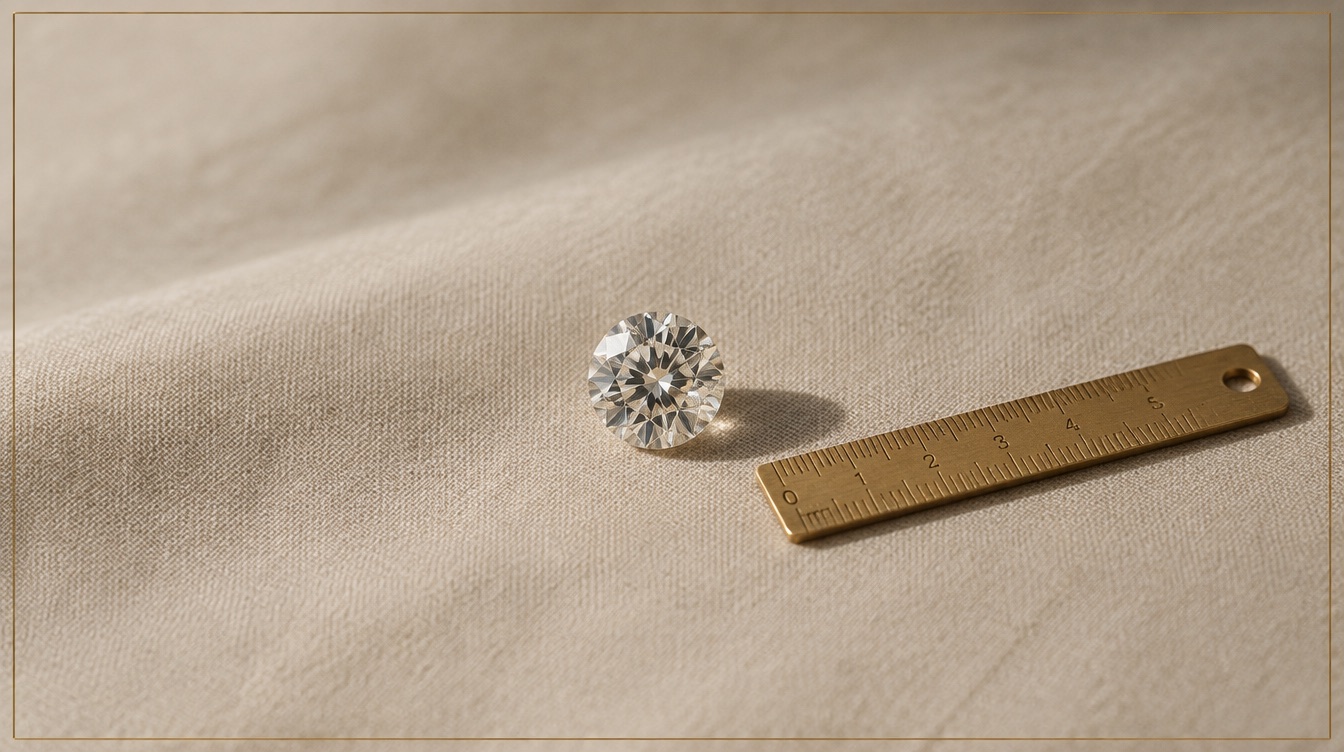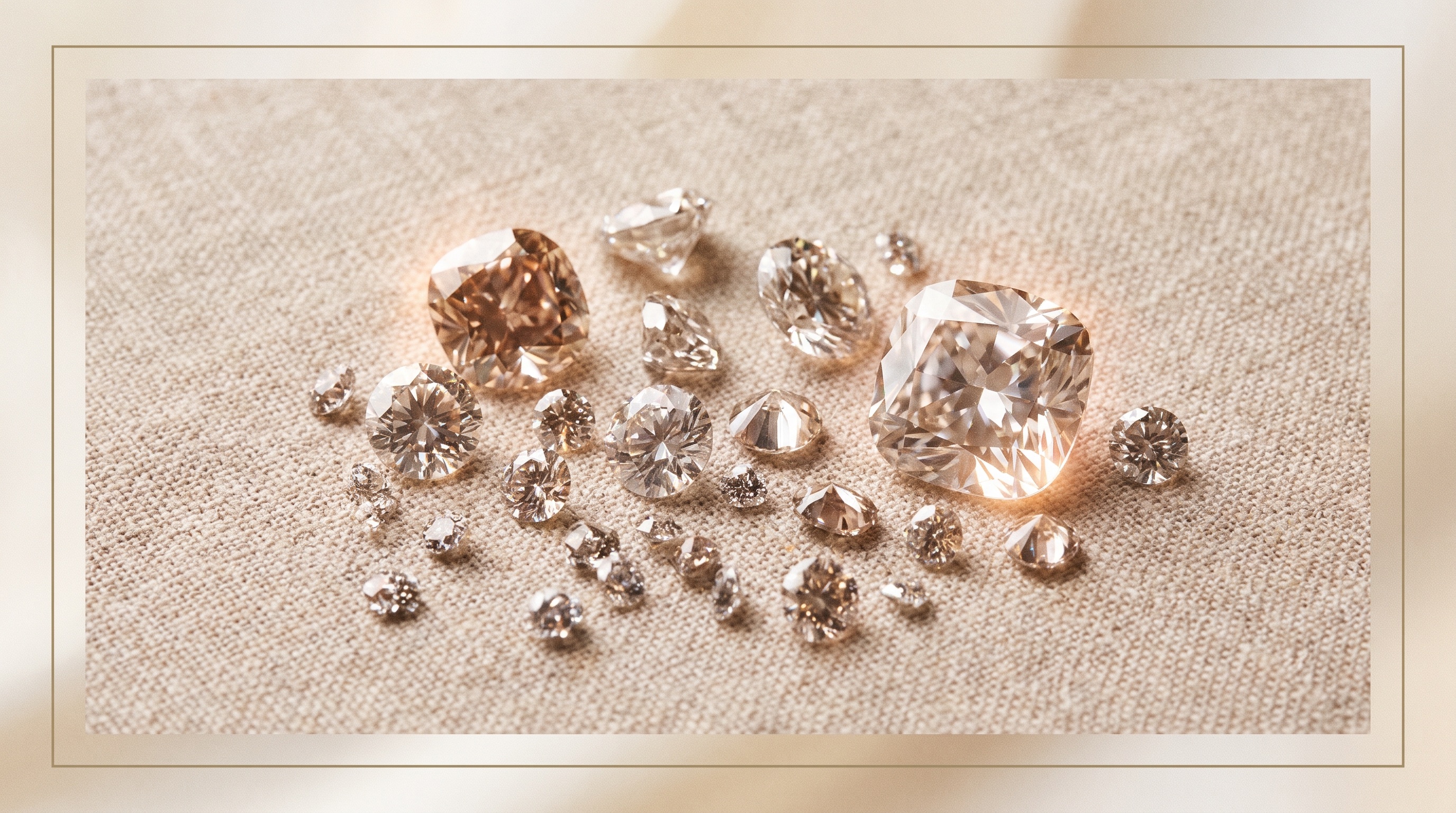
A carat is the unit used to measure a diamond's weight — not its size — equal to exactly 200 milligrams. Every diamond sold anywhere in the world is weighed in carats, from a fraction-of-a-point melee accent to a multi-carat center stone, and that single number is one of the first things buyers ask about because it plays such an outsized role in how a diamond is priced.
But "carats in diamonds" gets confused with a lot of adjacent ideas — size, quality, value, even the word "karat" used for gold purity. This guide covers the basics properly: where the carat came from, how it's subdivided, why carat weight drives price in surprising, non-linear jumps, the misconceptions that trip up first-time buyers, and how carat weight actually fits alongside the other three Cs of diamond grading.
What Does "Carat" Mean, Exactly?
In the diamond trade, a carat (abbreviated "ct") is a unit of mass equal to 200 milligrams, or one-fifth of a gram. It has nothing to do with a diamond's dimensions, its brightness, or how "good" it is — it simply describes how much the stone weighs on a scale. A 1.00ct diamond and a 2.00ct diamond of the same shape and cut quality are the same stone in every respect except that the second one weighs twice as much.
This distinction matters because carat weight is frequently talked about as though it were a size measurement — "how big is the diamond" and "how many carats is it" get used interchangeably in casual conversation, but they are not the same question. A diamond's actual footprint is measured in millimeters, and carat weight is only loosely tied to it depending on the stone's shape and how it's cut. This guide sticks to carat weight as a concept; buyers who specifically want millimeter-by-shape sizing data should look at a dedicated carat-to-size reference rather than this one.
Carat vs. Karat: A Common Point of Confusion
"Carat" (diamond weight) and "karat" (gold purity) are pronounced identically and spelled almost the same, which causes real confusion for first-time buyers. A "14 karat" or "18 karat" gold ring refers to how much pure gold is alloyed into the metal — 24 karats being pure gold — and has nothing to do with the diamond's weight set into that ring. A jeweler describing "an 18 karat gold ring with a 1 carat diamond" is using two completely unrelated measurement systems in the same sentence, and mixing them up is one of the most common vocabulary mistakes new buyers make when researching engagement rings or fine jewelry.
The History of the Carat: From Carob Seeds to a Global Standard
The word "carat" comes from the Greek "keration," meaning carob seed. Ancient gem traders across the Mediterranean and Middle East used dried carob seeds as small counterweights on balance scales, on the assumption that the seeds were reasonably uniform in weight from pod to pod — a convenient, widely available reference object in an era before standardized metal weights were common. In practice, carob seeds vary more than ancient traders assumed, and for centuries afterward, different trading centers, countries, and even individual cities defined a "carat" slightly differently, creating friction and disputes whenever gemstones changed hands across a border.
That inconsistency wasn't fully resolved until 1907, when an international conference of weights and measures fixed the carat at exactly 200 milligrams, tying it permanently to the metric system rather than to any variable organic reference. This "metric carat" was adopted by trading centers and eventually grading laboratories around the world, and it remains the universal standard used today — every GIA, IGI, and GCAL report anywhere on earth uses the same 200-milligram definition, which is one reason carat weight is treated as the most objective and universally comparable of the traditional 4Cs. Unlike color or clarity, which involve trained human judgment under controlled conditions, carat weight is a direct physical measurement on a calibrated scale, with essentially no room for grader-to-grader disagreement.
Carats vs. Points: How Diamond Weight Is Subdivided
Below one carat, diamond weight is commonly discussed in "points," where 100 points equal 1.00 carat. A half-carat diamond is "fifty points," a quarter-carat diamond is "twenty-five points," and so on — the point figure is simply the carat weight with the decimal removed and read as a whole number. This shorthand exists because trade conversation moves quickly, and "a fifty-pointer" is faster to say than "a half-carat stone," especially when a jeweler or buyer is discussing dozens of stones across a price list or trade-show table in a single sitting.
Points terminology shows up constantly on invoices, in verbal trade negotiations, and in casual buyer-facing conversation, so it's worth being comfortable translating between the two systems at a glance:
| Points | Carat Weight | Common Trade Shorthand |
|---|---|---|
| 10 points | 0.10ct | "Ten pointer" |
| 25 points | 0.25ct | "Quarter carat" |
| 33 points | 0.33ct | "Third carat" |
| 50 points | 0.50ct | "Half carat" / "fifty pointer" |
| 75 points | 0.75ct | "Three-quarter carat" |
| 90 points | 0.90ct | "Ninety pointer" |
| 100 points | 1.00ct | "One carat" (points terminology stops here) |
Once a stone crosses one carat, the trade generally switches back to carat language rather than continuing in points — nobody describes a two-carat stone as "two hundred points." The points system exists specifically to make sub-carat weights easier to say and compare quickly, and it disappears once whole-carat numbers take over.
Is a Carat a Measure of Size? (Briefly)
No — carat weight measures mass, and mass scales with a stone's full three-dimensional volume, not with its visible face-up spread. Two diamonds of the same carat weight can look noticeably different in diameter depending on their shape and how deep or shallow they're cut, which is why carat weight alone is a poor substitute for the millimeter measurements printed on a grading report. This size-versus-weight relationship is a deep topic on its own — with its own shape-by-shape millimeter charts — and is covered in detail in Guru Diam's dedicated carat chart guide rather than repeated here; this piece stays focused on what carat weight is and how it drives value.
How Carat Weight Is Measured and Certified
Carat weight is measured on a precision electronic scale calibrated specifically for gemstones, capable of resolving weight to the thousandth of a carat before being rounded to the hundredth of a carat for reporting purposes — the standard used on GIA, IGI, and GCAL certificates. This measurement happens with the stone unmounted, since any metal setting would add weight that isn't the diamond's own. It's why a loose stone's certified carat weight is the only fully reliable figure to build a purchase decision around, while a "1 carat" figure quoted for an already-mounted ring should be treated as an estimate until the stone is weighed loose or the certificate is checked directly.
Because this measurement is purely mechanical, carat weight carries none of the ambiguity that color and clarity grading can carry. Two different graders weighing the same stone on calibrated equipment will get the same number every time, which is part of why carat weight functions as such a clean, comparable anchor point across price lists, invoices, and buyer conversations in a way that "very slightly included" or "faint yellow" simply can't.
Why Carat Weight Drives Price — But Not in a Straight Line
It would be simple if price scaled directly with carat weight — a 2.00ct diamond costing exactly twice as much as a comparable 1.00ct stone. In reality, price per carat climbs as carat weight increases, so a 2.00ct diamond of similar quality typically costs considerably more than double a 1.00ct stone. Two forces explain this. First, larger rough diamond crystals suitable for cutting into bigger finished stones are significantly rarer than the small rough used for sub-carat production, so supply tightens sharply as target weight climbs. Second, cutting a larger stone from a given piece of rough is a more consequential decision for a cutter — more value is at stake in every cutting choice, and yield efficiency matters more, both of which add cost that gets reflected in the final price per carat.
The result is that diamond pricing moves in weight-based "bands" rather than a single flat per-carat rate: 0.50–0.69ct stones sit in one general price band, 0.70–0.89ct in another, 1.00–1.49ct in another again, and so on, with per-carat price stepping up meaningfully each time a stone crosses into a new, larger band. Buyers comparing two stones that look similar in size but sit in different weight bands are often comparing very different price points, which surprises people encountering wholesale or retail diamond pricing for the first time.
"Magic Sizes" and the Psychology of Just-Under-Carat Pricing
Within those broader pricing bands, certain exact weights — 0.50ct, 0.75ct, 1.00ct, 1.50ct, 2.00ct, and other round numbers — carry outsized demand relative to the weights immediately next to them. Buyers gravitate toward round numbers because they're easy to describe, easy to compare, and satisfying to shop for ("I want a one-carat diamond" is a far more common request than "I want a 0.97-carat diamond," even though the two are visually indistinguishable). The trade calls these round numbers "magic sizes," and demand concentrates on them heavily enough that price per carat often jumps sharply right at the threshold, even though the physical stone barely changes from one side of the line to the other.
This creates a well-known pattern: a diamond weighing just under a magic size — 0.90ct, 0.97ct, 0.99ct — commonly sells for noticeably less per carat than an otherwise identical stone that crosses into 1.00ct territory, simply because it falls just outside the psychological threshold buyers are searching for. A stone at 1.10ct, having already cleared the threshold, typically sits closer in price to other stones just above 1.00ct than the jump from 0.99ct to 1.00ct would suggest. The table below illustrates the general pattern using an indexed price-per-carat comparison — actual figures vary by quality grade, shape, and market conditions, but the relative shape of the curve holds consistently across the trade.
| Carat Weight | Position Relative to Magic Size | Illustrative Price-Per-Carat Index |
|---|---|---|
| 0.90ct | Just under 1.00ct threshold | 100 (baseline) |
| 0.95ct | Approaching 1.00ct threshold | ~104 |
| 0.99ct | Immediately under threshold | ~108 |
| 1.00ct | At the magic size | ~135–145 |
| 1.05ct | Just past threshold | ~138 |
| 1.10ct | Past threshold, approaching next band | ~142 |
The index above is directional, not a quoted price list — it illustrates the shape of the pricing curve rather than a specific dollar figure for any grade or shape. The practical takeaway for buyers is straightforward: a well-cut 0.90ct or 0.97ct diamond can deliver visually near-identical presence to a 1.00ct stone at a meaningfully lower price, which is exactly why experienced trade buyers deliberately source just-under-threshold weights when a client's priority is visual impact per dollar rather than the specific bragging-rights number on the certificate.
Common Buyer Misconceptions About Carat Weight
Carat weight is the single most talked-about number on a diamond's certificate, which unfortunately also makes it the most misunderstood. A few misconceptions come up often enough to be worth addressing directly.
"Bigger carat weight always means a better diamond." Carat weight measures size potential, not quality. A large stone with poor cut proportions, heavy inclusions, or a strong yellow tint can look noticeably worse — and be worth substantially less — than a smaller, better-cut, cleaner stone. Weight is one input into value, not the whole equation.
"Two stones of the same carat weight always look the same size." Shape and cut proportions change how a given weight is distributed, so weight alone doesn't guarantee a matching visual footprint even within the same carat figure — a genuinely useful thing to understand conceptually, even without diving into the shape-specific millimeter data covered elsewhere.
"A 1-carat diamond is always dramatically more expensive than a 0.90-carat diamond because it's 'a full carat.'" The premium is real, as covered above, but it's driven by demand psychology around the round number rather than any meaningful physical difference between the two stones — a 0.90ct and a 1.00ct diamond of the same shape and quality are close to indistinguishable side by side.
"Total carat weight (ctw) on a ring listing tells you the size of the center stone." On multi-stone jewelry, ctw refers to the combined weight of every stone in the piece — the center stone plus any accent or halo stones — not the center stone's individual weight. A ring listed at "1.50ctw" might have a 1.00ct center stone with 0.50ct total in smaller accents, or a different split entirely; buyers should always ask for the center-stone weight specifically.
"Carat weight is a quality grade." It isn't graded on a scale of "good" to "bad" the way color and clarity are — it's simply a fact about the stone, reported precisely and objectively, with no subjective judgment involved in the number itself.
How Carat Weight Fits With the Other 3Cs
Carat weight is one-quarter of the traditional "4Cs" framework used to describe and grade a diamond, alongside cut, color, and clarity — but it's worth understanding how differently it behaves compared to the other three. Cut describes how well a diamond's proportions and finish were executed, and is widely considered the factor with the single biggest impact on visual brilliance; a well-cut smaller stone can out-sparkle a poorly cut larger one. Color describes the presence or absence of a yellow or brown tint in a diamond that's meant to look colorless, graded on a letter scale from D (colorless) to Z (noticeably tinted). Clarity describes the presence of internal or surface characteristics — inclusions and blemishes — graded from Flawless down through Included grades.
Carat weight interacts with all three: a larger stone makes color tint and inclusions more visually apparent to the naked eye than the same grades would be in a smaller stone, since there's simply more surface area and depth for the eye to inspect. This is why experienced buyers shopping at larger carat weights often tighten their color and clarity targets rather than loosening them, even though tighter grades cost more — a visible inclusion or a noticeable tint reads as a much bigger flaw in a 2.00ct stone than in a 0.30ct stone. Buyers working with a fixed budget generally have to trade off among the 4Cs, and understanding which trade-offs are visually meaningful (cut and, at larger sizes, color and clarity) versus which are largely psychological (chasing a whole-number carat threshold) leads to smarter purchasing decisions.
Carat Weight Tiers: A Quick Overview
Different carat-weight ranges tend to serve different roles in the trade, from small accent stones to statement center stones. The table below gives a general overview of how weight tiers map to common usage, without getting into shape-specific millimeter sizing.
| Carat Weight Range | Common Role | Typical Certification Status |
|---|---|---|
| Under 0.18ct | Melee — pavé, channel, and accent settings | Uncertified parcel goods, QC'd to a color/clarity baseline |
| 0.18ct–0.29ct | Small accent and side stones | Typically uncertified individually |
| 0.30ct–0.69ct | Entry-level center stones, larger accents | Individually certifiable (GIA/IGI/GCAL) |
| 0.70ct–0.99ct | Popular "near-magic-size" center stone range | Individually certified |
| 1.00ct–1.99ct | Classic engagement-ring center stone range | Individually certified |
| 2.00ct and above | Statement center stones | Individually certified, often with more detailed reports |
These are general trade groupings rather than fixed rules — plenty of fine jewelry falls outside them — but they're a useful mental map for understanding where a given stone sits relative to typical demand and certification norms.
Carat Weight in Natural vs. Lab-Grown Diamonds
Carat weight is measured and defined identically for natural and lab-grown diamonds — 200 milligrams is 200 milligrams regardless of how the stone formed. What differs between the two categories is how carat weight interacts with price. Natural diamond rough above a certain size becomes exponentially rarer, which is the main force behind the steep price-per-carat curve described earlier. CVD lab-grown diamonds are produced under controlled conditions that make larger finished stones considerably more available relative to natural supply, which is part of why lab-grown carat weight has historically carried a smaller price premium band-to-band than natural, even though the same magic-size demand psychology still applies to both categories. A buyer comparing carat-weight pricing between natural and lab-grown stones should expect the general "bigger costs disproportionately more" pattern in both, just at a different overall price level.
Practical Tips for Buying by Carat Weight
- Decide whether visual size or the round-number itself matters more to you. If it's visual size, a well-cut stone just under a magic-size threshold (0.90ct–0.97ct rather than 1.00ct, for example) can offer meaningfully better value.
- Don't chase carat weight at the expense of cut. A well-cut smaller stone will generally out-sparkle a larger, poorly cut one, and cut quality is not something a buyer can compensate for after purchase.
- Tighten color and clarity expectations as carat weight increases. Flaws and tint become more visible in larger stones, so the grades that were acceptable at 0.30ct may not read the same way at 2.00ct.
- Ask for individual stone weight, not just total carat weight, on multi-stone pieces. Ctw figures alone don't tell you how much weight sits in the center stone versus the accents.
- Confirm carat weight against the certificate, not the listing description. A GIA, IGI, or GCAL report is the definitive source for a stone's exact weight; marketing copy and mounted-ring estimates can be rounded or imprecise.
Sourcing Diamonds by Carat Weight Wholesale
Guru Diam supplies loose CVD lab-grown diamonds and natural diamonds across the full range of commercially relevant carat weights, in standard, antique, and fancy shapes, with IGI, GIA, and GCAL certification available at 0.30ct and above. Trade buyers sourcing specific carat-weight targets — including just-under-magic-size stones for value-focused clients — can browse current inventory through certified diamonds and matched sets through matching pairs, with fancy color options available separately through fancy color loose diamonds. In-stock inventory ships same-day from Guru Diam's New York and Los Angeles locations, and jewelers building custom pieces around a specific carat-weight target can move from stone selection to a finished setting through custom jewelry in 4-6 days. New trade accounts can apply through trade partner, with current terms and catalog access available at the wholesale hub.
Frequently Asked Questions
What exactly is a carat in a diamond?
A carat is a unit of weight equal to 200 milligrams, standardized internationally in 1907. It measures how much a diamond weighs, not its physical dimensions or its quality — a diamond's size and quality are separate measurements entirely.
What are carats in diamonds made up of — how does the points system work?
Diamond weight below one carat is commonly expressed in "points," where 100 points equal 1.00 carat. A 0.50ct stone is called a "fifty pointer," a 0.25ct stone a "quarter carat," and so on — it's simply an alternate way of expressing the same carat figure.
Is carat the same as karat?
No. "Carat" measures a diamond's weight, while "karat" measures gold purity on a scale up to 24 karats (pure gold). They sound identical but describe completely different things, and mixing them up is a common mistake for first-time jewelry buyers.
Why is a 1-carat diamond so much more expensive than a 0.90-carat diamond?
Round "magic size" weights like 1.00ct carry disproportionate buyer demand because they're easy round numbers to shop for, which pushes price per carat up sharply right at that threshold. A 0.90ct or 0.99ct stone can look virtually identical to a 1.00ct stone while costing noticeably less per carat.
Does more carat weight always mean a better diamond?
No. Carat weight measures size potential only — it says nothing about cut quality, color, or clarity. A smaller, well-cut, clean diamond can look more brilliant and be worth more than a larger stone with poor cut or visible flaws.
What does ctw mean, and is it different from carat weight?
Ctw stands for "total carat weight" and refers to the combined weight of every stone in a multi-stone piece, such as a halo ring or tennis bracelet — not any single stone's individual weight. Always ask for the center-stone weight separately when a piece is listed by ctw.