
A custom jewelry quote is built from several line items, and the center stone is only one of them. Metal type and weight, setting complexity, band or shank construction, CAD design time, hand finishing, and any revisions outside the original scope all add cost on top of the stone — and on plenty of builds, that combined total is larger than the stone line itself. If you sell custom pieces and you're only walking a customer through "the diamond costs X," you're setting up a conversation where every other number on the invoice looks like a surprise.
None of this is unique to any one shop or style of ring. It's how custom fabrication has always worked — a stone is a fixed input, and everything that happens to it after it's chosen is labor and design time billed the same way a tailor bills for a made-to-measure suit rather than a rack garment. Here's the full breakdown, in the order it actually gets built.
Why This Matters More With Lab-Grown Center Stones
Lab-grown diamonds cost meaningfully less than natural diamonds of comparable size and quality — that's a well-established, industry-wide fact at this point, not a claim specific to any one supplier. That shift changes the shape of a custom quote. When the stone was the dominant cost, metal and labor could hide inside it as a rounding error. With a lower stone cost, fabrication — metal, setting, CAD, finishing — makes up a proportionally bigger share of the total than it used to. Retailers who built their pricing conversations around "the stone is basically the whole cost" run into more pushback now, simply because the math has shifted.
This isn't a temporary adjustment period that resolves itself once customers get used to lab-grown pricing — it's a permanent shift in how a custom quote is structured. A customer who's done even minimal research knows a lab-grown center stone costs a fraction of what the natural equivalent would, and they're doing that math against the total quote whether or not you walk them through it. If the fabrication side isn't explained, the gap between "what I expected to pay for a cheaper stone" and "what the finished ring actually costs" reads as a markup instead of what it actually is: metal, labor, and design time that never changed.
Walking a customer through the build cost isn't optional anymore; it's the difference between a quote that makes sense and one that looks padded.
The Anatomy of a Custom Jewelry Quote
Every custom build breaks down into the same handful of buckets, regardless of style. What varies is how much each one costs relative to the others, and that depends entirely on the design choices the customer makes.
| Cost Driver | What Increases It | Relative Labor Impact |
|---|---|---|
| Metal type & weight | Platinum > 18K > 14K; heavier shank, larger ring size | Low to Medium |
| Setting style | More prongs, hidden halos, pavé, three-stone vs. solitaire | Medium to High |
| Band/shank work | Contoured profiles, split shanks, engraving, milgrain | Medium |
| CAD & design time | Fully custom vs. modified stock design; number of renders | Medium |
| Finishing & polishing | Hand-finishing, rhodium plating, texture work | Low to Medium |
| Revisions outside scope | Structural changes after CAD approval, added stones mid-build | Variable, can be High |
None of these are stone-related. All of them are billed because they represent real time and real material, and none show up if a customer only sees a single "diamond price" on the quote. These buckets don't move independently, either — a decision on setting style changes the metal weight underneath it, and a heavier shank changes the finishing time. A quote isn't six numbers added in a column; it's one design decision cascading through the rest.
Metal Type and Weight
Metal is priced by weight and by alloy, and it's the easiest line item to explain because customers already understand that platinum costs more than gold. What's less obvious to them is that ring size, band width, and shank thickness all change the weight — a size 10 ring in a wide comfort-fit band uses noticeably more metal than a size 6 in a thin band, even in the identical design.
Karat and Alloy Choices
- 14K gold — the standard for most custom bridal and fashion work; available in white, yellow, and rose, and the most forgiving alloy to cast and repair down the line
- 18K gold — higher precious-metal content, softer, priced up accordingly, and slightly more prone to scratching in daily wear because the alloy is less hardened than 14K
- Platinum — heaviest and most expensive per gram, also the most labor-intensive to cast and finish; jewelers often position it as a lifetime metal despite the higher upfront cost
White gold carries one more cost line customers rarely anticipate: rhodium plating. White gold is naturally a pale yellow-gray, and the bright white finish comes from a rhodium layer applied at the end of fabrication. That layer wears down with daily contact and needs replating over time — a small but real maintenance cost platinum doesn't carry, since platinum is white straight through.
How Ring Size and Band Width Change the Metal Bill
Two identical designs at different sizes aren't the same job costed differently — they're genuinely different amounts of material. A wider band, a thicker shank profile, or a larger finger size all add gram weight, and metal is priced by the gram. Worth stating plainly to a customer comparing their quote to a friend's ring in "the same style": if the sizes or band widths differ, the metal cost was never going to match.
If a customer wants to move from 14K to platinum mid-conversation, that's not a small adjustment — it changes the metal cost and the finishing labor at the same time, since platinum's density and hardness change how long it takes to cast, file, and polish the same design.
Setting Complexity
This is where quotes diverge the most, and it's the category retailers most often under-explain. A solitaire with a four-prong head is the simplest setting to fabricate and finish. Add a halo, and you've added a ring of small accent stones that each need to be set individually, plus the metalwork to build the halo itself. Add a hidden halo, and you've added the labor of setting stones that aren't even visible from the top — which customers sometimes push back on until it's explained that the labor cost doesn't disappear just because the stones are hidden.
Setting Styles Ranked by Labor
A rough ordering, low to high setting labor:
- Solitaire, four or six prong
- Bezel — full metal surround, more machining time than prongs
- Three-stone
- Halo
- Pavé band with halo
- Hidden halo or double halo
- Custom sculptural settings with irregular stone placement
Accent stones in pavé or halo work are typically sourced as parcel goods rather than individually certified pieces — for retailers quoting these builds, that's worth understanding on its own, since melee is priced and sourced differently than the certified center stone. Melee generally runs a tight color-and-clarity range rather than a single certified grade, which is exactly what a halo or pavé design needs: consistency across a dozen or more small stones matters more than any one having its own paperwork. When a design calls for fancy color accents rather than white melee, the sourcing gets narrower still — calibrated fancy color melee is typically available in yellow, pink, blue, and green, and matching those across a band or halo takes real sorting time before a single stone gets set.
Why "Invisible" Labor Still Costs Money
Hidden halos are the clearest example of a cost that's hard for a customer to intuit, because the point of the design is that the extra stones aren't visible when the ring is worn. But the setter still has to seat, secure, and finish each stone exactly as carefully as a visible accent stone — arguably more carefully, since flaws in a hidden halo can't be masked by viewing angle the way a visible flaw sometimes can. The same logic applies to any detail work under a stone or inside a gallery: a filigree underside or engraving on the inside of a shank takes time regardless of whether the customer sees it day to day.
Band and Shank Work
The shank is the part of the ring that touches the finger, and it carries its own labor cost independent of the setting up top. A plain, straight shank is the cheapest to cast and finish. A contoured shank built to sit flush against a wedding band, a split shank, or a shank with milgrain or engraving detail all add machining and hand-finishing time.
Contour is a common request customers don't always connect to cost, because the ask is usually framed around fit — "I want it to sit flush with my wedding band" — rather than fabrication. But building a shank that notches around a specific companion band, rather than sitting as a straight profile, means the setter is working to a second ring's geometry, not just the finger size. That's more design and fitting time than a standalone shank, even though the finished result looks like a small detail.
This is also where eternity-style and wedding-band detailing lives — since eternity bands and wedding bands sit in the same product family, any full-coverage stone-setting work down the shank scales labor the same way a wedding band would. A half-eternity band with stones across the front half costs less in setting labor than a full-eternity band with stones running the complete circumference, for the same reason a halo costs more than a solitaire: more individually set stones means more hand-setting time, independent of the center stone's price.
CAD and Design Time
Before anything gets cast, the design exists as a CAD file. A modified stock design — same setting family, adjusted for stone shape or size — takes far less design time than a fully custom build made from a sketch or reference image. Design time is billed because it's genuinely time: a CAD designer builds the file, renders it for approval, and revises it based on customer feedback before it ever reaches production. You can walk customers through this stage using the same process shown on how it works — it's the step between "I want this" and "this is what we're casting."
What a Revision Round Actually Includes
A single revision round isn't just "change the render and send it back." It means adjusting the underlying 3D model, re-rendering at whatever angle the customer needs to evaluate the change, checking that the adjustment doesn't create a structural problem elsewhere — a prong that's now too thin, a shank that no longer clears the stone — and sending the file back for approval. Two or three cycles are normal on a fully custom piece and are usually built into the quoted design fee. What blows up a timeline and a budget is a customer treating each round as a chance to reconsider the entire design rather than refine one element.
This is also where a modified-stock approach saves the most time relative to a from-scratch build. Starting from an existing setting family means the designer is adjusting proportions rather than solving problems a proven design has already solved — prong geometry known to hold a stone securely, a shank profile already cast and worn without issue. A fully custom sketch-to-CAD build carries none of that head start, which is part of why it costs more before a single stone or gram of metal enters the picture.
Finishing and Polishing
The last stage before a piece ships is finishing: polishing, rhodium plating (for white gold), texture work like brushed or hammered finishes, and any engraving. This stage is easy to underquote because it looks cosmetic, but hand-finishing is real labor time, and it's the stage most visible to the end customer — a poorly finished setting is the first thing a customer notices, regardless of how good the stone is.
Texture finishes carry more labor than a high-polish finish, not less, even though a brushed or hammered surface can look simpler. A mirror polish is a well-understood, largely mechanical process. A hand-hammered texture or brushed matte finish that has to look consistent across a curved shank is slower and more manual, because the finisher is working the surface by hand rather than a standard buffing sequence. Engraving adds its own separate time on top of the base finish, and hand engraving — as opposed to machine-set lettering — takes longer still and is priced accordingly.
Where Quotes Turn Into Disputes
Most pricing disputes on custom work don't come from one big miscalculation — they come from small assumptions that never got said out loud at intake, and only surface once the customer sees a number they weren't expecting.
Common Mistakes That Make a Quote Look Padded
- Quoting a single "custom jewelry" price instead of itemizing stone, metal, setting, CAD, and finishing separately — a lump sum invites the assumption that the number is arbitrary, because there's nothing to check it against.
- Not flagging metal or setting upgrades in the moment they happen. If a customer casually says "actually, let's do platinum" and that change isn't priced and confirmed before design work continues, the final number lands as a surprise rather than a decision the customer remembers making.
- Treating hidden or detail work as free because it isn't visible in the finished piece — a hidden halo or filigree underside costs real labor whether or not the customer sees it again after the fitting.
- Letting "just one small change" accumulate across several rounds without re-quoting, so five individually reasonable tweaks add up to a structural redesign that was never priced as one.
Scoping Revisions at Intake
This is the single biggest source of quote disputes, and it's almost entirely preventable. The fix is scoping revisions before CAD work starts, not after.
- In scope, usually included: minor proportion tweaks, prong style swap, ring size adjustment before casting
- Out of scope, usually billed separately: changing setting style after CAD approval, adding stones mid-design, switching metal type after casting has started, structural redesigns requested after a render was already approved
Retailers who set this expectation at intake — "your quote includes up to two rounds of CAD revisions; anything beyond that or any structural change is billed separately" — avoid almost every version of this argument. Retailers who don't set it upfront end up eating the cost of a customer's indecision or having an awkward conversation after the fact. Neither is necessary if it's written into the order at the start.
Language for Explaining the Breakdown to a Customer
When a customer assumes the stone is the whole price, the fix isn't a lecture — it's a short, concrete walkthrough. A few lines that work in practice:
- "The stone is one line on this quote. The setting, the metal, and the finishing work are separate costs because they're separate labor — think of it like the difference between buying fabric and buying a tailored suit."
- "Your design has [X] prongs and a halo, which means more hand-setting time than a solitaire. That's reflected in the setting line, not the stone line."
- "If you want to change the setting style after we've already built the CAD file, that's a new design pass — I want to flag that now so there's no surprise later."
- "Platinum and 18K aren't just 'nicer' — they're heavier and more labor-intensive to finish, which is why the metal line moves when you switch."
- "The stone cost less than it would have a few years ago — that's real, and it's why the ring feels more affordable overall. It just means the build cost is a bigger slice of the total than it used to be, not that anything's being marked up."
Framing it as "here's what you're actually paying for" rather than "here's why it costs more" keeps the conversation collaborative instead of defensive. The line items exist whether or not a customer sees them broken out — the only choice a retailer makes is whether the customer learns about them before the sale, or from an invoice total that doesn't match expectations after it.
A Hypothetical Quote Breakdown (Illustrative Only)
The numbers below are illustrative examples only, not real pricing, and exist to show how the categories stack — not to represent any actual quote.
| Line Item | Hypothetical Example |
|---|---|
| Center stone | $1,000 |
| Metal (14K white gold, size 6.5) | $250 |
| Setting (halo, hand-set) | $300 |
| CAD design (2 revisions included) | $150 |
| Finishing & rhodium plating | $75 |
| Total | $1,775 |
In this illustrative example, the stone is a little over half the total — but a slightly larger halo, a heavier shank, or a jump to platinum shifts that ratio fast. That's the point: the stone line is a fixed number once the diamond is chosen, but everything else is a function of the design decisions made after that.
A Second Example: The Same Stone in a Simpler Setting
It's worth seeing the same center stone priced against a plain solitaire instead of a halo, since that comparison is the one customers most often make in their own head without saying it out loud.
| Line Item | Hypothetical Example |
|---|---|
| Center stone (same as above) | $1,000 |
| Metal (14K white gold, size 6.5) | $220 |
| Setting (four-prong solitaire) | $110 |
| CAD design (modified stock design) | $85 |
| Finishing & rhodium plating | $60 |
| Total | $1,475 |
Same stone, same carat weight, same certificate — a $300 difference in total price with nothing about the diamond changing. That gap is entirely the setting, the CAD approach, and the finishing time — the clearest illustration of why a quote built around "the stone costs X" breaks down the moment a customer compares two designs side by side.
Sourcing the Stone Separately From the Build
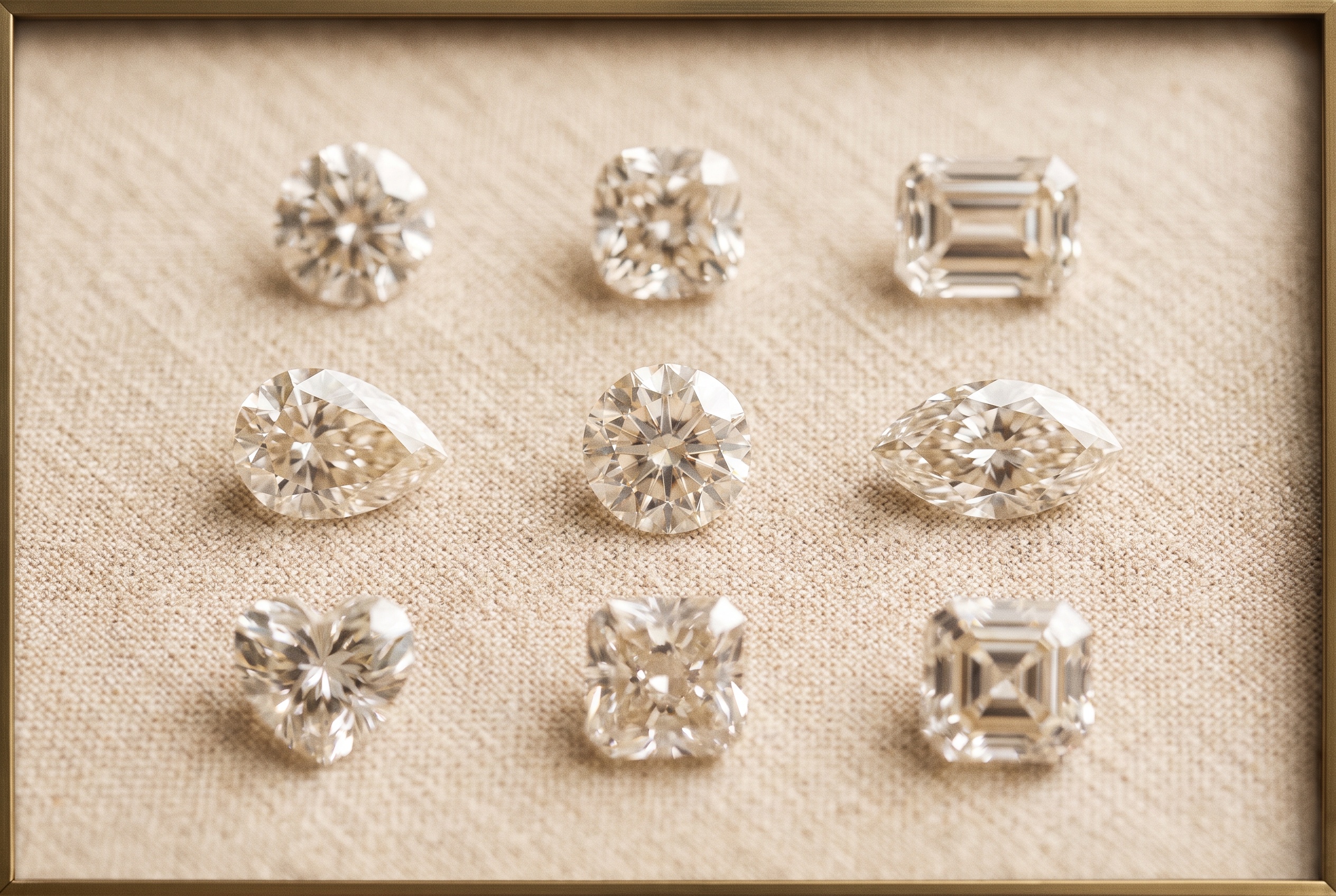
Retailers working with a custom jewelry partner often source the center stone as a certified loose diamond first, then quote the build separately. For stones 0.30ct and above, that means an IGI, GIA, or GCAL certificate accompanies the diamond, which is worth showing the customer directly — it's the one part of the quote that comes with third-party paperwork attached, and pairing that certificate with the certified diamond selection makes the "why does the stone cost what it costs" conversation easy, since the answer is on the cert.
Separating the two decisions — stone first, build second — also gives a customer a natural checkpoint to see the fixed number before design work starts. Once the stone is chosen and the certificate is in hand, everything downstream (metal, setting, CAD, finishing) is the variable part of the quote, and it's easier to have the fabrication conversation once the stone number is locked and out of the discussion.
If you're setting up a recurring custom program rather than a one-off build, it's worth working the sourcing and fabrication sides together from the start rather than pricing them separately every time — that's a conversation for contact us.
Frequently Asked Questions
Why does a custom ring cost more than just the diamond price?
Because the diamond is only one line item in the build. Metal weight, setting labor, CAD design time, and finishing are all separate costs that exist independent of the stone — a $1,000 stone in a simple solitaire and the same stone in a hand-set halo with a contoured shank will produce two very different total quotes, even though the stone line doesn't change.
Does switching from 14K gold to platinum change the price by a lot?
Yes, on two fronts. Platinum is priced higher per gram than gold, and it's denser, so the same design uses more metal by weight. It's also more labor-intensive to cast and finish, which adds to the finishing line as well as the metal line.
What setting styles cost the most to fabricate?
Generally, anything involving hand-set accent stones costs more than a plain solitaire — halos, pavé bands, hidden halos, and three-stone settings all add labor because each accent stone is set individually. Hidden halos in particular tend to surprise customers, since the added labor isn't visible in the finished piece.
How should I handle a customer who wants to change the design after CAD approval?
Set the expectation before the CAD stage starts: the quote includes a set number of revision rounds, and anything requested after approval — a different setting style, an added stone, a metal switch — is treated as a new design pass with its own cost. Putting this in writing at intake removes almost all of the friction later.
Are accent stones in a pavé or halo setting certified the same way as the center stone?
No. Center stones at 0.30ct and above are typically IGI, GIA, or GCAL certified individually. Small accent stones used in pavé, halo, or eternity-style work are sourced as parcel goods — quality-controlled against a color and clarity baseline, but not individually certified the way the center stone is.
Is lab-grown diamond pricing why fabrication costs make up more of the quote now?
In part. Lab-grown diamonds cost meaningfully less than natural diamonds of comparable size and quality, which is widely understood across the trade. As the stone cost has come down, metal, labor, and finishing haven't — so they represent a larger share of the total quote than they did when natural stones dominated custom work.