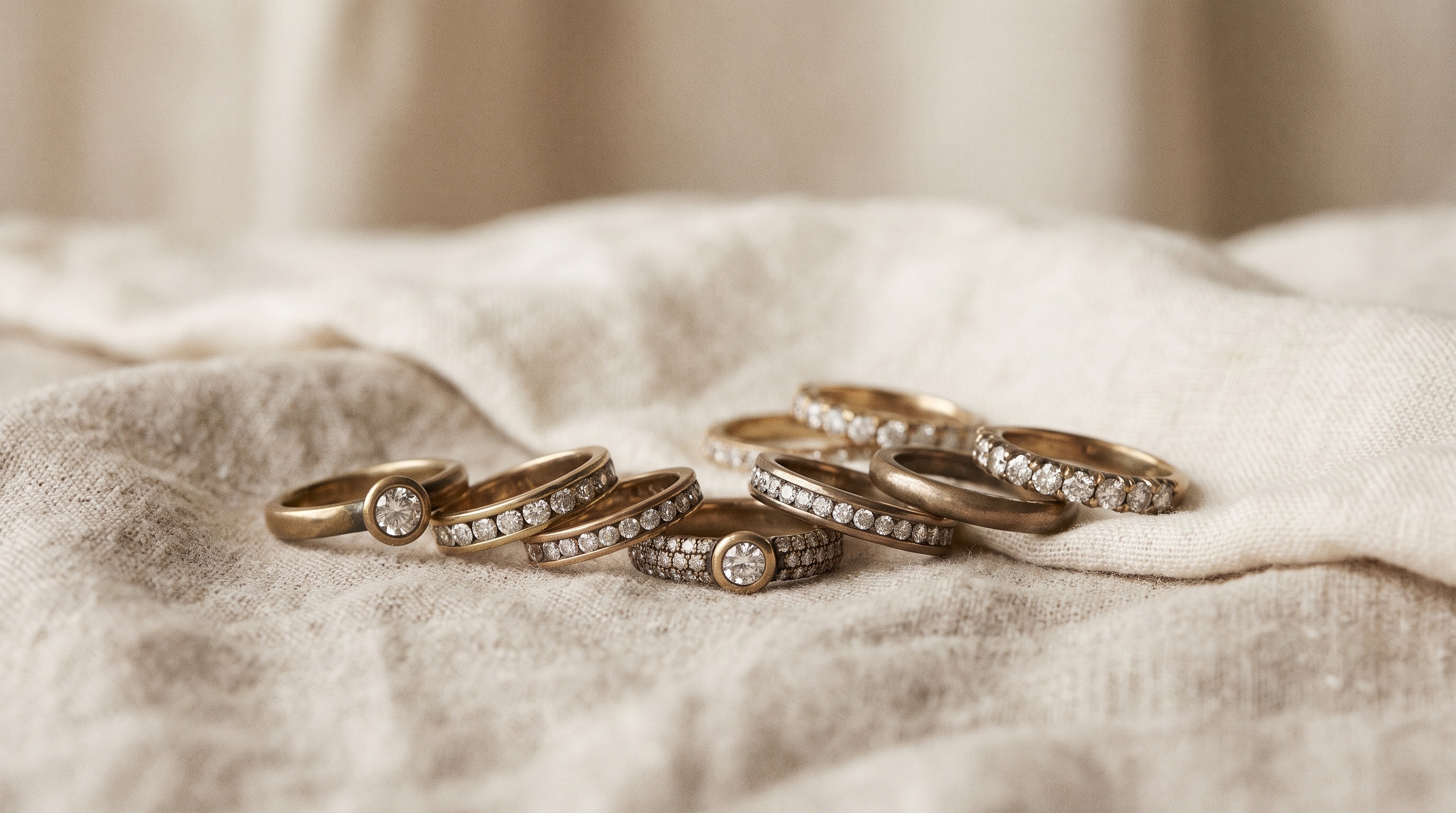
Wedding band setting types are the methods used to hold diamonds in a wedding or eternity band — channel, shared-prong, bezel, flush, pavé, and bar are the six most common — and each carries different tradeoffs for daily-wear durability, comfort against an adjacent engagement ring, and how easily the band can later be resized. Because a wedding band is worn every day, often stacked against another ring, the right setting choice depends less on which looks best in a photo and more on how it holds up and adjusts over years of wear.
This guide compares the six setting types a jeweler or buyer is most likely to encounter on a wedding or eternity band, with the mechanics of each covered briefly — deeper technical breakdowns of individual settings exist elsewhere — so most of the space here goes to the band-specific questions that actually drive a purchase or stocking decision: which settings hold up best to daily stacking wear, which sit most comfortably against the finger and an adjacent ring, which suit full, three-quarter, or half eternity coverage versus an accent-only band, and — the question buyers ask a jeweler far more often than any other — how hard each setting type is to resize later.
Why Setting Type Matters More on a Wedding Band Than an Engagement Ring
An engagement ring is typically built around one or a small number of stones and is often worn with a degree of protective habit — taken off for manual work, swapped for a plain band day-to-day in some cases. A wedding band, by contrast, is worn continuously, doesn't come off for most daily activities, and in a large share of cases sits stacked directly against an engagement ring, rubbing against it thousands of times a day. That combination — constant wear, constant contact with another ring, and constant exposure to hands, fabric, and daily tasks — makes setting type a bigger factor in wedding band selection than it typically is for a standalone piece. A setting that looks nearly identical to another in a case can behave very differently after five years of stacked, daily wear, and the six setting types below diverge specifically on the points that matter for that kind of use: how exposed the stones are, how the band's profile interacts with a neighboring ring, and how the band responds when it eventually needs to be resized.
Channel Setting
A channel setting holds a row of diamonds between two parallel metal walls, with the stones' girdles gripped from either side rather than by individual prongs — no metal rises above the stones, so the band's top surface reads smooth and continuous. On a wedding band specifically, this is one of the most requested setting types precisely because that smooth profile stacks cleanly against almost any engagement ring shape and snags on almost nothing, which matters more on a band worn every day than on an occasional piece. The tradeoff is that a channel-set band is genuinely difficult to resize — the channel walls are precisely fitted to the stones along the entire row, and cutting into or stretching that structure risks loosening stones or distorting the channel width, which is why channel-set bands are among the more resize-limited styles covered here.
Shared-Prong (Shared-Claw) Setting
A shared-prong setting uses a single prong between each pair of adjacent stones to hold both of them at once, rather than giving every stone its own full set of four prongs — this reduces the amount of metal visible between stones and maximizes how much diamond surface shows for a given total carat weight, a look many buyers specifically want in a full-eternity band. On a wedding band, shared-prong is a strong choice for buyers prioritizing visible sparkle and light performance over the lowest possible snag risk; the shared prongs do sit slightly raised above the band's surface, so they're a bit more exposed to catching on clothing or hair than a channel or flush setting, and prongs on any shared-prong band should be checked periodically over years of daily wear since they're the structural point most likely to need re-tightening. Resizing a shared-prong band is moderately difficult — easier than a full channel, since there's no continuous wall to disturb, but still constrained by the fact that any cut into the shank has to happen between stones, so the available resize points depend on exactly where the diamonds sit relative to the ring's sides and back.
Bezel Setting
A bezel setting surrounds each stone (or a small number of stones) with a continuous rim of metal that wraps entirely around the girdle, holding it in place without any prongs at all. On a wedding band, bezel setting is most often used for accent stones rather than full eternity coverage, since bezel-setting an entire band's worth of stones is a more labor-intensive, higher-cost build than channel or shared-prong — but where it is used, it's the most protective setting type on this list, fully enclosing each stone's edge and largely eliminating chip risk from a stray knock. That same enclosure reduces light entering from the sides, so a bezel-set band reads a little less sparkly than an equivalent pavé or shared-prong band, which is a fair tradeoff for buyers who specifically want a durable, low-profile band for manual work or an active lifestyle. Bezel-set bands resize reasonably well for isolated accent stones near the sides of the shank, but a bezel setting positioned at or near the sizing point still requires more careful work than a plain band, since the bezel itself has to be preserved intact through the resize.
Flush (Gypsy) Setting
A flush setting — also called gypsy setting — sets each stone individually into its own drilled recess in solid metal, so the stone sits level with the band's surface with no raised metal or prongs around it at all. This is the lowest-profile, most snag-resistant setting type covered here, and on a wedding band it's a frequent choice specifically for buyers who want visible diamonds without any raised element to catch on gloves, tools, or an instrument case — men's wedding bands lean on flush setting disproportionately for exactly this reason. The visual cost is reduced sparkle, since light enters the stone only from directly above rather than from multiple angles, and flush-set stones on a wedding band are almost always small, since the technique works best with stones under roughly 3-4mm. Flush setting is the single hardest setting type on this list to resize: because each stone sits in metal that's been drilled and burnished directly around it, resizing near a flush-set stone risks disturbing the seat entirely, and a full-eternity flush-set band is close to impossible to resize without full disassembly and re-setting.
Pavé Setting
A pavé setting uses small metal beads, raised between each stone, to hold a densely packed field of diamonds with minimal visible metal — the beads sit slightly proud of the surface, and the overall effect is a continuous, sparkling texture that reads as more diamond than metal. On a wedding band, pavé delivers the most light performance and overall sparkle of any setting on this list, which makes it a popular choice for a full or three-quarter eternity band meant to read as a statement piece. It's a less durable choice for constant daily wear than channel or bezel, though — the raised beads are more exposed to catching and wearing down over years than a smooth channel wall, and pavé bands benefit from more frequent prong/bead inspection than lower-profile settings. Resizing a pavé band is difficult for the same structural reason as channel: the beads are set in a specific, tightly spaced pattern around the shank, and stretching or cutting into that pattern risks loosening multiple stones at once rather than just the ones directly at the resize point.
Bar Setting
A bar setting is a middle ground between channel and pavé: individual thin metal bars separate each stone (or pair of stones) rather than one continuous channel wall, so more light enters from the sides than a true channel setting allows, while still giving each stone more structural protection than a pavé bead does. On a wedding band, bar setting is a reasonable compromise pick for buyers who want more visible light performance than a channel-set band but more daily-wear durability than pavé — the bars sit slightly raised, similar to shared-prong, so snag risk is moderate rather than minimal. Resizing a bar-set band sits in the same moderate-difficulty range as shared-prong: there's no single continuous structure to preserve, but the resize point still has to land between bars rather than through one, which limits exactly where a jeweler can cut and rejoin the shank.
Setting Type Comparison for Wedding and Eternity Bands
The table below summarizes daily-wear durability, resizing difficulty, and relative cost tier for each setting type as applied specifically to a wedding or eternity band — not as a general ranking of the setting technique in isolation.
| Setting Type | Daily-Wear Durability | Resizability | Relative Cost Tier |
|---|---|---|---|
| Channel | Excellent — smooth, enclosed, very low snag risk | Difficult — continuous channel walls resist alteration | Moderate |
| Shared-prong (shared-claw) | Good — prongs need periodic tightening checks | Moderate — depends on stone spacing near the resize point | Moderate to high |
| Bezel | Excellent — fully enclosed, best chip protection | Moderate — good away from the bezel, harder at the resize point | High (labor-intensive to set) |
| Flush (gypsy) | Excellent — lowest profile, minimal snag risk | Very difficult — often requires disassembly near stones | Moderate |
| Pavé | Fair — raised beads wear and catch more over time | Difficult — tightly spaced pattern resists alteration | High |
| Bar | Good — more protection than pavé, less than channel | Moderate — must land between bars | Moderate to high |
Matching Setting Type to Eternity Coverage
How much of the band is covered in diamonds changes which setting type makes the most practical sense. Guru Diam treats full eternity, three-quarter eternity, half eternity, and accent-only diamond wedding as coverage options on a single band builder rather than separate products, and setting type is one of the variables that interacts most directly with that coverage choice:
- Full eternity (diamonds around the entire band): Channel and shared-prong are the two most common choices, since both hold up structurally to a continuous run of stones all the way around the shank, including the section that sits against the palm and takes the most contact. A full-eternity band is also the hardest coverage style to resize regardless of setting type, since there's no plain metal section left to work with — this is worth flagging to a buyer up front rather than after the fact.
- Three-quarter eternity (diamonds across roughly the top 270°): Leaves a small plain-metal section at the back, which gives a jeweler a workable resize point regardless of which setting type covers the diamond portion — this is a meaningful practical advantage over full eternity for a buyer who anticipates needing a resize later.
- Half eternity (diamonds across roughly the top 180°): The most common everyday compromise, and the coverage style with the most flexibility on setting type — channel, shared-prong, bar, and pavé all work comfortably here, since the plain-metal back half both keeps cost down and gives a clean resize point.
- Accent-only (a small cluster or single row, not a full band of stones): Bezel and flush setting are most common here, since both work well for a small number of stones and both suit the lower-profile, understated look accent-only buyers tend to want.
Resizing Implications by Setting Type
Resizing is the setting-type consideration buyers most often overlook at the point of purchase, and it deserves more direct attention than it usually gets, since a wedding band is more likely to need a resize after the fact than an engagement ring — it's frequently bought slightly ahead of a final fitting, or as a gift, or before a wearer's ring size settles post-wedding. The core issue is structural: any resize requires a jeweler to cut into the shank, stretch or compress it, and rejoin the metal, and every setting type covered here restricts where and how that cut can safely happen.
Full eternity bands in any setting type are the hardest to resize, since there's no plain-metal section anywhere on the shank to cut into without disturbing a stone — a jeweler resizing a full-eternity band, particularly a channel-set or pavé one, is often looking at a partial or full re-set rather than a simple stretch. Flush-set bands are the single most resize-limited setting type on a per-stone basis, since each stone's seat is drilled and burnished directly into the metal around it, and disturbing that seat during a resize risks the stone's security even away from the strict eternity case. Channel and pavé are both difficult for the same underlying reason — a continuous, precisely fitted structure runs the length of the diamond section, and any alteration to shank width in that zone risks loosening more than one stone at once. Shared-prong, bar, and bezel settings resize somewhat more predictably, since each stone (or pair) is a more discrete unit, but even these depend heavily on exactly where the plain-metal sections fall relative to where a resize needs to happen. The practical takeaway for a retailer: a buyer who isn't certain of their final ring size, or who's buying as a gift, is often better served by a three-quarter or half-eternity band in shared-prong, bar, or bezel setting than by a full-eternity channel or pavé band, purely on resizing grounds — a point worth raising at the point of sale rather than after a customer returns needing a resize a supplier's setting can't easily accommodate.
Comfort and Fit Against an Adjacent Engagement Ring
Because a wedding band so often sits stacked against an engagement ring, how a setting type's profile interacts with the ring next to it matters as much as how it wears on its own. Low-profile settings — channel, flush, and bezel — sit flatter against an adjacent ring and are far less likely to catch on a solitaire's prongs or a halo's raised edge, which is part of why they're such common wedding-band choices specifically for stacking rather than solo wear. Shared-prong, bar, and pavé settings sit slightly higher, which can create a small gap or catch point against certain engagement ring profiles — this isn't usually a dealbreaker, but it's worth a buyer trying the pairing on before committing, especially with a domed or cathedral-style engagement ring where the two rings' profiles need to nest together comfortably rather than fight for space. Comfort against the finger itself follows a similar logic: flush and channel settings have no raised elements at all, so they're generally the most comfortable for a wearer whose hands are in frequent contact with tools, equipment, or fabric, while shared-prong and pavé, though not uncomfortable in normal wear, are the two most likely to be felt or occasionally caught during manual tasks.
Setting Type and Diamond Shape on a Wedding Band
Round brilliant remains the dominant shape across all six setting types on a wedding band, largely because it's the easiest shape to source consistently matched at the small melee sizes most bands use, and its faceting performs reliably in a channel, shared-prong, or pavé arrangement without needing special orientation. Baguette-cut stones are the most common alternative and pair most naturally with channel setting, since the channel's straight walls suit a baguette's rectangular outline better than a curved prong arrangement would. Bezel and flush settings work with either round or small fancy shapes, since both techniques set stones individually rather than in a connected row, giving a jeweler more shape flexibility per stone than channel or pavé allow. Buyers mixing shapes within one band — alternating round and baguette, for example — should expect a narrower supplier pool, since matching two shapes consistently across a full band is a more demanding sourcing and cutting task than a single-shape run.
Metal Choice Interactions by Setting Type
Platinum is the most commonly requested metal for channel, bezel, and full-eternity shared-prong bands specifically because its density holds up better than gold to the metal-on-metal wear a setting's raised or structural elements take over years of daily contact with an adjacent ring. Gold — white, yellow, or rose — remains common across every setting type here and is generally the more budget-conscious choice, though a shared-prong or pavé band in a softer gold alloy will show prong wear sooner than the same design in platinum, which is worth factoring into a resize-and-maintenance conversation with a buyer at the point of sale rather than only at first resize. Flush setting is comparatively metal-agnostic, since the technique relies on burnishing rather than prong tension, and performs comparably well across platinum and gold alike.
Sourcing Wedding Bands by Setting Type from Guru Diam
Guru Diam is a trade-only, B2B wholesale diamond and jewelry supplier with locations in New York and Los Angeles, sourcing wedding and eternity bands across channel, shared-prong, bezel, flush, pavé, and bar setting types, in full, three-quarter, half, and accent-only coverage, in both CVD lab-grown and natural diamonds. Melee consistency — matched color and clarity across a full band — is a bigger factor in setting quality than most buyers realize, particularly on channel and pavé bands where mismatched stones are more visible in a continuous line than in any other product format; Guru Diam's matched melee and pair sourcing is built around exactly that consistency requirement. Individually certified stones (IGI, GIA, and GCAL all available) are relevant for any wedding band built around a larger accent stone rather than melee — Guru Diam's certified diamond inventory covers that case directly. In-stock band inventory ships same-day (before 6pm EST from New York, before 4pm PST from Los Angeles), and custom wedding band and matching engagement ring builds — a genuine advantage for a retailer trying to pair setting styles precisely across a bridal set — are finished in 4-6 days through Guru Diam's custom jewelry program. New trade accounts can apply through trade partner, and current wedding and eternity band inventory across all six setting types is browsable at the wholesale hub.
Choosing a Setting Type: A Practical Decision Framework
For a buyer or retailer weighing setting type against real-world priorities rather than appearance alone, a few simple questions do most of the work. If daily-wear durability and low snag risk matter most — a manual job, an active lifestyle, a first-time wedding band buyer unsure what to expect — channel or flush setting are the strongest starting points. If maximum visible sparkle matters most and the band will see comparatively gentler wear, pavé or shared-prong deliver the most light performance per carat. If the buyer isn't certain of their final ring size, or the band is a gift, steering away from full-eternity coverage in channel or pavé setting — toward three-quarter or half eternity in shared-prong, bar, or bezel — meaningfully reduces the odds of a difficult resize later. And if the band will be worn stacked against a specific engagement ring, having both pieces in hand (or at minimum, a clear description of the engagement ring's profile) before finalizing setting type avoids the comfort and fit issues that otherwise only surface after purchase.
Frequently Asked Questions
Which wedding band setting type is most durable for everyday wear?
Channel, flush, and bezel settings are generally the most durable for daily wear, since none of them use raised prongs or beads that can bend, catch, or snag. Channel setting is the most common of the three specifically for wedding bands because it also stacks cleanly against most engagement ring profiles.
Which setting type is hardest to resize on a wedding band?
Flush (gypsy) setting is generally the hardest to resize, since each stone sits burnished into its own drilled seat in the metal, and disturbing that seat during a resize risks the stone's security. Channel and pavé settings are also difficult to resize, particularly in full-eternity coverage, since both involve a continuous structure running the length of the diamond section.
What's the difference between shared-prong and pavé setting?
Shared-prong setting uses one prong to secure two adjacent stones at once, showing more visible diamond surface with less metal than a fully individually pronged setting. Pavé uses small raised beads between each stone in a dense, continuous field — pavé generally shows even less metal and more sparkle than shared-prong, but is less durable for constant daily wear.
Should a full eternity band and a half eternity band use the same setting type?
Not necessarily — full eternity coverage removes any plain-metal section, which makes durability and resizing more important considerations regardless of setting, so channel and shared-prong are more common there. Half eternity leaves a plain-metal back section, which gives more flexibility on setting type since durability and resizing pressure are lower.
Which setting type is best for stacking a wedding band with an engagement ring?
Low-profile settings — channel, flush, and bezel — generally stack most comfortably against an engagement ring, since they sit flat with no raised prongs or beads to catch on the engagement ring's setting. Shared-prong, bar, and pavé sit slightly higher, which is usually fine but worth trying against the specific engagement ring before committing, especially with a domed or cathedral profile.
Are melee diamonds in a channel or pavé wedding band individually certified?
Usually not — most wedding band melee (typically under 0.30ct per stone) ships as uncertified parcel goods against a quality baseline like DEF+ color, VS+ clarity, rather than individually graded. A band built around a larger single accent stone above 0.30ct would use a certified stone instead, but that's uncommon for melee-driven setting styles like channel and pavé.
Guru Diam is a trade-only wholesale diamond and jewelry supplier with locations in New York and Los Angeles, sourcing wedding and eternity bands across channel, shared-prong, bezel, flush, pavé, and bar setting types in both lab-grown and natural diamonds. Browse current inventory at the wholesale hub or apply for a trade account through trade partner.