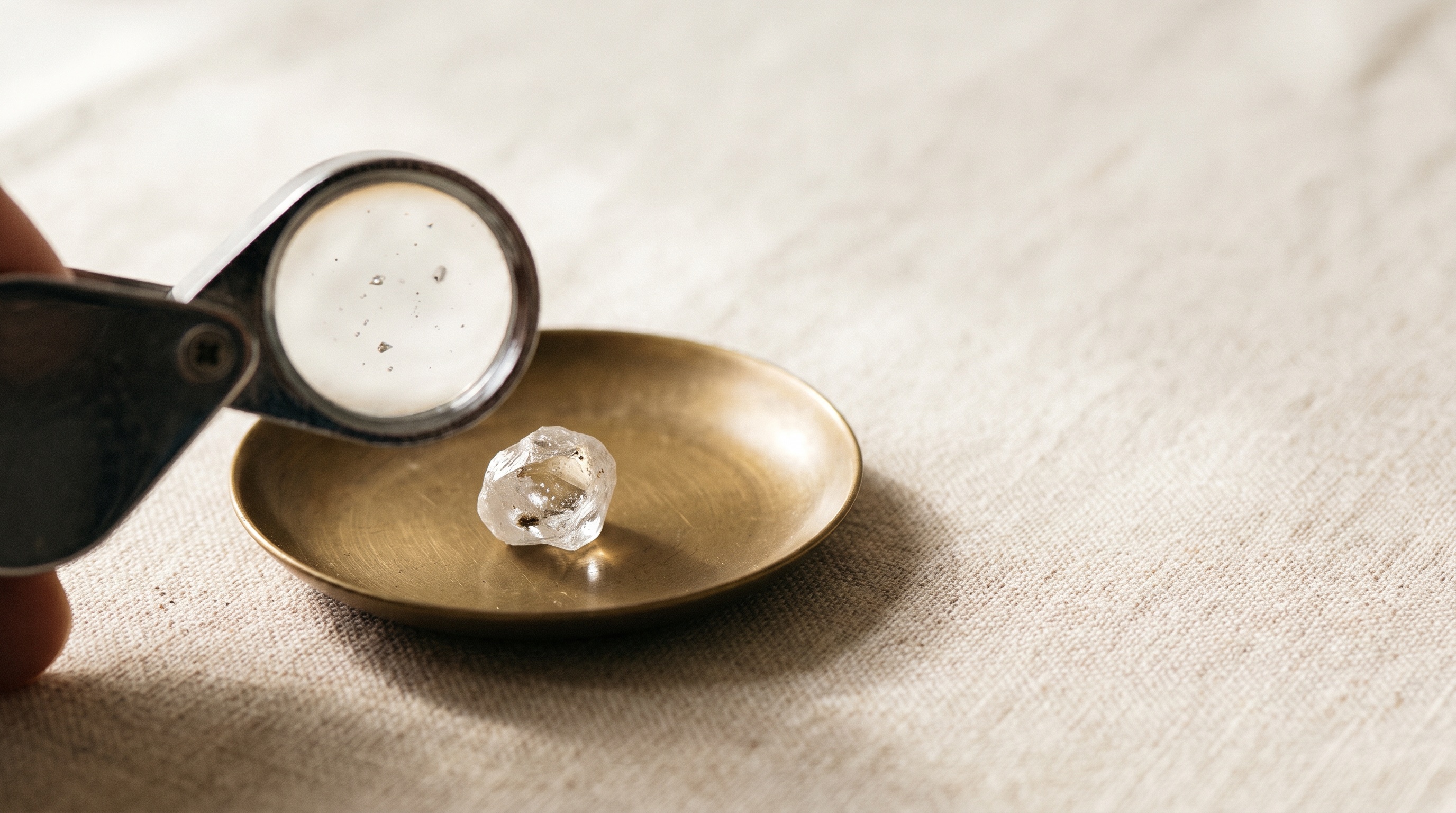
VS1 (Very Slightly Included, first tier) is a diamond clarity grade one step above VS2 and one step below VVS2 on the GIA, IGI, and GCAL clarity scale. Stones at VS1 have minor inclusions that are difficult to locate even under 10x magnification and are essentially never visible to the naked eye, in any shape, at any reasonable carat weight. It's the grade most jewelers reach for specifically when a design calls for extra visual margin — step-cut center stones, larger carat weights, or a client who's specifically asked for the cleanest stone reasonably affordable.
Where VS1 Sits on the Clarity Scale
| Grade | Meaning | Inclusion visibility |
|---|---|---|
| FL / IF | Flawless / Internally Flawless | No inclusions visible under 10x magnification |
| VVS1 / VVS2 | Very, Very Slightly Included | Extremely difficult to see under 10x; invisible without magnification |
| VS1 / VS2 | Very Slightly Included | Minor inclusions, difficult to locate under 10x; invisible to the naked eye in virtually all cases |
| SI1 / SI2 | Slightly Included | Noticeable under 10x; SI2 occasionally visible without magnification |
| I1-I3 | Included | Visible to the naked eye |
VS1 and VVS2 are close enough in practice that the difference mostly matters to graders and collectors rather than to how a finished piece looks on a hand. VS1 and VS2 are closer still — the gap between them is one of the smallest, most subtle steps on the entire clarity scale, which is exactly why so many buyers end up choosing VS2 instead once they understand how little practical difference the upgrade buys.
What Separates VS1 From VS2
Both grades describe minor, hard-to-find inclusions, but VS1 stones typically have fewer inclusions, smaller inclusions, or inclusions positioned in less visually significant locations than VS2 stones. A grader distinguishing between the two is often weighing subtle differences in inclusion count and position rather than any dramatic visual gap — which is why, absent a loupe and training, most people cannot reliably tell a VS1 and VS2 stone apart by eye, even side by side. The practical difference shows up mainly in two scenarios: very large stones, where facet size makes even minor inclusions marginally more visible, and step-cut shapes, where the open, mirror-like facet structure makes any remaining characteristic easier to spot than it would be in a brilliant cut.
Why Step Cuts Push Buyers Toward VS1
Step-cut shapes — emerald, asscher, baguette, and antique step cuts like the lozenge or trillion when faceted as a step rather than a brilliant — use long, parallel facets that act like a hall of mirrors rather than scattering light the way brilliant-cut facets do. This means inclusions that would be effectively camouflaged in a round or cushion brilliant become genuinely visible in a step cut at the same clarity grade. For this reason, many jewelers and buyers treat VS1 as the practical floor for step-cut center stones rather than VS2, accepting the modest price premium in exchange for real visual insurance in a shape that doesn't hide flaws well.
VS1 vs. VS2 vs. VVS2: Practical Comparison
| Grade | Naked-eye appearance | Best for |
|---|---|---|
| VVS2 | Eye-clean with wide margin in all shapes and sizes | Large step-cut center stones, collectors, maximum peace of mind |
| VS1 | Eye-clean with solid margin in nearly all cases | Step cuts, larger carat weights, brilliant cuts where extra margin is wanted |
| VS2 | Eye-clean in nearly all shapes and sizes | Brilliant cuts, most standard commissions, best value-to-cleanliness ratio |
How Clarity Grading Works
A trained grader examines a stone under 10x magnification and assesses the number, size, position, type, and visual contrast of every inclusion and blemish present, then assigns an overall grade reflecting the combined impact of everything observed — not a simple inclusion count. This is why two VS1 stones can still look subtly different from each other: the grade is a category covering a defined range of acceptable inclusion profiles, not one single fixed appearance. Reputable labs like GIA, IGI, and GCAL typically have more than one grader independently review a stone before finalizing its report, which is part of why certified grading carries real trust in the trade compared to an uncertified in-house grade.
Inclusions (internal characteristics like feathers, pinpoints, clouds, or crystals) and blemishes (external characteristics like small nicks or naturals on the surface) both factor into the final clarity grade. Inclusions generally weigh more heavily since they're permanent, while many blemishes can be polished away without significant weight loss — a VS1 grade typically results from a combination of very minor examples of both.
Is VS1 Worth the Price Premium Over VS2?
For most brilliant-cut engagement rings under roughly two carats, the honest answer is that VS1 buys peace of mind more than it buys a visible difference — VS2 is already eye-clean in that context, and the premium for VS1 doesn't translate into anything a viewer, or usually even the wearer, will actually see. Where VS1 earns its premium is in the specific scenarios already covered: step-cut center stones, larger carat weights where facet size increases scrutiny, and buyers who specifically want the extra margin for their own confidence rather than for any measurable visual outcome. Framed honestly to a client, this is a legitimate reason to choose VS1 — buying certainty has real value even when the alternative would likely have looked the same.
VS1 Across Carat Weights
| Carat range | VS1 experience |
|---|---|
| Under 1.00ct | Comfortably eye-clean in all shapes; VS2 would likely perform identically |
| 1.00-2.50ct | Eye-clean with solid margin; a sensible upgrade point for step cuts specifically |
| 2.50ct+ | Larger facets make VS1's extra margin genuinely useful, especially in step cuts and fancy shapes |
VS1 in Lab-Grown vs. Natural Diamonds
Clarity grading is identical in method and terminology between CVD lab-grown and natural diamonds — a VS1 report from GIA, IGI, or GCAL means the same thing regardless of origin. Lab-grown stones more commonly show pinpoint and cloud-type inclusions tied to the growth process, while natural stones more often show feathers and mineral crystals from geological formation, but this distinction doesn't change how a buyer should evaluate or shop for VS1 clarity in either case.
A Practical Framework for Recommending VS1
For jewelers advising clients, VS1 makes the most sense as a specific-case upgrade rather than a default starting point: recommend it for step-cut center stones, for center stones above roughly 2-2.5 carats regardless of shape, and for clients who explicitly prioritize certainty over squeezing maximum size or setting budget from their spend. For everything else — brilliant cuts under 2 carats, accent and side stones, budget-conscious commissions — VS2 typically delivers the same real-world appearance for a meaningfully lower price, making it the better default recommendation in most standard cases.
Reading the Plotting Diagram, Not Just the Grade
Every GIA, IGI, or GCAL clarity report includes a plotting diagram — a visual map showing the type and exact position of each identified inclusion and blemish. For a VS1 stone, this diagram typically shows very few marks, often just one or two small symbols positioned toward the girdle rather than clustered under the table. Reviewing the plot rather than relying on the grade name alone tells a buyer or jeweler two things the letter grade can't: whether the stone's characteristics happen to sit in a location that will be covered by a prong or bezel once set, and whether the specific inclusion type present (a feather versus a pinpoint, for instance) carries any durability consideration beyond pure appearance. Feathers, in particular, are worth a second look even at VS1 — while a VS1-grade feather is minor by definition, its exact position relative to the stone's edge is worth confirming for a piece that will see daily wear and occasional knocks.
VS1 for Side Stones, Melee, and Matched Sets
For a center stone, VS1's extra margin over VS2 has a clear rationale in step cuts and larger sizes. For side stones and melee, that rationale weakens considerably — smaller facets already camouflage minor inclusions effectively, so specifying VS1 across an entire line of channel-set or pavé accent stones often adds real cost without a corresponding visible benefit. A more cost-effective approach many jewelers use is reserving VS1 (or higher) specifically for the center or focal stone, while sourcing SI1 or VS2 for smaller accent and melee stones, where the size difference alone does most of the work of keeping the overall piece looking clean. The exception is a matched-pair or matched-set commission where every stone is a similar, larger size and equally visible — earrings built from two substantial VS1 stones, for example, where consistency across both stones matters as much as the grade itself.
Frequently Asked Questions
Is VS1 clarity better than VS2?
Technically yes, on the grading scale, but the practical visual difference is minimal in most shapes and sizes. VS1 buys real value specifically in step cuts and larger carat weights, where its extra margin is more likely to matter.
Can you see inclusions in a VS1 diamond?
Essentially never without magnification, in any shape or reasonable carat weight. VS1 is one of the cleanest commercially common clarity grades before reaching the VVS and flawless tiers.
Is VS1 worth it for a round diamond?
For most round brilliants under about 2 carats, VS2 already looks identical to VS1 to the naked eye, making VS1 more of a certainty premium than a visible upgrade in that specific case.
What's the difference between VS1 and VVS2 clarity?
VVS2 sits one step cleaner than VS1 on the scale, with inclusions that are even harder to locate under magnification. The practical visual gap between the two is very small, similar to the gap between VS1 and VS2.
Does VS1 clarity cost much more than VS2?
The premium is typically modest rather than dramatic, though it varies by carat weight and market conditions. It's usually a smaller jump than the price gap between VS2 and SI1.
Is VS1 the right clarity for an emerald cut diamond?
It's a common and sensible choice. Emerald and other step cuts show inclusions more readily than brilliant cuts, so many buyers and jewelers set VS1 as the practical clarity floor for this shape specifically.
How VS1 Interacts With Color and Cut
Clarity doesn't operate in isolation from the other three Cs, and understanding the interaction helps explain why chasing VS1 in isolation can be the wrong lever to pull. Cut quality has the largest effect on how "clean" a stone appears overall — a well-cut diamond's strong light return and pattern of scintillation genuinely help camouflage minor clarity characteristics, sometimes making a well-cut VS2 look as clean in practice as a poorly cut VS1. Color grade interacts more subtly: a warmer color grade slightly reduces overall contrast within the stone, which can make small inclusions marginally less noticeable, though this is a minor secondary effect compared to cut quality and shouldn't be treated as a substitute for adequate clarity. For a buyer or jeweler working within a fixed budget, this generally argues for prioritizing cut quality first, appropriate clarity for the shape second, and treating any further clarity upgrade past VS2 (into VS1 and beyond) as a lower-priority spend unless the shape or carat weight specifically calls for it.
VS1 and Long-Term Value Considerations
For buyers thinking about resale or long-term value retention — a less common but real consideration in bridal and investment-adjacent purchases — higher clarity grades do generally command a modest premium in resale markets, all else equal, since a documented VS1 grade is an objective, verifiable characteristic on a certified report. That said, clarity grade alone is rarely the dominant factor in resale value; carat weight, shape popularity, and overall market demand for the specific combination of characteristics typically matter more. Framing VS1 primarily as a "better resale investment" oversells its actual impact compared to framing it accurately: a modest, verifiable quality marker that matters most in the specific shape and size scenarios where its visual benefit is also real.
Common Misconceptions About VS1 Clarity
A handful of misunderstandings come up repeatedly with this grade specifically:
- "VS1 means flawless to the eye and VS2 doesn't." Both grades are effectively eye-clean in the overwhelming majority of real purchases. The difference is a matter of degree and margin, not a bright line between "visible" and "invisible."
- "A higher clarity number always means a better-looking stone." Cut quality has a larger effect on overall visual appeal than clarity grade does once a stone clears the eye-clean threshold, which VS2 already does in nearly all cases. A poorly cut VS1 can look duller than a well-cut VS2 despite the "better" clarity grade.
- "VS1 diamonds never have visible inclusions under any circumstances." Under 10x magnification, VS1 inclusions are present and identifiable by a trained grader — the grade describes difficulty of detection at that magnification level, not total absence of any internal characteristic.
- "All VS1 stones from different sellers are equivalent." Grading is inherently a professional judgment exercise, and while major labs apply consistent standards, borderline stones near a grade boundary can occasionally be graded differently by different labs or graders. This is another reason the plotting diagram and full report matter more than the single-letter grade in isolation.
VS1 for Fancy Color and Specialty Stones
Clarity considerations shift somewhat for fancy color diamonds compared to standard white stones. In a strongly colored fancy diamond — a fancy yellow, pink, or blue — the body color itself reduces contrast within the stone, which can make minor inclusions somewhat less visually prominent than the identical inclusion would be in a colorless or near-colorless white diamond. This doesn't mean clarity becomes irrelevant for fancy colors, but it does mean the same VS1-versus-VS2 decision framework that applies to white diamonds doesn't transfer directly — a fancy color buyer is often better served prioritizing color saturation and hue over pushing clarity higher than necessary, since color is the primary value and visual driver for that category of stone specifically.
Buyer Scenarios Where VS1 Is the Right Call
Pulling the guidance above together, a handful of concrete scenarios consistently justify choosing VS1 over VS2: an emerald or asscher-cut center stone of any real size, given step cuts' open facet structure; a round or fancy-shape center stone above roughly 2.5 carats, where larger facets increase scrutiny; a client who has explicitly said cost is secondary to certainty and clarity specifically matters to them; and a matched-pair commission like stud or drop earrings where consistency and cleanliness across two equally visible stones outweighs the modest cost difference. Outside these scenarios — most rounds and cushions under 2 carats, most side and accent stones, most budget-conscious commissions — VS2 delivers effectively the same real-world result for less money, and steering a client toward VS2 in those cases is the more honest, value-conscious recommendation rather than defaulting to the higher grade simply because it sounds better on paper.
Sourcing VS1 Clarity from Guru Diam
Guru Diam stocks VS1 across our certified loose diamond range, CVD lab-grown with IGI, GIA, and GCAL certification available, alongside our standard DEF+/VS+ baseline inventory. In-stock VS1 stones ship same-day from New York or Los Angeles, and our team can help match clarity grade to shape and carat weight for a specific commission before a client quote goes out — particularly useful for step-cut and larger-carat designs where the VS1-versus-VS2 decision actually matters. Our custom jewelry program finishes rings in 4-6 days from CAD approval, and trade accounts can review full inventory through the wholesale hub or a trade partner account.
Full plotting diagrams and grading reports are available for review before purchase on every stone in our inventory, so a jeweler working through the VS1-versus-VS2 decision for a specific client commission can make that call based on the actual stone's characteristics rather than the grade name alone. For step-cut and larger-carat center stone requests specifically, our team can pull a short list of matching VS1 options with images ahead of a client presentation, saving the back-and-forth of sourcing individual stones after a design has already been approved.