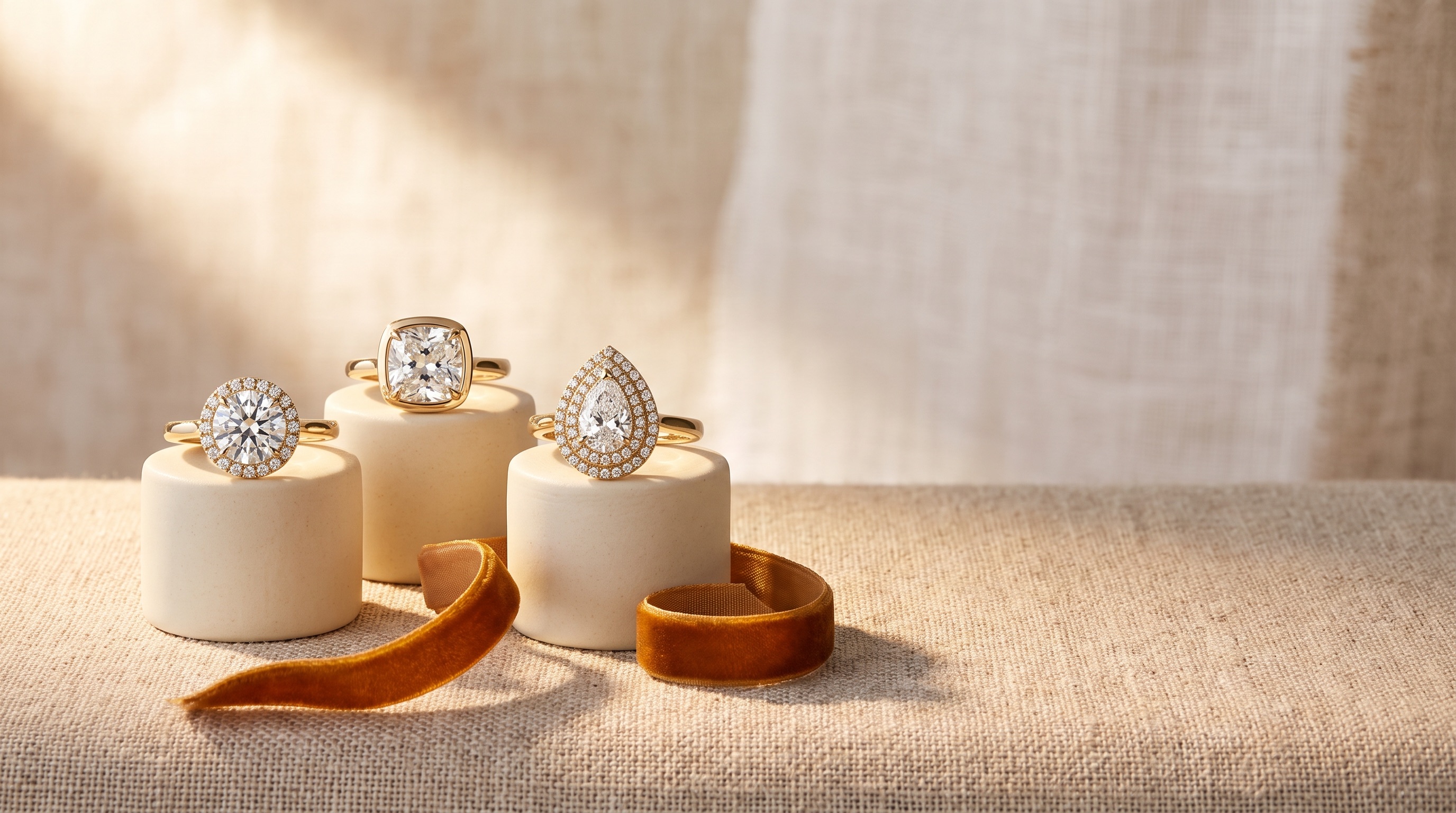
A halo ring setting surrounds a center stone with a ring of smaller accent diamonds, and within that broad category several distinct subtypes exist — single halo, double halo, hidden halo, and floating halo are the four most commonly requested, and each changes the ring's look, cost, and practical wear characteristics in a genuinely different way. Knowing which subtype a customer means by "halo" — not just that they want a halo generally — changes the sourcing conversation meaningfully, since the four variations differ in stone count, setting complexity, and price.
This guide compares the four main halo subtypes directly: what defines each one structurally, how they look side by side, the tradeoffs of each, and how to have a more precise conversation with a customer or buyer about which one actually fits their goals. It's written to sit alongside a general definition of what a halo setting is and a deep dive on hidden halo specifically — this guide's job is the comparison across subtypes that neither of those covers on its own.
Why "Halo Setting" Isn't One Single Style
The term "halo setting" describes a broad design principle — small accent stones encircling a center stone — rather than one fixed construction. In practice, four structurally distinct approaches to that principle have become common enough in the trade to have their own names, and a customer asking for "a halo ring" without further specification could reasonably mean any of the four. Sourcing melee, planning a build, or quoting a price all depend on knowing which one is actually being requested, since the four subtypes differ meaningfully in stone count, visible design impact, and manufacturing complexity.
Single Halo Setting
The baseline version of the style: one continuous ring of small accent diamonds set directly around the center stone, visible from every angle when the ring is viewed from above. This is what most buyers picture by default when they hear "halo setting," and it's the version most widely available across mass-market and custom production alike.
- Stone count: Typically 16–40 small accent melee, depending on center stone size and halo width.
- Visual effect: Makes the center stone appear meaningfully larger — often 20-30% larger in apparent face-up size — at a fraction of the cost of achieving the same visual size with a single larger center stone.
- Best for: Buyers wanting the classic, most recognizable halo look at the most accessible price point within the category.
Double Halo Setting
Two concentric rings of accent diamonds surround the center stone rather than one — an inner halo set close against the center stone and a second, slightly larger halo set just outside it, sometimes on a raised or stepped platform to add dimension between the two rings.
- Stone count: Roughly double a single halo, often 35–70+ small accent melee depending on ring size and both halos' widths.
- Visual effect: Amplifies the size-enhancing effect of a single halo further, and adds more overall sparkle and a more substantial, statement-piece presence on the hand.
- Best for: Buyers who want maximum visual impact and perceived size, and who are comfortable with the higher stone count and setting complexity (and correspondingly higher cost) that a second ring of stones requires.
Hidden Halo Setting
A ring of accent diamonds sits beneath the center stone's girdle, hidden from a direct top-down view and only visible from the side profile or when the ring is tilted. This creates a design that reads as a clean, unadorned solitaire from straight above but reveals an unexpected extra layer of sparkle and detail from other angles — a deliberate "surprise" element some buyers specifically want.
- Stone count: Typically fewer than a visible single halo, since the ring sits at a smaller diameter directly at the girdle rather than spreading outward — commonly 12–24 small accent melee.
- Visual effect: Doesn't meaningfully increase the center stone's apparent face-up size the way a visible halo does, since the accent stones aren't visible from the primary viewing angle — the appeal is the side-profile surprise detail and added structural support, not size enhancement.
- Best for: Buyers who want a clean, classic solitaire look for everyday viewing with a personal, less-obvious detail underneath — a popular choice for buyers who find a fully visible halo too ornate for their taste but still want some extra sparkle in the design.
For a full deep dive on this specific subtype — construction detail, setting technique, and sourcing considerations — see our dedicated hidden halo ring guide.
Floating Halo Setting
A ring of accent diamonds encircles the center stone but is set with a visible gap of open space between the halo and the center stone itself, rather than sitting snug directly against the stone's girdle the way a single halo does. The open gap creates the visual effect of the center stone appearing to float independently within the ring of accent diamonds.
- Stone count: Comparable to a single halo, typically 16–40 small accent melee, since the core construction is similar aside from the gap.
- Visual effect: A more modern, airy look than a snug single halo — the visible negative space reads as more contemporary and slightly less traditional, and some buyers find it makes the center stone feel more like an independent focal point rather than merged visually with its surrounding accent stones.
- Best for: Buyers wanting a halo's size-enhancing and sparkle benefits with a more modern, less densely clustered aesthetic than a traditional snug halo.
Halo Subtypes Compared Side by Side
| Subtype | Typical Stone Count | Apparent Size Boost | Visible From Top? | Best For |
|---|---|---|---|---|
| Single halo | 16–40 | Significant (~20-30%) | Yes, fully | Classic, accessible halo look |
| Double halo | 35–70+ | Greatest of the four | Yes, fully, with added dimension | Maximum visual impact and sparkle |
| Hidden halo | 12–24 | Minimal — not the point of this style | No, side-profile only | Clean solitaire look with a hidden detail |
| Floating halo | 16–40 | Significant, more modern presentation | Yes, with visible gap | Modern, airy aesthetic |
How Setting Complexity Differs Across the Four Subtypes
From a manufacturing standpoint, the four subtypes require meaningfully different setting approaches, which is worth understanding when quoting or planning production timelines. A single halo is the most straightforward — one continuous ring of pavé or micro-prong-set stones at a consistent radius. A double halo essentially doubles that same work while also requiring the two rings to sit at a consistent, complementary spacing from each other, adding an alignment step a single halo doesn't need. A hidden halo requires setting stones in a tighter, less accessible space directly beneath the center stone's girdle, which demands more precise, small-format setting work than a visible halo at a wider radius. A floating halo requires maintaining a consistent, deliberate gap between the halo and the center stone across the entire circumference — a small manufacturing detail, but one that shows immediately if the gap comes out uneven, making it more exacting than a snug single halo despite a similar stone count.
Which Center Stone Shapes Work Best With Each Subtype
- Round and cushion pair well with all four subtypes, since their symmetrical or near-symmetrical outlines suit an evenly spaced surrounding ring of accent stones regardless of the specific halo style.
- Oval, pear, and marquise (elongated shapes) suit single and double halos especially well, since the halo reinforces the shape's elongated silhouette; hidden halos work less dramatically with these shapes since the effect isn't visible from above regardless of center stone shape.
- Emerald and other step cuts pair distinctively with a floating halo's more geometric, modern gap-set look, since the clean rectangular lines of a step cut complement the deliberate negative space more than a snug traditional halo does.
Cost Differences Across the Four Subtypes
Stone count is the primary cost driver across all four subtypes, since accent melee and the labor to set it scale roughly with how many stones a given design requires. A hidden halo, using the fewest accent stones of the four, is typically the least expensive halo option to add to a given center stone. A single halo and a floating halo use a comparable stone count and land at a similar price point, with a floating halo sometimes carrying a modest premium for the more exacting gap-setting work involved. A double halo, using roughly twice the stone count of a single halo, is consistently the most expensive of the four to produce, both in raw material and in the added alignment labor between the two rings.
Common Buyer Mistakes When Choosing a Halo Subtype
- Assuming "hidden halo" adds visible size the way a regular halo does. Buyers sometimes choose a hidden halo expecting the same face-up size boost as a visible halo, then are surprised the center stone doesn't read larger from above — the hidden halo's appeal is the side-profile detail, not size enhancement.
- Not specifying which subtype when requesting a quote. Because stone count and setting complexity vary substantially across the four, a vague "halo setting" request can produce a wide range of quotes depending on which subtype the quoting jeweler assumes.
- Overlooking maintenance differences. A double halo's higher stone count means more individual prongs or pavé settings to inspect and maintain over time compared to a single or hidden halo — a real long-term ownership consideration some buyers don't think through at the point of purchase.
Additional Halo Variations Worth Knowing
Beyond the four primary subtypes covered above, a handful of secondary halo variations come up often enough in custom and higher-end production to be worth naming explicitly:
- Cushion halo. Not a separate structural mechanism from a single halo, but a specific shape treatment where the accent-stone ring follows a softened, rounded-square cushion outline rather than tracing the center stone's exact outline — commonly used with round or cushion center stones to add a distinctive silhouette.
- Sunburst (or fan) halo. Accent stones radiate outward from the center stone in graduated sizes, largest near the outer edge, rather than sitting in a uniform ring of matched small stones — a more elaborate, vintage-inspired variation that requires calibrated melee across multiple graduated sizes rather than a single uniform size.
- Halo with pavé shank. Any of the four primary subtypes combined with a shank that continues the sparkle down the band itself with pavé-set accent stones, rather than transitioning to a plain, unset band — a common upgrade that increases total stone count and diamond weight beyond the halo alone.
These variations layer on top of, rather than replace, the four primary structural subtypes — a sunburst halo, for instance, is still fundamentally a single or double halo in terms of its basic visible-from-above structure, with the sunburst treatment describing the graduated stone-sizing pattern specifically.
Halo Setting Metal Considerations
Because a halo setting's accent stones are typically set in delicate micro-prong or pavé work, metal choice affects both the setting's durability and its finished appearance more than it might for a simpler solitaire. Platinum and 18k white gold are the most common choices for halo work specifically because their density and hardness hold fine micro-prong detail well over years of wear, an important consideration given how many small individual prongs a dense single or double halo requires relative to a center-stone-only setting. Yellow and rose gold halos are also widely produced and popular, but a jeweler should confirm the metal's hardness and prong-gauge specification are adequate for the stone count and prong density the specific halo subtype requires, since an underbuilt halo in a softer metal alloy is more prone to individual prongs wearing thin or catching over time than a properly specified platinum or 18k build.
Maintenance and Prong Inspection for Halo Rings
Because halo settings — particularly double halos — involve a meaningfully higher total prong count than a simple solitaire, routine maintenance and inspection matter more for this category than for a single-stone ring. A jeweler inspection roughly every six to twelve months is a reasonable general baseline for any prong-set ring, but a dense halo with dozens of individual micro-prongs benefits from a slightly more attentive inspection schedule, since a single loose or worn prong on a halo accent stone (which is small and easy to overlook relative to a center stone) can result in a lost stone that goes unnoticed longer than a comparable issue with a larger, more visually prominent center stone would. Retailers selling halo pieces should set expectations with customers at the point of sale about this maintenance cadence, particularly for double halo designs with the highest total prong count of the four subtypes.
A Brief History of the Halo Setting
The halo setting's core design principle — surrounding a center stone with smaller accent stones to enhance its visual size and brilliance — has roots reaching back to Georgian and Victorian-era jewelry, where a cluster of smaller stones surrounding a larger center stone was a recognized and popular construction well over a century before the term "halo" became standard trade vocabulary for the style. The style saw a significant contemporary resurgence beginning in the early 2010s, driven substantially by high-profile celebrity engagement rings featuring the design, which brought halo settings — and specifically the single halo subtype — into mainstream consumer awareness at a scale the style hadn't previously seen. Hidden and floating halo variations developed later as designers and manufacturers looked for ways to differentiate the now-ubiquitous basic halo look, offering buyers who wanted some of the halo's benefits without its by-then very familiar fully-visible appearance a more distinctive alternative within the same broad design family.
How to Talk Through Halo Subtype With a Customer
Because the term "halo" is used loosely in consumer-facing marketing and social media far more often than the specific four subtypes covered in this guide, a sales conversation that starts from a reference image or a specific structural question tends to land on the right subtype faster than one that starts from the word "halo" alone. Asking whether the customer wants the accent stones visible from directly above (ruling hidden halo in or out immediately), whether they're drawn to a denser, more sparkling look or a cleaner, more open one (pointing toward double versus single or floating), and whether budget flexibility exists for the higher stone count a double halo requires are three quick questions that narrow a vague "I want a halo ring" request down to one of the four specific subtypes within the first few minutes of a consultation, well before any center stone or metal decision needs to be finalized.
Halo Settings and Center Stone Value: A Two-Way Relationship
A halo's size-enhancing effect creates a genuine strategic tradeoff worth discussing directly with budget-conscious buyers: because a single or double halo can make a smaller center stone read as visually larger, a buyer with a fixed total budget can choose to allocate more of that budget toward halo construction and accent stones and correspondingly less toward the center stone's own carat weight, arriving at a finished ring that reads as a larger overall piece than the same total budget would produce with a bigger center stone in a plain solitaire setting. This tradeoff runs in the opposite direction for a hidden halo, which doesn't offer the same face-up size boost — a buyer specifically motivated by maximizing perceived size on a fixed budget should generally be steered toward a visible subtype (single, double, or floating) rather than hidden, reserving the hidden halo recommendation for buyers whose primary interest is the side-profile detail rather than size optimization.
Sourcing Halo Setting Diamonds and Melee at Wholesale
Because every halo subtype relies on tightly matched accent melee surrounding a center stone, lot consistency matters across all four — a mismatched accent stone is visually obvious in a dense single or double halo, and equally obvious in a hidden halo's tighter, closer-viewed setting. Guru Diam supplies calibrated diamond melee sized and graded for halo work, across natural and CVD lab-grown material, alongside certified center stones — round brilliants and the fancy and antique shapes that pair well with any of the four halo subtypes covered above, with IGI, GIA, and GCAL certification all available.
For jewelers and designers building a custom halo piece — single, double, hidden, or floating — the custom jewelry program handles the full build in-house, with finished pieces delivered in 4-6 days. Matched accent melee for any halo configuration is available through matching pairs, center stones through certified diamonds, and fancy color options for a colored center stone or accent halo through fancy color loose diamonds. Trade accounts can review terms at the wholesale hub or apply through trade partner.
Frequently Asked Questions
What's the difference between a single halo and a double halo?
A single halo has one continuous ring of accent diamonds around the center stone. A double halo adds a second, slightly larger ring of accent stones just outside the first, roughly doubling the stone count and delivering more overall sparkle and a more substantial presence on the hand, at a higher cost.
Does a hidden halo make a diamond look bigger?
Not meaningfully, no — because the accent stones sit beneath the center stone's girdle and aren't visible from directly above, a hidden halo doesn't produce the same apparent size increase a visible single or double halo does. Its appeal is the side-profile detail and added sparkle when the ring is tilted, not size enhancement.
What is a floating halo setting?
A floating halo is a ring of accent diamonds set with a visible gap of open space between the halo and the center stone, rather than sitting snug against it. This creates the visual effect of the center stone appearing to float independently, giving a more modern, airy look than a traditional snug halo.
Which halo setting is the least expensive?
A hidden halo typically uses the fewest accent stones of the four common subtypes, which usually makes it the least expensive halo option to add to a given center stone. A double halo, using roughly twice the stones of a single halo, is typically the most expensive.
Can any diamond shape be used with any halo subtype?
Most shapes work with most subtypes, but some pairings are more visually successful than others — elongated shapes like oval and pear pair especially well with single and double halos since the halo reinforces the elongation, while step cuts like emerald pair distinctively with a floating halo's more geometric gap-set look.
How many accent diamonds are typically used in a halo setting?
It varies by subtype: a hidden halo often uses as few as 12-24 accent melee, a single or floating halo typically uses 16-40, and a double halo can use 35-70 or more, since it combines two full rings of accent stones.