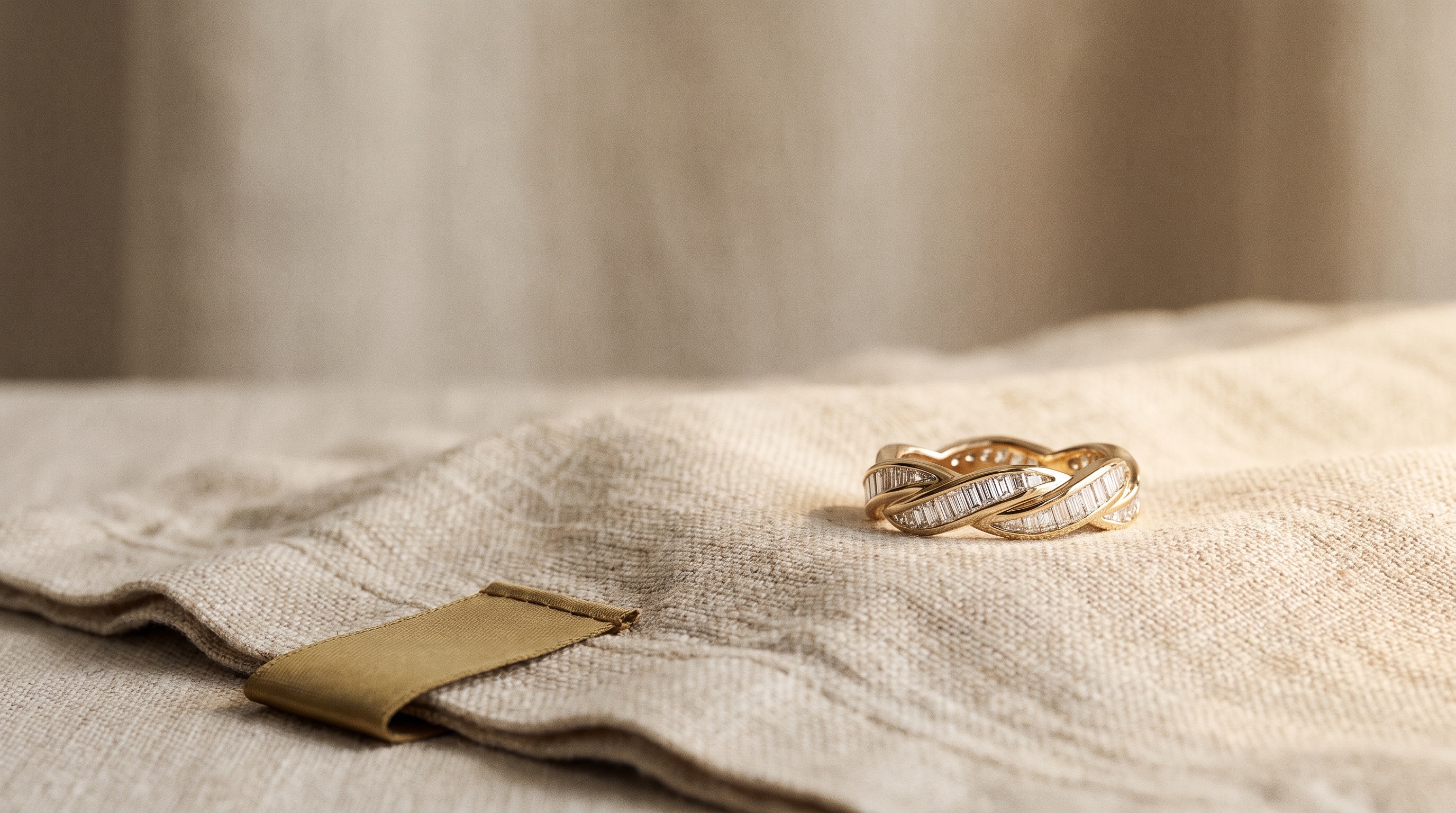
A twisted band diamond ring is a full eternity or wedding-band-style ring whose shank spirals rather than running as a flat, level circle, with diamonds channel-set or pavé-set following that twist along part or all of the band. For a wholesale buyer, the twist is not a cosmetic detail — it changes how stones are calibrated, how the setting is engineered, and what the piece costs to produce compared to a standard straight-shank eternity or wedding band.
This guide covers twisted band diamond rings from the sourcing side: how the spiral shank changes the setting job, which stone-setting approach fits which price and durability target, the calibration challenges unique to a twisted channel, and what a retailer or manufacturer should confirm before placing a stocking or custom order.
What a Twisted Band Diamond Ring Actually Is on a Build Sheet
On a production floor, a twisted band diamond ring starts from the same base category as a standard diamond eternity or wedding band — a full-coverage or partial-coverage diamond-set shank — with one added construction variable: the metal itself is formed with a rotation along its length rather than sitting flat. That rotation can range from a single gentle helix (the shank turns roughly a quarter to half turn across its width) to a more pronounced double or triple twist, sometimes built as two interwoven bands that cross each other rather than one continuous spiral. Every other build decision that applies to a straight eternity band — coverage tier, setting style, carat weight, metal type — still applies here, but each one interacts with the twist in a way that a buyer sourcing this style for the first time should understand before quoting a price.
How the Spiral Shank Changes the Setting Job
On a flat-shank eternity band, a channel or pavé line runs in a single plane, which means every stone sits at the same angle relative to the finger and the setter's tooling can move in one consistent direction around the ring. A twisted shank breaks that consistency: as the metal rotates, the angle of the setting surface changes continuously along the twist, so each diamond (or each short run of diamonds) has to be seated at a slightly different angle than the one before it. This is the core reason a twisted band costs more in labor than a straight-shank equivalent carrying the same total carat weight — the setter is compensating for a constantly shifting plane rather than repeating one motion around a level circle.
The practical effect shows up in two places a buyer should ask about directly: how the supplier maintains consistent light performance across the twist (a poorly executed spiral can leave some stones facing more toward the viewer and others rotated partly away, reading as uneven sparkle even when every stone is well-cut), and how the channel or prong line is kept structurally sound through the rotation points, since a twist concentrates stress at the points where the shank changes direction most sharply.
Setting Style Comparison for Twisted Bands
The setting method used to follow the twist is the single biggest driver of both cost and durability in this category. The table below compares the four approaches that make up the large majority of wholesale twisted band orders.
| Setting Approach | Durability | Relative Cost | Sourcing Complexity |
|---|---|---|---|
| Channel-set along the twist | High — metal rails protect stone girdles through the rotation | Moderate to high | High — rails must be bent and closed evenly at a constantly changing angle |
| Pavé following the spiral | Moderate — small beads are more exposed to snagging at rotation points | Moderate | Moderate to high — bead placement must track the curve without visible gaps |
| Single row, prong or shared-prong | Moderate — fewer contact points but each one bears more stress at a twist | Lower to moderate | Lower — simplest line to set, still requires angle compensation |
| Double row (interwoven twin bands) | Lower to moderate — two thinner bands are individually less rigid than one wider shank | Highest | Highest — two separate diamond lines must stay matched in size and spacing as they cross |
Channel setting is generally the recommended default for a twisted band intended for everyday wear, since the rail protects each stone's girdle through the points of highest mechanical stress. Pavé delivers a more continuous, denser sparkle along the spiral at a lower cost than channel work, but the smaller beads holding each stone are more vulnerable at the rotation points specifically, which is worth flagging to a retail buyer positioning the piece for daily wear versus occasional wear. Double-row interwoven builds are the most visually dramatic and the most expensive to both source and repair, and are better suited to a statement or anniversary positioning than a primary wedding band.
Diamond Calibration Challenges Specific to a Twisted Channel
Calibrating stones for a straight channel is a matter of matching size and depth along one flat line. A twisted channel adds a second variable: as the shank rotates, the channel's effective width — as seen from directly above, which is how the eye reads the ring in normal wear — narrows and widens slightly through the twist even when the physical channel dimension stays constant. A supplier sourcing melee for a twisted band has to calibrate to the channel's true geometry through the rotation, not just its nominal width at the flattest point, or the result is a run of stones that fit properly at some points along the spiral and sit loose or proud at others.
This is also where stone shape matters more than on a straight band. Round brilliant melee tolerates a twisting channel better than an elongated shape like baguette, because a round stone's footprint doesn't change as its orientation rotates relative to the viewer. Baguette or other elongated melee set into a twist has to be cut and oriented individually to the local angle of the shank at that point, which is a meaningfully higher-touch sourcing and setting process than specifying a single blended parcel — a buyer ordering an elongated-stone twisted band should expect a longer lead time and a per-position stone spec rather than a bulk melee parcel line item.
Prong, Rail, and Durability Considerations Through the Twist
A twisted shank concentrates wear differently than a flat one. The high points of each rotation take more direct contact against countertops, fabric, and other jewelry than the corresponding points on a level band, and the metal at a rotation point is also, by construction, thinner in cross-section at certain angles than the same shank measured straight on. Retailers evaluating a twisted band supplier should ask specifically how the build reinforces metal thickness at the twist points, since this is the detail most likely to produce a support-request months after sale if it's under-engineered.
Prong-tightening and channel-rail inspection also need to happen somewhat more often on a twisted band carrying daily wear than on a comparable straight-shank eternity band, simply because the rotation points see more incidental contact. Platinum's density gives it a real durability edge here, the same way it does on full-eternity straight bands, and is worth recommending as the default metal for a twisted band a customer intends to wear every day rather than as an occasional statement piece.
Single-Row vs. Double-Row (Interwoven) Twisted Builds
Single-row twisted bands — one shank, one continuous diamond line following the spiral — are the volume workhorse of this category and the easiest for a first-time buyer to price and stock, since they draw on the same channel or pavé setting skills used across straight eternity bands, just applied to a rotating surface. Double-row or interwoven builds, where two thinner diamond-set bands cross and twist around each other, read as a more elaborate, higher-end piece and command a meaningfully higher wholesale price, but they carry real added sourcing complexity: the two rows have to be matched in stone size and spacing independently, and because each band is individually thinner than a single-row shank of the same total width, the finished piece needs more careful metal engineering to avoid excess flex at the crossing points. A retailer building a first twisted band assortment should anchor on single-row styles and treat double-row as a premium, made-to-order line rather than a core stocking SKU.
Lab-Grown vs. Natural Diamonds for Twisted Bands
As with straight eternity bands, a twisted band's per-carat cost advantage from lab-grown diamonds compounds across the many small stones the design requires, making CVD lab-grown melee the default choice for buyers who want a visually full, continuously sparkling spiral at an accessible price point. Natural diamonds remain a real segment for this style too, particularly for a retailer matching an existing natural piece in a customer's collection or serving a buyer who specifically wants natural origin regardless of size. Because CVD lab-grown diamonds share the same hardness, optical properties, and long-term wear characteristics as natural stones, there's no durability or appearance difference between the two once set into a twisted channel — the sourcing differences are entirely about per-carat cost, available supply in matched sizes, and lead time, not anything that changes with wear.
Certification and Quality Standards
The individual stones used in a twisted band are, in the large majority of builds, melee-range (commonly under 0.30ct each) and ship as an uncertified calibrated parcel screened against a quality baseline — DEF+ color, VS+ clarity is a standard baseline for CVD lab-grown melee — rather than individually graded, the same convention used across the eternity and wedding band category generally. A twisted band built around one or two larger accent or center-style stones above 0.30ct would use individually certified stones for those positions, with IGI, GIA, or GCAL certification available depending on what the retail buyer needs. What a wholesale buyer should confirm before a first order is the supplier's stated melee QC baseline and size-tolerance spec for the parcel actually sorted to the twisted channel's true geometry — not a generic parcel description that ignores the twist.
Pricing a Twisted Band Diamond Ring for Resale
Wholesale cost on a twisted band scales with the same core inputs as a straight eternity or wedding band — total carat weight, diamond origin, metal weight — plus a labor premium specific to the twist itself, which typically runs meaningfully higher than a comparable straight-shank build because of the angle-compensation work described above. Retailers pricing a twisted band line for the first time should ask a prospective supplier to separate stone cost, metal cost, and twist-specific setting labor into distinct quote line items rather than accepting one blended per-carat number, since the labor premium varies significantly by setting style (channel costs more to twist than a single prong row) and by twist intensity (a gentle single helix costs less to execute than a tight double or triple twist). Quoting a twisted band off a straight-band labor assumption is one of the more common ways retailers under-price this category on a first order.
Evaluating a Wholesale Supplier for This Category
A few criteria matter specifically for twisted band sourcing beyond the general melee-matching and turnaround questions that apply to any eternity or wedding band order: whether the supplier calibrates stones to the channel's actual rotated geometry rather than a flat nominal width, how they reinforce metal at rotation points, and whether they can show a sample piece or close-up photography demonstrating consistent light performance through the twist rather than only from a straight-on angle. A supplier without direct twisted-band setting experience will often quote this style using straight-band assumptions, which shows up later as visible unevenness or a structurally thin point at one or more twist locations — worth confirming before committing to a first bulk or custom order.
Custom and Made-to-Order Twisted Band Programs
Because twisted and spiral shank geometry varies so much by design — twist intensity, single versus double row, channel versus pavé — this is a category where a large share of wholesale volume runs through custom or made-to-order builds rather than a fixed catalog SKU, more so than for a standard straight eternity band. Guru Diam's custom engagement ring and band program, finished in 4-6 days, extends to twisted and spiral band builds specified to a retailer's own twist angle, setting style, and carat-weight preferences, and is unbranded by default so retailers can resell the finished piece as their own. Buyers wanting to build a fancy-color twisted band — a pink or yellow diamond spiral accent line, for instance — can source those stones through Guru Diam's fancy color loose diamonds catalog alongside a custom build, rather than sourcing the color stones and the finished piece from two separate vendors.
Common Sourcing Mistakes to Avoid
The most frequent mistake buyers make on a first twisted band order is requesting a melee parcel using the same size and tolerance spec they'd use for a straight channel, without accounting for how the channel's visible width shifts through the rotation — this produces a run that looks correctly calibrated on paper but sits unevenly once set. A second common mistake is treating twist-specific setting labor as a rounding error on top of standard eternity band pricing rather than its own quoted line item, which leads to underpriced quotes that get renegotiated after the fact. A third is defaulting to a double-row or heavily twisted design for a customer's everyday-wear band without flagging the added maintenance and lower structural margin at the crossing points — a single-row, moderate twist is usually the more durable everyday recommendation, with double-row positioned as a statement or occasional-wear piece instead.
Documentation Wholesale Buyers Should Request
Because a twisted band is built from many small, mostly uncertified stones rather than one certified center diamond, buyers sometimes assume there's little paperwork worth asking for. A few documents are worth requesting on any bulk or custom twisted band order regardless:
- Melee QC baseline statement — the color and clarity floor the parcel was screened against (commonly DEF+/VS+ for CVD lab-grown melee), since twisted-band melee ships as uncertified parcel goods rather than individually graded stones.
- Size-tolerance spec sorted to the twist — confirmation that the stated diameter range was calibrated against the channel's actual rotated geometry, not just a flat nominal width, given the calibration issue described above.
- Metal gauge and reinforcement notes at rotation points — since a twisted shank is thinner in cross-section at certain angles than a comparable flat band, it's worth asking whether the build spec calls out extra gauge or reinforcement specifically at the twist's highest-stress points.
- Certificate for any individually certified accent or center stone — if the twisted design pairs melee with one or two larger IGI, GIA, or GCAL-certified stones, that certificate should travel with the piece separately from any general parcel documentation.
Asking for this up front, before a first large order, avoids a common friction point down the line: a retail customer questioning stone consistency or a loose setting months after purchase with no paperwork trail back to what was actually shipped and how it was calibrated to the twist.
Sourcing Twisted Band Diamond Rings Through Guru Diam
Guru Diam is a trade-only, B2B wholesale diamond and jewelry supplier with locations in New York and Los Angeles, sourcing twisted and spiral band diamond rings in CVD lab-grown diamonds, with IGI, GIA, and GCAL certification available for any individually certified accent or center-style stone in the build. As with the rest of Guru Diam's lab-grown catalog, stones are cut and polished at the company's India workshop before final grading and shipment from the New York and Los Angeles locations. Custom twisted band builds, specified to a retailer's exact twist geometry, setting style, and carat-weight target, are completed in 4-6 days, and jewelers sourcing larger accent stones for a twisted design can pull pre-matched sets through matching pairs or individually certified stones through certified diamonds. New trade accounts can apply through trade partner, current inventory is browsable at the wholesale hub, and a custom twisted band build can be started directly through custom jewelry.
Frequently Asked Questions
What is a twisted band diamond ring, exactly?
It's a full or partial-coverage diamond eternity or wedding-band-style ring where the metal shank itself spirals rather than sitting flat, with diamonds channel-set or pavé-set following the twist. It's built on the same base category as a standard eternity band, with the rotation as the added construction and pricing variable.
Why does a twisted band cost more to produce than a straight eternity band?
The setting angle changes continuously along a twisted shank, so each stone or short run of stones has to be seated at a slightly different angle than the one before it, rather than repeating one motion around a level circle. That angle-compensation work is a real labor premium on top of standard stone and metal cost.
Is channel setting or pavé better for a twisted band?
Channel setting generally holds up better for daily wear because the metal rail protects each stone's girdle through the twist's points of highest stress, while pavé gives a denser, more continuous sparkle at a lower cost but leaves smaller beads more exposed at the rotation points. The right choice depends on whether the piece is positioned for everyday wear or occasional wear.
Should a twisted band use melee or larger matched stones?
Most twisted band volume runs through calibrated melee (commonly under 0.30ct per stone), sourced as an uncertified parcel against a quality baseline rather than individually graded. A design incorporating a larger accent or center-style stone above 0.30ct would use individually certified stones for those positions instead.
Are double-row or interwoven twisted bands a good stocking choice?
They're a strong premium or made-to-order offering but generally not the best core stocking SKU — two independently thinner bands crossing each other cost more to source and set, and carry a lower structural margin at the crossing points than a single-row twist. Most retailers anchor stocking around single-row styles and treat double-row as a custom upsell.
Do lab-grown diamonds work well in a twisted band setting?
Yes — CVD lab-grown diamonds have the same hardness and optical properties as natural diamonds, so there's no durability or appearance difference once set into a twisted channel. Lab-grown's per-carat cost advantage compounds across the many small stones a twisted design typically uses, which is why it's the default choice for a full, continuously sparkling spiral at an accessible price point.
Guru Diam is a trade-only wholesale diamond supplier with locations in New York and Los Angeles, sourcing custom twisted and spiral band diamond rings in CVD lab-grown diamonds with IGI, GIA, and GCAL certification available. Browse current inventory at the wholesale hub or apply for a trade account through trade partner.