A trilliant cut diamond is a triangular-shaped diamond cut with a brilliant faceting pattern — curved or straight sides meeting at three points, with a facet arrangement designed to maximize brilliance and fire rather than step-cut clarity. It's one of the rarer shapes a jeweler will encounter in general inventory, most often used as a side stone flanking a larger center stone or, less commonly, as a center stone itself in a distinctive three-stone or solitaire design. This guide covers what defines a trilliant cut, how it differs from the closely related trillion cut, how it's faceted and graded, what drives its price, and how to source it wholesale.
"Trilliant" and "trillion" are used almost interchangeably in the trade and in casual buyer search behavior, which causes real confusion — the two names refer to closely related triangular cuts with a shared origin, and most suppliers, including Guru Diam, don't maintain a hard technical distinction between them in day-to-day sourcing conversations. This guide treats the terms as referring to the same family of triangular brilliant-cut diamond, while noting where a meaningful technical distinction does exist for buyers who want the detail.
What a Trilliant Cut Diamond Actually Is
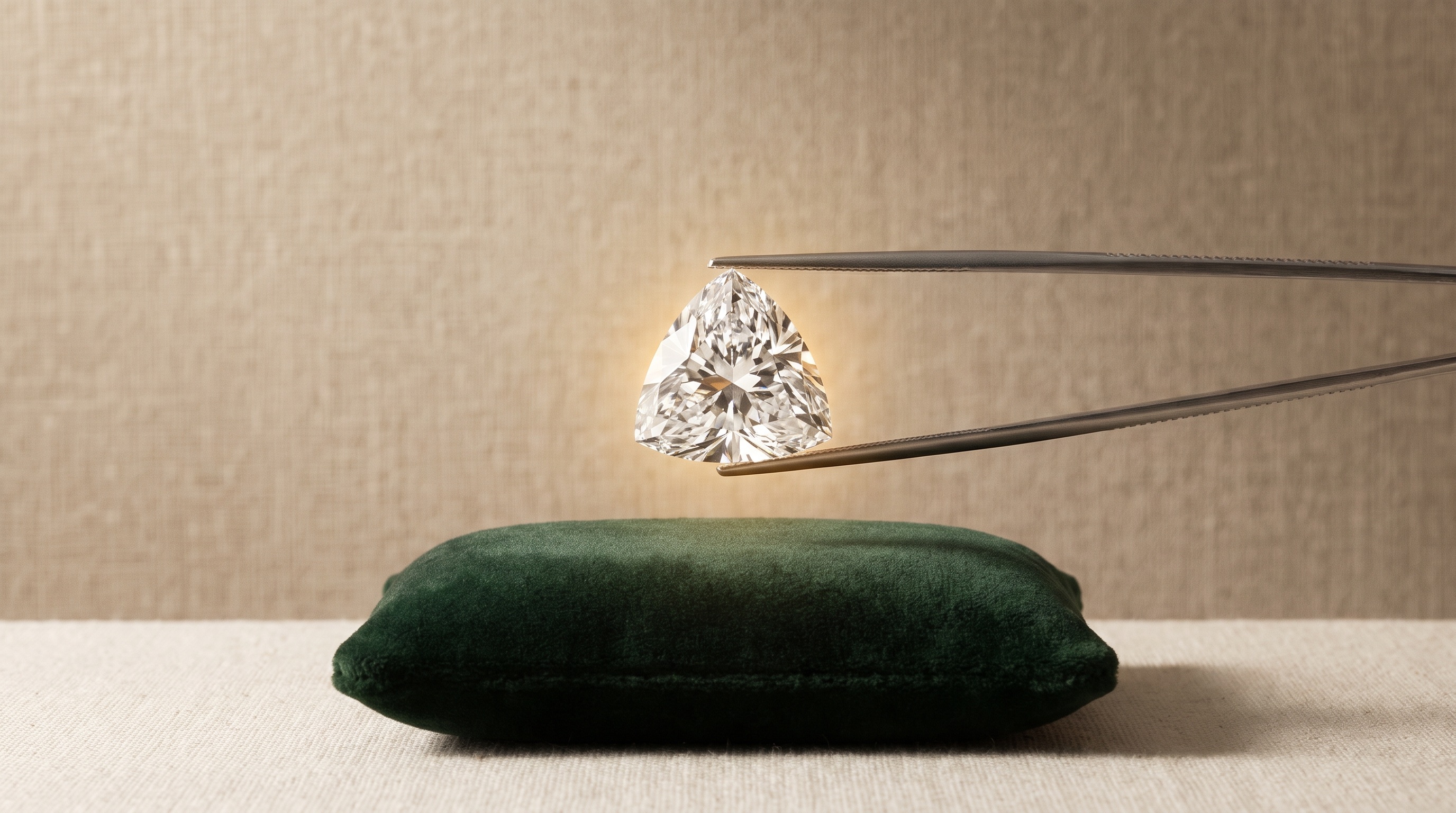
A trilliant cut diamond has a triangular outline — three sides, three points — cut with a brilliant facet pattern (kite- and triangle-shaped facets radiating from the culet, similar in spirit to a round brilliant's facet logic but arranged for a triangular outline). The sides can be cut straight, giving a crisper, more geometric triangle, or gently curved (convex), which is the more common modern treatment and produces a softer outline that resists chipping at the points better than a perfectly straight-sided triangle does. The curved-side version is what most buyers and most trade inventory refer to simply as "trilliant" today.
Trilliant vs. Trillion: Is There a Real Difference?
Historically, "Trillion" was a specific patented cut name (originating from a 1962 Amsterdam design, with a later trademarked refinement), while "trilliant" emerged as a more generic trade term for triangular brilliant-cut stones generally. In practice today, the patent protections have long since lapsed and the terms are used interchangeably across most of the trade — a buyer asking for a "trillion cut diamond" and a buyer asking for a "trilliant cut diamond" are, in the overwhelming majority of cases, describing the same category of stone. The one place a technical distinction sometimes still gets drawn is in very precise antique-cut sourcing, where "trillion" may specifically denote a straighter-sided, more angular historical faceting style and "trilliant" the more common modern curved-side version — but this distinction is not standardized industry-wide, and a buyer should always confirm the exact faceting style wanted with reference photos rather than relying on the name alone.
Trilliant as an Antique-Style Cut
Trillion sits within Guru Diam's antique cut tier alongside Old Mine, Old European, Hexagonal, Moval, Lozenge, Kite, Criss-Cut, and Padparadscha cuts — the premium category built around cuts that require specialized faceting knowledge and that carry meaningfully thinner inventory than standard modern shapes like round, princess, or oval. This antique-tier positioning matters for buyers: a trilliant-cut stone isn't priced or sourced the same way a common modern fancy shape is, and a supplier's depth of trilliant inventory is a reasonable proxy for how seriously they invest in antique-cut sourcing generally.
How a Trilliant Is Faceted
A well-cut trilliant typically carries somewhere between 31 and 50 facets depending on the exact style, arranged to bounce light back through the crown the way a round brilliant does, rather than pooling it in long step-cut planes the way an emerald or Asscher cut does. The three points are the structural weak spots of the shape — thin, acute angles that concentrate stress — which is why quality cutting and, later, protective prong or bezel placement at the points matter more for a trilliant than for shapes without sharp corners.
Trilliant Cut Diamond Grading: What Changes vs. Round Brilliant
The 4Cs still apply to a trilliant — carat, color, clarity, and cut — but cut grading works differently than the standardized Excellent-to-Poor scale major labs apply to round brilliants. Fancy shapes including trilliant don't receive a formal cut grade from GIA in the same structured way round brilliants do; instead, a report will describe proportions and finish (polish and symmetry) without an overall cut grade, which means buyers evaluating trilliant cut quality need to rely more on visual inspection — brilliance, symmetry between the three points, and evenness of the outline — than on a single graded number.
| Attribute | Round Brilliant | Trilliant Cut |
|---|---|---|
| Overall cut grade on report | Formally graded (Excellent–Poor) | Not formally graded; proportions/finish described instead |
| Facet count (typical) | 57–58 | 31–50 depending on style |
| Vulnerable points | None (no sharp corners) | Three points require protective setting |
| Common use | Center stone | Side stone most often; occasional center stone |
| Relative inventory depth | Deepest of any shape | Thin; antique-tier sourcing |
Trilliant as a Side Stone: The Most Common Use Case
The trilliant's most common role in finished jewelry is as a pair of side stones flanking a larger center stone in a three-stone ring, chosen specifically because the triangular shape's straight inner edge can sit flush against a round, cushion, or oval center stone in a way that a round or pear side stone can't match as cleanly. Matching a pair of trilliants for a three-stone setting requires close attention to size, angle, and color/clarity consistency between the two stones, since any mismatch is highly visible in a side-by-side pairing at eye level.
Trilliant as a Center Stone
Used less often as a center stone, a trilliant reads as a distinctive, geometric, statement choice rather than a traditional bridal center — appealing to designers and buyers building a genuinely antique-inspired or Art Deco-style piece rather than a conventional engagement ring silhouette. Setting a trilliant as a center stone requires more deliberate prong or bezel placement at the three points than a round or oval center does, since there's no rounded edge anywhere on the stone to distribute pressure evenly.
Natural vs. Lab-Grown Trilliant Diamonds
Trilliant cut diamonds are available in both natural and CVD lab-grown material, and the choice between them follows the same broader tradeoffs as any other shape: lab-grown offers a substantially lower per-carat cost at comparable color and clarity, while natural carries the rarity and provenance positioning some buyers and their retail customers specifically want. Because trilliant is a lower-volume shape overall, inventory depth in either material is thinner than for round or oval, which makes advance sourcing and lead-time planning more important than it would be for a common shape.
Pricing Considerations for Trilliant Cut Diamonds
Trilliant cut diamonds generally price at a premium per carat relative to round brilliant of the same weight and quality, reflecting both the specialized cutting skill required and higher rough or grown-crystal loss during faceting compared to a round brilliant's more efficient yield. Matched pairs for three-stone settings carry an additional premium over two individually sourced trilliants of similar spec, because true matching — size, angle, color, and clarity all aligned — takes more sourcing effort than pulling two unrelated stones from inventory.
What to Check Before Buying Trilliant Cut Diamonds Wholesale
Beyond the standard 4Cs, a buyer sourcing trilliant cut diamonds should specifically check point protection (how sharp and thin the three points are relative to the stone's overall proportions, since overly thin points are more prone to chipping during setting or wear), outline symmetry (whether the three sides and angles are genuinely even rather than visibly lopsided), and — for a matched pair — that both stones share the same angle and length-to-width ratio, not just similar carat weight.
Common Buyer Mistakes With Trilliant Cut Diamonds
The most common mistake is assuming "trilliant" and "trillion" name a meaningfully different product and shopping the two terms separately, which can unnecessarily narrow a search and miss relevant inventory listed under the other name. A second common mistake is treating trilliant like a standard modern shape with deep, always-available inventory, when in practice — especially for larger carat weights or natural material — sourcing may require more lead time than a round or oval order. A third is underestimating how visible a mismatched trilliant side-stone pair is once set, which argues for buying pairs together from a single matched lot rather than assembling two stones independently.
The History Behind the Trilliant Cut
The triangular brilliant-cut diamond traces back to a cut developed in Amsterdam in the early 1960s, which was patented and licensed under the "Trillion" name in North America starting in the early 1970s by a jewelry manufacturing company that controlled the trademark for a period. As the specific patent and trademark protections lapsed over subsequent decades, the shape spread more broadly across the trade under a mix of names — trillion, trilliant, and occasionally trigon or trillian — with cutters in different regions developing their own variations on facet count and side curvature. Today the shape sits alongside other true antique-style cuts precisely because so few modern cutters maintain deep expertise in getting the three-point symmetry and light performance right, which is the same skill gap that keeps Old Mine, Old European, and Kite cut inventory thin relative to standard modern shapes.
Straight-Sided vs. Curved-Sided Trilliant: A Closer Look
The straight-sided version reads as a crisper, more purely geometric triangle and tends to show a distinctive "bowtie" light-and-dark pattern across the table, similar in concept to the bowtie effect seen in marquise and pear shapes, caused by the way light travels through the elongated central facets. The curved-sided (convex) version softens that geometric read, distributes stress more evenly across the perimeter rather than concentrating it purely at the three points, and is generally considered more durable for everyday wear in a ring setting. Most current wholesale inventory, including Guru Diam's, defaults to the curved-sided style unless a buyer specifically requests the straighter, more historically literal antique treatment.
Matching a Trilliant Pair: What Actually Goes Wrong
Beyond carat weight and color/clarity, three specific mismatches account for most of the visible problems in a poorly matched trilliant side-stone pair: a difference in the crown angle that makes one stone appear brighter or duller than its twin under the same light; a length-to-width ratio mismatch that makes one triangle look squatter or more elongated than the other even at identical carat weight; and inconsistent point trimming, where one stone's three points are cut noticeably sharper or more blunted than the other's. None of these show up clearly on a spec sheet listing only carat, color, and clarity, which is why buying a matched trilliant pair from a single lot examined together — rather than assembling two independently sourced stones that happen to share a carat weight — meaningfully reduces the risk of a visibly mismatched pair reaching a finished ring.
Trilliant Cut Diamonds in Fancy Colors
Trilliant is cut in fancy color stones as well as colorless material, most often in yellow given how well a warm fancy color plays against the shape's geometric brilliance, though it can also be cut in pink, blue, or green where supply allows. Fancy color trilliant is a genuinely thin niche within an already-thin shape category, and buyers looking for a fancy color trilliant — especially a matched pair — should expect longer sourcing lead times than for a colorless trilliant of the same carat weight.
Alternatives to Consider Alongside Trilliant
Buyers drawn to a trilliant for its geometric, antique-adjacent look but concerned about point durability or sourcing lead time sometimes consider Kite cut or Half-Moon shapes as related alternatives for side-stone placement, since both share the antique-tier sourcing profile and a similarly distinctive silhouette without the trilliant's three sharp points. For a center-stone application specifically, a Criss-Cut or an Old Mine cut can deliver a comparably antique-inspired statement with a more forgiving setting profile for everyday wear.
Sourcing Trilliant Cut Diamonds Through Guru Diam
Guru Diam carries trilliant cut diamonds within its antique cut range, alongside Old Mine, Old European, Hexagonal, Moval, Lozenge, Kite, Criss-Cut, and Padparadscha cuts, in both natural and CVD lab-grown material with IGI, GIA, or GCAL certification depending on the stone. Matched trilliant pairs for three-stone settings can be sourced together to guarantee consistency across both stones, and same-day shipping applies to in-stock inventory ordered before 6pm EST from New York or 4pm PST from Los Angeles. For a custom three-stone or trilliant-center design, Guru Diam's custom engagement ring program finishes in 4–6 days once stones are selected.
Caring for a Trilliant Cut Diamond in a Finished Piece
Because the three points are the shape's structural weak spot, a trilliant set in a ring benefits from periodic prong inspection more than a round or oval stone would — a loosened or worn prong at a point is a higher-risk scenario for chipping than the same wear at a rounded edge. Retail buyers should be advised to have a trilliant-set ring's prongs checked at routine cleaning and inspection visits, and jewelers stocking trilliant-set pieces should factor slightly more careful handling into transit and display than they would for a round-stone equivalent. This isn't a reason to avoid the shape — trilliants are cut and worn successfully every day — but it is a genuine point of difference worth setting buyer expectations around at the point of sale.
Trilliant Cut Diamonds and Resale Considerations
Because trilliant is a lower-volume shape with a smaller pool of active buyers relative to round, oval, or cushion, resale liquidity for a trilliant-cut stone is generally lower than for the most common modern shapes — a factor worth mentioning to a retail customer who raises resale or investment considerations, consistent with the honest, non-promotional framing that applies to diamond value generally. This doesn't affect a trilliant's suitability as a design choice; it's simply a market-liquidity fact that a jeweler should be prepared to answer honestly if asked, the same way any less common shape carries a similar caveat.
Working With a Designer on a Trilliant Piece
A designer sketching a trilliant-forward piece should confirm sourcing timeline and matched-pair availability before finalizing a design for a specific stone count, since a design that assumes a matched pair will be readily available on a short turnaround can stall if the exact size and quality combination needed isn't in current stock. Building a small amount of flexibility into the design — a slightly adjustable prong basket that can accommodate a small range of trilliant sizes rather than one exact millimeter measurement — gives a jeweler more room to work with whatever matched pair is actually available at the time of sourcing, rather than requiring a custom-cut pair that extends the project timeline considerably.
Frequently Asked Questions
Is a trilliant cut diamond the same as a trillion cut diamond?
In the overwhelming majority of trade usage, yes — the terms describe the same family of triangular brilliant-cut diamond and are used interchangeably. A small number of sourcing contexts draw a finer historical distinction between straighter-sided "trillion" and curved-sided "trilliant," but this isn't standardized, so always confirm the exact faceting style with reference photos.
What is a trilliant cut diamond used for?
Most commonly it's used as a matched pair of side stones flanking a larger center stone in a three-stone ring, chosen because its straight inner edge fits cleanly against round, cushion, or oval centers. It's also used, less commonly, as a distinctive geometric center stone in Art Deco-inspired designs.
Are trilliant cut diamonds more expensive than round diamonds?
Generally yes, per carat, at comparable color and clarity — trilliant cutting requires more specialized skill and loses more material to faceting than the highly efficient round brilliant cut, and inventory is significantly thinner.
Can you get a lab-grown trilliant cut diamond?
Yes. Trilliant cut is available in both natural and CVD lab-grown material, with the same general cost and rarity tradeoffs that apply between natural and lab-grown in any shape.
How many facets does a trilliant cut diamond have?
Typically between 31 and 50 facets depending on the specific faceting style, arranged in a brilliant-cut pattern designed to maximize light return through the triangular outline.
Why are the points on a trilliant cut diamond a concern?
The three points are thin, acute angles that concentrate stress more than a rounded or gently angled shape does, making them more vulnerable to chipping. Careful cutting and protective prong or bezel placement at the points during setting both matter more for a trilliant than for shapes without sharp corners.
Does a trilliant cut diamond have good sparkle?
Yes — its brilliant facet arrangement is specifically designed for light return, so a well-cut trilliant shows strong brilliance and fire, comparable in character to a round brilliant rather than the flash-and-flatness pattern of a step-cut shape like emerald or Asscher.
How to Photograph and Merchandise Trilliant Cut Pieces
Because the trilliant's brilliance and outline symmetry are its main selling points, product photography and case merchandising should emphasize a straight-on top view that shows the full triangular outline and facet pattern clearly, rather than an angled view that can make the shape read as an irregular pear or shield to an unfamiliar shopper. For a three-stone piece, showing the full assembly — center stone plus both matched trilliant side stones — from a single consistent angle helps a retail customer actually see the pairing quality that a jeweler paid a premium to source, rather than losing that detail in a cropped or angled product shot. Case cards and online listings for trilliant pieces also benefit from a short explanatory line about the shape, since it's unfamiliar enough to many shoppers that a plain "trilliant cut" label without context can read as a typo for "brilliant cut" rather than a distinct shape name.
Related Reading
For more on Guru Diam's antique cut range, see the guides to Old Mine cut, Old European cut, and trapezoid diamond side stones. Learn more about the full range of diamond cut styles or how to plan a three-stone engagement ring setting.
Browse Guru Diam's certified diamonds and matching pairs, or learn about our trade partner program and custom jewelry services.