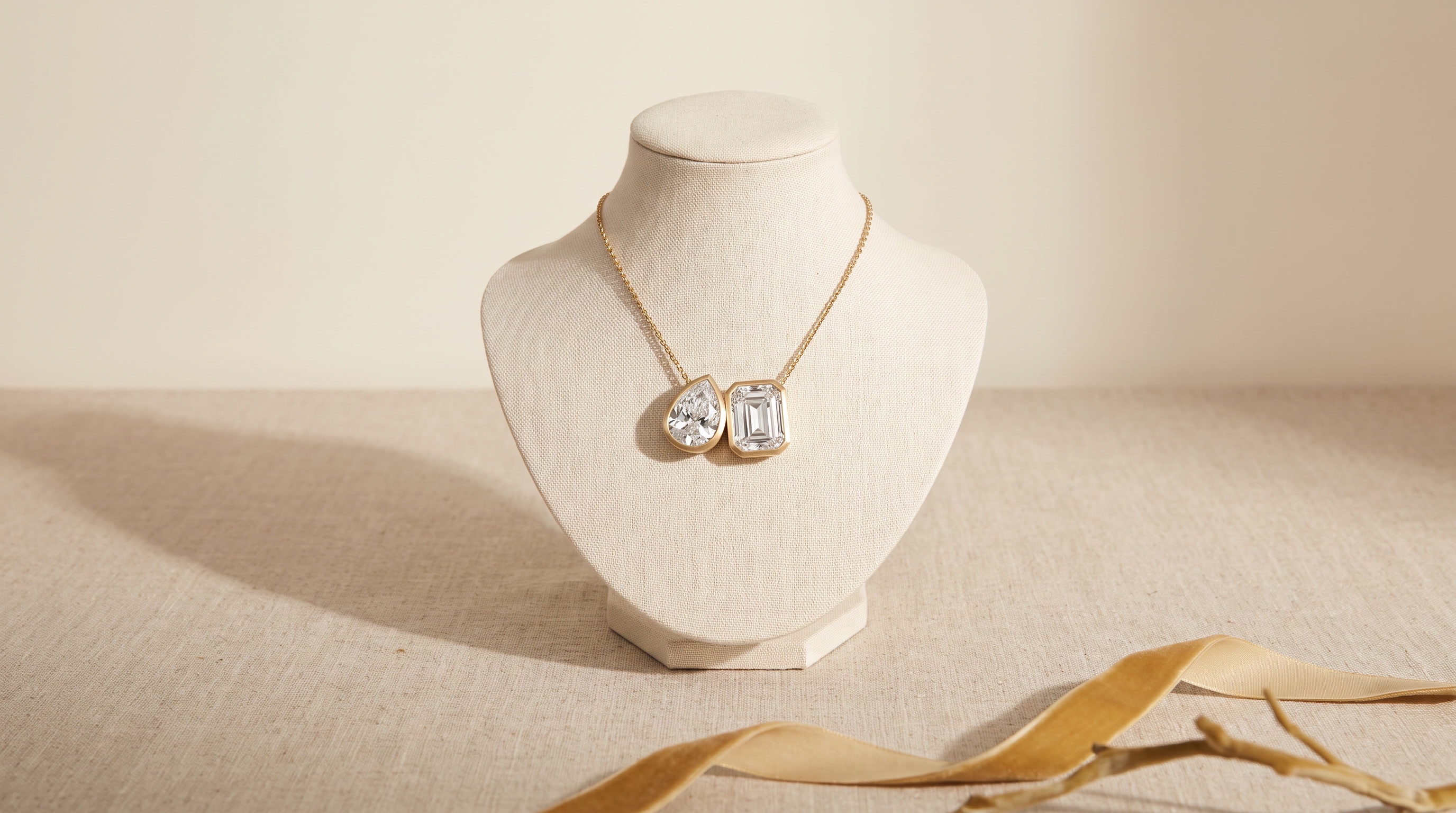
A toi et moi necklace ("you and me" in French) suspends two gemstones — historically two diamonds, though modern versions frequently pair a diamond with a colored stone — side by side or slightly crossed at a pendant's center, symbolizing two people or two elements joined together. For a jeweler, the category is a two-stone matching and pairing problem rather than a single-stone sourcing task, since the visual impact of the piece depends heavily on how well the two stones read together in size, shape, and color relationship.
This guide is written for the trade — jewelers, designers, and manufacturers sourcing loose diamonds and gemstones to build toi et moi necklaces for their own retail or private-label lines. It covers stone pairing strategy, common design formats, setting approaches, and what to ask a wholesale supplier before placing an order in this category.
What Makes Toi et Moi a Distinct Sourcing Category
Unlike a solitaire pendant, where a single stone's individual quality is the entire story, a toi et moi design lives or dies on how convincingly the two stones relate to each other visually. That means a jeweler sourcing for this category needs either two closely matched diamonds (same or near-identical size, shape, and color grade) for a classic diamond-diamond toi et moi, or a deliberately chosen diamond-and-colored-stone pairing where the contrast itself is the design's point. Both approaches require a different sourcing conversation with a supplier than a standard single-stone order.
The Two Main Toi et Moi Formats
Matched Diamond Pair
The traditional format pairs two diamonds of the same or very similar carat weight, cut, and color/clarity grade, set to sit beside or slightly overlapping each other. Because both stones are visible simultaneously and directly beside each other, mismatches that would be unnoticeable in separate pieces — a faint color difference, a slightly different cut proportion — become far more obvious here, making this the more demanding matching task of the two formats.
Diamond and Colored Stone Pairing
The more common modern interpretation pairs a diamond with a colored gemstone (sapphire, emerald, ruby, or a fancy color diamond), leaning into contrast rather than uniformity. This format is generally more forgiving to source since the two stones aren't being judged against each other on the same grading scale, but it introduces a different sourcing challenge: making sure carat weight and stone proportions between the two feel intentionally balanced rather than mismatched by accident.
Stone Pairing Considerations by Format
| Consideration | Matched Diamond Pair | Diamond + Colored Stone |
|---|---|---|
| Color matching priority | Critical — visible side by side | Lower — contrast is the point |
| Carat weight balance | Should be near-identical | Can vary; visual weight matters more than exact carat match |
| Shape pairing | Usually identical shape | Often mixed (round diamond + oval sapphire, for example) |
| Certification approach | Both stones typically certified individually at 0.30ct+ | Diamond certified individually; colored stone certification varies by lab and stone type |
Common Toi et Moi Necklace Styles
Beyond the classic two-stone pendant, the format extends into a floating "sisters" pendant where the two stones hang independently on the same chain rather than touching in a single setting, a crossover pendant where the two stones' settings physically overlap at an angle, and a three-stone variation (sometimes still marketed under the toi et moi name, though technically distinct) that adds a smaller accent stone between the two main stones. Each variation changes the setting engineering somewhat, but the core sourcing task — pairing two stones that read intentionally together — stays the same across all of them.
Setting Approaches
Shared Bail / Single Point of Connection
Both stones are set into a single connected mounting that shares one bail or connection point to the chain, keeping the two stones close together and visually unified as one pendant.
Independent Floating Settings
Each stone is set into its own small bezel or prong mount and threaded separately onto the chain, letting the two stones move and catch light independently rather than being rigidly fixed relative to each other.
Crossover / Interlocking Setting
The two stone settings are joined at an angle so the pieces visually cross or overlap slightly, a more structurally complex build that requires more precise metalwork than a simple shared-bail design.
Carat Weight and Sizing Guidance
Toi et moi necklaces are produced across a wide carat range depending on price point — entry pieces commonly pair two stones in the 0.10-0.25ct range each, while statement pieces can pair center stones of 0.50ct or more each. A jeweler building a line across price tiers should plan sourcing so that the size relationship between the two stones stays visually proportionate at every tier, rather than scaling one stone up while leaving the other at entry size, which reads as an error rather than an intentional design choice.
Natural vs. Lab-Grown Diamonds for This Category
Both natural and CVD lab-grown diamonds work for toi et moi pieces and look identical once set, but lab-grown material gives a jeweler more room to size up the diamond side of the pairing without proportionally increasing the piece's total cost — useful specifically in this category, where visual balance between the two stones often calls for a larger diamond than a natural-stone budget would otherwise support. For a diamond-and-colored-stone pairing specifically, sourcing the diamond and the colored stone are typically two separate supplier relationships, since few wholesale suppliers carry deep inventory in both categories at the certification and quality level a matched pairing calls for.
What to Ask a Supplier When Sourcing for This Category
- Can the supplier provide two diamonds matched specifically to each other (not just two stones meeting the same general spec independently), for a matched diamond-pair design?
- What's the shape and size range available as consistently matched pairs, rather than needing to hand-select from mixed general inventory?
- Is certification available on both stones individually, and does the supplier's paperwork make clear which certificate belongs to which stone in the finished piece?
- Can the supplier reliably reorder a matching pair to the same specification if the design becomes a standing retail item?
Certification for Toi et Moi Pieces
Diamonds at 0.30ct and above used in a toi et moi design are typically individually certified through IGI, GIA, or GCAL, with both stones in a matched pair carrying their own separate certificate even when sold and set as a pair. A retailer selling the finished piece should be able to present both certificates to a customer, since a toi et moi's appeal rests partly on the buyer understanding exactly what each of the two stones is — particularly in a diamond-and-colored-stone pairing, where a customer may want independent verification of the colored stone's origin and treatment status as well.
Pricing a Toi et Moi Necklace for Retail
Pricing this category requires accounting for two stones plus a setting that's typically more labor-intensive than a single-stone pendant mount, since aligning and securing two settings relative to each other takes more bench time than mounting one stone. A jeweler quoting a custom toi et moi commission should price the setting labor separately from stone cost rather than assuming it scales the same way a single-stone pendant would, since the alignment and finishing work genuinely does take longer per piece.
The History and Symbolism Behind the Format
The toi et moi ring format dates back to 18th-century France and gained enormous visibility when Napoleon commissioned one for Joséphine de Beauharnais, pairing a diamond and a sapphire — a moment widely credited with popularizing the two-stone symbolic format in the first place. The necklace adaptation is a more recent extension of the same idea, carrying the same "two elements, one piece" symbolism into a category with more room for design variation than a ring's fixed band format allows, which is part of why the pendant version has room for the floating and crossover styles a ring format can't easily support.
Merchandising Toi et Moi as a Gifting Category
Because the format's symbolism reads clearly (two stones representing two people or two connected ideas), retailers can merchandise it directly around anniversary, partnership, and milestone-gifting occasions without needing to explain the design's meaning at length — the visual format tells its own story. This makes toi et moi necklaces a natural complement to an existing bridal or anniversary jewelry line, since the same customer base shopping for engagement or anniversary pieces is a reasonable audience for a symbolically matched two-stone pendant as well.
Adjustable Spacing and Chain Length Options
Some toi et moi necklace designs allow the two stones to be spaced along an adjustable slider mechanism rather than fixed at a set point on the chain, giving a customer the option to wear the piece with the stones close together or spread further apart along the neckline. This adds a small amount of manufacturing complexity — the slider mechanism has to be built to hold position securely without slipping during normal wear — but gives a retailer a genuine styling-flexibility selling point that a fixed-position design can't offer. Chain length itself typically runs shorter than a standard pendant chain (16-18 inches) so the two-stone motif sits visibly at the collarbone rather than lower on the chest, though an 18-20 inch option is worth stocking alongside the shorter length for customers with a different preferred neckline.
Chain and Metal Considerations
Because a toi et moi pendant is typically a focal piece rather than a subtle accent, chain choice matters more than it does for some other pendant categories — a chain that's too delicate can visually compete poorly against two stone settings, while one that's too heavy can overwhelm a smaller-carat pairing. Metal tone (white, yellow, or rose gold, or platinum) should generally match or deliberately complement both stones' settings rather than being chosen independently, since a mismatched metal tone between the two stone settings is one of the more common visible errors in a poorly executed toi et moi build. A jeweler stocking this category across multiple metal tones should keep the chain length and clasp style consistent across the line, so metal tone is the only real variable a customer is choosing between when comparing options side by side.
Comparing Toi et Moi to Other Two-Stone Formats
| Format | Stone Relationship | Typical Sourcing Complexity |
|---|---|---|
| Toi et moi | Two stones, side by side or crossed, equal visual weight | Moderate to high — matching or intentional pairing required |
| Diamond crossover ring | Two stone lines or accents crossing at an angle | Moderate — melee matching plus setting alignment |
| Halo pendant | One center stone, melee surround | Lower — melee is supporting, not co-equal |
Why the Toi et Moi Format Has Resurged in Retail Demand
The toi et moi format saw a significant resurgence in consumer visibility after several widely publicized celebrity engagement rings used the two-stone design, which pulled the format out of a relatively niche antique-jewelry-collector audience and into mainstream bridal and gifting conversation. Necklace and pendant versions followed the same demand curve shortly after, since the format's symbolism translates naturally from a ring to a pendant without losing its meaning, and a necklace carries a lower price barrier to entry than a ring for a customer who wants to try the two-stone look without committing to an engagement piece. Retailers who already stock toi et moi rings have a natural, low-friction opportunity to extend the same design language into a necklace line for customers drawn to the symbolism but not currently shopping for a ring.
Common Mistakes When Sourcing a Matched Pair
The most frequent sourcing mistake in this category is ordering two stones that independently meet the same stated grade (say, two 0.50ct F/VS1 rounds) without confirming the supplier actually paired them against each other for face-up appearance, since two stones can carry identical paper grades while still looking subtly different side by side due to fluorescence, cut proportion variance within the same grade, or minor body-color differences that a grading report doesn't fully capture. A second common mistake is finalizing the setting design before both stones are in hand, which risks a setting built to a spec that doesn't quite match what the matched pair actually looks like once placed together. Confirming a physical, side-by-side review of the matched pair before finalizing setting production avoids both problems and is a standard best practice worth insisting on with any new supplier relationship for this category.
Building a Toi et Moi Line Across Price Tiers
A well-planned toi et moi line typically spans an accessible entry tier (small matched diamonds or a modest diamond-and-colored-stone pairing), a mid-tier with larger stones and a more structurally interesting setting, and a top tier featuring a larger certified diamond pair or a diamond paired with a fine, independently certified colored stone. Sourcing across tiers from a single supplier relationship — where possible — simplifies quality consistency and reorder logistics compared to sourcing each tier's stones from a different vendor.
Extending the Toi et Moi Concept to Earrings and Bracelets
The two-stone pairing concept behind toi et moi necklaces extends naturally into other categories — toi et moi stud or drop earrings pair two stones within a single earring rather than across a pair, and toi et moi bracelets typically feature the two-stone motif as a central station along an otherwise plain band. Sourcing logic carries over directly: a jeweler who has already worked out a reliable matched-pair sourcing relationship for necklaces can extend the same supplier conversation to these adjacent categories without renegotiating matching standards from scratch, since the core requirement — two stones that read intentionally together — doesn't change between a pendant, an earring, and a bracelet station.
Photographing and Merchandising a Toi et Moi Piece
Because the format's entire appeal depends on the visual relationship between the two stones, product photography for this category benefits from an angle that clearly shows both stones and their spacing relative to each other, rather than the closer single-stone macro crop that works for a solitaire pendant. Retailers merchandising toi et moi pieces in-store should likewise present them on a display that keeps both stones visible and well-lit simultaneously, since a display angle that partially obscures one stone undercuts the entire symbolic point of the design in a way it wouldn't for a single-stone piece.
Sourcing Toi et Moi Diamonds Wholesale
Guru Diam supplies certified loose diamonds suited to matched-pair sourcing, including stones selected and paired specifically for two-stone designs like toi et moi necklaces, across both natural and CVD lab-grown material with IGI, GIA, and GCAL certification available. In-stock inventory ships same-day (before 6pm EST from New York, before 4pm PST from Los Angeles), and jewelers building a custom toi et moi commission can work directly with Guru Diam's custom jewelry team, which finishes custom pieces in 4-6 days. Trade accounts can browse matched-pair inventory at matching pairs or certified loose stones at certified diamonds, start a custom build at custom jewelry, and apply for a trade account through trade partner, with current program terms at the wholesale hub.
Frequently Asked Questions
What does toi et moi mean on a necklace?
Toi et moi means "you and me" in French and refers to a design that pairs two gemstones — traditionally two diamonds, though modern versions often pair a diamond with a colored stone — set side by side or crossed to symbolize two people or two connected elements.
Do both stones in a toi et moi necklace need to match?
It depends on the format. A classic matched-diamond-pair design needs both stones closely matched in size, shape, and color, while a diamond-and-colored-stone pairing leans into contrast rather than matching, so exact uniformity matters less.
Are toi et moi necklace stones individually certified?
Diamonds at 0.30ct and above are typically individually certified through IGI, GIA, or GCAL, with both stones in a matched pair carrying their own separate certificate even when sold and set together.
Can toi et moi necklaces use lab-grown diamonds?
Yes — CVD lab-grown diamonds look identical to natural stones once set and give a jeweler more flexibility to size up the diamond in a pairing without proportionally increasing total cost, which is useful for keeping the two stones visually balanced.
What's the difference between a toi et moi necklace and a crossover design?
A toi et moi necklace pairs two co-equal stones, often side by side, symbolizing two elements joined together. A crossover design more specifically refers to two stone lines or settings physically crossing at an angle, which can appear within a toi et moi piece or independently in other jewelry categories like rings.
What should I ask a supplier before sourcing a toi et moi commission?
Confirm whether the supplier can provide two stones matched specifically to each other rather than two stones that independently meet the same general spec, ask about available shape and size range as matched pairs, and confirm certification is available and clearly documented for both stones individually.
Why has demand for toi et moi jewelry grown recently?
Several widely publicized celebrity engagement rings used the two-stone toi et moi format, pulling it into mainstream bridal and gifting conversation. Necklace and pendant versions followed the same demand curve since the symbolism carries over naturally and the format offers a lower-price entry point than a ring.
Can a toi et moi necklace pair a diamond with a colored gemstone?
Yes — this is the more common modern interpretation, pairing a diamond with a sapphire, emerald, ruby, or fancy color diamond. Exact size and grade matching between the two stones matters less here than in a matched-diamond-pair design, since the contrast itself is the point.
Guru Diam is a trade-only wholesale diamond supplier with locations in New York and Los Angeles, supplying certified loose diamonds and matched pairs — natural and CVD lab-grown — for jewelers and manufacturers building toi et moi and other two-stone designs. Browse current matched-pair inventory at matching pairs or apply for a trade account through trade partner.