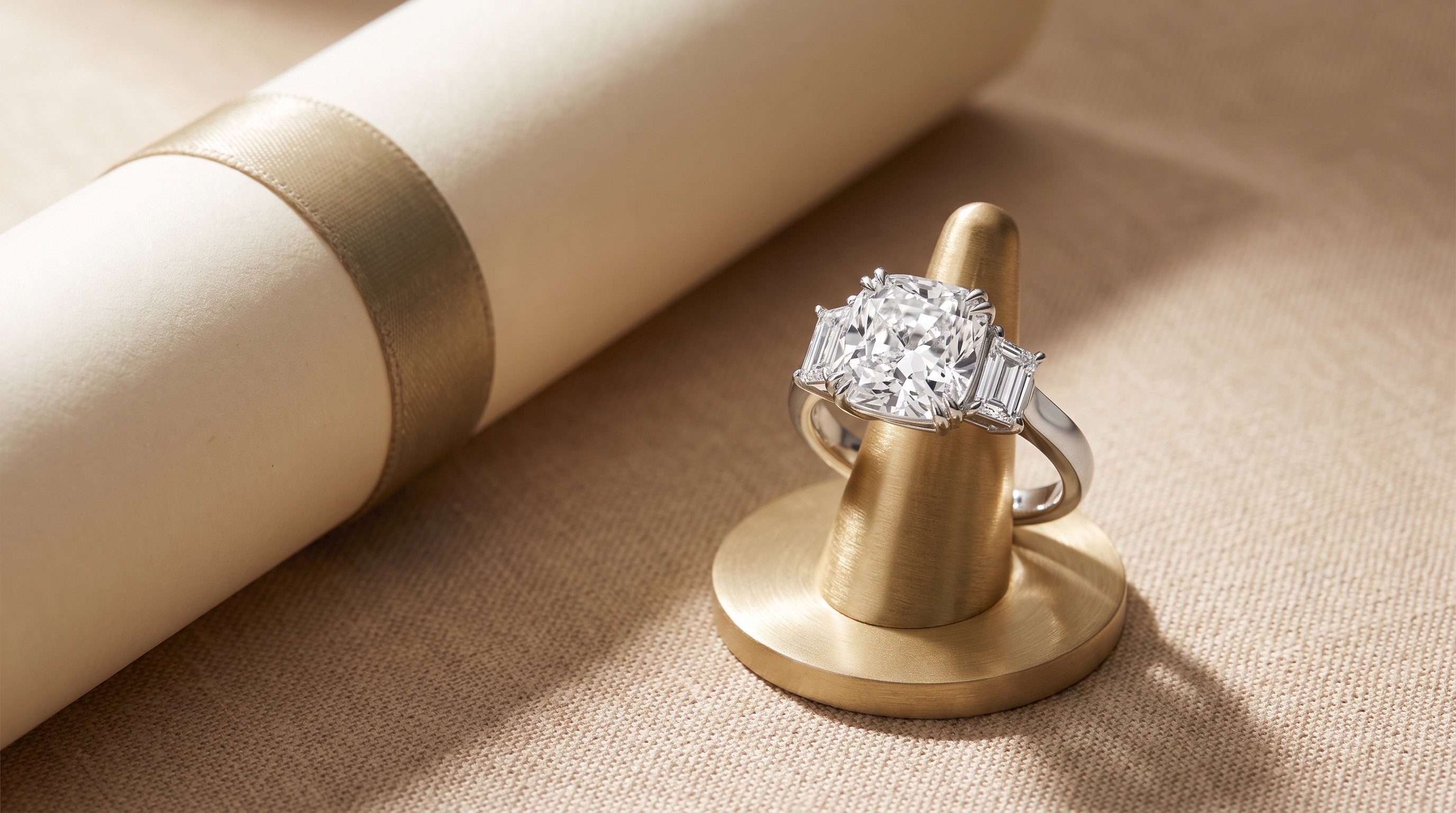
A three-stone setting is a ring design built around a center stone flanked by two smaller side stones, most commonly a matched pair set on either shoulder of the band. It's one of the oldest structured ring formats still in regular production, and its enduring popularity has as much to do with genuine design flexibility — center and side shapes, sizes, and construction methods can all be varied independently — as it does with the past-present-future symbolism usually attached to it.
What separates a well-built three-stone ring from a mediocre one isn't really the concept, which is simple, but the execution of details that don't always get covered together: how the side stones are actually mounted (prong, shared-prong, or bezel, each with real tradeoffs), how to choose side-stone shapes and sizes that complement rather than compete with the center stone, what matched-pair sourcing actually means and why it matters more here than in almost any other setting style, metal and durability considerations specific to a three-stone build, the variations worth knowing, and the mistakes that show up most often in three-stone orders. This guide covers all of it in depth, going well beyond the one-paragraph summary a general settings overview typically gives the style.
What Defines a Three-Stone Setting
Structurally, a three-stone setting is defined by exactly what the name says: one larger center stone plus two smaller stones, one on each side, mounted so that all three sit along the visual axis of the ring's face. That's a broader category than it might first sound — the center and side stones can share the same shape or contrast deliberately, the side stones can be set close against the center stone or with a small visible gap, and the mounting method for each side stone is an independent design choice rather than something fixed by the format itself.
Three-stone is sometimes confused with a couple of adjacent styles that look similar at a glance but are structurally distinct:
- Toi et moi setting. Two stones, no dominant center — the toi et moi format deliberately avoids the hierarchy that defines a three-stone ring, where the center stone is unambiguously the visual focal point and the side stones are secondary.
- Cluster setting. Multiple smaller stones grouped to mimic the appearance of one larger stone, rather than one clearly larger center stone with two distinct, individually visible side stones.
- Trilogy pendant or trilogy band styles. The three-stone concept extends beyond rings into pendants and anniversary bands, but this guide focuses specifically on the engagement-ring application, where the format originated and remains most common.
The Symbolism Behind Three-Stone Rings
The three-stone format is most widely associated with a past-present-future reading — the two side stones representing a couple's shared history and their hoped-for future, with the center stone representing the present moment of the engagement itself. That symbolism is genuinely old and widely referenced in jewelry marketing going back decades, but it's worth being straightforward about it: the meaning is an interpretation layered onto a design format, not a technical property of the ring, and plenty of buyers choose a three-stone setting purely for its visual balance and the way it makes a ring's front read as wider and more substantial for a given total carat weight, with the symbolism as a secondary or even incidental appeal. Some buyers also read the three stones as representing three people (a couple plus a child, for instance) or three phases of a relationship beyond the literal past-present-future framing. None of these readings is more "correct" than another — the format's flexibility of meaning is part of why it has stayed popular across very different eras of engagement ring design.
Anatomy of a Three-Stone Setting
| Component | Role |
|---|---|
| Center stone | The largest and visually dominant stone, typically set with its own dedicated prong head, basket, or bezel — usually the same shape family as the side stones but not required to be |
| Side stones (accent stones) | The two flanking stones, ideally a matched pair in shape, size, and quality — mounted independently of the center stone's head, using prong, shared-prong, or bezel construction depending on the design |
| Gallery rail / basket | The under-structure connecting the center stone's head to the side-stone mountings — its design affects how continuous or segmented the three stones appear from the side profile |
| Shoulders | The sections of the shank where the side stones sit, which can be plain, pavé-set, or carry additional detailing depending on the overall design |
| Shared or dividing prongs | Where a shared-prong construction is used, the prongs positioned between the center and side stones do double duty, holding both stones with a single prong rather than each stone getting its own full set |
Side-Stone Construction: Prong, Shared-Prong, and Bezel
How the side stones are actually mounted has a bigger effect on a three-stone ring's look, durability, and cost than most buyers realize going in, and it's a decision independent of shape or carat weight:
- Individual prong setting. Each side stone gets its own dedicated set of prongs, fully separate from the center stone's head. This gives each stone maximum light exposure and the cleanest, most classic three-stone look, with a small visible gap typically left between center and side stones. It's also the setting method that shows off a well-matched side-stone pair most clearly, since nothing obscures the direct visual comparison between the two.
- Shared-prong setting. A single prong sits between the center stone and each side stone, doing the job of securing both at once rather than each stone getting its own full prong count on that shared edge. This tightens the visual gap between stones, creating a more continuous, unbroken line across the ring's front, and uses marginally less metal — a genuine but modest cost and weight saving. The tradeoff is a slightly less flexible resizing and repair process, since a shared prong is structurally doing more work and a repair on one stone's mounting can affect the neighboring stone's security if not done carefully.
- Bezel setting for side stones. The side stones are wrapped in a thin metal rim rather than held by prongs, giving a smoother, lower-profile, more protected mount — a common choice for buyers who want the center stone's brilliance from an open prong or basket head, but want the side stones protected from snagging and chipping during daily wear. Bezel-set side stones read as slightly more modern and give up a small amount of light entry compared to fully open prongs, since more metal surrounds the stone's edge.
These three approaches aren't mutually exclusive within one ring — a common combination is a prong or basket-set center stone paired with bezel-set side stones, giving the ring's focal point maximum brilliance while the side stones get extra edge protection in a spot that sees more daily contact with the adjacent finger.
Three-Stone vs. Other Popular Setting Styles
| Setting Style | Visual Width | Symbolism | Side-Stone Sourcing Complexity | Best For |
|---|---|---|---|---|
| Three-stone | High — the widest-reading front of these three styles for a given center carat weight | Strong (past-present-future association) | Higher — requires a genuinely matched pair of side stones | Buyers who want a substantial ring front and value the symbolic framing |
| Halo | High, but achieved through a ring of small stones around the center rather than two larger flanking stones | None specific to the format | Moderate — many small melee stones, but matching is less visually critical per-stone than a two-stone pair | Buyers maximizing perceived carat size on a fixed budget |
| Solitaire | Low — narrowest front of the three, all visual weight on one stone | None specific to the format | None — single stone only | Buyers who want the center stone to be the ring's sole focal point |
Where a halo setting achieves visual width by surrounding the center stone with many small accent stones, and a solitaire deliberately avoids added width altogether, a three-stone setting sits in between structurally — two clearly visible, individually appreciable stones rather than a ring of melee or nothing at all. That structural difference is also why side-stone sourcing matters so much more here than for a halo: a halo's small melee stones read as a unified ring of sparkle even with minor variation between individual stones, but two larger, clearly visible side stones sitting directly beside each other on a three-stone ring will show any mismatch in size, color, or cut quality far more obviously.
Choosing Side-Stone Shapes and Sizes Relative to the Center Stone
Side-stone selection is arguably the single most consequential design decision in a three-stone build, more so than metal or even center-stone shape, because it's the one variable that's genuinely open-ended rather than following an obvious default. A few general principles guide most successful pairings:
- Matching shapes read as classic and cohesive. Round side stones with a round center, or trapezoid/tapered baguette side stones with an emerald-cut center, are the most common and lowest-risk pairing approach, since the shapes echo each other rather than compete visually.
- Contrasting shapes can work but require more deliberate design. Pairing an oval or pear center with trapezoid or half-moon side stones is a recognized combination that plays elongated and geometric shapes against each other, but it benefits from seeing a rendering or physical mockup before committing, since the visual balance is harder to predict than a matching-shape pairing.
- Side-stone size is typically 30-50% of the center stone's total carat weight, combined. This isn't a strict rule, but side stones sized dramatically larger than that tend to compete with the center stone for visual attention, while side stones sized much smaller can read as an afterthought rather than a deliberate design element. The right ratio also depends on shape — elongated side-stone shapes like baguettes can look proportionate at a smaller relative carat weight than round side stones would.
- Side-stone shape should account for how it frames the center stone's silhouette, not just its own individual appearance — a trapezoid, for instance, is specifically cut with an angled edge designed to nest against a step-cut center stone's corner, which a rectangular baguette doesn't do as cleanly.
| Center Stone Shape | Well-Paired Side-Stone Shapes | Why It Works |
|---|---|---|
| Round brilliant | Round, trapezoid, tapered baguette | Round side stones mirror the center's symmetry; trapezoids and tapered baguettes add a clean geometric contrast without fighting the round's curves |
| Oval | Half-moon, pear, trapezoid | Half-moon and pear shapes echo the oval's curved elongation; trapezoids provide a more angular counterpoint for buyers wanting contrast |
| Emerald / Asscher (step cuts) | Trapezoid, tapered baguette | Both are step-cut shapes designed to nest cleanly against a rectangular or square center stone's corners and facet pattern |
| Cushion | Half-moon, trapezoid, round | Cushion's rounded-corner square shape pairs flexibly with both curved and geometric side-stone options |
| Pear | Half-moon, trapezoid, marquise | Side stones that continue the pear's asymmetric taper toward the point create a more unified overall silhouette |
| Princess | Trapezoid, triangle, tapered baguette | Sharp-cornered geometric side stones reinforce rather than soften the princess cut's angular character |
Advantages of a Three-Stone Setting
- Substantial visual width for the total carat weight invested. A three-stone front reads as larger and more prominent across the finger than a single stone of equivalent total weight, since the visual mass is spread across a wider area rather than concentrated in one point.
- Genuine design flexibility. Shape, size ratio, and construction method for the side stones are all independently adjustable, which makes three-stone one of the more customizable formats for buyers who want a ring that isn't a stock template.
- Meaningful symbolism, if the buyer wants it. The past-present-future framing gives some buyers a genuine emotional hook that a solitaire or halo doesn't offer in the same way, though as covered above, plenty of buyers simply like the look and skip the symbolism entirely.
- A natural fit for stone reuse or family stones. Because the format has three distinct, individually meaningful positions, it's a common choice for incorporating an inherited or sentimental stone as one of the side stones alongside a newly sourced center stone.
- Anniversary upgrade potential. Some couples treat an initial three-stone ring as a starting point, later upgrading the center stone or side stones for an anniversary — the format lends itself to that kind of staged investment more naturally than a fixed halo or pavé design.
Drawbacks and Practical Considerations
- Side-stone matching is a real sourcing challenge. Because both side stones sit close together and are directly comparable to the eye, any mismatch in size, color, or cut quality between them is far more visually obvious than a similar mismatch would be in a halo's small melee stones — this is covered in more depth in the matched-pair sourcing section below.
- Higher total stone cost than a solitaire of the same visual impact. Three stones, even with side stones considerably smaller than the center, add real cost — buyers comparing a three-stone build against a solitaire on a fixed budget should expect a real tradeoff between center-stone size and the addition of side stones.
- More settings to maintain. Three separate stone mountings mean three sets of prongs (or a bezel plus two prong sets, depending on construction) to inspect and maintain over the ring's lifetime, rather than one.
- Resizing can be marginally more involved than a plain-shank solitaire, particularly with shared-prong construction, since the resizing work has to preserve the exact spacing and prong integrity across three connected stone positions rather than one.
- Shared-prong designs slightly reduce future flexibility. If a buyer later wants to swap or upgrade one side stone independently of the other, a shared-prong construction makes that a more involved repair than fully independent prong settings would.
Metal Choice and Durability
A three-stone setting's structural demands sit between a simple solitaire and a more elaborate style like a cathedral: three separate stone mountings need to be secured along the ring's front, which puts more cumulative prong-and-metal work into a smaller span than a single-stone design.
| Metal | Durability for Three-Stone Builds | Notes |
|---|---|---|
| Platinum | Excellent | Dense and resistant to metal loss over years of wear, a strong choice given the number of prong tips a three-stone design has to maintain across its lifetime; develops a matte patina some wearers prefer and others have re-polished |
| 18k white/yellow/rose gold | Very good | Common and versatile for three-stone builds; slightly softer than platinum, so shared-prong designs in particular benefit from confirming adequate prong gauge at the design stage |
| 14k gold | Good | Higher alloy content makes it more scratch- and bend-resistant day to day than 18k, a practical option for buyers prioritizing daily durability over marginally higher gold purity |
Regardless of metal, shared-prong three-stone designs in particular benefit from an explicit conversation with a jeweler about prong gauge before finishing — because a shared prong is doing double duty holding two adjacent stones, it carries more structural responsibility than a standard individual prong, and an undersized shared prong is one of the more common points of failure in an older three-stone ring that comes in for repair.
Matched-Pair Sourcing: Why Side-Stone Quality Matters
Side-stone sourcing deserves its own dedicated attention in a three-stone build, because it's structurally different from sourcing accent melee for a halo or pavé design. A halo's small stones are numerous enough that the eye reads them collectively, as an overall band of sparkle, and a single stone slightly off in size or color rarely stands out. A three-stone ring has exactly two side stones, positioned directly beside each other and directly comparable at a glance — which means any mismatch is immediately visible in a way a halo's melee never is.
A genuinely matched pair means the two side stones are aligned across several dimensions at once, not just carat weight:
- Size and proportions. Matched millimeter dimensions, not just matched carat weight — two stones can weigh the same but have visibly different face-up size if their proportions differ.
- Color grade. Even a one-grade difference in color between two side stones sitting a few millimeters apart is often visible to the naked eye under normal lighting, more so than the same one-grade gap would be between a center stone and a ring of distant halo melee.
- Clarity and cut quality. A pair where one stone is noticeably more brilliant than the other under the same light draws the eye toward the mismatch rather than the ring as a whole.
- Fluorescence, where relevant. Mismatched fluorescence between two side stones can cause one to appear slightly hazier or bluer than its pair under UV-heavy lighting, a subtler issue but one that's specifically a matched-pair concern rather than a single-stone grading question.
This is a genuine specialty within diamond sourcing, distinct from simply buying two individually well-graded stones — a jeweler or designer building a three-stone ring benefits from sourcing side stones specifically as a pre-matched pair rather than assembling two separately purchased stones and hoping they read as a set. Guru Diam's matching pairs category is built around exactly this need — side stones and other symmetrical pairings sourced and paired for consistency across size, color, and cut quality, rather than left to individual sourcing and comparison.
Common Three-Stone Variations Worth Knowing
The three-stone format covers more design ground than the basic concept suggests, and knowing the variations helps a buyer describe more precisely what they actually want:
- Classic matched three-stone. Center and side stones all share the same shape, with side stones roughly proportional in size to the center — the most traditional and lowest-risk version of the style.
- Contrast-shape three-stone. Deliberately different shapes for center versus side stones — a round or oval center with trapezoid or half-moon side stones is a common example — for buyers who want more visual distinction between the ring's elements.
- Graduated three-stone. Side stones sized noticeably smaller relative to the center than a standard proportion, emphasizing the center stone more strongly while still keeping the symbolic three-stone format.
- Bezel-accented three-stone. Bezel-set side stones paired with a prong or basket-set center, balancing brilliance on the focal stone with extra protection on the side stones, as covered in the construction section above.
- Vintage-inspired three-stone. Incorporates milgrain, filigree, or antique-cut side stones (Old Mine or Old European cuts, for instance) alongside a modern or antique-cut center stone, for buyers building a period-appropriate design.
- Toi et moi-adjacent hybrids. Some modern designs blur the line between a true three-stone ring and a toi et moi by using two near-equal side stones close in size to the center, intentionally softening the format's traditional visual hierarchy — worth flagging explicitly to a designer if that's the intended look, since it departs from the classic proportions covered earlier in this guide.
Common Mistakes Buyers Make When Choosing a Three-Stone Setting
- Treating side-stone sourcing as an afterthought. Because the center stone naturally gets most of the attention during the buying process, side stones sometimes get sourced late and separately, increasing the odds of a visible mismatch. Sourcing the side-stone pair alongside the center stone, or from a source that specializes in matched pairs, avoids this.
- Choosing side-stone size purely by budget rather than proportion. Side stones sized well outside the roughly 30-50% combined-weight range covered earlier can throw off the ring's visual balance in either direction — too large and they compete with the center stone, too small and they read as an afterthought rather than a deliberate design choice.
- Not deciding on construction method (prong, shared-prong, or bezel) before finalizing the design. Because this choice affects both appearance and future repair flexibility, as covered above, deciding on it early avoids having to revisit an otherwise-finished design.
- Overlooking wedding band pairing. A three-stone ring's wider front, especially with side stones set close to the shank's edge, can complicate flush pairing with a straight wedding band in the same way a raised or wide-profile setting does — this is worth raising with a jeweler at the design stage rather than after the engagement ring is finished, similar to the pairing considerations covered in our cathedral setting guide.
- Assuming symbolism requires a specific shape or metal. The past-present-future meaning attaches to the format itself, not to any particular shape, metal, or size combination — buyers sometimes over-constrain their design choices trying to preserve a "correct" symbolic version that doesn't actually exist as a fixed standard.
Sourcing Three-Stone Rings and Matched Side Stones
A three-stone build puts more weight on sourcing quality than most other setting styles, simply because there are three stones' worth of grading, matching, and construction decisions involved instead of one. Guru Diam supplies certified loose diamonds — natural and CVD lab-grown, with IGI, GIA, and GCAL certification all available — across the round, fancy, and antique shapes commonly used for both center and side stones in a three-stone build. Side-stone pairs sourced specifically for size, color, and cut consistency are available through the matching pairs category, which is the more relevant path for this style than sourcing two individual stones separately and hoping they read as a set. Buyers building a fancy-color three-stone piece, whether as a full fancy-color design or a fancy-color center with white side stones, can browse fancy color loose diamonds.
For jewelers and designers building three-stone pieces to order, the custom jewelry program handles construction in-house — including the prong, shared-prong, or bezel side-stone mounting decisions covered earlier — with custom engagement rings finished in 4-6 days. Center stones can be sourced through the certified diamonds category. Trade accounts can review terms at the wholesale hub or apply through trade partner. Buyers comparing a three-stone build against other setting styles before deciding may find our broader engagement ring settings guide useful, and buyers finalizing sizing on a custom three-stone build can check our ring size chart guide before production begins.
Frequently Asked Questions
What does a three-stone setting actually symbolize?
The most common reading is past, present, and future — the two side stones representing shared history and hoped-for future, with the center stone representing the present moment of engagement. That symbolism is a widely referenced interpretation rather than a fixed technical rule, and many buyers choose the style purely for its visual balance without attaching specific meaning to it.
How should side stones be sized relative to the center stone?
A common guideline is roughly 30-50% of the center stone's carat weight combined between the two side stones, though the right ratio also depends on side-stone shape — elongated shapes like baguettes can look proportionate at a smaller relative weight than round side stones. Side stones sized well outside that range risk either competing with the center stone or reading as an afterthought.
What's the difference between prong, shared-prong, and bezel side-stone settings?
Individual prong settings give each side stone its own dedicated prongs and the most open light exposure, with a small visible gap between stones. Shared-prong settings use one prong to secure both the center stone and an adjacent side stone, creating a tighter, more continuous look but with slightly less flexibility for future repairs. Bezel settings wrap the side stones in a metal rim for a smoother, more protected profile at a small cost to light entry.
Why does side-stone matching matter more for a three-stone ring than for a halo?
A halo surrounds the center stone with many small melee stones that read collectively, so minor variation between individual stones rarely stands out. A three-stone ring has only two side stones, positioned directly beside each other and directly comparable at a glance, so any mismatch in size, color, or cut quality is far more visible.
Can the center and side stones be different shapes?
Yes — contrast-shape pairings, such as a round or oval center with trapezoid or half-moon side stones, are a recognized and common three-stone variation. Matching shapes across all three stones is more traditional and generally lower-risk visually, but contrasting shapes are a legitimate design choice when planned deliberately.
Is a three-stone setting more expensive than a solitaire?
Generally yes, for equivalent visual impact, since a three-stone build involves the added cost of two side stones on top of the center stone. Buyers comparing the two styles on a fixed budget typically face a real tradeoff between a larger single center stone in a solitaire versus a smaller center stone plus side stones in a three-stone design.