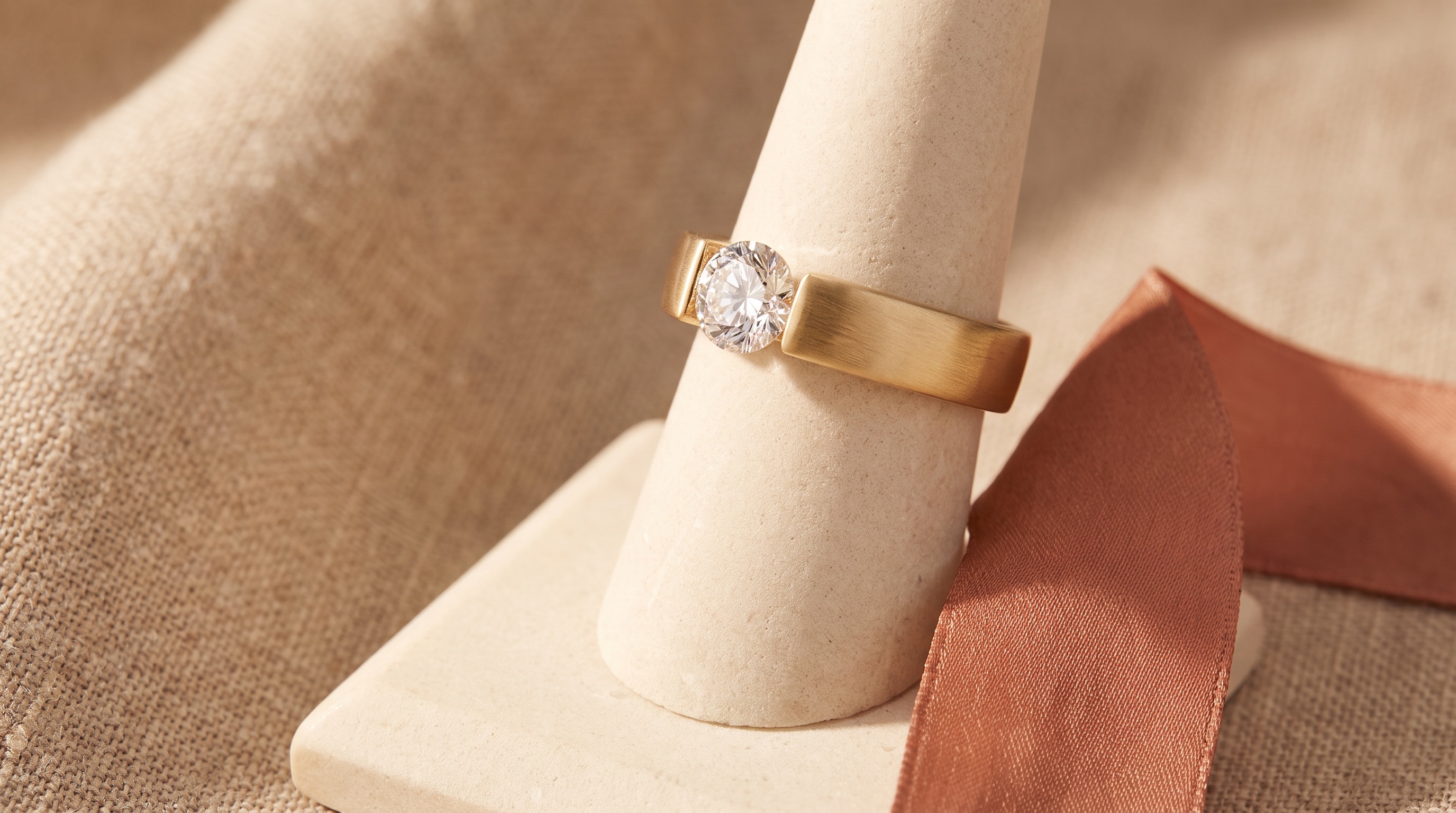
A tension setting ring holds its center stone using the spring-like pressure of the metal band itself, gripping the stone at two small points along its girdle with no visible prongs or bezel rim — creating the illusion that the diamond is floating in open air. The style depends on precise metal engineering to maintain consistent holding pressure over years of wear, which makes it one of the more structurally demanding settings to produce correctly, and generally requires platinum or another high-strength alloy rather than standard gold. It's one of the more technically demanding settings in modern jewelry-making, and getting it right matters more than with most other styles, since a poorly engineered tension mount is a genuine security risk rather than just a cosmetic shortcoming.
How a Tension Setting Actually Holds the Stone
Unlike every other common setting style, a tension setting has no independent metal structure gripping the stone from above or around it — instead, the ring band itself is cut, engineered, and calibrated so that its two ends squeeze the stone at small notches or grooves cut into the stone's girdle, using the metal's own spring tension as the sole holding force. Getting this right requires the metal to be strong enough to maintain consistent, unchanging pressure over years of temperature changes, impacts, and metal fatigue — too little pressure and the stone can shift or fall out, too much pressure applied incorrectly during fabrication risks fracturing the stone at the point of contact.
Why Tension Settings Require Specific Metals
Because the setting's entire holding mechanism depends on the metal's own spring-like structural memory, tension settings require a metal with both high strength and the ability to return reliably to its exact original shape after the small amount of flexing involved in wearing and normal impacts. Platinum is the standard choice for this reason — its combination of strength, density, and resistance to permanent deformation under repeated stress makes it far more reliable for a tension mechanism than gold, which is more prone to gradually deforming (and therefore loosening its grip) under the same sustained pressure over years of wear. High-karat, well-alloyed white gold can be engineered for tension settings by a specialist, but it's considered a less reliable long-term choice than platinum and isn't recommended for a stone the customer considers irreplaceable.
Which Diamond Shapes Work Best in a Tension Setting
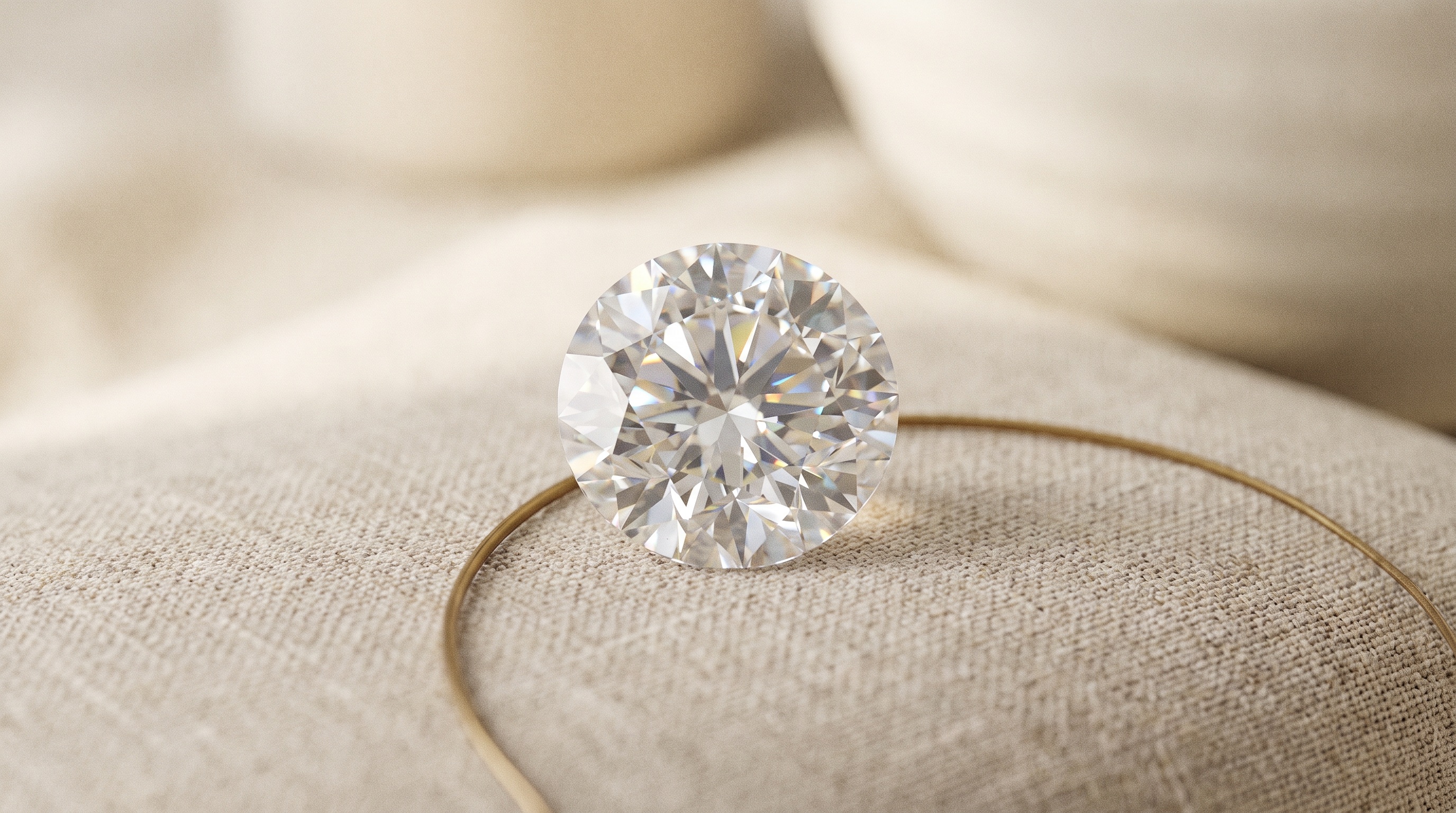
Round brilliant diamonds are the most common and most reliable choice for tension settings, since a round stone's girdle offers a consistent, symmetric surface for the two tension points to grip evenly. Princess and other angular shapes can be tension-set but require more specialized engineering to grip securely at the corners without concentrating stress at a single vulnerable point. Elongated shapes (oval, marquise, pear) are the most challenging to tension-set reliably, since their girdle shape doesn't offer the same even, symmetric gripping surface a round stone does — a jeweler experienced specifically in tension work should be consulted before committing to a tension setting for any shape beyond round or a simple square/princess outline.
Durability: The Real Tradeoffs
Tension settings are strikingly modern and maximize light entry to the stone from nearly every angle, since there's no prong or bezel rim blocking any part of the stone's crown or upper girdle. That openness comes at a real durability cost relative to more conventional settings: because the setting relies entirely on continuous metal pressure rather than a mechanical claw or enclosing rim, an impact strong enough to flex the band even briefly can, in rare cases, momentarily release enough pressure for the stone to shift or dislodge — a failure mode that essentially doesn't exist in a well-made prong or bezel setting. This is why tension settings are generally positioned to customers who understand and accept this tradeoff explicitly, rather than sold as a drop-in aesthetic alternative to a standard prong setting without that conversation.
Resizing a Tension Setting Ring
Resizing is the single most consequential practical limitation of a tension setting. Because the ring's holding mechanism depends on the band's exact engineered dimensions and spring properties, resizing a tension setting — which necessarily changes the band's circumference — risks altering the precise pressure calibration that holds the stone securely. Some tension designs can be resized within a narrow range by a specialist who re-calibrates the tension after resizing, but many jewelers recommend against resizing a tension setting at all beyond a very small adjustment, and any resizing must be done by someone with specific tension-setting experience rather than a generalist bench jeweler. This is worth flagging explicitly to customers at the point of sale, particularly for a ring being purchased ahead of a size that might change later (weight fluctuation, for instance).
How Tension Settings Are Fabricated
Producing a reliable tension setting requires more specialized equipment and expertise than most other setting styles — precise calibration of the metal's spring tension, custom-cut notches in the stone's girdle sized to the exact stone being set (meaning the setting typically can't be mass-produced ahead of stone selection the way a standard prong head can), and rigorous testing of the finished piece's holding pressure before it's considered complete. Because of this, tension settings are usually produced by jewelers or workshops with specific tension-setting experience rather than as a standard catalog offering from a general bench, and lead times can run longer than a comparable prong or bezel build for this reason.
Notching the Stone: What Buyers Should Know
Most tension settings require small notches or grooves cut into the diamond's girdle at the exact points where the metal will grip it — a step that, done correctly by an experienced setter, doesn't meaningfully affect the stone's structural integrity or its certified weight in any way that matters, but does represent a permanent modification to that specific stone. Buyers should understand that a stone notched for a tension setting is being fitted to that specific setting; removing it later for a different setting style is possible but leaves the notches visible unless the stone is subsequently reset into another tension design or the notches are addressed by a lapidary.
Origins of the Tension Setting
The modern tension setting traces back to Niessing, a German jewelry house that pioneered and patented the technique in the 1970s, applying precise metal engineering to a mounting concept that hadn't been commercially viable before advances in metallurgy and fabrication tolerance made it reliable at scale. What started as a single manufacturer's signature technique has since become a broader setting category produced by specialist workshops worldwide, though the underlying engineering challenge — maintaining exact, unchanging spring pressure over decades of daily wear — remains the same core problem every tension-setting workshop has to solve, regardless of who originally popularized the style.
Tension Settings in Wedding Bands
Tension-style wedding bands — plain bands using the same floating-stone visual concept, sometimes with a single small diamond or a line of accent stones set with the same tension principle — have grown as a category alongside tension engagement rings, appealing to couples who want their wedding band to echo the same modern, minimalist aesthetic as a tension engagement ring. A full eternity band using tension setting around its entire circumference is significantly more complex and expensive to produce reliably than a single-stone tension ring, since every stone along the band needs its own precisely calibrated tension point, and most workshops recommend a partial or single-accent tension design for a band rather than attempting a full tension eternity build.
Pairing a Tension Engagement Ring With a Wedding Band
Because a tension setting's band is engineered with a specific cut and gap to hold its center stone, pairing it with a conventional wedding band during everyday wear (stacking the two rings on the same finger) requires more upfront planning than pairing a standard prong engagement ring with a band. Some tension designs accommodate a straight band sitting flush against them without issue; others have a shaped or curved profile at the point of tension that doesn't sit flush against a plain band, requiring either a custom-contoured wedding band or acceptance of a visible small gap between the two rings when worn together. This is worth discussing with the customer during the engagement ring sale itself, well before the wedding band purchase, so the two pieces are planned as a set rather than discovered to be a poor fit later.
Appraisal and Insurance Notes
Insurance appraisers and jewelers evaluating a tension setting for replacement value or repair should note the setting's specialized construction explicitly in any appraisal documentation, since a generic repair estimate based on a standard prong or bezel setting will understate both the cost and the specialized labor a tension repair actually requires. Customers should also be advised that not every jeweler can service a tension setting even for routine inspection, so identifying a qualified repair source at the time of purchase — rather than after a problem arises — avoids a stressful search for a tension specialist under time pressure.
Common Myths About Tension Settings
- "The stone is barely held in place." A properly engineered and tested tension setting holds its stone with substantial, reliable pressure — the "floating" look is a visual illusion, not an indication of a loose or insecure mount.
- "Any jeweler can resize it like a normal ring." As covered above, resizing requires a specialist capable of re-calibrating the setting's tension, not a generalist bench jeweler.
- "Tension settings work in any metal." Reliable tension mechanics depend heavily on the specific metal's strength and resistance to deformation — platinum is the standard for good reason, and lower-strength metals aren't recommended for the style.
- "It's a brand-new, untested style." Tension setting has been commercially produced and refined since the 1970s — it's a mature, well-understood technique in the hands of an experienced specialist, not an experimental one.
Cost Considerations
Tension settings sit at the higher end of the setting-cost spectrum, comparable to or exceeding invisible settings in labor cost, due to the precision engineering, specialized tooling, and rigorous testing the style requires. Combined with platinum being the standard (and more expensive) metal choice for reliable tension work, a tension setting ring typically represents a meaningfully higher total build cost than an equivalent prong or bezel design in the same metal — a cost difference worth setting clear expectations around early in a custom-build conversation.
Tension Setting at a Glance
| Factor | Tension Setting | Standard Prong (for comparison) |
|---|---|---|
| Light entry / brilliance | Maximum — virtually nothing blocks the stone | Minimal blocking, but not fully open |
| Recommended metal | Platinum (standard); high-karat white gold by specialists only | Any metal, forgiving of choice |
| Best diamond shapes | Round brilliant most reliable; princess with specialist work | Nearly any shape |
| Resizing | Difficult to impossible without specialist re-calibration | Easy, standard bench service |
| Relative production cost | High — comparable to invisible setting | Lowest |
| Fabrication lead time | Longer, requires specialist | Standard |
Talking Customers Through the Tension Setting Decision
A tension setting is best positioned to a specific kind of customer: someone drawn to its modern, minimalist look and maximum light performance, who understands and accepts the tradeoffs around resizing limitations and the setting's more specialized (and less universally serviceable) construction. It's not the right recommendation for a customer primarily focused on long-term low-maintenance durability, or for a customer likely to need a size adjustment in the near future — for those priorities, a full bezel or well-built prong setting generally serves better. Framing the conversation around what the customer actually wants day-to-day, rather than the style's striking showroom appeal alone, tends to produce a better long-term outcome for both the retailer and the customer.
Care and Maintenance
Tension setting rings should never be attempted as a DIY or non-specialist repair — even a small, well-intentioned adjustment to the pressure balance by a jeweler unfamiliar with tension work can compromise the setting's structural integrity in a way that isn't visually obvious until the stone loosens. Customers should be advised to have a tension setting inspected periodically by the original maker or a jeweler with specific tension-setting expertise, rather than relying on a generic annual jewelry check-up at a shop without that specialization. Avoiding sharp impacts to the band itself — more so than with other setting styles, where an impact to the band doesn't directly affect the stone's security — is also worth mentioning explicitly to customers choosing this style.
Testing and Quality Control Before a Tension Ring Ships
A reliably made tension setting undergoes deliberate holding-pressure testing before it's considered finished — checking that the stone is gripped securely under a range of small applied forces meant to simulate normal wear, not just a visual check that the stone sits in place. Workshops experienced in tension work typically build in a margin above the minimum pressure needed to hold the stone, accounting for some gradual pressure loss over years of metal fatigue, rather than calibrating to the bare minimum at time of fabrication. Retailers sourcing tension settings from a manufacturer should ask directly what testing process is used before a piece ships, since this step is the actual guarantee behind the setting's long-term reliability, not something that can be verified by eye at final inspection.
Setting a Realistic Customer Expectation Timeline
Because tension settings require a specific stone already selected before the setting can be precisely engineered around it, and because the fabrication itself takes longer than a standard prong or bezel build, retailers should set clear expectations with customers about lead time from the very first conversation about a tension setting. A customer expecting the same turnaround as a simple prong solitaire may be disappointed by a tension build's longer timeline if it isn't flagged early, whereas the same timeline framed upfront as "the tradeoff for this specific look" tends to be well received.
When to Steer a Customer Away From Tension Setting
Not every customer drawn to a tension setting's look is actually well served by it, and part of good retail practice is being willing to steer a customer toward a different style when their stated priorities don't match what tension setting delivers. A customer who mentions they expect to lose or gain noticeable weight in the near future, who works in a physically demanding manual trade, or who explicitly prioritizes minimal maintenance and universal repairability over aesthetics is usually better served by a full bezel or well-built prong setting instead — both of which can achieve a similarly clean, modern look through a low-profile design without tension's specific durability and resizing tradeoffs.
How Tension Compares to Other "Architectural" Settings
Tension setting is often considered alongside other visually striking, structurally distinctive setting styles like full bezel and invisible setting, but the three solve very different problems. A full bezel maximizes protection at some cost to brilliance; an invisible setting maximizes an unbroken visual surface of stones at high fabrication complexity; a tension setting maximizes light entry and visual drama at the cost of resizing flexibility and universal serviceability. Retailers stocking or building across all three styles should be clear with customers about which tradeoff each style is actually optimizing for, since customers often approach all three as interchangeable "modern" options without realizing how differently each one performs day to day.
Sourcing Tension Setting Builds Through Guru Diam
Guru Diam builds custom tension setting rings in platinum, finished by bench jewelers experienced specifically in tension work, in 4-6 days and unbranded by default so retailers can resell as their own. Because stone selection and setting fabrication happen through the same account, jewelers can source a round brilliant diamond sized and cut appropriately for a reliable tension mount without separately vetting a stone supplier and a tension-specialist setter.
Start a custom tension build through custom jewelry, or browse round brilliant loose stones suited to tension work through the wholesale hub. Trade accounts can be set up through trade partner. For a full comparison of tension against other setting styles, see GD's engagement ring settings guide, and for how a stone's proportions affect fit in a tension mount, see the diamond anatomy guide. Certified round brilliant stones for tension work are available under certified diamonds, and matched pairs for a tension-set band's flanking accents are available under matching pairs.
Frequently Asked Questions
What is a tension setting ring?
A tension setting ring holds its center stone using the spring-like pressure of the metal band itself, gripping the stone at two small points along its girdle with no visible prongs or bezel. The design creates the illusion that the diamond is floating between the two ends of the band.
Is a tension setting a good choice for everyday wear?
It can be, but it requires precise metal engineering (typically in platinum) to maintain consistent pressure over years of wear, and it carries more risk of dislodging the stone under a sharp impact than a prong or bezel setting. Customers should understand this tradeoff before choosing tension purely for its modern look.
Can a tension setting ring be resized?
Only with real difficulty, and only by a specialist who can re-calibrate the tension after resizing. Because the setting's holding mechanism depends on the band's exact engineered dimensions, most jewelers recommend against resizing a tension setting beyond a very small adjustment.
Why do tension settings need platinum?
Platinum's strength and resistance to permanent deformation under sustained pressure make it far more reliable for a spring-tension holding mechanism than gold, which is more prone to gradually losing its grip strength under the same continuous stress over years of wear.
Which diamond shape works best in a tension setting?
Round brilliant diamonds are the most common and most reliable choice, since a round stone's girdle offers a consistent, symmetric surface for the two tension points to grip evenly. Elongated and angular shapes require more specialized engineering and are considered less reliable.
Does a tension setting damage the diamond?
Most tension settings require small notches cut into the diamond's girdle where the metal grips it. Done correctly by an experienced setter, this doesn't meaningfully affect the stone's structural integrity or certified weight, but it is a permanent modification fitted to that specific setting.