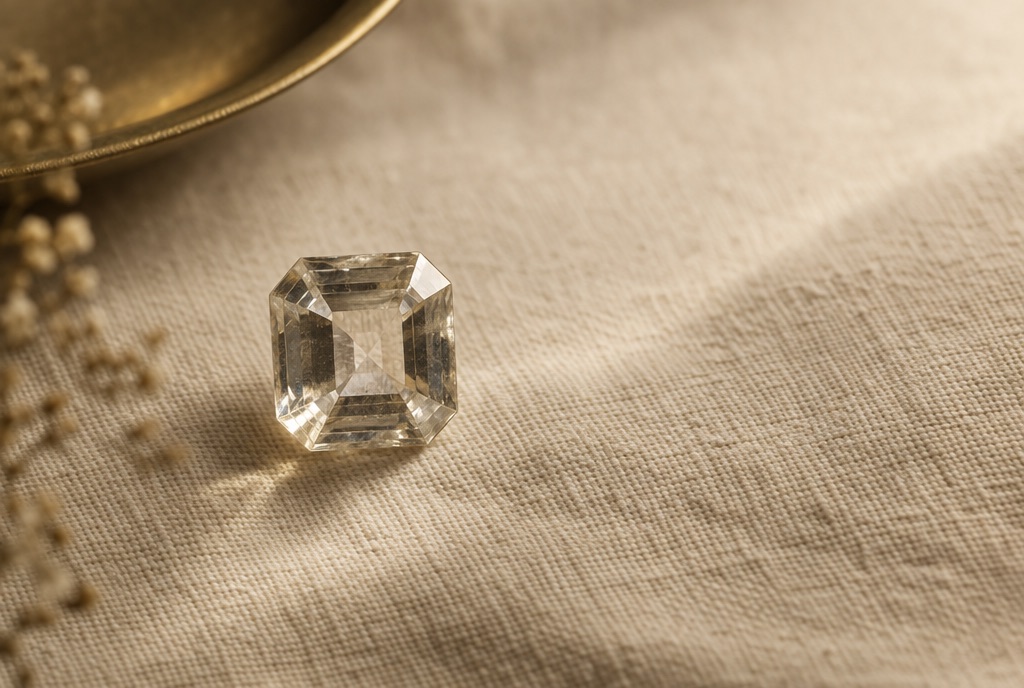
A table cut diamond is one of the earliest faceted diamond styles, produced by grinding the pointed top of a natural octahedral crystal into a single large, flat facet (the "table") with a corresponding flat or shallow-pointed base below. Predating the old mine and old European cuts by roughly two centuries, table cuts are prized today for their genuinely antique, glassy, low-brilliance appearance — a deliberate departure from the fire and scintillation modern cuts are engineered to produce.
What Is a Table Cut Diamond?
The table cut emerged in the 14th and 15th centuries as the first meaningful step beyond the point cut — the earliest fashioned diamond form, which simply polished a natural octahedron's existing crystal faces without reshaping them. Cutters realized that grinding away the top point of the octahedron created a flat, mirror-like face that let more light into the stone and made the diamond noticeably more attractive when viewed face-up. That flat top facet is the "table" the cut is named for, and in its earliest form it was often the diamond's only meaningfully worked surface — the pavilion below frequently remained close to its natural crystal faces, sometimes with a corresponding flat facet (a "culet" in miniature) ground into the point at the back.
Structurally, a table cut diamond is close to a square or rectangular tablet: a large flat table, four beveled corner facets connecting it to the girdle, and a flat or gently pointed pavilion. There is no crown of small facets building up to the table, and no pavilion faceting designed to bounce light back up through the stone the way a modern brilliant's does. That absence of faceting is exactly what gives table cuts their distinctive look and their historical importance as a transitional cut between the raw octahedron and later, more elaborate styles.
Table Cut vs. Later Antique Cuts
| Cut | Era | Faceting | Light behavior |
|---|---|---|---|
| Point cut | Pre-1300s | None; natural octahedron faces polished only | Minimal; near-raw crystal appearance |
| Table cut | 1400s-1600s | Single large table facet, flat pavilion, beveled corners | Glassy, deep, low brilliance; large flashes rather than scintillation |
| Old single cut | 1600s-1700s | 8 crown facets + table, 8 pavilion facets + culet (18 total) | Noticeably more life than a table cut; still soft by modern standards |
| Old mine cut | 1700s-1800s | 58 facets, cushion-shaped outline, high crown, small table | Warm, candlelight-flattering brilliance with broad flashes |
| Old European cut | Late 1800s-1930s | 58 facets, rounder outline, higher crown than modern round | More brilliance than old mine, softer than modern round brilliant |
| Modern round brilliant | 1919-present | 57-58 facets, mathematically optimized proportions | Maximum brilliance, fire, and scintillation under all lighting |
This progression matters for buyers because it explains what a table cut is not: it is not a rougher or lower-quality version of a modern round brilliant, it is a genuinely different visual objective. Table cuts were never intended to sparkle the way a contemporary engagement ring stone does — they were designed to showcase the diamond's inherent clarity and the play of large, deep flashes of light across a flat, mirror-like surface, which is precisely why they read as unmistakably antique the moment you see one in person.
Why Table Cut Diamonds Look the Way They Do
Modern cutting is optimized around a set of angle relationships between crown and pavilion facets that maximize total internal reflection — light enters through the table and crown, bounces off the pavilion facets, and exits back through the top, creating the rapid, sparkling pattern known as scintillation. A table cut has none of that pavilion engineering. Light entering the flat table either passes largely straight through the stone (since the pavilion below is flat or only lightly faceted) or reflects as a few large, slow flashes rather than many small, quick ones. The visual result is a diamond that looks glassy and deep rather than fiery — closer to a polished piece of optical glass than to a contemporary brilliant.
This is also why table cut diamonds were so frequently set in closed-back, foiled settings during the Renaissance and well into the 17th century. Jewelers of the period backed the stone with a thin sheet of reflective foil, sometimes tinted, to compensate for the cut's limited internal light return and to boost apparent brilliance and color. A foiled table cut in an original antique setting behaves quite differently, visually, than the same rough cut and mounted openly in a modern setting — a detail worth understanding before assuming a period piece's stated color or brilliance reflects the diamond alone.
Table Cut Shapes and Outlines
- Square table cut — the most historically common form, following the octahedron's natural symmetry most directly.
- Rectangular (elongated) table cut — cut from a more elongated rough crystal, or shaped deliberately for a specific design, such as a pendant or a betrothal ring's central stone.
- Table cut with clipped corners — an early precursor to what would eventually become the octagonal step cut and, much later, the emerald cut; clipping the corners reduced chipping risk at the diamond's most vulnerable points.
Because table cuts were fashioned individually by hand, with no standardized proportions the way modern round brilliants have, no two are identical — table depth, corner bevel angle, and overall symmetry vary meaningfully between original antique stones. That individuality is part of the appeal for collectors and for buyers seeking a genuinely one-of-a-kind antique-style center stone rather than a calibrated, repeatable cut.
Table Cut Diamonds Today: Antique vs. Reproduction
Genuine period table cut diamonds — stones actually fashioned between the 1400s and 1600s — are rare and turn up almost exclusively through estate jewelry, auction houses, and specialist antique dealers, typically already set in a period-appropriate mounting. Most buyers encountering "table cut diamond" today, particularly in a bridal or fine jewelry context, are looking at a modern reproduction: a diamond intentionally cut in the historical table-cut style using contemporary cutting equipment, either from natural rough or CVD lab-grown rough, since the cut is defined entirely by its faceting geometry rather than the diamond's origin.
Reproduction table cuts serve a specific, growing niche: buyers who want a Renaissance or Tudor-inspired engagement ring or piece — often paired with black-rhodium blackened-gold settings, button-back collets, or other period-accurate design elements — without sourcing an actual centuries-old stone, which brings provenance, condition, and availability complications an antique-style reproduction avoids entirely. A well-executed modern table cut delivers the same glassy, deep visual signature as a genuine period stone, cut to consistent, checkable proportions and available in both natural and CVD lab-grown material.
Table Cut Diamond Buying Considerations
| Factor | What to look for |
|---|---|
| Table-to-stone ratio | Larger tables generally intensify the glassy, deep look; smaller tables read closer to an old single cut |
| Corner bevel symmetry | Even beveling at all four corners signals careful hand-fashioning, whether antique or modern reproduction |
| Pavilion condition (antique stones) | Chips or recutting to the pavilion on a genuine period stone can meaningfully affect both appearance and value |
| Setting compatibility | A closed-back or foiled setting is period-authentic but conceals the stone's true color and clarity; open settings show the diamond as-is |
| Certification | Older antique stones are less commonly certified by GIA/IGI/GCAL than modern reproductions; a certified modern table cut offers clearer, checkable grading |
Buyers new to antique-style cuts sometimes expect a table cut to perform like a modern diamond under jewelry-store lighting and are surprised by how little it sparkles by comparison. That reaction usually resolves once the stone is understood on its own terms — a table cut's value proposition is historical authenticity and a distinctive, deep visual character, not brilliance competing with a modern round or cushion cut.
Clarity and Color in Table Cut Diamonds
Because a table cut's large, flat table facet acts almost like a window directly into the stone, inclusions and color tend to be considerably more visible than they would be in a modern brilliant cut of equivalent grade — there's no faceting pattern to visually break up or mask internal characteristics the way a well-cut round brilliant's pavilion does. This makes clarity and color grade meaningfully more important to the finished look of a table cut than they are for many modern shapes, and it's part of why closed-back foiled settings were historically so common: they concealed color tinting the open flat table would otherwise reveal plainly.
For a modern reproduction table cut intended for an open setting, buyers who want a clean, undistracting appearance should generally prioritize a higher clarity grade (VS2 or better) and a whiter color grade than they might choose for a shape like round brilliant or cushion, where facet patterns do more of the visual work of masking minor inclusions and warmth.
Table Cut in Engagement Rings and Fine Jewelry
Table cut center stones have seen a genuine resurgence in demand tied to the broader popularity of Georgian- and Renaissance-inspired engagement ring design — black-rhodium blackened 18k gold, button-back closed collets, and high-contrast icy-white antique cuts set against a dark, architectural mounting. A table cut fits naturally into this aesthetic precisely because it is period-authentic rather than a modern cut styled to look old, and it pairs well with companion old mine or rose cut side stones for a cohesive antique-inspired piece.
Outside center-stone use, table cuts also appear in pendant and earring designs seeking a distinctly historical look, and in recreation or restoration work for collectors and museums reproducing period pieces where sourcing an actual antique stone isn't practical or available.
Caring for a Table Cut Diamond
Table cut diamonds carry the same 10-on-Mohs-scale hardness and durability as any other diamond cut — the cut style affects appearance, not structural resilience. The primary practical consideration is the flat table facet itself, which shows surface scratches, oils, and fingerprints more visibly than a faceted crown would, simply because there's more uninterrupted flat surface for residue to sit on and be noticed. Regular cleaning with mild soap and a soft brush keeps a table cut's signature glassy clarity looking its best, and setting prongs at the more delicate corner bevels deserve the same periodic inspection any antique or fine-cornered cut requires.
Sourcing a Table Cut Diamond: What to Ask
Given how few table cuts move through the general trade compared to standard modern shapes, buyers are well served asking a few direct questions before committing: whether the stone is a genuine antique piece or a modern reproduction, what certification (if any) accompanies it, whether the pavilion has been recut or repaired if antique, and — for a modern reproduction — whether natural or CVD lab-grown rough was used, since both are viable and the cut style itself doesn't depend on origin. A supplier able to answer all of these clearly, rather than deflecting, is the more reliable source for a stone this specialized.
Table Cut Diamonds in the Broader History of Diamond Cutting
Understanding where the table cut sits in diamond cutting's overall timeline helps explain why it looks the way it does rather than treating it as an isolated curiosity. Diamond cutting evolved as a slow, centuries-long response to better tools and a growing understanding of how faceting affects light behavior: from unworked crystals, to the point cut's minimal polishing, to the table cut's single flat facet, to the old single cut's basic 18-facet arrangement, and eventually to the much more elaborate old mine and old European cuts that dominated fine jewelry through the 19th and early 20th centuries before the mathematically-optimized modern round brilliant arrived in 1919. Each step added complexity specifically to capture more of the diamond's potential brilliance, which makes the table cut a genuinely early data point in that progression — a diamond cut before cutters had developed the tools or the optical understanding to do much more than flatten the crystal's natural point.
This historical position is exactly why table cuts read so distinctly today. A buyer encountering one for the first time is looking at a design choice that predates the entire concept of engineering a diamond for maximum sparkle, and that context is worth communicating clearly to anyone considering one for a period-inspired piece — the appeal is authenticity to that specific historical moment, not an attempt to compete with what a modern cut delivers.
Table Cut Diamond Pricing Considerations
Pricing a table cut diamond, whether antique or reproduction, differs meaningfully from pricing a standard modern shape. Genuine period stones are priced on a combination of carat weight, condition, provenance, and rarity, with well-documented history or an intact original setting commanding a premium beyond what the diamond's 4Cs alone would suggest — closer to how the antiques and collectibles market prices an item than how a modern certified stone is priced. Modern reproduction table cuts, by contrast, price more conventionally against carat weight, color, and clarity, similar to any custom-cut fancy shape, though the specialized hand-fashioning required (there's no calibrated, mass-produced table cut the way there is for a round brilliant) typically carries a cutting premium over a standard shape of comparable size.
Buyers comparing a natural table cut reproduction against a CVD lab-grown equivalent will generally see the same cost relationship that holds across other fancy antique shapes: lab-grown material offers a meaningfully lower cost basis for the same visual result, which matters more for a niche cut like this than for popular modern shapes, since the labor cost of hand-fashioning an uncommon cut is a larger share of the total price than the rough material itself.
Table Cut in Mixed-Cut Antique Jewelry Design
Designers working in Georgian, Renaissance, or broader antique-revival styles frequently combine a table cut center stone with rose cut or old mine cut accent stones, rather than using table cuts throughout a piece. This mixed-cut approach is itself historically accurate — period jewelry rarely used a single cut style uniformly, since cutting techniques and available rough varied piece to piece even within the same workshop and era — and it gives a modern piece more visual texture than a single repeated cut would provide. A table cut's flat, deep glassy character contrasts effectively against a rose cut's faceted dome or an old mine cut's warmer brilliance, which is part of why experienced antique-style designers often specify table cut specifically for a center stone and reserve other antique cuts for supporting roles in the same piece.
Identifying an Authentic Antique Table Cut
For buyers specifically seeking a genuine period stone rather than a modern reproduction, a few characteristics help distinguish authentic antique table cuts: hand-fashioned asymmetry (period tools couldn't achieve the precision of modern cutting equipment, so slight irregularities in the table's exact proportions or the corner bevels are expected and, for collectors, often desirable rather than a flaw); wear patterns consistent with centuries of handling and setting changes; and, where available, documented provenance connecting the stone to a specific piece, collection, or historical period. A stone marketed as a genuine antique table cut with perfectly calibrated modern proportions and no wear characteristics at all is worth additional scrutiny before assuming authenticity.
Table Cut Diamonds and the Rose Cut: A Common Pairing Explained
Rose cuts and table cuts frequently appear together in period jewelry discussions, and it's worth being clear about how they differ despite both predating modern brilliant cutting. A rose cut is domed on top with triangular facets radiating from a central point and a flat, unfaceted base — the opposite structural arrangement from a table cut, which is flat on top with a single large facet and a corresponding flat or minimally faceted base. Where a table cut produces a glassy, deep look through its flat table, a rose cut produces a softer, more diffused sparkle through its faceted dome, closer to candlelight glimmer than a brilliant cut's crisp flash. Designers combining the two in a single piece are drawing on genuinely different optical effects, not two variations on the same theme, which is part of why the pairing reads as rich and textured rather than repetitive in finished antique-style jewelry.
Table Cut Diamond Availability and Lead Times
Because table cuts are neither a standard calibrated shape nor commonly held as ready stock the way round or cushion brilliants are, buyers should expect a longer sourcing timeline than a standard shape purchase — whether that means locating a genuine antique stone through specialist dealers or auction channels, or commissioning a modern reproduction cut to order from natural or CVD lab-grown rough. Planning for this lead time at the start of a custom design project, rather than after a setting has already been finalized, avoids the common friction of a completed mounting waiting on a center stone that takes considerably longer to source than expected.
Frequently Asked Questions
What is a table cut diamond?
A table cut diamond is an early faceted diamond style, dating to the 1400s-1600s, made by grinding a single large flat facet (the table) into the top of a natural octahedral crystal, typically with a flat or lightly faceted pavilion below. It predates the old mine and old European cuts.
Does a table cut diamond sparkle like a modern diamond?
No — table cuts produce a glassy, deep appearance with a few large flashes of light rather than the fast scintillation of a modern round brilliant. The flat faceting wasn't designed for maximum brilliance the way contemporary cuts are.
Can you buy a modern table cut diamond?
Yes. Modern reproduction table cuts are cut deliberately in the historical style, from either natural or CVD lab-grown rough, for buyers seeking a Renaissance- or Georgian-inspired antique look without sourcing an actual centuries-old stone.
Why were table cut diamonds often set in foil-backed settings?
Table cuts return relatively little internal brilliance on their own, so Renaissance and early modern jewelers backed them with reflective foil to boost apparent brightness and, in some cases, tint their color.
Are table cut diamonds a good choice for an engagement ring?
They can be, particularly for buyers drawn to a genuinely antique or Georgian-style aesthetic, but clarity and color matter more visually than in modern cuts since the flat table shows inclusions and tint clearly. A higher clarity and whiter color grade is generally worth prioritizing.
How is a table cut different from an old mine cut?
A table cut has minimal faceting — essentially one large flat table and a flat pavilion. An old mine cut, which came roughly two to three centuries later, has a full 58-facet cushion-shaped arrangement designed to produce meaningfully more brilliance while still keeping the warm, antique character.
Sourcing Table Cut and Other Antique Diamonds from Guru Diam
Guru Diam specializes in antique and unusual cuts alongside our full range of standard shapes — old mine, old European, kite, moval, lozenge, criss-cut, and reproduction historical styles like the table cut, in addition to natural diamonds, certified loose stones, and finished jewelry. Because stones like the table cut move in low volume and are typically fashioned to order rather than held as standard calibrated stock, we work directly with clients on antique-style commissions, sourcing or cutting to the specific proportions, clarity, and color a piece calls for. All CVD lab-grown material carries IGI, GIA, or GCAL certification as needed, and in-stock inventory ships same-day from our New York or Los Angeles locations.
For a table cut or other antique-style center stone paired with a period-inspired setting, our custom jewelry program finishes pieces in 4-6 days once a design and stone are confirmed. Trade accounts can review our broader antique-cut and certified diamond program through the wholesale hub or by setting up a trade partner account, and our certified loose diamond catalog covers the modern shapes a table cut is most often paired with in mixed-cut designs.