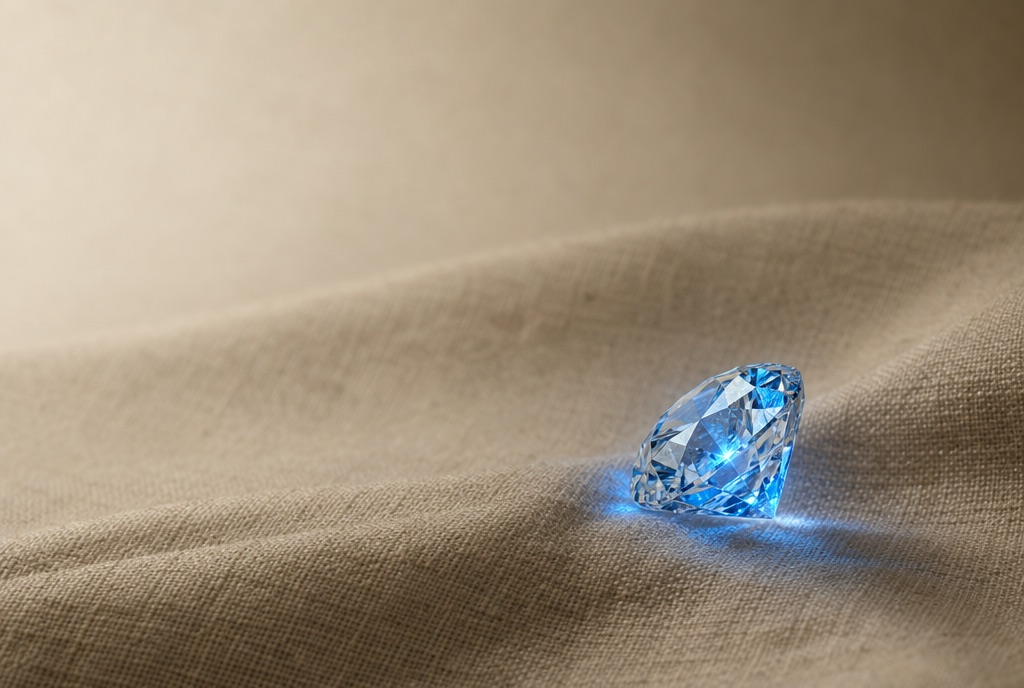
Strong blue fluorescence describes a diamond that emits a noticeably visible blue glow under ultraviolet (UV) light, one step below "Very Strong" on the GIA, IGI, and GCAL fluorescence scale. For most diamonds, strong blue fluorescence has little to no visible effect under normal lighting and can even make a warmer-colored stone appear whiter — but in a smaller number of high-color, very strong fluorescence stones, it can cause a hazy or oily appearance, which is exactly why fluorescence still gets more buyer attention (and price discounting) than its actual visual impact usually justifies.
What Diamond Fluorescence Actually Is
Fluorescence is a diamond's reaction to ultraviolet light — a physical property caused by trace amounts of boron or other elements within the crystal structure, causing the stone to emit visible light (most commonly blue, though yellow, orange, and white fluorescence also occur) when exposed to UV radiation. Daylight and many fluorescent light sources contain a meaningful UV component, which is why fluorescence can show up in ordinary settings, not just under a dedicated blacklight. Under lighting with little to no UV content — most indoor incandescent and LED lighting — fluorescence has essentially no visible effect at all, since there's no UV present to trigger the reaction.
The GIA/IGI/GCAL Fluorescence Scale
| Grade | Visibility under UV | Typical effect on appearance |
|---|---|---|
| None | No visible reaction | No effect; baseline appearance |
| Faint | Barely perceptible reaction | Essentially no visible effect under normal lighting |
| Medium | Clearly visible reaction under UV | Rarely affects face-up appearance under normal light |
| Strong | Strongly visible reaction under UV | Usually negligible; can slightly soften warmth in lower color grades; rare haze risk in high-color stones |
| Very Strong | Intensely visible reaction under UV | Higher (though still uncommon) chance of visible haziness, especially in D-F color stones |
It's worth being precise about what "strong" means on this scale: it's a real, meaningfully visible reaction under a UV light source, but it is not the same as the stone glowing or looking blue under ordinary room or daylight conditions. Confusing "reacts strongly under a blacklight" with "looks blue in everyday wear" is the single most common misunderstanding buyers bring to fluorescence.
Does Strong Blue Fluorescence Affect Appearance in Normal Light?
For the large majority of strong blue fluorescence diamonds, the answer is no — under typical indoor lighting with minimal UV content, a strong fluorescence stone looks essentially identical to a non-fluorescent stone of the same color and clarity grade. The visible effect fluorescence can have shows up specifically under UV-rich conditions, most commonly outdoor daylight, where the blue glow can very subtly interact with the stone's body color. In lower color grades (roughly I and below), this interaction can actually work in the buyer's favor: the blue fluorescence counteracts some of the stone's natural yellow tint, making it appear whiter than its grade alone would suggest under those lighting conditions.
When Strong Fluorescence Becomes a Real Concern: The "Overblue" or Hazy Effect
The genuine risk case for strong blue fluorescence is concentrated in a narrower band than its reputation suggests: high-color diamonds (D through F) with strong or, more commonly, very strong fluorescence occasionally develop a hazy, oily, or slightly milky appearance in strong UV-rich light, sometimes called the "overblue" effect. This happens because the fluorescent reaction in an already very colorless stone can visually compete with, rather than complement, the diamond's natural brilliance and transparency. It is a real phenomenon, but statistically uncommon even within the D-F, strong-to-very-strong fluorescence population — the large majority of stones in that combination show no noticeable haze at all, which is why individual stone inspection under actual daylight matters more here than in almost any other buying decision on this scale.
Strong Blue Fluorescence by Color Grade
| Color grade range | Effect of strong blue fluorescence |
|---|---|
| D-F (colorless) | Small but real chance of a hazy or oily look in UV-rich daylight; worth in-person or video review before buying |
| G-I (near colorless) | Usually negligible effect; occasionally a very subtle, generally imperceptible whitening |
| J-M (faint yellow) | Can visibly counteract warmth, making the stone appear whiter under UV-rich light — often viewed as a mild benefit |
This table is the core practical takeaway for anyone shopping specifically for a strong blue fluorescence stone: the grade range where fluorescence carries real risk (D-F) is a fairly narrow slice of the market, and the grade range where it's most likely to help (J and below) is where fluorescence-discounted stones can represent genuinely good relative value, not just a compromise.
Why Strong Fluorescence Diamonds Trade at a Discount
Despite the actual visual effect being negligible for most stones, strong and very strong fluorescence diamonds have historically traded at a price discount relative to otherwise-identical non-fluorescent stones — commonly in the range of a modest single-digit to low-teens percentage, varying by market and specific stone. This discount reflects buyer perception and historical caution around fluorescence more than it reflects measured visual risk across the fluorescence population as a whole; independent testing (including GIA's own published research) has found that trained observers generally cannot reliably distinguish strong-fluorescence stones from non-fluorescent stones of the same color and clarity in blind comparison under normal lighting, outside the narrower high-color haze cases described above.
For value-focused buyers, this pricing gap is genuinely actionable: a well-vetted strong blue fluorescence stone in the G-M color range, confirmed free of haze via direct inspection, often delivers the visual result of a higher-priced non-fluorescent stone at a meaningfully lower cost.
How to Check a Specific Stone for Haze Before Buying
Because the haze risk is stone-specific rather than something the fluorescence grade alone predicts reliably, a few practical steps add real confidence: view the stone in actual outdoor daylight, not just indoor store lighting, since that's the condition where any haze effect would actually appear; ask for video or in-person viewing from multiple angles rather than relying on a static photo; and for D-F color stones specifically, treat strong or very strong fluorescence as a flag worth this extra step, rather than an automatic disqualifier — the majority still show no visible issue.
Strong Blue Fluorescence in Lab-Grown vs. Natural Diamonds
Fluorescence occurs in both natural and CVD lab-grown diamonds, though the underlying cause and prevalence differ somewhat between the two. Natural diamond fluorescence is most commonly tied to trace boron incorporated during the diamond's geological formation. CVD lab-grown diamonds can also fluoresce, sometimes related to growth-process factors specific to the CVD method, and are graded on the identical GIA/IGI/GCAL fluorescence scale used for natural stones. The visual guidance in this guide — negligible effect for most stones, real but uncommon haze risk concentrated in high-color, high-fluorescence combinations — applies to both origins equally.
Fluorescence and Clarity: Two Independent Characteristics
Fluorescence and clarity are graded and reported entirely separately on a diamond's certificate, and there's no inherent relationship between them — a strong blue fluorescence stone can carry any clarity grade, from Flawless to Included, independent of its fluorescence rating. Buyers occasionally assume the two are connected because both can, in different and unrelated ways, affect a stone's overall optical impression, but confirming one tells you nothing about the other, and each should be evaluated on its own terms.
Should You Buy a Strong Blue Fluorescence Diamond?
For most buyers, particularly in the G-M color range, strong blue fluorescence is a non-issue at worst and a genuine value opportunity at best — it can make a warmer stone look whiter under UV-rich conditions while trading at a meaningful discount to non-fluorescent equivalents. The one group that should take a closer, more deliberate look is buyers considering a D-F color stone with strong or very strong fluorescence, where the (still uncommon) haze risk is concentrated; for that specific combination, direct daylight review before purchase is a genuinely worthwhile extra step rather than an unnecessary precaution.
Common Misconceptions About Blue Fluorescence
- "Fluorescent diamonds glow blue in everyday light." Fluorescence only shows under UV-rich conditions like outdoor daylight or a blacklight — not under typical indoor lighting, which has minimal UV content.
- "All strong fluorescence diamonds look hazy." The haze effect is real but uncommon, and concentrated specifically in high-color (D-F) stones with strong to very strong fluorescence — most stones outside that narrow combination show no visible haze at all.
- "Fluorescence always hurts a diamond's appearance." In lower color grades, strong blue fluorescence can actually make a stone appear whiter under UV-rich light by counteracting yellow body color.
- "Fluorescence and clarity are related." They're independently graded characteristics with no inherent connection to one another.
How Fluorescence Perception Has Shifted in the Trade
Fluorescence's reputation among diamond buyers has been shaped more by decades of trade caution than by the underlying visual data. For much of the 20th century, fluorescent diamonds — particularly strong and very strong grades — were broadly treated as inferior, based largely on anecdotal reports of hazy stones rather than systematic study. GIA's own research program, examining large samples of fluorescent diamonds compared against non-fluorescent equivalents, found that trained observers could not reliably distinguish most strong-fluorescence stones from non-fluorescent ones under normal lighting conditions, and that the haze effect associated with fluorescence is real but concentrated narrowly in high-color stones, not spread evenly across the fluorescent population. That research has gradually shifted informed buyer and grader perception, though pricing in the broader market has been slower to fully catch up, which is exactly why fluorescence-discounted stones remain a persistent value opportunity for buyers willing to do the extra diligence.
How to Check a Diamond's Fluorescence Yourself
A basic long-wave UV flashlight (commonly available and inexpensive) lets a buyer or jeweler observe fluorescence directly, though it's worth pairing this check with an outdoor daylight viewing to assess real-world appearance rather than relying on the UV light alone — a strong reaction under a dedicated blacklight doesn't by itself tell you whether the stone will show any visible haze in normal wear. For a more rigorous assessment, comparing the stone side by side against a known non-fluorescent stone of similar color and clarity, viewed together in the same daylight conditions, gives a more reliable read than evaluating the fluorescent stone in isolation.
How Fluorescence Is Reported on a Certificate
GIA, IGI, and GCAL reports list fluorescence as a distinct line item alongside the 4Cs, typically noting both the intensity grade (None through Very Strong) and, on GIA reports specifically, the fluorescence color when it's something other than blue. This reporting is standardized enough that comparing fluorescence grades across certificates from different labs is generally reliable, unlike some more subjective aspects of grading, since fluorescence intensity is assessed using calibrated UV light sources under controlled conditions rather than purely by visual judgment alone.
Regional and Market Variation in Fluorescence Pricing
The size of the fluorescence discount isn't uniform across markets — some regions and buyer segments have historically shown stronger preference against fluorescent stones than others, leading to more pronounced price gaps in those markets specifically. Buyers and dealers who understand this variation can sometimes find better relative value by sourcing fluorescent stones from markets where the discount is steeper than the underlying visual risk would justify, effectively arbitraging a pricing inefficiency driven by regional perception rather than measurable quality difference.
Strong Blue Fluorescence and Diamond Shape
| Shape | Fluorescence visibility consideration |
|---|---|
| Round brilliant | Even light distribution across many small facets tends to mask any subtle haze effect better than step cuts |
| Emerald / Asscher (step cuts) | Large, open facets make any haze effect, if present, more visible than in brilliant cuts — extra scrutiny warranted for high-color, high-fluorescence stones in these shapes |
| Cushion, oval, pear | Generally similar to round brilliant in masking subtle optical effects; still worth daylight review for D-F, strong-to-very-strong combinations |
| Radiant | Hybrid faceting falls between brilliant and step-cut behavior; moderate additional scrutiny warranted |
This shape interaction mirrors the same pattern seen with clarity: step cuts, with their large open facets, tend to reveal optical characteristics — whether inclusions or a fluorescence-related haze — more readily than brilliant cuts, whose faceting pattern is specifically engineered to break up and scatter light rather than let a viewer look straight through the stone. A buyer specifically considering a high-color, strong-fluorescence stone in an emerald or asscher cut should weight the daylight-inspection recommendation even more heavily than the same combination in a round brilliant.
Fluorescence Color Beyond Blue
While blue is by far the most common fluorescence color in diamonds, yellow, orange, and white fluorescence also occur, each with different visual implications. Yellow fluorescence, notably, tends to reinforce rather than counteract a stone's warm body color, which can make an already warmer-colored diamond appear even more yellow under UV-rich conditions — the opposite of blue fluorescence's typical whitening effect in lower color grades. White fluorescence is comparatively rare and, similar to blue, is generally associated with a low risk of visible haze except in unusual combinations. Buyers should check the specific fluorescence color reported on a certificate rather than assuming "fluorescence" uniformly means blue, since the practical implications genuinely differ by color.
Practical Buying Strategy for Fluorescence-Discounted Stones
Buyers looking to take advantage of fluorescence pricing inefficiencies without taking on unnecessary risk are generally best served with a straightforward approach: focus on the G-M color range, where strong blue fluorescence carries negligible-to-positive visual effect and the price discount represents genuine, low-risk value; request daylight photography or video for any specific stone under consideration regardless of color grade, since individual stone variation exists even within generally low-risk combinations; and reserve extra scrutiny specifically for D-F color stones with strong or very strong fluorescence, where the discount is often steepest but the (still uncommon) haze risk is genuinely concentrated. This approach captures most of fluorescence's value opportunity while avoiding its narrow but real risk case.
Fluorescence and Long-Term Stability
A common but reasonable question buyers ask is whether fluorescence changes over time — the answer is no. Fluorescence is a fixed physical property of a given diamond's crystal structure, determined at formation (for natural stones) or during growth (for CVD lab-grown stones), and it doesn't fade, intensify, or otherwise change with age, wear, or cleaning. A diamond graded strong blue fluorescence on its original certificate will carry that same rating indefinitely, which is worth knowing both for buyers evaluating an older certificate and for jewelers fielding the occasional customer question about whether a stone's fluorescence might diminish over years of ownership.
Talking to Customers About Fluorescence: A Practical Framing
Jewelers and sales staff explaining fluorescence to customers often get better results leading with the practical outcome rather than the technical mechanism: framing strong blue fluorescence as "a characteristic that's usually invisible in daily wear and often comes with a real price advantage, with one narrower situation worth checking directly" communicates the genuinely useful takeaway more effectively than opening with an explanation of UV light and boron trace elements. Customers who understand the practical tradeoff clearly are better equipped to make a confident decision, and are considerably less likely to second-guess a fluorescent stone purchase later based on secondhand information or outdated trade lore they encounter after the fact.
A Quick Reference for Fluorescence Buying Decisions
| Situation | Recommendation |
|---|---|
| G-M color, strong or very strong blue fluorescence | Generally safe to buy with confidence; likely genuine value versus non-fluorescent equivalent |
| D-F color, faint to medium fluorescence | Minimal risk; proceed as with any non-fluorescent stone in this range |
| D-F color, strong or very strong fluorescence | Request daylight video/photos or in-person review before committing |
| Any color, yellow fluorescence | Check reported color carefully; yellow fluorescence can reinforce rather than offset body color |
This kind of simple decision matrix captures the practical guidance in this guide in a form that's easy to apply quickly at the point of purchase, without needing to re-derive the underlying reasoning about UV light, boron trace elements, or the specific mechanics of the overblue effect each time a new stone comes up for consideration.
Frequently Asked Questions
What does strong blue fluorescence mean on a diamond certificate?
It means the diamond emits a strongly visible blue glow under ultraviolet light, one step below "Very Strong" on the GIA, IGI, and GCAL fluorescence scale. It does not mean the diamond glows blue under normal indoor lighting.
Does strong blue fluorescence make a diamond look worse?
Usually not. For most color grades, strong blue fluorescence has little to no visible effect, and in warmer (lower) color grades it can actually make the stone appear whiter under UV-rich light. A hazy appearance is a real but uncommon risk mainly in high-color (D-F) stones.
Why do strong fluorescence diamonds cost less?
Historical buyer caution around fluorescence has kept prices lower for strong and very strong fluorescence stones, even though most show no measurable visual difference from non-fluorescent stones of the same grade. This makes well-vetted fluorescent stones a genuine value opportunity for many buyers.
Should I avoid a D or E color diamond with strong fluorescence?
Not automatically, but it's worth a closer look — direct daylight viewing or video from multiple angles — since the (still uncommon) hazy "overblue" effect is concentrated specifically in high-color stones with strong to very strong fluorescence.
Is fluorescence the same in lab-grown and natural diamonds?
Both can fluoresce and are graded on the identical GIA/IGI/GCAL scale, though the underlying cause differs (trace boron in natural stones versus growth-process factors in CVD). The visual guidance is the same for both.
Does strong fluorescence affect a diamond's clarity?
No — fluorescence and clarity are independently graded characteristics with no inherent relationship. A strong blue fluorescence stone can carry any clarity grade.
Sourcing Fluorescence-Graded Diamonds from Guru Diam
Every certified stone Guru Diam carries, natural and CVD lab-grown alike, ships with full GIA, IGI, or GCAL documentation including fluorescence grade, so buyers and jewelers can evaluate a specific stone's full profile rather than guessing at how a given grade combination will present. For clients specifically considering a strong or very strong fluorescence stone in a higher color range, our team can arrange direct or video review under daylight-equivalent conditions before a commission moves forward.
In-stock inventory ships same-day from New York or Los Angeles, our custom jewelry program finishes pieces in 4-6 days, and trade accounts can review our full certified diamond program, across every color, clarity, and fluorescence combination, through the wholesale hub or a trade partner account. Our certified loose diamond catalog lists fluorescence grade alongside the full 4Cs for every stone.