A step cut diamond is any diamond cut with rows of long, parallel, rectangular or trapezoidal facets arranged in flat "steps" that run around the stone's crown and pavilion, rather than the triangular and kite-shaped facets radiating from the culet that define a brilliant cut. Emerald, Asscher, baguette, and trapezoid cuts are all step cuts; round brilliant, oval, cushion, and radiant are not. The distinction matters for buyers and jewelers because step cuts and brilliant cuts behave differently under light, tolerate clarity and color differently, and are sourced and priced differently across the trade.
This guide covers what makes a cut a "step cut" specifically, which common diamond shapes fall into the category, how step cuts compare to brilliant cuts on light performance and inclusion visibility, and what to look for when sourcing step-cut diamonds wholesale.
What Makes a Cut a "Step Cut"
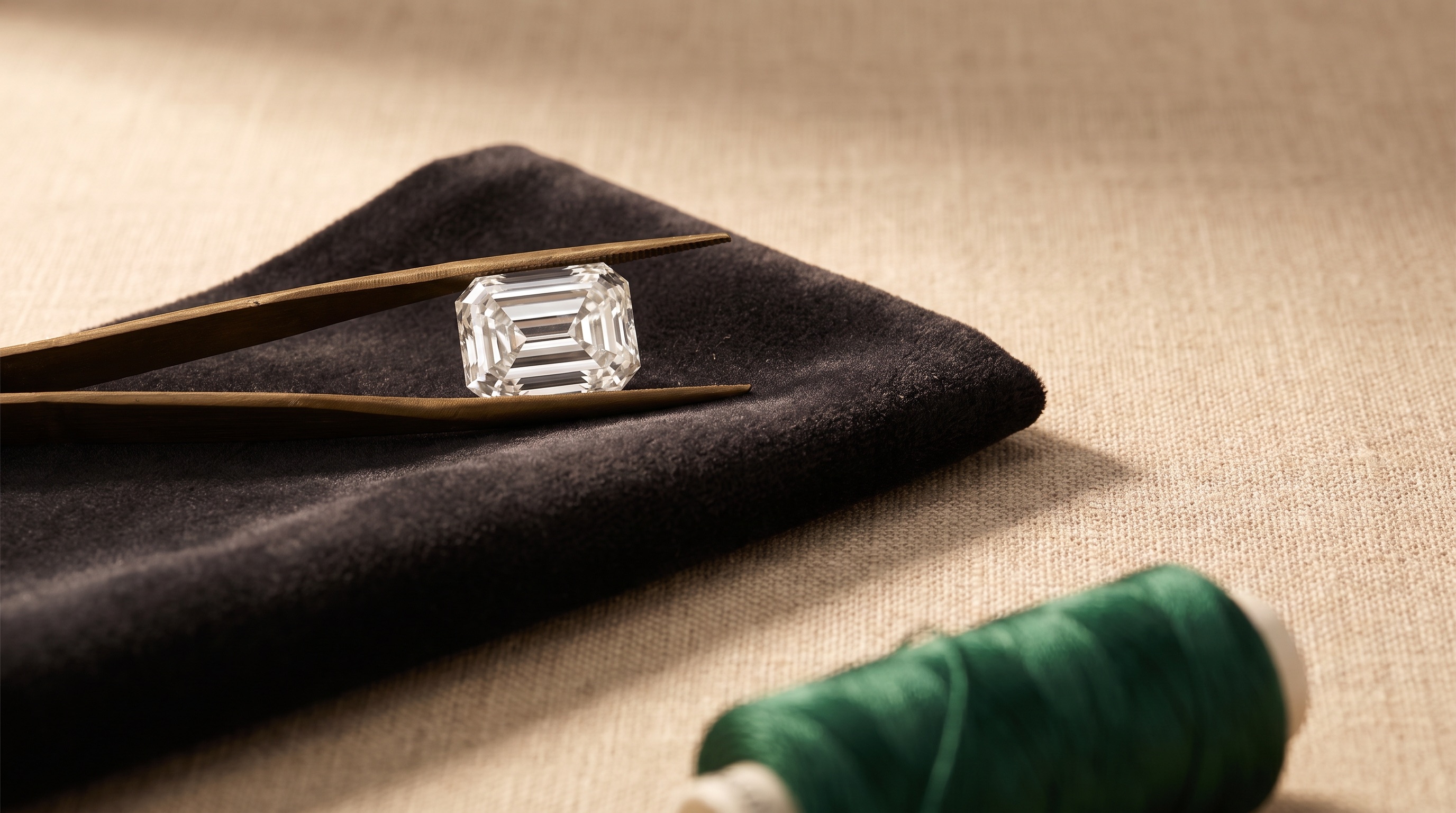
A step cut's defining feature is its facet arrangement: long, flat, rectangular or trapezoidal facets run in concentric rows — "steps" — around the stone's crown above the girdle and pavilion below it, typically with a large, flat, rectangular or square table facet at the top. This is structurally different from a brilliant cut, where triangular and kite-shaped facets are arranged to radiate outward from the culet at the base, maximizing the number of facets and the amount of light scatter for maximum sparkle. A step cut's larger, flatter facets act more like a hall of mirrors, producing a cleaner, more subdued play of light sometimes described as a "hall of mirrors" effect rather than the intense scintillation of a brilliant cut.
Common Step Cut Shapes
Emerald Cut
A rectangular step cut with cut (chamfered) corners, historically the most recognized step cut shape and a longstanding staple of fine jewelry and engagement ring design. Emerald cuts typically have fewer facets than most brilliant cuts, which puts more visual demand on clarity and symmetry precision.
Asscher Cut
Essentially a square emerald cut with more dramatically cropped corners and a higher crown, giving it a distinctive X-pattern visible through the table. Asscher cuts share the emerald cut's clarity sensitivity but read as more geometric and compact due to their square proportions.
Baguette Cut
A narrow, elongated rectangular step cut most commonly used as a side or accent stone rather than a center stone, frequently seen flanking a larger center diamond in three-stone rings or set in a straight or tapered line in eternity bands and watch bezels.
Trapezoid ("Trap") Cut
A step-cut variant with two parallel sides of different lengths and two angled sides, most commonly used as a side stone shaped to flank and complement an emerald, Asscher, or radiant center stone.
Other Step Cut Variants
Tapered baguettes (baguettes that narrow toward one end, used to follow a curved or angled setting line), half-moon cuts with a flat step-cut base paired with a curved edge, and square emerald cuts (an emerald-style step cut in square rather than rectangular proportions) round out the category's less common but still commercially relevant variants.
Step Cut vs. Brilliant Cut: Key Differences
| Characteristic | Step Cut | Brilliant Cut |
|---|---|---|
| Facet shape | Long, flat rectangles/trapezoids in parallel rows | Triangular and kite-shaped, radiating from the culet |
| Light performance | Fewer, larger flashes of light ("hall of mirrors") | More numerous, smaller flashes; maximum overall sparkle |
| Clarity sensitivity | Higher — the open table makes inclusions more visible | Lower — facet pattern helps mask minor inclusions |
| Color sensitivity | Higher — less light scatter to help mask body color | Lower — brilliance helps disguise faint color tints |
| Common shapes | Emerald, Asscher, baguette, trapezoid | Round, oval, cushion, radiant, princess, pear, marquise, heart |
Neither category is objectively "better" — the difference is a matter of the visual effect a buyer wants. A step cut suits a buyer who prefers a quieter, more architectural sparkle and a large, clear window into the stone's interior; a brilliant cut suits a buyer prioritizing maximum overall fire and scintillation.
Clarity and Color Grading Considerations for Step Cuts
Because a step cut's large, flat table offers a clear, largely unobstructed view straight down into the stone, inclusions that would be effectively hidden by a brilliant cut's facet pattern are far more visible in a step cut of comparable clarity grade. Buyers sourcing emerald or Asscher cuts, in particular, typically prioritize VS2 or better specifically to avoid eye-visible inclusions through the open table, whereas the same clarity concern is much less pressing on a round brilliant or cushion cut. The same open-table effect applies to body color: step cuts show faint color tints more readily than brilliant cuts do, since there's less light scatter to help mask a warm tint, which is why buyers commonly choose a slightly higher color grade for a step cut than they would feel necessary for a brilliant cut of otherwise comparable visual quality.
Cut Quality Grading for Step Cuts
Step cuts present a specific grading challenge: the GIA cut grade scale (Excellent through Poor) that applies to round brilliants does not extend to fancy shapes, including step cuts, so a step-cut diamond's certificate reports proportions, symmetry, and polish individually rather than a single combined cut grade. Buyers evaluating step cut quality should look closely at table and depth percentage, corner symmetry (particularly important on Asscher cuts given their pronounced X-pattern), and — for elongated shapes like emerald and baguette — length-to-width ratio, since a ratio outside the commonly preferred range for that shape can make a stone look either too narrow or too square regardless of how well individual facets are cut.
Setting Considerations Specific to Step Cuts
Step cuts have sharp, exposed corners — especially pronounced on emerald and Asscher cuts — that carry a higher chip risk than the more rounded facet junctions of most brilliant cuts, which makes corner protection a real setting consideration rather than a cosmetic afterthought. Prong placement directly over or immediately adjacent to each corner is standard practice for emerald and Asscher cut center stones specifically to guard against chipping at the stone's most vulnerable points. Baguette and trapezoid side stones, since they're typically channel-set or bezel-set rather than prong-set, get a comparable degree of edge protection through the channel or bezel wall itself rather than through individual prongs.
Sourcing Step Cut Diamonds Wholesale
Step cut availability varies significantly by shape and size: emerald and Asscher cuts are commercially available across a wide carat range as both natural and CVD lab-grown material, baguette and trapezoid cuts are produced primarily as calibrated melee and small accent stones for exactly the sizes standard three-stone and channel settings call for, and less common variants like tapered baguettes or square emeralds require a supplier with genuine fancy-shape cutting capability rather than a purely round-focused inventory. Buyers should ask a prospective wholesale supplier directly whether step cuts are sourced as-needed per order or held as standing calibrated inventory, since a supplier without standing step-cut inventory can introduce meaningfully longer lead times on a design that calls for exact-match baguette or trapezoid side stones.
What to Ask a Wholesale Supplier About Step Cuts
- What length-to-width ratio range is available for emerald and baguette cuts, since this ratio drives how the finished stone actually looks more than any single grading parameter?
- Are baguette and trapezoid side stones sold as calibrated, size-matched sets rather than individually, since three-stone and channel designs depend on tight size and color consistency across the side stones?
- What clarity floor does the supplier recommend for a given step cut shape and size, given the category's higher sensitivity to eye-visible inclusions through the open table?
- Is certification available for step cut center stones at 0.30ct and above, and does the supplier's melee-range step cut inventory follow a stated commercial clarity/color standard?
Natural vs. Lab-Grown Step Cut Diamonds
CVD lab-grown material is available across essentially the same range of step cut shapes as natural diamond, and because step cuts already retain a comparatively high percentage of the rough material they're cut from relative to a round brilliant, the cost advantage of choosing lab-grown over natural in a step cut specifically tracks closely with the general lab-grown discount seen across other shapes. Buyers sourcing step cuts for a price-sensitive product line commonly default to lab-grown material for exactly this reason — the discount is consistent and predictable rather than shape-dependent in some unusual way specific to step cuts.
Step Cuts in Antique and Vintage-Style Jewelry
Step cuts, and the emerald cut in particular, carry strong Art Deco associations, having been a defining shape of 1920s and 1930s jewelry design alongside the era's geometric, architectural aesthetic more broadly. Buyers and designers building vintage-inspired or Art Deco-style collections lean on step cuts specifically for this historical resonance, often pairing an emerald or Asscher center stone with baguette or trapezoid side stones to recreate period-accurate three-stone and cocktail ring silhouettes.
Step Cuts as Side and Accent Stones
Beyond their use as center stones, baguette and trapezoid step cuts are among the most commonly used accent shapes across fine jewelry generally — flanking a round, oval, or cushion brilliant center stone in a three-stone ring, running in a straight or tapered line along a shank or eternity band, or set into the bezel of a diamond watch. This dual role — occasional center stone, frequent accent stone — means step cut demand from a manufacturer's perspective isn't purely tied to step-cut-center-stone rings; a supplier's calibrated baguette and trapezoid inventory sees steady demand from brilliant-cut-center designs as well.
Common Buyer Misconceptions About Step Cuts
A common misconception is that step cuts are inherently "less brilliant" in a way that makes them a lower-quality choice — in reality, step cuts are simply optimized for a different visual effect (clarity and depth of the stone's interior) rather than maximum sparkle, and a well-cut step cut in appropriate clarity and color is not a compromise choice, just a different aesthetic one. Another common misconception is that all rectangular diamonds are "emerald cut" — radiant and cushion-modified rectangular shapes are brilliant cuts with a rectangular outline, not step cuts, and confusing the two leads buyers to misjudge how much clarity and color matter for a given stone.
Step Cuts in Fancy Color Diamonds
Because step cuts show body color more readily than brilliant cuts due to their reduced light scatter, the shape has a particular, well-established use case in fancy color diamonds: an emerald or Asscher cut can showcase a strong, saturated fancy yellow, pink, blue, or green more clearly than a brilliant cut of the same color grade would, since the step cut's open facets let the stone's actual body color read through more directly rather than being partially masked by scintillation. Buyers and designers working with fancy color center stones in yellow, pink, blue, or green frequently request step cut options specifically for this reason, alongside the more commonly seen cushion and radiant fancy color cuts.
Reading a Step Cut Diamond's Grading Report
A grading report for a step cut diamond reports the same core information as any other shape — carat weight, color, clarity, and measurements — but omits the single combined cut grade that appears on round brilliant reports, since GIA does not extend its Excellent-to-Poor cut grade scale to fancy shapes including step cuts. Instead, buyers should read the report's polish and symmetry grades individually, check the measurements section for length-to-width ratio, and, where available, look at the report's proportions diagram to assess table and depth percentage directly rather than relying on a single summary grade the way they might for a round brilliant. Buyers unfamiliar with fancy-shape reports sometimes mistake the absence of an overall cut grade for a missing or incomplete report, when it simply reflects how GIA and other labs grade non-round shapes.
History and Origins of the Step Cut
Step cutting predates the modern brilliant cut by centuries, with early step-cut styles (including the table cut and, later, the emerald cut itself, originally developed to cut colored emeralds safely before being adapted for diamonds) appearing well before the mathematically optimized brilliant cut proportions developed in the early 20th century. The style saw a major resurgence during the Art Deco period of the 1920s and 1930s, when its clean, geometric lines suited the era's architectural design sensibility, and it has remained in steady use ever since as both a period-appropriate choice for vintage-style jewelry and a standalone aesthetic preference independent of any specific era.
Pricing Patterns Across Step Cut Shapes
Emerald and Asscher cuts, as popular center-stone shapes, are priced comparably to other fancy center-stone shapes of similar carat weight, clarity, and color, with the length-to-width ratio and corner symmetry acting as meaningful price modifiers within a given grade combination. Baguette and trapezoid accent stones are priced primarily by total carat weight and size-matching precision across a set rather than by individual stone grading, since they're almost always sold and used as calibrated groups rather than as single stones evaluated in isolation.
Step Cuts Compared to Radiant and Cushion Cuts
Buyers new to the category sometimes confuse step cuts with radiant and cushion cuts, since all three can appear in similar rectangular or square outlines. Radiant and cushion cuts, however, are brilliant-style cuts — they use triangular and kite-shaped facets arranged for maximum light return, just within a rectangular or cushion-shaped outline rather than round — and are graded and priced more like other brilliant shapes, with lower clarity and color sensitivity than a true step cut. A radiant cut is sometimes described informally as a "cut-cornered rectangular brilliant" for exactly this reason: it borrows the step cut's outline without adopting its facet structure or its clarity and color sensitivity. Buyers who want a rectangular silhouette with more forgiving clarity requirements often choose radiant or cushion over emerald or Asscher specifically for this reason, while buyers who want the true step-cut light performance and clean geometric lines choose emerald or Asscher despite the added clarity and color sensitivity.
Building a Step Cut Assortment as a Retailer
A retailer building out a step cut offering should plan for at least emerald and Asscher cut center stones across a small range of carat weights, plus a standing supply of calibrated baguette and trapezoid side stones sized to fit common three-stone and channel-set mountings, since side-stone demand for step cuts is often driven by brilliant-cut center stone designs rather than step-cut center stones alone. Retailers newer to the category sometimes underestimate side-stone demand relative to center-stone demand, then find themselves sourcing baguettes reactively per order rather than holding calibrated stock — a supplier relationship that includes standing baguette and trapezoid inventory in common sizes avoids this lag and lets a retailer quote a finished three-stone or eternity design without waiting on a per-order side-stone sourcing cycle.
Frequently Asked Questions
What is a step cut diamond?
A step cut is a diamond cut with long, flat, rectangular or trapezoidal facets arranged in parallel rows or "steps," rather than the triangular facets radiating from the culet that define a brilliant cut. Emerald, Asscher, baguette, and trapezoid are all step cuts, and the category spans both center-stone and accent-stone use across fine jewelry.
Is emerald cut the same as step cut?
Emerald cut is one specific step cut shape — a rectangular cut with chamfered corners — but "step cut" is the broader category that also includes Asscher, baguette, trapezoid, and other similarly-faceted shapes.
Do step cut diamonds sparkle less than brilliant cuts?
Step cuts produce fewer, larger flashes of light rather than the many small flashes of a brilliant cut, giving a quieter "hall of mirrors" look rather than maximum overall sparkle. This is a different visual effect, not a lower-quality one, and buyers who prefer a calmer, more architectural look often choose a step cut for that reason alone.
What clarity grade should I choose for a step cut diamond?
VS2 or better is a common recommendation for emerald and Asscher cut center stones specifically, since the open table makes inclusions more visible than they would be in a brilliant cut of the same grade.
Are step cut diamonds more likely to chip?
Step cuts, especially emerald and Asscher cuts, have sharp exposed corners that carry a higher chip risk than a brilliant cut's more rounded facet junctions, which is why prong placement directly over each corner is standard setting practice for these shapes — buyers should confirm a ring's prong layout accounts for this before assuming any four-prong setting is equally protective across shapes.
Can step cut diamonds be lab-grown?
Yes — CVD lab-grown material is available across essentially the same range of step cut shapes as natural diamond, at a cost discount consistent with lab-grown pricing for other shapes.
Is a radiant cut a step cut?
No. Radiant and cushion cuts use brilliant-style faceting within a rectangular or cushion outline, not the parallel step facets of a true step cut like emerald or Asscher, and are graded with lower clarity and color sensitivity as a result.
Sourcing Step Cut Diamonds Wholesale
Guru Diam supplies emerald, Asscher, baguette, and trapezoid step cut diamonds in both CVD lab-grown and natural material, alongside its full range of antique, regular fancy, and round shapes, with IGI, GIA, and GCAL certification available on loose stones at 0.30ct and above. Calibrated baguette and trapezoid side stones are available as matched sets for three-stone and channel-set designs. Trade buyers can review current inventory through fancy color loose diamonds and certified diamonds, and explore custom center-and-side-stone pairings through custom jewelry. In-stock inventory ships same-day from Guru Diam's New York and Los Angeles locations. New trade accounts can apply through trade partner, with current terms available at the wholesale hub. For related fundamentals, see our 4Cs of diamonds guide and diamond cut grades guide.
Guru Diam is a trade-only wholesale diamond supplier with locations in New York and Los Angeles, carrying antique, regular fancy, and round diamond shapes in both CVD lab-grown and natural material, with IGI, GIA, and GCAL certification available. Browse current inventory in fancy color loose diamonds or apply for a trade account through trade partner.