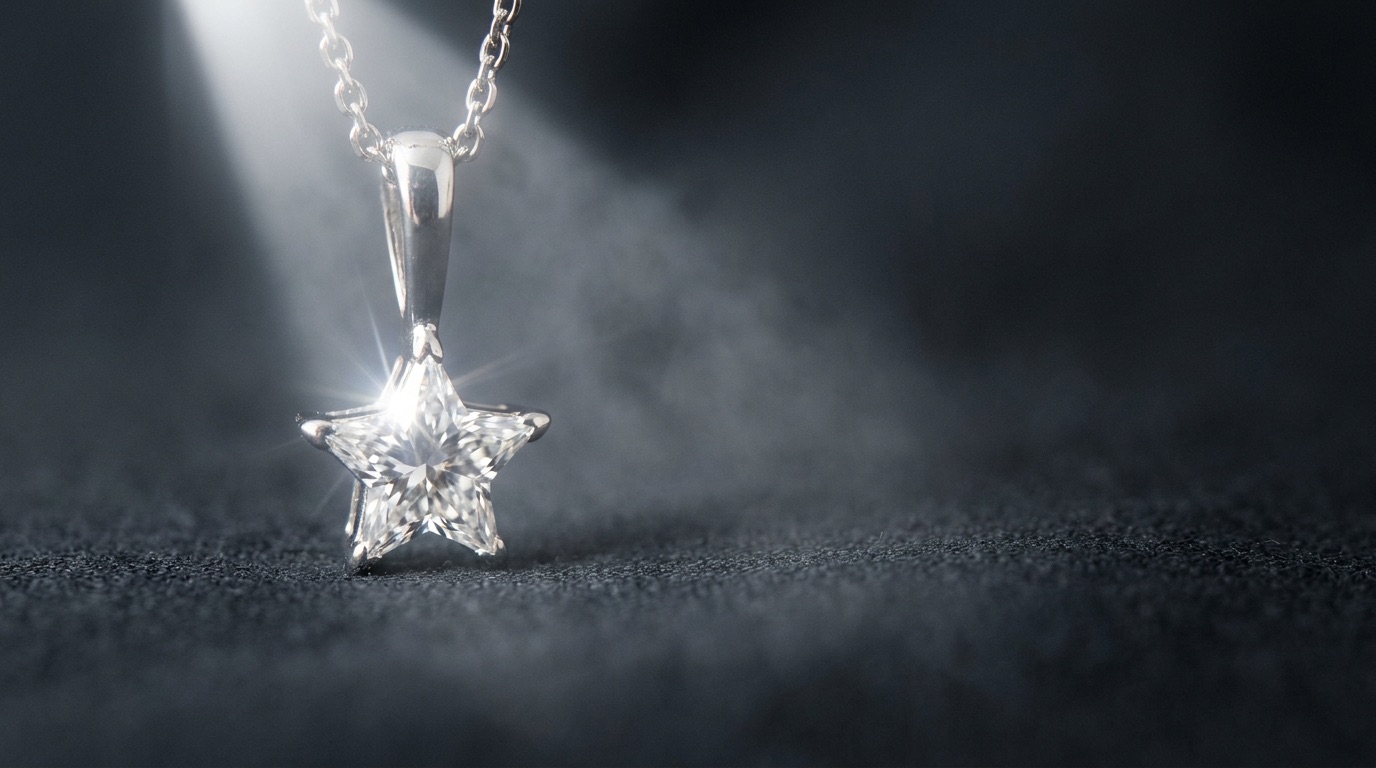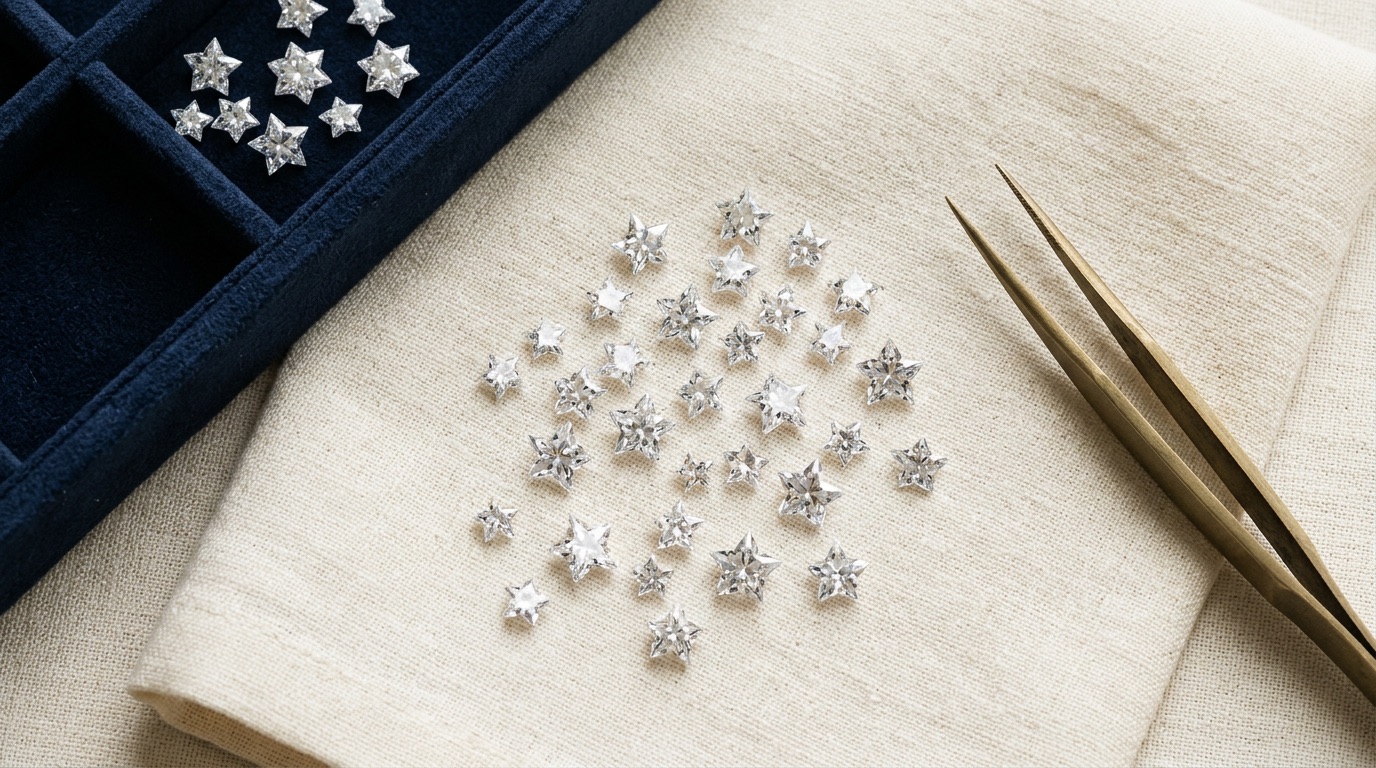

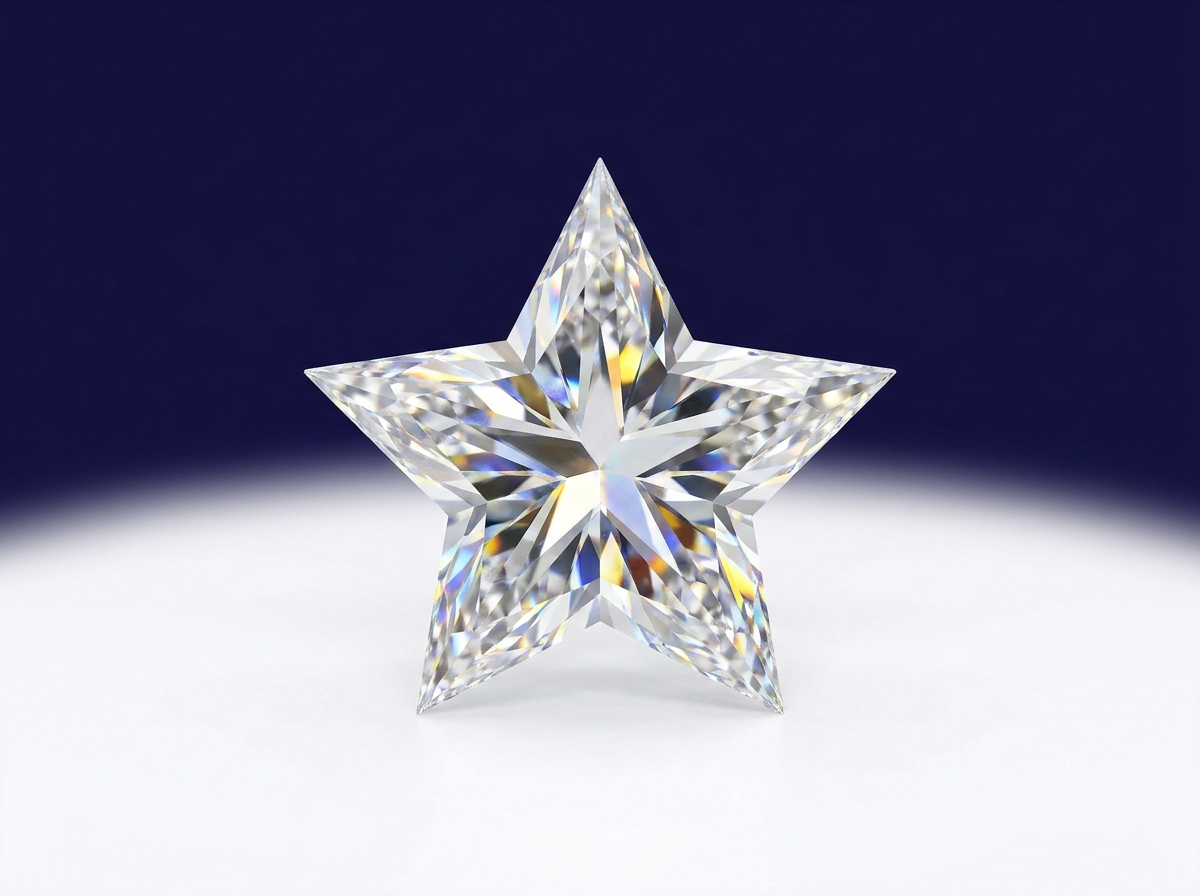
A Star cut diamond is a novelty fancy shape faceted into a five- or six-pointed star outline, brilliant-faceted across each point to keep the shape lively rather than flat. It's used as an accent or statement stone in custom jewelry rather than as a standard center-stone cut. Guru Diam stocks Star cut as IGI-certified lab-grown loose diamonds, on hand and ready to ship, with made-to-order cutting available for anything outside current stock.
What is a Star cut diamond, exactly?
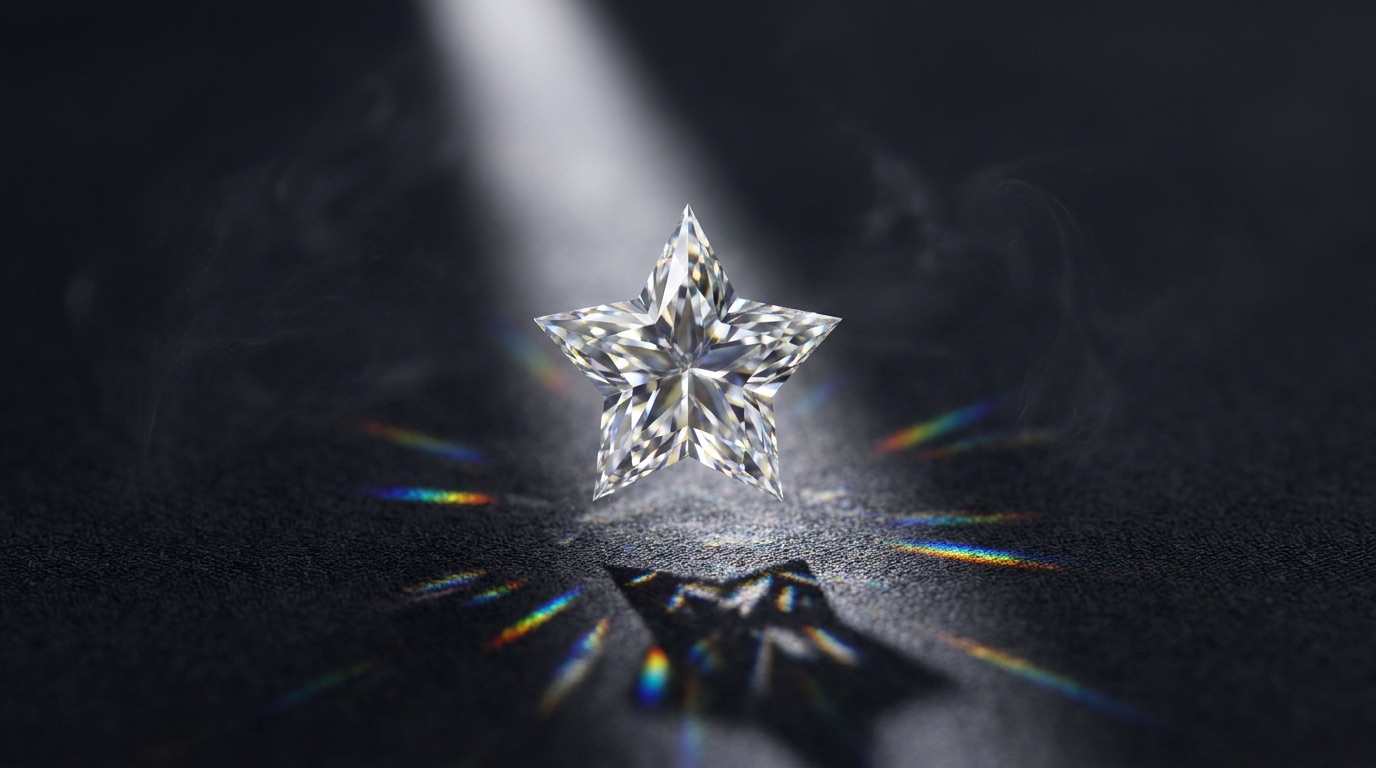
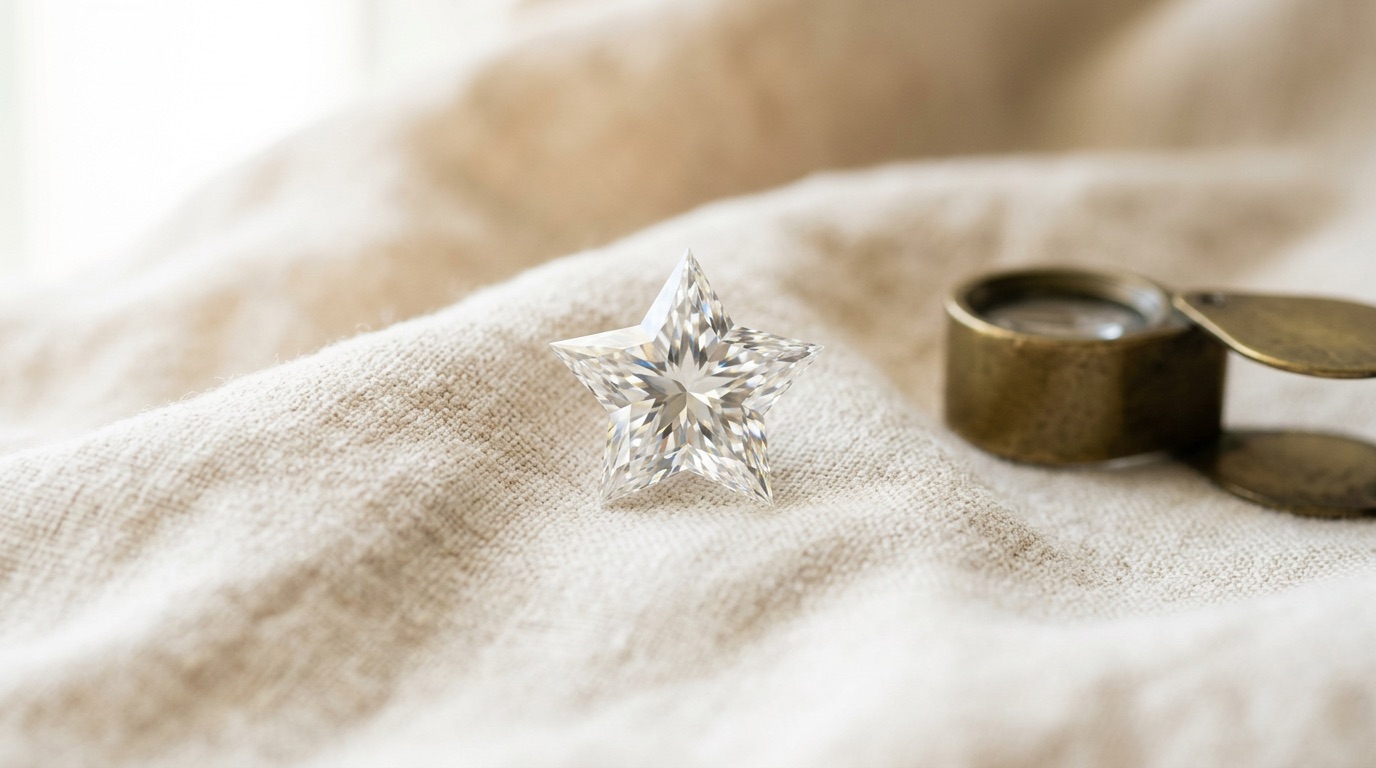
A Star cut diamond is a fancy shape faceted so its outline reads as a five- or six-pointed star rather than a round, oval, or classic geometric silhouette. The points aren't just an outline trick — the cutter carries brilliant-style faceting into each point, so the stone still throws light the way a round or fancy brilliant does instead of going flat and glassy at the tips the way a poorly executed novelty cut can.
The distinction matters in the trade because "star" gets used loosely. A star motif set into a cluster of small round melee — sometimes called a starburst — is a completely different product from a single diamond cut into a star outline. A Star cut is one stone, one shape, cut to a point-count spec (typically five or six points) the way a Kite or Trillion is cut to its own outline spec. It is graded and certified as an individual stone, not treated as a parcel of small accent goods.
Because the shape isn't a recognized standard on most grading-lab shape lists, "Star cut" functions as a trade name rather than a GIA or IGI shape category — certificates typically list it as a fancy/modified shape with the star geometry noted in the report, similar to how other specialty outlines get documented.
Construction differs meaningfully between a five-point and a six-point Star cut, and the two aren't interchangeable in a design. A five-point star reads as the familiar, instantly recognizable star silhouette — the shape most clients picture when they ask for a "star diamond." A six-point star sits closer to a compass or snowflake outline once faceted, with an extra pair of points that changes both the light pattern and the design vocabulary it suits — six-point work leans more toward celestial and geometric themes than the more universally recognizable five-point outline. Point count is a spec decision a buyer needs to make up front, not an afterthought, since it changes the cutting plan from the first pass on the rough.
Facet layout on a well-cut Star cut mirrors brilliant-cut logic rather than step-cut logic: a table facet at the center, then crown and pavilion facets carried out into each point rather than stopping short of the tips. A cutter who facets only the body of the star and leaves the points as flat, unfaceted spikes is taking a shortcut that kills the stone's brilliance exactly where the eye is drawn first — the points are the shape's signature, so they're also where cutting quality is easiest to judge at a glance.
Where Star cut fits in a jeweler's line
Star cut is not a center-stone shape for a standard engagement ring, and treating it as one is the most common misstep with a first-time buyer of the shape. Its real place in a line is as an accent or statement stone: a cluster setting built around a cluster of points, a single Star cut used as the centerpiece of a themed custom commission, or a small detail stone set into a larger design where the star silhouette is the point of the piece rather than incidental to it.
That makes it a design-led purchase more than a spec-sheet purchase. A buyer typically isn't reordering Star cut on a recurring restock cycle the way they would round melee or standard fancy shapes — the purchase gets triggered by a specific client conversation or a specific commission brief, which is part of why on-hand availability matters more here than on commodity shapes. If the stone is sitting in inventory when the conversation happens, the jeweler can close the sale on the spot instead of quoting a cutting lead time and hoping the client waits.
Common design themes that call for Star cut
A handful of recurring commission types account for most Star cut demand, and knowing them helps a jeweler recognize the opening before a client even names the shape. Celestial and night-sky themes are the broadest category — a Star cut paired with smaller round melee to suggest a starfield, often in pendant or earring pairs. Nautical and "guiding star" commissions tend to favor a single statement Star cut set as a pendant or ring centerpiece, frequently tied to a personal or memorial story rather than a pure fashion purchase. Patriotic, military, and civic-service commissions are a steady source of custom Star cut work — often set alongside colored stones, enamel, or engraving where the star carries the symbolism the client is commissioning the piece for. Seasonal gifting around year-end holidays adds a smaller but real bump in interest, since a star reads immediately as a holiday motif without needing to be literal about it.
Sports, military-unit, and regional pride commissions — a client wanting a star tied to a specific team, service branch, or state symbol — round out the remaining demand. None of these are high-volume categories on their own, but together they explain why Star cut demand tends to arrive as a burst tied to a season or a specific client story rather than as steady, predictable reorder volume.
Why so few wholesalers carry Star cut as standing stock
The points are the whole story here. A sharp, symmetrical point on a diamond is structurally the weakest part of the stone — there's less material backing the tip, and any impact concentrates stress right at the point rather than spreading across a rounded or beveled edge. A five- or six-point star has that vulnerability repeated multiple times around a single stone, through cutting, polishing, setting, and years of daily wear on a finished piece.
That risk profile is exactly why most of the trade treats Star cut as a one-off custom order rather than a shape worth holding real inventory against. Carrying stock means carrying the risk of chip damage sitting in a drawer, and cutting to order means a cutter is only producing the stone once a specific commission calls for it. It's a rational response to a genuinely fragile shape — not a sign that the shape is undesirable, just that it doesn't behave like a round or a cushion sitting safely in parcel stock.
How Guru Diam sources and cuts Star cut diamonds
Guru Diam cuts Star cut diamonds in-house, which is what makes carrying any on-hand stock of a shape this custom-order-driven workable in the first place. Rather than depending on an outside cutting house's schedule for a shape most cutters rarely touch, an in-house team can run a Star cut to a specific point count, size, and symmetry target on the same production line used for the rest of the fancy-shape catalog.
That in-house control supports two purchase paths side by side: on-hand pieces ready to ship now for a buyer who needs the stone immediately, and made-to-order cutting for a size, point count, or carat weight that isn't currently sitting in stock. A custom commission built around Star cut isn't dependent on finding the one existing stone that happens to fit — the size can be cut to the piece.
The rough selection matters more for a Star cut than for most standard shapes. A star outline wastes more of the rough crystal than a round or a cushion does — the points require material to be cut away from areas a rounder shape would keep — so a cutter is weighing yield loss against point sharpness and symmetry from the first planning stage, not just polishing a pre-formed blank.
Grading and quality considerations specific to Star cut
Symmetry is the grading factor that matters most on a Star cut, more than it would on a round or a cushion. Because the points repeat around the stone, any inconsistency between them — one point longer, one point blunter, one point off-center from the girdle outline — reads immediately to the eye in a way that a small symmetry deviation on a round brilliant does not. When you're evaluating a Star cut, look at the points as a set before you look at anything else.
Point condition under magnification is the second check, and it's specific to this shape. A chipped point is far more visible and far harder to repair invisibly than damage to a rounded or beveled edge — there's no way to gently re-polish a blunted star point back to a sharp tip without losing meaningful size and reshaping the whole point. Inspect every point tip before setting, not just the table and crown the way you would on a standard shape.
Color and clarity requirements can flex more than they would on a center-stone round, because Star cut is doing an accent or statement job rather than carrying a solitaire's full visual weight on its own. That said, buyers commissioning a Star cut as a true centerpiece — not a small accent — should hold color and clarity to the same standard they'd apply to any statement stone, since the whole point of choosing this shape is usually to showcase it, not hide it in a supporting role.
Carat weight ranges also split along that same accent-versus-statement line. Smaller Star cuts sized for cluster and accent work prioritize a clean, consistent point profile over raw size — the goal is a repeatable unit that reads correctly next to its neighbors in a cluster. Larger, statement-size Star cuts are sized and graded more like a solitaire fancy shape, where size, symmetry, and clarity all carry real weight in the buying decision because the stone is meant to stand alone as the visual center of the piece.
Certification for Star cut diamonds
Guru Diam's Star cut inventory is CVD-grown and IGI-certified, with GIA certification available on request for buyers who need it for a specific client or market. Across the broader lab-grown catalog, Guru Diam works with IGI, GIA, and GCAL, so a jeweler with a house preference on cert lab has room to ask.
Certification on a Star cut reads a little differently than on a round or a standard fancy shape — the report will typically classify it as a fancy or modified brilliant shape with the star outline noted, since it isn't one of the handful of shapes with its own dedicated category on most lab shape lists. Carat weight, color, clarity, and cut-related measurements are reported the same way as any other certified stone; ask your account rep to confirm exactly how the specific stone's report characterizes the shape before you commit it to a client-facing spec sheet.
Pricing factors for Star cut diamonds
Star cut pricing is shaped by a few factors that don't apply the same way to standard shapes:
- Rough yield. A star outline sacrifices more of the original rough crystal than a round or cushion does to carve out the points, so a Star cut typically retains less finished weight from a given piece of rough than a more conservative shape would.
- Cutting labor. Faceting five or six points to brilliant standard — not flat, not glassy — takes more cutter time and more precision passes than a single continuous curved outline. That labor shows up in the price per stone.
- Symmetry grade. Because points expose any inconsistency so clearly, a high-symmetry Star cut commands a real premium over one with visible point irregularity, more so than the symmetry premium you'd see on a round brilliant.
- Size and point count. Larger statement-size Star cuts and six-point variants generally carry a higher per-piece price than smaller five-point accent sizes, both for the added rough required and the added faceting complexity.
- On-hand vs. made-to-order. A piece already cut and sitting in inventory is priced and available immediately; a made-to-order piece is priced against the specific size and symmetry target requested and carries a cutting lead time before it ships.
Ask for trade pricing against your specific size and point-count spec rather than assuming a flat per-carat rate — Star cut doesn't price like a commodity round, and a quote against your exact target is more useful than a general range. Because demand arrives commission by commission rather than as steady restock volume, pricing conversations tend to happen stone-by-stone or job-by-job rather than as a standing account discount tier the way high-turnover round goods work.
Worth setting expectations with a retail client on this point too: a Star cut will generally run higher per carat than a round of comparable color and clarity, purely on cutting labor and yield loss, even though lab-grown production keeps the overall price accessible relative to a natural stone of the same specification. Framing that difference honestly up front — it's a cutting-complexity premium, not a scarcity markup — keeps the retail conversation grounded.
Styling and setting guidance for jewelers reselling Star cut
Protecting the points starts at the setting bench, not at the point of sale. Prong placement that shields each tip, a bezel or half-bezel approach for the most exposed points, and channel or flush-set framing for smaller accent-size Star cuts all reduce the day-to-day chip risk that makes this shape harder to live with than a round. Walk your client through wear expectations the same way you would with a pavé ring — a Star cut earns its visual impact, but it isn't a stone to set-and-forget the way a round or cushion is.
Metal and finish choices tend to follow the theme driving the commission. Celestial and night-sky pieces often pair Star cut with white metals and a scattering of smaller round melee to read as a starfield. Nautical "north star" commissions lean toward a single statement Star cut as a pendant or ring centerpiece rather than a cluster. Patriotic and commemorative commissions frequently use Star cut alongside colored stones or enamel work where the star shape itself carries the symbolism.
For a jeweler pitching this shape to a client, the honest sell is individuality: a Star cut is not a shape most other jewelers down the block are showing, and it photographs distinctly on social and in-store display. That's a legitimate selling point on its own — you don't need to oversell durability claims the stone can't back up. Set the expectation that this is a statement piece for occasional wear and special-occasion pieces, not a daily-wear solitaire, and the client relationship stays honest.
Comparing Star cut to other pointed accent shapes: Trillion and Kite
Star cut sits in a family of pointed fancy shapes that share the same core trade-off — striking, distinctive outlines that carry real point-chip risk and real cutting complexity. Two shapes worth knowing alongside Star cut, both part of Guru Diam's antique-tier catalog:
- Trillion cut. A triangular brilliant with three points instead of five or six. Trillion is far more established in the trade as a side-stone shape — it shows up regularly flanking a round or cushion center stone — and while its three points carry the same chip vulnerability as a Star cut's points, its simpler outline makes it easier to cut and easier to source as standing inventory.
- Kite cut. A four-sided shape tapering to a single point at one end, most often used as a side stone or accent in antique-style settings. Kite carries one true vulnerable point rather than several, which is part of why it's a more common shape to see held in stock than Star cut.
The practical difference for a buyer: Trillion and Kite are shapes you can typically source as a standing-stock purchase for a design that calls for a pointed accent without the full custom-order runway. Star cut, with more points and a more complex outline, sits further toward the custom-commission end of that spectrum — which is exactly why on-hand Star cut inventory is worth checking before assuming it has to be a special order.
How to order Star cut diamonds wholesale from Guru Diam
For a Star cut that matches current on-hand inventory in size, point count, and quality, it ships as in-stock, on-hand inventory — no cutting lead time. For a size, point count, or carat weight outside current stock, made-to-order cutting is available, cut in-house rather than sourced from an outside cutting house's queue.
If the Star cut is destined for a custom piece rather than shipping loose, the finished-jewelry timeline (CAD through a completed, set piece) runs 4–6 days from Guru Diam's New York and Los Angeles desks — that turnaround applies to the finished jewelry build, not to sourcing the loose stone itself, since a made-to-order cut needs its own lead time ahead of the jewelry build.
Because Star cut availability shifts commission by commission, the most efficient way to check current stock is directly against real-time inventory rather than assuming a general quote applies to your exact size and point-count target. A verified wholesale account gives trade buyers that live view — on-hand pieces, sizes, and trade pricing — plus a direct line to a gemologist for anything that needs made-to-order cutting or a design consult before you commit to a client brief.
Open a verified wholesale account at /signup, or book time directly with a gemologist to talk through a specific commission — point count, size, setting plan, and turnaround — at /book-appointment.
Frequently Asked Questions
What is a Star cut diamond used for?
Star cut diamonds are used as accent or statement stones in custom jewelry — cluster settings, themed designs, or a centerpiece built specifically around the shape — rather than as a standard center stone for an engagement ring.
Why don't more wholesalers stock Star cut diamonds?
The five or six points on a Star cut are chip-prone and difficult to cut and set cleanly, so most of the trade treats it as a one-off custom order rather than standing inventory.
Are Star cut diamonds certified?
Yes. Guru Diam's Star cut inventory is CVD-grown and IGI-certified, with GIA certification available on request.
Can I get a Star cut diamond made to a specific size for a custom piece?
Yes. Made-to-order cutting is available for sizes outside current on-hand stock, cut in-house rather than sourced externally. Custom jewelry (CAD to finished piece) runs 4–6 days from our New York and Los Angeles desks once the stone is ready.
How is a Star cut different from a Trillion or Kite cut?
All three are pointed fancy shapes with real chip risk at their tips, but Star cut has more points and a more complex outline than either. Trillion and Kite are more commonly held as standing stock; Star cut sits further toward custom-order territory, though Guru Diam keeps on-hand pieces available alongside made-to-order cutting.
What should I check before setting a Star cut diamond?
Inspect every point under magnification for chips or blunting before setting — repair on a damaged point is far more visible than on a rounded edge — and confirm symmetry across all points, since any inconsistency between them is more noticeable on a Star cut than on a round or cushion.