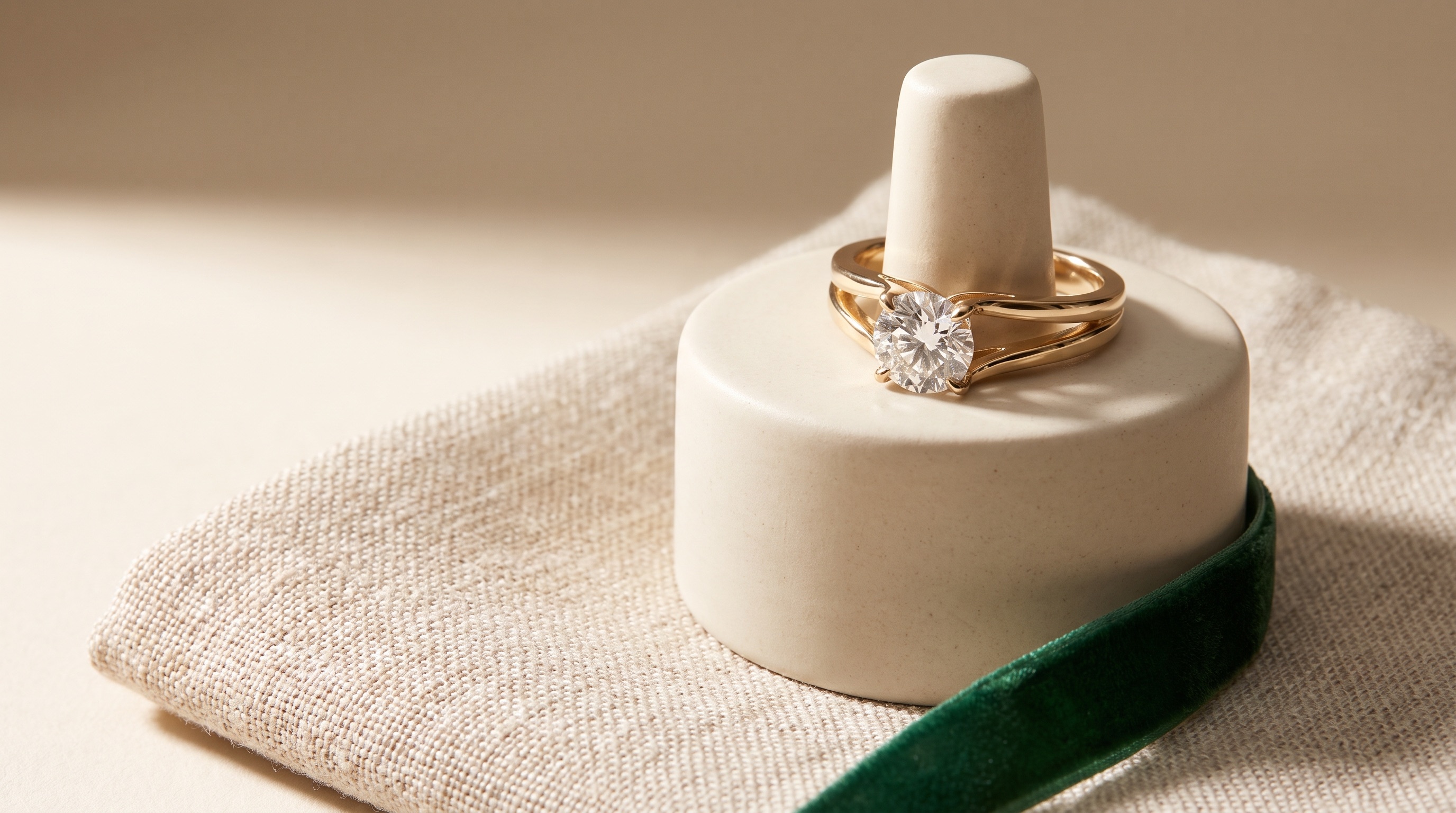
A split shank diamond ring is a setting where the band divides into two or more separate strands as it approaches the center stone, typically rejoining at the head to frame it from two directions rather than one. The split sections are commonly lined with pavé or channel-set accent diamonds, which adds sparkle along the shoulders and, from a manufacturing standpoint, changes how the setting is built, sized, and priced compared to a plain shank.
For a jeweler deciding what to stock, "split shank" isn't a single product — it's a construction category that spans a wide range of labor complexity, accent diamond weight, and price point. A two-row pavé split shank in 14k gold and a three-row micro-pavé split shank in platinum with a hidden halo can sit two or three price tiers apart, even though both would show up under the same search term to a customer walking through the door. This guide is written for independent jewelers, designers, and small manufacturers deciding how to source, price, and build out split shank inventory — not for a shopper comparing rings, but for the buyer who has to stock the case those shoppers browse. It covers how split shank settings are constructed, where they fit against solitaire and cathedral mountings on a stocking and margin basis, which center stone shapes pair with the style most reliably, and what to check when sourcing mountings or building custom pieces around them.
What Is a Split Shank Setting, Mechanically?
On a plain shank ring, the band is a single continuous piece of metal that widens slightly under the head to support the center stone. A split shank replaces that single band with two (or occasionally three) separate metal strands for roughly the last third to half of the band's length before it reaches the setting, then rejoins — sometimes into the gallery structure directly, sometimes into a decorative bridge — to hold the center stone. The visual effect is a band that appears to "open up" and cradle the stone from two directions instead of tapering into it from one.
Structurally, this matters for a few reasons a bench jeweler or sourcing buyer needs to think about even though a shopper never will:
Metal Distribution Changes
Splitting the shank into two thinner strands generally uses a comparable or slightly greater total metal weight than a single wider band of the same overall width, because each strand still needs enough thickness to hold its shape and support any accent stones set into it. A split shank isn't automatically a metal-saving design — it's a structural and aesthetic choice, and casting houses price it on labor and stone-setting time more than on raw metal weight saved.
The Rejoin Point Is a Structural Stress Point
Wherever the two strands merge back into a single gallery or bridge, that junction carries load every time the ring flexes on the finger — putting it on, taking it off, and the ordinary twisting a ring absorbs during a normal day. A well-built split shank reinforces that junction with enough metal thickness to avoid fatigue cracking over years of wear; a poorly built one is a common source of warranty repairs on inexpensive imports. This is one of the first things worth checking on a sample mounting before committing to a reorder-able SKU.
Accent Stone Placement
The strands themselves are usually set with pavé (small stones held by shared prongs or beads) or channel-set stones (stones set flush between two metal walls, no visible prongs), running along the top or outer edge of each strand. Pavé reads as more sparkle-dense and is more labor-intensive to set; channel-set reads cleaner and is generally more durable for everyday-wear pieces since there are no raised prongs to catch on clothing.
Why Independent Jewelers Stock Split Shank Settings
Split shank has held steady, non-seasonal demand in the bridal category for over a decade because it solves a specific merchandising problem: it lets a jeweler offer more visible diamond weight and sparkle around a modest center stone without inflating the center stone's own price. A customer working with a fixed budget who wants a ring that "looks bigger" often gets more visual impact from a split shank with a half carat of pavé along the shoulders than from stretching that same budget into a marginally larger, plainer center stone. That makes split shank inventory a useful complement to solitaire inventory rather than a replacement for it — the two styles serve different parts of a customer's decision, and stocking both covers more of the floor traffic a bridal counter sees in a given month.
From a case-merchandising standpoint, split shank pieces also photograph and display well from an angle, which matters more than it used to now that a large share of bridal shopping starts online before a customer ever walks into a store. A jeweler building out a web catalog or Instagram grid benefits from having a few split shank options that create visual variety against a case otherwise dominated by plain and cathedral solitaires.
Split Shank Construction Types
Not all split shanks are built the same way, and the construction type is the single biggest driver of both retail price and setting labor cost. When sourcing, it's worth being specific about which of these a supplier is quoting, since "split shank" alone doesn't pin down the labor involved.
Two-Row Pavé Split Shank
The most common version: the band splits into two strands, each lined with a single row of pavé-set round diamonds. This is the baseline SKU most jewelers carry first, since it balances visible sparkle against a moderate diamond weight and setting time.
Multi-Row (Three-Strand) Split Shank
The band divides into three strands rather than two, sometimes with the center strand plain and the outer two pavé-set, sometimes all three set. This reads as noticeably more substantial on the hand and carries a meaningfully higher accent diamond count, which pushes both cost and retail price up a tier.
Channel-Set Split Shank
Rather than pavé, the strands carry channel-set stones — usually princess or baguette cuts — set flush between two rails of metal. This construction holds up better under daily wear for customers in manual trades or active lifestyles, since there's no raised prong to snag, though the flush setting requires more precise stone calibration during manufacturing.
Split Shank with a Hidden Halo or Bridge Detail
Some split shank mountings add a small halo of pavé diamonds set into the underside of the gallery, visible mainly when the ring is viewed from the side or the wearer's own vantage point. This is a common upsell built on top of a standard split shank base rather than a separate mounting category, and it's worth quoting separately since it adds meaningful bench time for a detail most customers only notice after the sale.
Split Shank vs. Solitaire vs. Cathedral: Stocking and Pricing Comparison
For a buyer deciding how to allocate case space and open-to-buy dollars across bridal mounting styles, the practical differences come down to setting labor, accent diamond exposure, and how forgiving each style is to resize and repair. The table below compares the three most commonly stocked engagement ring shank styles on those terms.
| Factor | Split Shank | Plain Solitaire | Cathedral |
|---|---|---|---|
| Typical accent diamond weight | 0.15ct–0.50ct+ across the shoulders, scales with row count | None, or a token amount at the shoulder only | Usually none on the arch itself; sometimes light pavé on the shoulders |
| Relative setting labor | Higher — two or three strands each need individual stone-setting and finishing | Lowest — a single band and head, minimal stone-setting beyond the center | Moderate — the raised arch adds bench time over a flat shank but less than split-strand setting |
| Resizing difficulty | Higher — resizing must account for two strands rejoining evenly, and pavé near the sizing point can be disturbed | Lowest — a single band resizes with standard bench technique | Moderate — the raised arch doesn't complicate resizing much on its own |
| Retail price position relative to a plain solitaire of the same center stone | Typically 15%–40% higher, depending on row count and accent carat weight | Baseline | Typically 10%–20% higher, mainly for the raised metalwork |
| Best-fit customer | Wants more visible sparkle/size on a fixed center-stone budget | Wants the center stone to be the sole visual focus | Wants a taller, more dramatic profile without added stone weight |
| Common repair/warranty issue | Prong wear on pavé strands; fatigue at the shank rejoin point on thin construction | Prong wear on the head only | Prong wear on the head; the arch itself rarely fails |
None of this makes one style categorically "better" to stock — it's a mix decision. A case with only plain solitaires misses the segment of customers actively looking for a shoulder-diamond option, and a case overloaded with split shank and other labor-heavy constructions ties up more open-to-buy dollars per unit than the sell-through on any single style usually justifies.
Center Stone Shape Compatibility with Split Shank Settings
Split shank mountings are generally available across standard shapes, but some center stone shapes pair with the style more naturally than others, largely because of how the shoulders visually frame the stone's outline.
| Center Stone Shape | Fit with Split Shank | Notes for Sourcing |
|---|---|---|
| Round Brilliant | Excellent — the most commonly requested pairing | Widest semi-mount availability; safest first SKU to stock |
| Oval | Excellent | The split shank's opening angle flatters an oval's elongated outline; strong current demand |
| Cushion | Very good | Works especially well with pavé rather than channel-set strands, softening the cushion's corners |
| Emerald / Asscher | Good, with a caveat | Step-cut stones show inclusions more readily, so pairing with a busy split shank doesn't hide anything — center stone clarity matters more here than with a brilliant cut |
| Pear / Marquise | Good | Split shank helps visually anchor the narrower point of these shapes; less commonly requested but a reliable special-order fit |
| Antique cuts (Old Mine, Old European, Kite, Trillion) | Case-by-case | Antique-style stones are usually paired with period-appropriate solitaire or cathedral mountings rather than a modern split shank; if a customer requests the combination, it's typically a custom build rather than a stocked semi-mount |
For a jeweler stocking semi-mount inventory rather than building every piece to order, round and oval account for the large majority of split shank requests, which makes them the safest shapes to keep pre-set head sizes on hand for.
Metal and Manufacturing Considerations
A handful of manufacturing details separate a split shank mounting that holds up to years of daily wear from one that generates repeat warranty claims, and they're worth checking directly on a sample before committing to a reorder relationship with any supplier.
Strand Thickness at the Rejoin Point
As noted above, the point where the strands merge back together carries real mechanical stress. On a well-engineered mounting, that junction is noticeably thicker than the strands themselves — thin, purely decorative rejoins are a common cause of cracking after a year or two of wear, particularly in white gold, which work-hardens differently than platinum under repeated flexing.
Platinum vs. 14k/18k Gold
Platinum holds a prong setting longer under wear before it needs re-tipping, which matters more on a split shank than a plain band because there are simply more prongs (or more channel walls) in contact with stones. Gold split shanks, especially in 14k, are more prone to prong wear on the pavé strands over several years and should be flagged to customers as needing a shorter re-check interval — a detail worth building into a store's own care and warranty messaging, independent of what any supplier says.
Rhodium Plating on White Gold
White gold split shanks are rhodium plated the same as any other white gold mounting, but the plating on a split shank wears unevenly faster than on a plain band, because the multiple raised strands see more surface contact against clothing, countertops, and other objects than a single flat band does. This is a normal, expected maintenance item — plan for it in after-sale care conversations rather than treating it as a defect.
Consistent Melee Sizing Across a Production Run
Pavé and channel-set strands depend on calibrated melee diamonds sized consistently enough that a bench setter isn't hand-fitting mismatched stones into a fixed channel width. Sourcing from a supplier who calibrates melee to a consistent size and clarity baseline for the run reduces bench rework and keeps finished-piece quality consistent across a reorder, which matters more for split shank pieces than for a plain band precisely because there are more stones involved per unit.
Pricing and Margin Considerations When Stocking Split Shank
Because split shank mountings carry more setting labor and more accent diamond weight than a plain solitaire, they typically carry a wider dollar spread between wholesale cost and retail price — which can look attractive on a margin percentage basis, but ties up more capital per unit sitting in a case. A few practical points worth building into a stocking plan:
Labor Is the Larger Variable, Not Metal
Between two split shank mountings of similar metal weight, the price difference is driven far more by row count, stone-setting style (pavé versus channel), and accent diamond count than by the metal itself. When comparing quotes across suppliers, breaking out labor from materials cost makes it much easier to spot where a price difference is actually coming from.
Accent Diamond Quality Should Match, Not Exceed, the Center Stone's Positioning
It's common for buyers new to split shank sourcing to over-spec accent diamond clarity relative to what a customer will ever notice in melee-sized stones. A DEF+/VS+ baseline is standard for calibrated pavé and channel melee in the trade and is generally indistinguishable to the eye from a higher grade at that size — spending up for a higher clarity grade on stones this small adds cost without a corresponding retail lift in most cases.
Semi-Mounts Reduce Per-Unit Capital Risk Compared to Fully Custom Builds
Stocking pre-set semi-mount split shanks (with an open head sized for common round and oval carat weights) lets a jeweler show the finished look on the floor without committing capital to a specific center stone until a customer actually selects one. This is generally the more capital-efficient way to build out split shank inventory compared to building fully custom pieces speculatively.
Sourcing Options: Semi-Mount Inventory vs. Custom Build
Jewelers generally source split shank settings one of two ways, and the right mix depends on store volume and customer expectations around lead time.
Stocked Semi-Mounts
A semi-mount arrives with the shank, shoulders, and accent stones already set, and an open head ready to receive a center stone the customer selects separately. This is the faster path to a sale — the piece can be finished same-day at the bench once a center stone is chosen — and it's the more practical approach for a store that wants split shank options visible and sellable on the floor without a special-order wait.
Fully Custom Builds
For a customer who wants a specific row count, an unusual center stone shape, or a metal combination not held in standard semi-mount inventory, a fully custom build is the better fit. Working with a manufacturing partner who finishes custom engagement rings in 4–6 days, rather than the 2–6 week turnaround that's typical industry-wide for custom bridal work, materially changes what a jeweler can promise a customer at the counter — a split shank build customized around a specific center stone and row count doesn't have to mean asking a customer to wait a month.
Inventory Strategy: How Many Split Shank SKUs to Stock
For most independent jewelers, split shank doesn't need to dominate the bridal case — it needs a deliberate, modest footprint that covers the most commonly requested variations without over-investing in a style that's still secondary to plain solitaire and cathedral demand for most customer bases.
Start with Round and Oval, Two-Row Pavé
Given how heavily round and oval dominate split shank requests, a starting inventory built around those two shapes in the standard two-row pavé construction covers the large majority of walk-in and online inquiries before expanding into three-row or channel-set variations.
Keep One Platinum and One 14k/18k Gold Option Per Shape
Metal preference splits fairly evenly across customer bases by region and price sensitivity, so having at least one platinum and one gold option per popular shape avoids losing a sale to a metal preference the case doesn't cover, without needing to double every SKU across every metal.
Reserve Three-Row and Hidden-Halo Variations for Custom Order
These carry meaningfully higher unit cost and slower turnover for most stores, making them better suited to a build-to-order path than sitting in the case as speculative stocked inventory, unless a store's specific customer base has shown consistent demand for the heavier construction.
Quality Checks Before Committing to a Reorder-able SKU
Before adding a split shank mounting to a standing reorder list, a few checks at the bench catch most of the issues that turn into warranty claims later:
- Flex-test the rejoin point — gently flex a sample piece and check for any give or gap at the junction where the strands merge; there should be none.
- Check prong height consistency across all set stones — uneven prong height on pavé strands is a common sign of rushed setting work and predicts early stone loss.
- Confirm melee color and clarity match across the full run, not just on the sample piece — a supplier's sample can look better than the production batch if melee sourcing isn't consistently calibrated.
- Verify hallmark and metal stamping is legible and correctly placed inside the shank, ideally away from where the strands split, since stamping placed too close to the split can weaken that section.
- Ask how the piece resizes before committing to a SKU for customers who may need sizing adjustments — some split shank constructions resize cleanly with standard bench technique, others require the strands to be carefully re-matched, which adds bench time a store should know about upfront.
Sourcing Split Shank Diamond Ring Settings Wholesale
Guru Diam is a trade-only wholesale supplier working with independent jewelers, designers, and manufacturers rather than direct consumers, and split shank engagement ring settings sit squarely inside our custom and finished jewelry capabilities. We build split shank mountings — two-row, three-row, pavé, and channel-set — around natural or lab-grown center stones, and our lab-grown catalog is CVD-grown exclusively; we don't carry HPHT material in that line. Center and accent stones ship with IGI, GIA, or GCAL certification depending on what a buyer's own customer base and price point call for, and calibrated melee for pavé and channel work is sourced to a consistent DEF+/VS+ baseline so a finished piece's accent stones match evenly across the shoulders.
For loose stones and other in-stock inventory, we ship same-day from both our New York and Los Angeles locations — New York before 6pm EST, Los Angeles before 4pm PST — so a jeweler building a semi-mount program can get center stones moving quickly once a customer selects one. Custom pieces, including a split shank build assembled around a specific center stone and row count, are finished in 4–6 days rather than the multi-week turnaround that's typical for custom bridal work industry-wide, which lets a store quote a realistic delivery date at the counter instead of asking a customer to wait a month for a piece built to their specifications.
Buyers building out certified center stone inventory for a semi-mount program can start with our certified diamonds category, and stores sourcing calibrated melee or matched accent stones for pavé and channel-set shoulders can browse matching pairs. For a fancy color center stone paired with a split shank build, our fancy color loose diamonds selection covers yellow, pink, blue, and green options. Trade accounts can review current terms and open an account through the wholesale hub or apply directly via trade partner, and stores ready to build a specific split shank piece around a chosen center stone can start that build through custom jewelry.
Frequently Asked Questions
What is a split shank diamond ring?
A split shank diamond ring is a setting where the band divides into two or more separate metal strands as it approaches the center stone, usually lined with pavé or channel-set accent diamonds along each strand before the strands rejoin at the head. It's a construction style available across most center stone shapes rather than a single fixed product.
Is a split shank setting more expensive than a plain solitaire?
Generally, yes — a split shank typically runs 15% to 40% higher at retail than a plain solitaire of the same center stone, mainly because of the added setting labor for the accent diamonds along the shoulders and the extra bench time to finish two or three strands cleanly rather than one continuous band.
Can split shank rings be resized?
Yes, but resizing is more involved than on a plain band. The bench work has to keep both (or all three) strands matched evenly after the resize, and if pavé stones sit close to where the ring is cut for sizing, extra care is needed to avoid disturbing the setting. It's a routine repair for an experienced bench jeweler, just a longer one than a plain shank resize.
Which center stone shapes pair best with a split shank setting?
Round brilliant and oval account for the large majority of split shank requests and have the widest semi-mount availability. Cushion, pear, and marquise also pair well; step cuts like emerald and Asscher work too, though center stone clarity matters more with those shapes since inclusions show more readily in a step cut.
Should an independent jeweler stock split shank semi-mounts or build them custom?
Most stores benefit from stocking a modest core of semi-mount split shanks in round and oval, two-row pavé construction, since that covers the bulk of walk-in demand and can be finished same-day once a customer picks a center stone. Heavier constructions like three-row or hidden-halo variations are usually better handled as custom builds rather than speculative stocked inventory.
What should a jeweler check before adding a split shank SKU to a reorder list?
Flex-test the point where the strands rejoin to make sure there's no gap or give, check that prong heights are even across the pavé, confirm melee color and clarity are consistent across the full production run rather than just the sample, and ask the supplier how the piece resizes before committing to it as a standing SKU.
Guru Diam is a trade-only wholesale diamond supplier with locations in New York and Los Angeles, building custom split shank and other engagement ring settings around a CVD-only lab-grown catalog alongside natural diamonds, certified loose stones, and finished jewelry across standard, antique, and exotic shapes. Browse certified inventory in the certified diamonds category, source calibrated accent stones through matching pairs, or start a custom split shank build through custom jewelry. Trade accounts can review current terms at the wholesale hub or apply through trade partner.