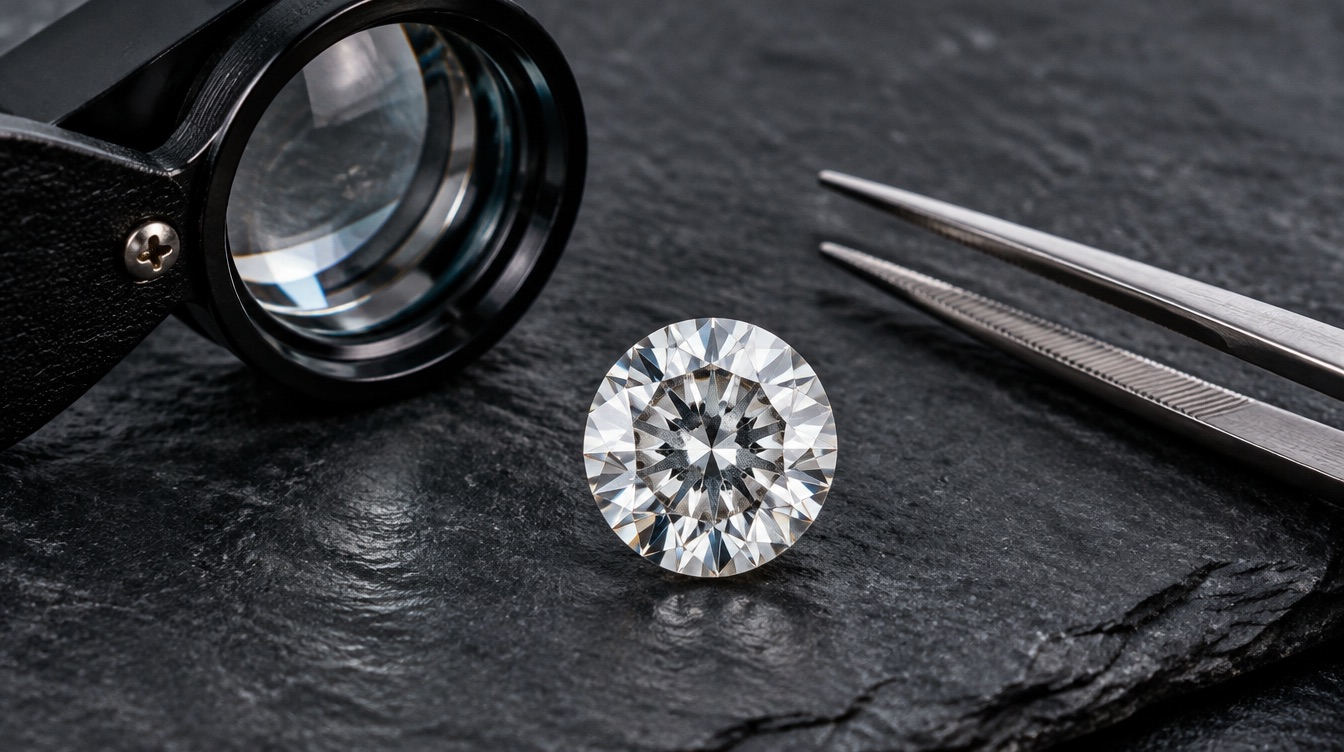
SI2 (Slightly Included, second tier) is a diamond clarity grade one step below SI1 and one step above the Included (I1-I3) range on the GIA, IGI, and GCAL clarity scale. Inclusions at SI2 are noticeable under 10x magnification and, unlike the grades above it, can occasionally be visible to the naked eye without any magnification at all — though whether a specific stone actually shows this depends heavily on the type, size, and position of its inclusions rather than the grade letter alone. SI2 sits at the point on the clarity scale where individual stone review stops being optional and becomes genuinely necessary before buying.
Where SI2 Sits on the Clarity Scale
| Grade | Meaning | Inclusion visibility |
|---|---|---|
| VS1 / VS2 | Very Slightly Included | Minor, hard to find under 10x; invisible to the naked eye |
| SI1 | Slightly Included, first tier | Noticeable under 10x; usually still eye-clean in brilliant cuts |
| SI2 | Slightly Included, second tier | Clearly noticeable under 10x; can occasionally be visible to the naked eye |
| I1 | Included, first tier | Typically visible to the naked eye |
| I2-I3 | Included, lower tiers | Visible to the naked eye; can affect durability and transparency |
SI2 is the widest and most variable grade in practical terms of any commonly purchased clarity tier. Where a VS2 or SI1 stone's appearance is fairly predictable from the grade alone, two different SI2 stones can look meaningfully different from each other — one might be essentially indistinguishable from a clean SI1 to the naked eye, while another might show a clearly visible inclusion in certain lighting or viewing angles. This variability is exactly why SI2 requires more individual attention from a buyer than higher grades do.
What Inclusions Typically Look Like at SI2
At SI2, inclusions are large enough or numerous enough to be readily apparent to a trained grader without needing to search for them under magnification. Common characteristics include larger feathers, more prominent crystal inclusions, noticeable clouds, or a combination of several smaller inclusions that collectively push the grade down from SI1. What determines whether a specific SI2 stone is eye-clean or not comes down to a short list of factors: the inclusion's size relative to the stone's total facet area, its position (centered under the table versus tucked near the girdle), its color and contrast against the surrounding diamond (a white or colorless inclusion is far less noticeable than a dark one), and the shape's facet pattern, which either helps hide or actively exposes the characteristic.
Dark inclusions — carbon spots or dark crystals — are the type most likely to create a visible SI2 stone, since their contrast against the surrounding diamond makes them stand out regardless of size. White or translucent inclusions of a similar size are much less likely to be noticeable, even in an otherwise identical SI2 grade. This is a critical distinction the grade letter alone doesn't communicate, and it's the single biggest reason SI2 shopping benefits from reviewing actual images or the stone in person rather than buying from the grade specification sheet alone.
Which Shapes Handle SI2 Best (and Worst)
Shape matters more at SI2 than at any cleaner grade, because the margin for error is thinner:
- Round brilliant is the most forgiving shape for SI2, since its facet pattern scatters light most effectively of any cut, camouflaging inclusions best.
- Cushion, princess, and oval brilliants perform well, though slightly less forgivingly than round, particularly oval, which can develop a "bowtie" effect (a dark shadow across the center) that sometimes draws attention to inclusions positioned within it.
- Marquise and pear brilliants have pointed ends where inclusions can occasionally concentrate visibility, worth a specific look at the tips.
- Emerald, asscher, and other step cuts are the least forgiving by a significant margin — their open, mirror-like facets make SI2 inclusions considerably more likely to be visible without magnification. Many jewelers set a firm floor of VS2 or VS1 for step-cut center stones specifically because SI2 in this shape category is a real visibility risk, not a marginal one.
SI2 vs. SI1 vs. VS2: Practical Comparison
| Grade | Naked-eye risk | Price position | Best for |
|---|---|---|---|
| VS2 | Very low risk; reliably eye-clean | Higher | Standard commissions wanting minimal review burden |
| SI1 | Low risk in brilliant cuts; some variability | Moderate | Budget-conscious brilliant-cut purchases with basic review |
| SI2 | Real risk, stone-dependent; requires individual review | Lower | Maximum-value brilliant-cut purchases where the buyer reviews the specific stone |
The price gap between SI1 and SI2 is often meaningful, and between SI2 and I1 the gap narrows again — which places SI2 in an interesting position as the last grade where "eye-clean" is still a realistic, achievable outcome with the right individual stone, before quality drops into a range where visible inclusions become the norm rather than the exception.
How to Actually Evaluate an SI2 Stone Before Buying
Because SI2 varies so much stone to stone, a grade-only purchase carries real risk. A practical evaluation checklist:
- Request high-resolution images or video of the actual stone, not a generic representative photo. Most reputable suppliers can provide this for individual stones, especially above roughly 0.50 carats.
- Review the plotting diagram for inclusion type and position — favor stones with inclusions plotted near the girdle over ones plotted centrally under the table.
- Ask specifically about inclusion color. A white or light-colored inclusion is a meaningfully safer bet than a dark one at this grade, even at the same size.
- Favor round and standard brilliant shapes over step cuts if SI2 is the target grade, given the significant difference in how well each hides inclusions.
- Consider carat size carefully. A small SI2 melee accent is a very safe bet; a large SI2 center stone in a step cut is the riskiest combination on this list.
SI2 for Budget-Conscious Buyers: When It Makes Sense
SI2 has a real, legitimate place in a value-conscious buying strategy — it isn't simply a compromise grade. For a round or cushion brilliant center stone, a carefully selected SI2 (reviewed via images or in person, not bought blind) can deliver a genuinely eye-clean stone at meaningfully better value than VS2 or SI1, freeing up budget for a larger carat weight, a better cut grade, or a more elaborate setting — all of which tend to have a bigger visible impact on the finished piece than clarity grade does past the eye-clean threshold. The tradeoff is that SI2 shopping takes more legwork: it isn't a grade to buy sight-unseen from a generic spec sheet the way VS2 comfortably can be.
SI2 in Lab-Grown vs. Natural Diamonds
Clarity grading methodology and terminology are identical between CVD lab-grown and natural diamonds at every lab. An SI2 report from GIA, IGI, or GCAL carries the same meaning regardless of the stone's origin. Lab-grown SI2 stones more commonly show pinpoint clusters and cloud-type inclusions from the growth process, while natural SI2 stones more often show feathers and mineral inclusions from geological formation — a difference in typical inclusion character worth knowing, but not one that changes the fundamental evaluation approach: review the specific stone, don't buy the grade blind.
SI2 for Side Stones and Melee
For smaller accent and melee stones, SI2 is frequently a very sensible default rather than a risk to manage carefully. Small facets naturally camouflage inclusions far more effectively than large ones, which is why SI2 — sometimes even lower — is a common, cost-effective standard for melee and pavé work across the trade, reserving higher clarity grades specifically for the center or focal stone where visibility and scrutiny are highest.
How Clarity Grading Actually Works
Clarity grading is a trained human assessment, not an automated measurement. A grader examines a stone under standardized 10x magnification and evaluates the number, size, position, nature, and relief (visual contrast against the surrounding stone) of every inclusion and blemish present, then assigns a grade reflecting their combined impact — not a simple inclusion count. This matters specifically for SI2 because the grade covers a genuinely wide range of underlying appearances: a stone can land at SI2 because of one moderately prominent inclusion, or because of several smaller ones that collectively push the grade down, and these two scenarios can look quite different from each other despite carrying the identical clarity grade on paper. Reputable labs — GIA, IGI, and GCAL among them — typically have more than one grader independently assess a stone before finalizing the report, which is part of why certified grading carries real trust in the trade relative to an uncertified in-house grade with no independent oversight.
Blemishes and inclusions are graded together but aren't the same thing. Inclusions are internal characteristics — feathers, crystals, clouds, cavities — that formed inside the stone and are permanent. Blemishes are external — small nicks, scratches, or naturals (unpolished remnants of the rough diamond's original surface) on the outside of the stone, some of which can be removed by minor repolishing without significant weight loss. At SI2, the grade more often reflects inclusions specifically, since blemishes alone rarely push a well-cut stone down this far on the scale.
Reading the Full Grading Report for an SI2 Stone
Given how much individual variation exists within the SI2 grade, the full grading report deserves more attention here than at cleaner grades. Beyond the plotting diagram showing inclusion location, look at the comments section, which often includes specific notes — "clouds not individually plotted" or a note about a feather's exact orientation, for instance — that give real insight into what a stone actually looks like beyond the letter grade. Cross-reference the plotted inclusion positions against how the stone will likely be set: an inclusion near where a prong or bezel edge will sit is effectively invisible once mounted, while the same inclusion positioned centrally under the table remains visible regardless of setting choice. This kind of report-level review is the single highest-leverage thing a buyer or jeweler can do to de-risk an SI2 purchase without paying for a cleaner, more expensive grade.
SI2 and Carat Weight: A Closer Look
| Carat range | SI2 experience |
|---|---|
| Under 0.50ct | Facets are small enough that most SI2 stones read as eye-clean even with a moderately visible inclusion by grading standards |
| 0.50-1.00ct | Individual stone review becomes genuinely important; outcomes vary meaningfully stone to stone |
| 1.00-2.00ct | Larger facets increase visibility risk; prioritize round or other forgiving brilliant shapes and review images closely |
| 2.00ct+ | SI2 carries real visibility risk at this size in most shapes; many buyers move up to SI1 or VS2 specifically for larger center stones |
This scaling pattern is worth communicating clearly to clients specifically drawn to SI2 for its price advantage: the grade's value proposition holds up well at smaller and moderate carat weights, but the math changes at larger sizes, where the same percentage savings on a bigger stone comes with meaningfully higher visibility risk that a small side-stone purchase never faced.
A Practical Framework for Recommending SI2
For jewelers advising clients on a tight budget, SI2 deserves a specific, honest framing rather than either blanket avoidance or blanket recommendation: it's a strong value option for round and other forgiving brilliant shapes under roughly 1.5 carats, provided the specific stone is reviewed via images or in person rather than bought from a spec sheet alone. It's a riskier choice for step cuts at any size, and for brilliant cuts above roughly 2 carats, where the size premium increases the odds a specific inclusion becomes noticeable. Framed this way, SI2 isn't a grade to avoid or to default to — it's a grade that rewards the extra step of reviewing the actual stone, which is exactly the kind of guidance that builds trust with a value-conscious client who appreciates being walked through the real tradeoff rather than just being upsold to a cleaner, pricier grade by default.
Frequently Asked Questions
Is SI2 clarity noticeable to the naked eye?
Sometimes, depending on the specific stone. Inclusion size, position, color, and the diamond's shape all determine whether a given SI2 stone is eye-clean or shows a visible characteristic — which is why individual stone review matters more at this grade than at cleaner ones.
Is SI2 a good clarity grade for an engagement ring?
It can be, particularly for round or cushion brilliant shapes, provided the specific stone is reviewed via images, video, or in person before purchase rather than bought from the grade alone.
What's the difference between SI1 and SI2 clarity?
SI1 inclusions are noticeable under magnification but reliably invisible to the naked eye in most cases. SI2 inclusions are more prominent and carry real risk of naked-eye visibility, making individual stone review more important.
Should I avoid SI2 clarity in a step-cut diamond?
It's worth real caution. Step cuts like emerald and asscher expose inclusions far more readily than brilliant cuts, so many buyers and jewelers set a higher clarity floor — VS2 or VS1 — specifically for step-cut center stones.
Does SI2 clarity affect a diamond's durability?
Rarely, at this grade specifically. Durability concerns become more relevant at the I1-I3 tiers, where larger or more structurally significant inclusions can occasionally affect a stone's strength. SI2 inclusions are generally a cosmetic consideration, not a structural one.
Can SI2 diamonds be certified?
Yes. SI2 is graded and certified the same way as any other clarity tier by GIA, IGI, and GCAL, with a full plotting diagram included on the report.
Common Mistakes When Buying SI2
A handful of recurring errors show up when buyers or first-time jewelers shop SI2 for the first time:
- Buying from a spec sheet alone. Treating SI2 like VS2 — trusting the grade letter without reviewing images, video, or the stone in person — is the single most common mistake, given how much more this grade varies stone to stone.
- Choosing a step cut to save money at SI2. The savings from choosing SI2 over a cleaner grade are real, but pairing that choice with a step-cut shape compounds visibility risk in a way that often erases the value of the savings once a visible inclusion shows up in the finished piece.
- Ignoring inclusion color. Two SI2 stones with similarly sized inclusions can look very different depending on whether the inclusion is white/translucent or dark — a distinction the grade letter doesn't communicate but that matters enormously for naked-eye appearance.
- Assuming a large stone and a small stone at SI2 carry equal risk. As covered above, carat weight meaningfully changes SI2's real-world risk profile — the same grade that's a safe bet at 0.75 carats is a meaningfully bigger gamble at 2.5 carats.
SI2 vs. Moving Up to a Cleaner Grade: A Cost-Benefit View
For a buyer weighing SI2 against SI1 or VS2, the honest cost-benefit calculation depends heavily on shape and size rather than being a fixed answer. In a round brilliant under a carat, the jump from SI2 to VS2 often buys very little visible improvement for a real price increase — money that would generally do more visible work spent on a larger carat weight or a better cut grade instead. In a step-cut shape or a larger center stone, that same jump buys real, meaningful risk reduction against a visible inclusion, making the upgrade a more defensible use of budget. The right answer isn't a fixed grade recommendation independent of context — it's matching the clarity floor to the specific shape and size in front of you, which is the core judgment call an experienced jeweler brings to a sourcing conversation that a generic online buying guide can't fully replicate without seeing the actual stone options available.
Sourcing SI2 Clarity from Guru Diam
Guru Diam stocks SI2 across our certified loose diamond range for buyers prioritizing value, with images available on request for individual stone review before purchase — exactly the kind of stone-specific evaluation this grade benefits from. Our team can help identify well-positioned, naturally eye-clean SI2 options for round and other brilliant-cut shapes, and steer step-cut commissions toward a higher clarity floor where it genuinely matters. In-stock inventory ships same-day from New York or Los Angeles, our custom jewelry program finishes pieces in 4-6 days, and trade accounts can review full inventory through the wholesale hub or a trade partner account.
Every stone we carry, SI2 included, ships with its full grading report and plotting diagram, and we can supply direct images on request before a purchase is finalized — the standard buying approach this grade specifically calls for. For jewelers building a value-tier line of engagement ring options for budget-conscious clients, our team can pull a curated set of pre-reviewed, naturally eye-clean SI2 stones in round and other forgiving shapes, saving the individual vetting work on each stone while still delivering the honest, stone-specific quality assurance this clarity grade requires.