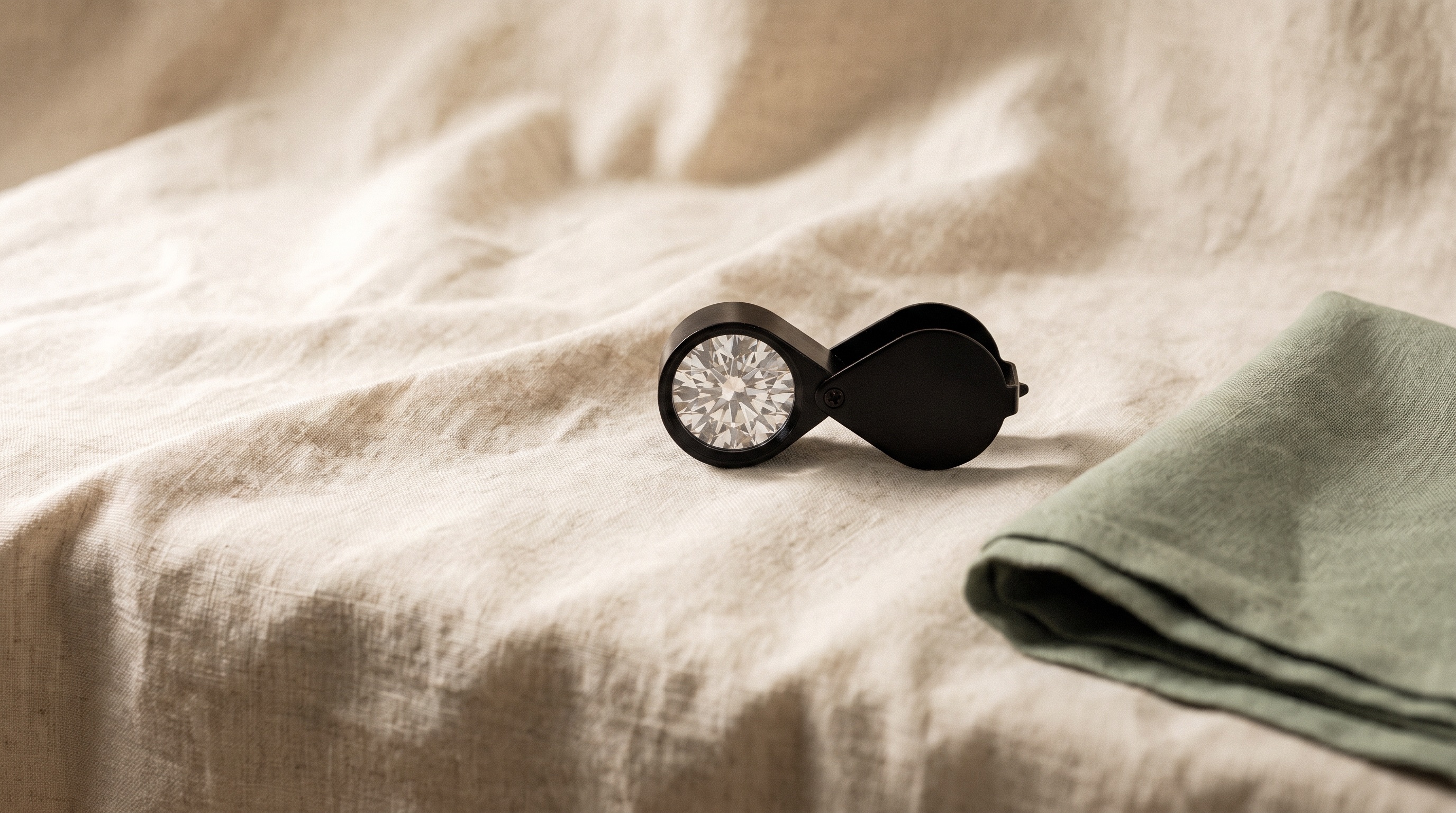
SI1 (Slightly Included, first tier) is a diamond clarity grade on the GIA, IGI, and GCAL scale, sitting one step below VS2 and one step above SI2. Inclusions at SI1 are visible to a trained grader under 10x magnification but are usually not visible to the naked eye once the stone is set — SI1 is widely regarded in the trade as the clarity grade that delivers the best balance of price and eye-clean appearance, which is exactly why it's one of the most consistently recommended grades for buyers who want a genuinely clean-looking stone without paying for a VS or higher grade they can't actually distinguish from SI1 with the naked eye.
Where SI1 Sits on the Clarity Scale
| Grade | Meaning | Inclusion visibility |
|---|---|---|
| FL / IF | Flawless / Internally Flawless | No inclusions visible under 10x magnification |
| VVS1 / VVS2 | Very Very Slightly Included | Extremely minor, difficult to find even under 10x; invisible to the naked eye |
| VS1 / VS2 | Very Slightly Included | Minor, hard to find under 10x; invisible to the naked eye |
| SI1 | Slightly Included, first tier | Noticeable under 10x; usually eye-clean in brilliant cuts |
| SI2 | Slightly Included, second tier | Clearly noticeable under 10x; can occasionally be visible to the naked eye |
| I1-I3 | Included | Typically visible to the naked eye |
SI1 occupies a genuinely important position on the clarity scale: it's the lowest grade where "eye-clean" is still the reasonable default expectation for most stones, rather than something that needs to be individually confirmed on every purchase the way it does at SI2 and below. That combination — meaningfully lower price than the VS tiers, while still looking clean to the naked eye in the large majority of cases — is exactly why SI1 has such a strong, durable reputation in the trade as the sensible default recommendation.
What Inclusions Typically Look Like at SI1
At SI1, inclusions are noticeable to a trained grader under 10x magnification without extensive searching, but they're generally smaller, fewer, or less contrasty than what defines SI2. Common characteristics include small feathers, minor crystal inclusions, or light clouding — present and identifiable, but modest enough in size and visibility that the large majority of SI1 stones read as clean to the naked eye once mounted. What determines whether a specific SI1 stone is genuinely eye-clean comes down to the same core factors that matter at any clarity grade: the inclusion's size relative to the stone's total facet area, its position (centered under the table is more visible than tucked near the girdle), its color and contrast against the surrounding diamond, and the shape's facet pattern.
Dark inclusions — carbon spots or dark crystals — remain the type most likely to create a visible SI1 stone, since contrast matters more than raw size. White or translucent inclusions of a similar size are far less likely to be noticeable, even within the same SI1 grade. This is the main reason two SI1 stones with the same certificate grade can look meaningfully different in person, and it's worth reviewing actual images or the stone itself rather than relying on the grade letter alone, particularly for a larger center stone.
Which Shapes Handle SI1 Best (and Worst)
- Round brilliant is the most forgiving shape for SI1, with a facet pattern specifically engineered to scatter light and break up the visibility of small inclusions — the large majority of round brilliant SI1 stones are reliably eye-clean.
- Cushion, oval, and pear are also generally forgiving, though larger stones in these shapes deserve a closer look, particularly toward the pointed ends of pear and marquise-adjacent shapes where inclusions can be more visible.
- Princess cut hides inclusions reasonably well in its center but can show them more clearly near the corners.
- Emerald and asscher (step cuts) are the least forgiving shapes for SI1 — their large, open facets act like windows into the stone, making inclusions considerably easier to spot than in a brilliant cut at the identical grade. Step-cut SI1 stones deserve individual review more consistently than brilliant-cut SI1 stones do.
SI1 vs. Nearby Grades
| Grade | Naked-eye appearance | Price position | Best fit |
|---|---|---|---|
| VS2 | Reliably eye-clean across virtually all shapes and sizes | Premium over SI1 | Buyers who want maximum confidence, especially in step cuts |
| SI1 | Usually eye-clean, especially in brilliant cuts | Trade's default value grade | Most buyers, most shapes, most budgets |
| SI2 | Variable; can occasionally be visible without magnification | Lower than SI1 | Budget-focused buyers willing to review the individual stone |
| I1 | Typically visible to the naked eye | Lowest of the commonly sold grades | Melee, accent stones, or buyers prioritizing size above all else |
The gap between SI1 and SI2 is where the trade sees the single biggest jump in "needs individual review" risk. SI1 is reliable enough as a grade that most brilliant-cut stones don't require exhaustive pre-purchase scrutiny; SI2 crosses into territory where that scrutiny becomes genuinely necessary on a stone-by-stone basis. This is the core reason SI1, not SI2, earns the trade's reputation as the reliable "sweet spot" grade.
Carat Size and SI1: Does Bigger Change the Picture?
Unlike color, which scales continuously and predictably with carat weight, clarity's relationship to size is less about the grade itself changing and more about a larger stone simply presenting a bigger facet area for an inclusion to become visible within. A given inclusion type at SI1 is somewhat more likely to be noticeable in a 2-carat stone than the identical relative inclusion in a 0.50-carat stone, purely because there's more magnified surface area to view it against.
| Carat range | SI1 eye-clean reliability |
|---|---|
| Under 0.75ct | Very high; SI1 is reliably eye-clean across nearly all shapes at this size |
| 0.75-1.50ct | Still high in brilliant cuts; individual review becomes more worthwhile in step cuts |
| 1.50-3.00ct | Generally still eye-clean in brilliant cuts, but individual stone review is recommended across all shapes at this size |
| 3.00ct+ | Individual stone review strongly recommended regardless of shape; consider VS2 for maximum confidence at this size |
Is SI1 Clarity Good for an Engagement Ring?
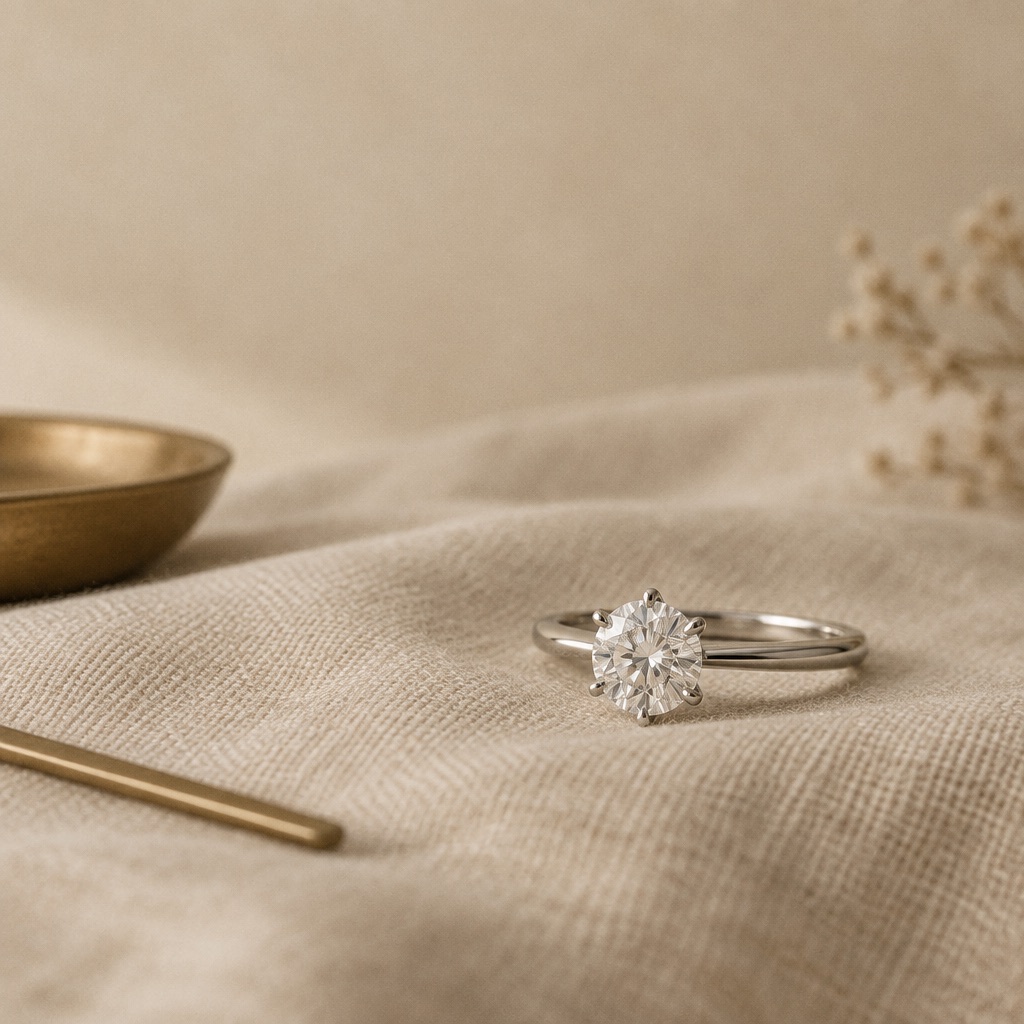
Yes, genuinely — SI1 is one of the most frequently recommended clarity grades for engagement ring center stones specifically because it delivers a reliably clean face-up appearance at a meaningfully better price than VS1 or VS2. For round brilliant, cushion, and oval shapes under about 1.5 carats, SI1 is close to a default-safe recommendation. Where SI1 warrants more individual scrutiny is in step-cut shapes (emerald, asscher) or in larger center stones, where the specific stone's inclusion type and position matter enough to review directly rather than relying on the grade alone.
SI1 in Lab-Grown vs. Natural Diamonds
Clarity grading methodology and the FL-to-I3 scale are identical between CVD lab-grown and natural diamonds, applied by the same major labs using the same 10x magnification standard. SI1 lab-grown diamonds are graded to the same standard as SI1 natural stones, and the buying guidance above — favor brilliant cuts for the least scrutiny, review step cuts and larger stones individually — applies equally to both.
A Practical Framework for Recommending SI1
For jewelers advising clients on where clarity fits into their budget, SI1 earns a strong default recommendation for brilliant-cut shapes under roughly 1.5 carats, where the grade reliably delivers an eye-clean result without the VS-tier price premium. Outside that comfort zone — step cuts, larger center stones, or a client who's specifically anxious about any visible inclusion regardless of statistical likelihood — either individual stone review or moving up to VS2 buys real peace of mind. This mirrors the logic used for color grade recommendations: match the clarity floor to the specific shape and size in front of you rather than applying one fixed rule to every commission.
SI1 Clarity in Natural Melee and Accent Work
Beyond center and side stones, SI1 also comes up frequently in discussions of melee-grade material, though it's worth noting the distinction clearly: individually certified loose stones at SI1 (0.30ct and above) follow the full grading process described here, while melee — the small calibrated stones used in pavé, halo, and channel work — is typically sold as uncertified parcel goods against a quality baseline like DEF+/VS+ rather than individually graded. A jeweler sourcing SI1-equivalent quality for melee should expect a parcel-level quality standard rather than a per-stone certificate, which is a normal and expected difference in how clarity is handled at that scale, not a shortfall in quality control.
Common Misconceptions About SI1 Clarity
- "SI1 always has visible flaws." "Slightly Included" describes visibility under 10x magnification, not to the naked eye — the large majority of SI1 stones, especially in brilliant cuts, look completely clean once mounted.
- "SI1 and SI2 are basically the same grade." SI1 is meaningfully more reliable for eye-clean results than SI2; the step between them represents a real, practical jump in how often individual review becomes necessary before purchase.
- "A higher clarity grade always looks better." Once a stone is confirmed eye-clean, additional clarity above that point has no visible effect on appearance — the difference between an eye-clean SI1 and a VVS1 is invisible without magnification, even though the price difference is substantial.
How Clarity Grading Actually Works
GIA, IGI, and GCAL clarity grading is performed by trained graders examining an unmounted diamond under 10x magnification, identifying and weighing every internal characteristic (inclusions) and external characteristic (blemishes) present, then assigning a grade based on the number, size, relief, and position of what they find. The 10x standard is a deliberate, universal benchmark — it's stricter than naked-eye viewing, which is exactly why grades like SI1 can carry visible-under-magnification inclusions while still looking clean in normal use. Graders also consider how the inclusions would affect a trained observer's overall impression of the stone, not just a mechanical count, which is part of why two stones with similar inclusion counts can sometimes land on different sides of a grade boundary.
It's worth understanding that clarity grading evaluates the stone in isolation from cut and color — a report lists all three (plus carat weight) as the "4Cs" precisely because they're independent characteristics that jointly determine a stone's overall appearance and value, even though they interact visually in the finished piece.
Why SI1 Sits Where It Does: The Eye-Clean Threshold
The clarity scale exists as a graduated response to a real practical question — how much does a given inclusion affect the stone's appearance and durability — and SI1 sits at a genuinely useful threshold within that gradient. It's positioned as the lowest clarity grade where eye-clean is still the reasonable default rather than something that needs individual confirmation on every stone, which is precisely why it holds such a strong, durable position in trade buying guidance. One step down, at SI2, that default flips: individual review becomes the responsible standard rather than an optional extra precaution.
SI1 and Cut Quality: A Connected Decision
Cut quality interacts meaningfully with how SI1 inclusions present. A well-cut stone with strong light return and scintillation does more to visually mask minor inclusions than a poorly cut stone does — the same optical "busyness" that makes a well-cut diamond sparkle also helps break up the visibility of small internal characteristics. This means an Excellent or Ideal cut SI1 stone often looks cleaner in practice than a mediocre-cut VS2, which is a genuinely useful piece of buying advice: when a client's budget forces a choice between clarity and cut, prioritizing cut quality typically delivers a better-looking finished stone.
SI1 for Side Stones vs. Center Stones
Clarity standards can reasonably relax for side and accent stones compared to a center stone, since smaller stones present less facet area for an inclusion to become visible within, and viewers naturally focus less scrutiny on accent stones than on the centerpiece. SI1 is comfortably above the bar needed for side stones in nearly every design, and for melee work specifically, SI1 or even SI2 is a common, sensible choice that balances cost and appearance appropriately for the stone's role in the overall piece. Reserving the highest clarity budget for the center stone, where scrutiny is naturally highest, is the more cost-effective allocation for most commissions.
Evaluating a Specific SI1 Stone Before Buying
Because SI1's eye-clean reliability, while high, isn't guaranteed on every single stone, a few practical steps add real confidence before a significant purchase: request the lab report's plotting diagram, which maps the specific inclusion's type, size, and position; ask whether the stone's inclusion is described as white/light or dark, since dark inclusions are more likely to be visible; and for larger stones or step cuts, request magnified photography or video. A certified SI1 grade is a strong statistical signal, but for a meaningful center stone purchase, confirming the specific inclusion's character takes only a few extra minutes and removes nearly all of the remaining uncertainty.
SI1 and Fluorescence: An Unrelated but Often-Confused Pairing
Clarity and fluorescence are graded and reported as entirely separate characteristics on a diamond's certificate, and buyers occasionally conflate the two — assuming a stone with strong fluorescence must also have lower clarity, or vice versa. There's no inherent correlation between the two: an SI1 stone can carry any fluorescence rating, from none to very strong, independent of its clarity grade. The one place the two occasionally interact is visually in stones with very strong fluorescence, which can in rare cases create a slightly hazy or oily face-up appearance — a separate phenomenon from clarity inclusions, and one worth checking directly on a specific stone if it's a concern, rather than assuming a connection to the clarity grade itself.
SI1 and Diamond Durability
Beyond appearance, clarity grade has a secondary but real connection to durability. Certain inclusion types — particularly larger feathers that reach close to the surface — can, in rare cases, present a minor durability consideration under significant impact, though this is far more relevant at I1-I3 than at SI1, where inclusions are smaller and less structurally significant. For everyday wear in a properly set piece, SI1 clarity carries no meaningful durability concern; this consideration becomes more relevant to discuss only when a client is looking at lower clarity grades for size or budget reasons and the specific inclusion type and location warrant a closer look.
SI1 and Resale or Upgrade Considerations
Clarity grade affects resale and trade-in value in a more muted way than color or carat weight, since eye-clean appearance — not the certificate grade itself — is what most secondary buyers actually evaluate. An eye-clean SI1 stone generally holds value comparably well to a VS2 of similar cut and color, since the visible difference between the two is negligible to begin with. Where clarity grade matters more for resale is at the lower end — SI2 and below carry more resale uncertainty specifically because eye-clean status isn't guaranteed, and a buyer evaluating a used stone has to assess that individually rather than trusting the grade alone. For jewelers running trade-in programs, SI1's reliability as a grade makes it one of the more straightforward clarity tiers to appraise consistently.
SI1 Across Fancy Shapes: A Closer Look
Beyond the general brilliant-versus-step-cut distinction already covered, individual fancy shapes handle SI1 somewhat differently within the brilliant category itself. Marquise and pear shapes can show a concentration of visibility at their pointed tips, worth checking directly on a specific stone rather than assuming even distribution. Heart-shaped diamonds, with their more complex facet pattern, generally handle SI1 about as well as round brilliant. Radiant cut, a hybrid between brilliant and step-cut faceting, falls in between the two categories — more forgiving than pure step cuts like emerald or asscher, but still worth a slightly closer look than a true brilliant cut at larger sizes. This shape-by-shape variation is exactly why a single "SI1 is always eye-clean" rule doesn't hold universally, even though it's a reliable default for the most commonly chosen shapes.
Frequently Asked Questions
Is SI1 clarity eye-clean?
Usually, yes — especially in round brilliant, cushion, and oval cuts under about 1.5 carats. SI1 is widely considered the trade's most reliable value grade for a clean face-up appearance.
What's the difference between SI1 and SI2?
SI1 inclusions are typically smaller or less contrasty and more reliably invisible to the naked eye than SI2, which can occasionally show visible inclusions without magnification, especially in larger stones or step cuts.
Is SI1 a good clarity grade for an engagement ring?
Yes, particularly for brilliant-cut shapes — SI1 is one of the most consistently recommended clarity grades in the trade for balancing price against a reliably eye-clean result.
Do SI1 diamonds look different in step cuts like emerald or asscher?
Yes — step cuts have broad, open facets that make inclusions more visible than in brilliant cuts, so SI1 stones in these shapes deserve individual review more consistently than round or cushion cuts do.
Should I pay more for VS2 instead of SI1?
Only if you want maximum certainty regardless of shape or size, or you're buying a larger step-cut center stone. For most brilliant-cut engagement rings under 1.5 carats, SI1 delivers the same visible result at a meaningfully lower price.
Does carat size affect whether SI1 looks eye-clean?
Somewhat — larger stones present more facet area, making a given inclusion marginally more likely to be visible. SI1 remains reliably eye-clean at most common engagement ring sizes, with individual review becoming more worthwhile above roughly 1.5-2 carats.
Does SI1 clarity affect a diamond's fluorescence?
No — clarity and fluorescence are independent characteristics graded and reported separately. An SI1 stone can carry any fluorescence rating, and there's no inherent relationship between the two.
Sourcing SI1 Clarity from Guru Diam
Guru Diam stocks a full clarity range including SI1 across our certified loose diamond inventory, CVD lab-grown with IGI, GIA, and GCAL certification available. Our team can pull the specific plotting diagram and magnified imagery for any SI1 stone in inventory, particularly useful for larger center stones or step-cut shapes where individual review adds real confidence before a commission moves forward. In-stock inventory ships same-day from New York or Los Angeles, our custom jewelry program finishes pieces in 4-6 days from CAD approval, and trade accounts can review our full clarity and shape matrix through the wholesale hub or a trade partner account.
Every stone we carry, SI1 included, ships with its full GIA, IGI, or GCAL grading report, and our team can walk through the specific inclusion type, size, and position on request — the most direct way to confirm a stone's eye-clean status before committing, especially for a larger or step-cut center stone. For commissions where shape, carat weight, and clarity all interact meaningfully, we're glad to help match the right grade to the specific piece.