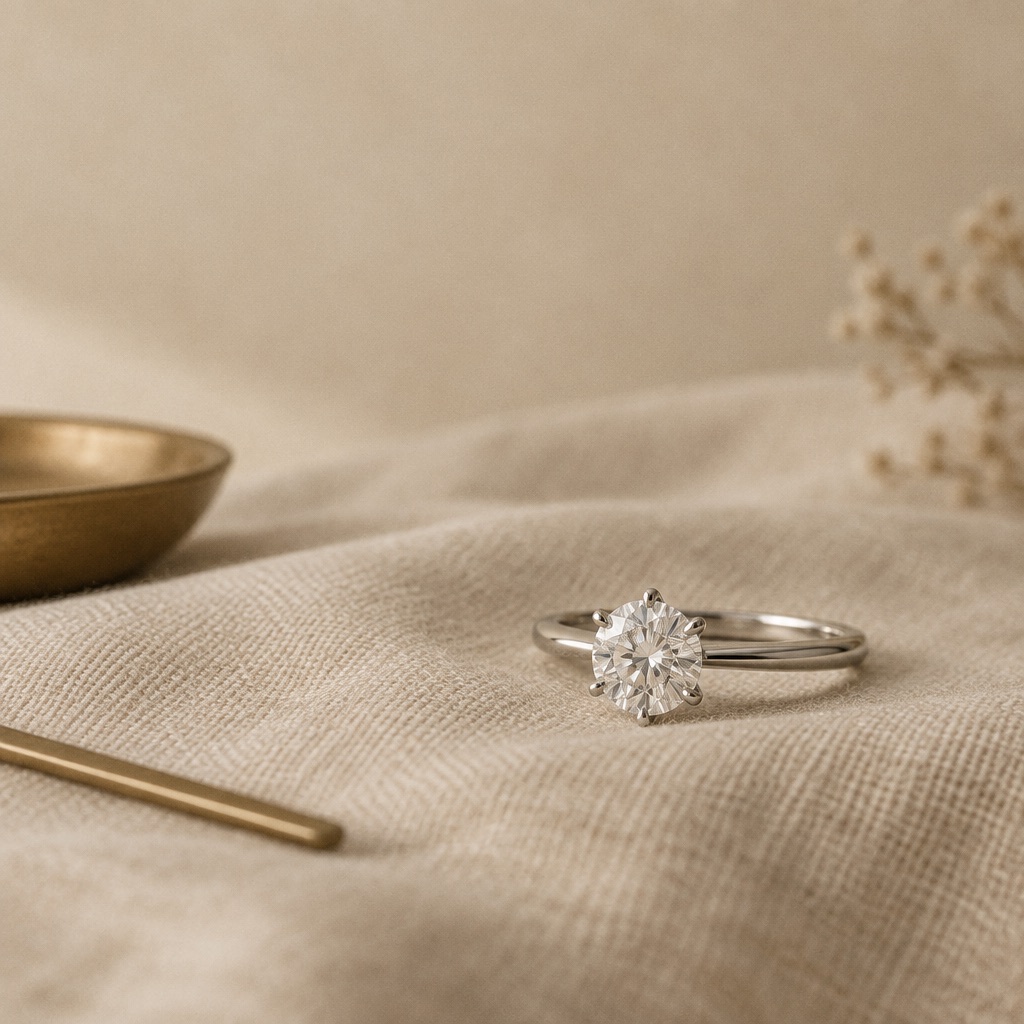
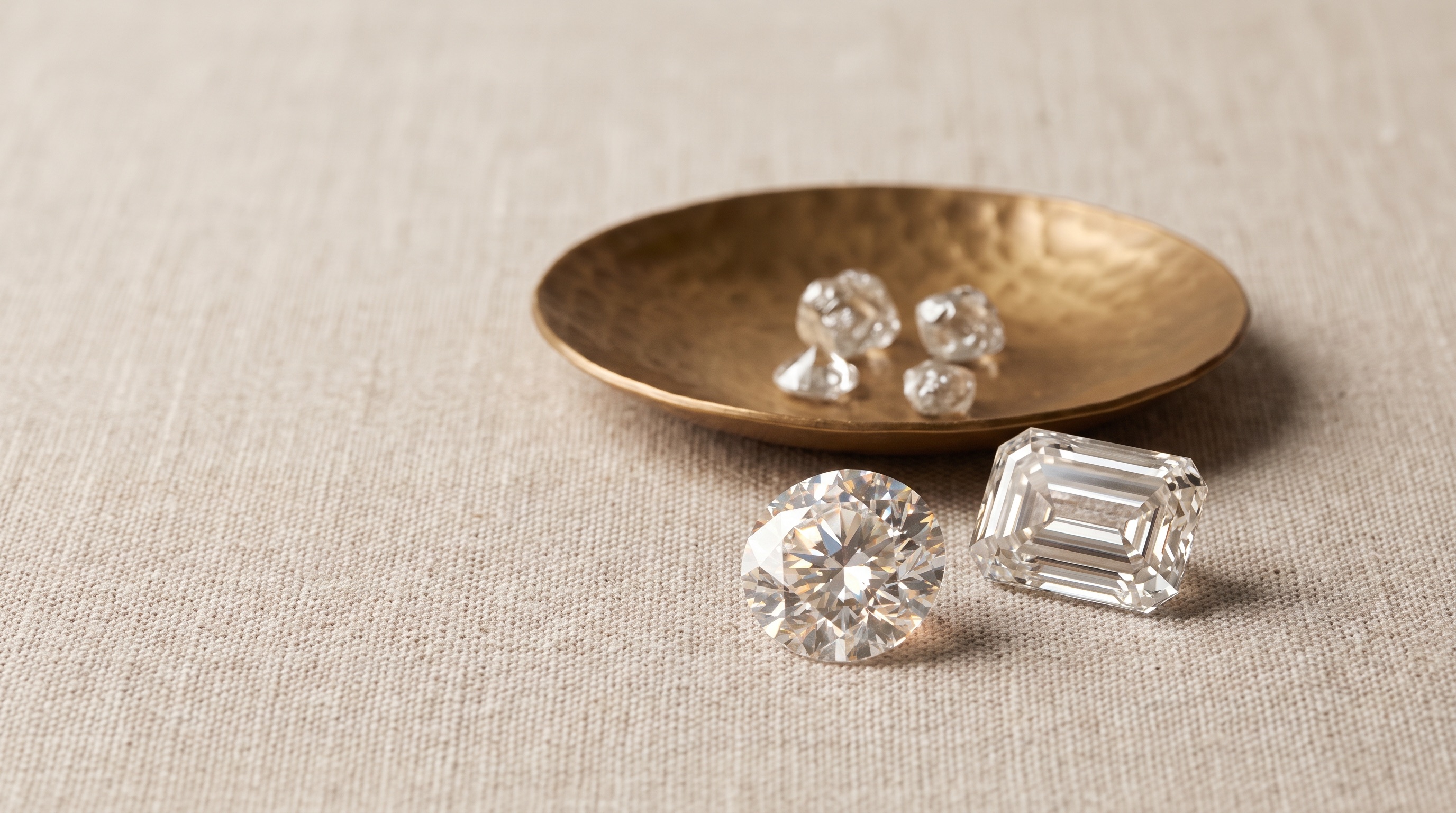
A round brilliant diamond is cut into 57 or 58 triangular and kite-shaped facets engineered to maximize brightness, fire, and scintillation, while an emerald cut diamond is a rectangular step cut with long, open, parallel facets that produce a quieter, mirror-like flash. Both are enduring, legitimate choices — one built for maximum sparkle, the other for calm, architectural light — and the right one depends on what a buyer actually wants a diamond to do on the hand.
Because round brilliant and emerald cut sit at opposite ends of the brilliant-cut/step-cut spectrum, comparing them is less about "better" and "worse" and more about understanding two genuinely different optical systems, two different sets of clarity and color requirements, and two different rough-diamond economics. This guide walks through facet structure, light behavior, sourcing implications, durability, and buyer profile for each shape, then covers what that means practically for jewelers deciding what to stock or recommend.
Round vs. Emerald Cut: The Core Comparison
Before getting into the mechanics behind each number, it helps to see the two shapes side by side. The table below summarizes the attributes that matter most for buying and sourcing decisions.
| Round Brilliant | Emerald Cut | |
|---|---|---|
| Facet structure | Brilliant cut — 57 or 58 facets (table, star, kite/bezel, upper- and lower-girdle, pavilion facets, optional culet) | Step cut — roughly 57 facets arranged in long, parallel rows ("steps") plus a large open table |
| Light performance | Maximum brilliance, fire, and scintillation — many small, scattered flashes as the stone moves | Broad, sheet-like flashes ("hall of mirrors") — fewer, larger reflections, quieter movement |
| Clarity recommendation | More forgiving — scattered facets camouflage small inclusions; SI1 or a clean SI2 often reads eye-clean | Least forgiving of any common shape — open table exposes inclusions directly; VS2 or better typically needed for a true eye-clean result |
| Color recommendation | More forgiving — constant light movement masks warmer body color; H–I can still read white | Less forgiving, especially in the corners — G or better generally needed to avoid visible warmth |
| Durability | No exposed corners; the most structurally resilient standard shape for everyday wear | Cropped corners are more protected than a pointed shape like princess, but still the most vulnerable part of the stone and benefit from corner-covering prongs |
| Rough yield / price behavior | Lower yield from octahedral rough; historically the highest per-carat premium of any shape at comparable grade | More efficient use of elongated rough than round; typically priced below round brilliant per carat at equivalent grade, though a truly eye-clean emerald cut narrows that gap |
| Popularity / demand | The most requested diamond shape worldwide, by a wide margin | A well-established, steady mid-market fancy shape — popular, but a distinct niche rather than a default choice |
Facet Structure: Brilliant Cut vs. Step Cut
The difference between round brilliant and emerald cut starts entirely at the facet level, and everything else in this guide follows from it. A round brilliant is a brilliant cut: its facets are small, triangular, and kite-shaped, arranged in concentric rings around a central table and radiating outward with full radial symmetry. That arrangement — refined over a century of cutting theory since Marcel Tolkowsky's 1919 proportion calculations — is specifically engineered to catch light entering from any angle and bounce it back out through the crown in many small, bright points.
An emerald cut is a step cut, a completely different faceting philosophy. Instead of many small facets, a step cut uses a smaller number of long, rectangular facets that run parallel to the girdle, stepping down in tiers from the table toward the culet — which is where the "step cut" name comes from. The corners are cropped, giving the shape its distinctive octagonal outline, but the body of the stone is dominated by broad, flat planes rather than triangular facets. Round brilliant and emerald cut aren't a "brighter" version and a "dimmer" version of the same idea; they're two different optical instruments built to do different jobs.
Light Performance: Scintillation vs. the Hall of Mirrors
Sparkle is usually described in three parts — brilliance (overall brightness), fire (flashes of spectral color), and scintillation (the flicker of light and dark as the stone moves) — and round brilliant is engineered to maximize all three simultaneously. Its high facet count means light entering the stone bounces internally many times before exiting, breaking into a large number of small, constantly shifting flashes. That's why a well-cut round brilliant seems to "come alive" under movement, chandelier light, or daylight.
An emerald cut trades that constant flicker for something calmer. Its long step facets act more like small internal mirrors: light entering the table reflects off a handful of broad planes and exits in large, clean sheets rather than scattered points. Trade buyers call this the "hall of mirrors" effect — a slower, more deliberate play of light that reads as sophisticated and architectural rather than flashy. Watched side by side, a round brilliant will out-sparkle an emerald cut in almost any lighting condition; that isn't a flaw in the emerald cut, it's the entire point of the design. Buyers choosing between the two are really choosing between two different visual personalities, not between a "good" cut and a lesser one.
Rough Diamond Yield and What It Means for Price Per Carat
Diamond rough forms closest to an octahedral crystal shape, and how efficiently a given cut can be carved from that rough shape has a direct, well-understood relationship to price per carat. A round brilliant sacrifices a meaningful portion of the original rough to achieve its circular outline and precise proportions — the crystal simply doesn't want to become a circle without losing material along the way. That lower yield is one of the reasons round brilliant has historically carried a premium per carat over many fancy shapes at comparable color, clarity, and finish grades; less finished weight recovered from a given piece of rough means the cutter has to charge more per carat retained to make the cutting economically worthwhile.
Emerald cut generally makes more efficient use of rough, particularly elongated crystals, because its rectangular outline and step facets follow the natural geometry of certain rough shapes more closely than a circle does. That's part of why emerald cut, like most fancy shapes, tends to price below round brilliant per carat at an equivalent grade — though buyers should treat this as a general historical relationship rather than a fixed number. Actual pricing on any given day depends on current rough availability, cutter capacity, and demand for both shapes, and the clarity premium emerald cut often requires (covered next) can narrow or even offset its yield advantage at the very top of the quality range.
Clarity Requirements: Why Emerald Cut Needs a Cleaner Stone
This is one of the most practically important differences between the two shapes for anyone sourcing at volume. A round brilliant's dense facet pattern does real visual work: light scattering constantly through dozens of small facets breaks up and camouflages small inclusions, which is why an SI1 or a clean SI2 round brilliant frequently reads eye-clean to an untrained observer. The same inclusion, in the same position, is much harder to hide in an emerald cut.
An emerald cut's open table and broad step facets function almost like a window into the stone. There's no scattering effect working in the buyer's favor — the eye gets a clear, largely undistorted view straight down into the diamond's interior. As a result, trade convention for emerald cut generally holds to a stricter internal clarity floor than round brilliant at the same visual-cleanliness bar — commonly VS2 or better for a stone meant to present as genuinely eye-clean, especially at larger carat weights where the table itself is larger and more revealing. Buyers pricing emerald cut against the same clarity grade they'd accept in a round brilliant are comparing two different real-world outcomes, not just two numbers on a certificate.
Color Requirements and the Corner Effect
Color follows a similar pattern to clarity, for the same underlying optical reason. A round brilliant's constant internal light movement masks warmer body color reasonably well — buyers can often go to H or even I color and still have the stone read white face-up, particularly in a yellow-gold or rose-gold setting that further disguises warmth. An emerald cut doesn't get that same cover. Its broad, still facets let the eye settle on the stone rather than being constantly redirected by sparkle, which makes any tint more visible — and that effect concentrates specifically in the cropped corners, where the facet geometry does the least to disperse color.
Trade buyers sometimes call this the "corner problem": an emerald cut can look acceptably white through the center of the table while showing a faint yellow cast right at the corners, in a way a round brilliant of the same grade simply wouldn't reveal. Because of this, sourcing for a genuinely colorless-reading emerald cut typically means holding to G color or better, where a round brilliant destined for the same shelf might comfortably sit a full grade or two lower and still satisfy the same customer.
Durability: Corners, Prongs, and Everyday Wear
Round brilliant has a structural advantage that has nothing to do with sparkle: it has no corners at all. Its continuous curved girdle distributes everyday impact evenly around the stone, which is a meaningful part of why round brilliant remains the default recommendation for a piece that will see daily wear, like an engagement ring worn every day for years.
Emerald cut, like every rectangular or square fancy shape, has corners — but not all cropped corners carry the same risk. A princess cut's sharp, unprotected points are genuinely the most vulnerable corners in common use; emerald cut's corners are cropped at an angle specifically to reduce that exposure, which makes it meaningfully more durable day to day than a pointed shape. It isn't, however, as inherently chip-resistant as a round brilliant, and the corners remain the stone's weakest point. In practice this is a setting question as much as a stone question: a well-designed setting with prongs that cover or protect the corners — rather than leaving them fully exposed — substantially reduces the real-world risk, which is why experienced jewelers pay close attention to corner protection specifically when setting emerald cut center stones, in a way that's simply a non-issue for round brilliant.
Carat Weight and Face-Up Size
Round brilliant and emerald cut of the same carat weight look meaningfully different on the hand, because they distribute weight across different outlines. Round brilliant concentrates its weight into a compact circle; emerald cut spreads the same weight across an elongated rectangle, which generally makes it read as larger — or at least as covering more visible surface area — at an equivalent carat weight.
| Carat Weight | Round Brilliant — Approx. Diameter (mm) | Emerald Cut — Approx. Face-Up (mm) |
|---|---|---|
| 0.50 ct | 5.1 | 5.5 x 3.8 |
| 1.00 ct | 6.4 | 7.0 x 5.0 |
| 1.50 ct | 7.4 | 8.0 x 5.7 |
| 2.00 ct | 8.1 | 8.7 x 6.2 |
| 3.00 ct | 9.3 | 10.0 x 7.1 |
These are typical trade-standard proportions rather than fixed values — an individual cutter's depth percentage, length-to-width ratio, and total depth all shift the actual measurements. A deeper-cut stone in either shape will read smaller than its carat weight suggests, and a shallow-cut stone will read larger, which is why checking actual millimeter dimensions matters more than carat weight alone when a buyer is optimizing for visible size.
Which Buyers Gravitate to Each Shape, and Why
Round brilliant remains the default recommendation for the widest range of buyers, and for good reason: it's the most extensively studied, most standardized, most universally understood diamond shape, with a deep, liquid resale and trade-in market and the broadest possible compatibility with any setting style. Buyers who haven't strongly researched diamond shapes tend to gravitate to round by default, and buyers who have researched shapes often still land on round specifically because they're optimizing for maximum light performance above every other consideration.
Emerald cut draws a more specific, more design-literate buyer. It appeals strongly to customers with an eye toward vintage, Art Deco, or architectural aesthetics — the cut's clean geometric lines and quiet light play read as intentional and sophisticated rather than maximalist. Emerald cut buyers are also, on average, more informed going in: because the shape's clarity and color sensitivity is well documented, buyers who specifically seek out emerald cut have often already learned that grade alone won't tell the whole story, and they tend to ask more pointed questions about actual photos, video, and corner color before committing. Retailers frequently report that emerald cut skews toward a slightly older or more deliberate shopper, while round brilliant appeals across the widest possible range, from first-time shoppers to buyers who have specifically researched cut theory.
Settings That Suit Each Shape
Round brilliant's radial symmetry makes it the most setting-flexible shape in the catalog — solitaire, halo, pavé, three-stone, vintage-inspired, or a fully custom architecture all work naturally, because the stone's own scintillation blends with whatever accent stones surround it rather than competing with them. Emerald cut asks for a bit more restraint. Because its value is in clean lines and quiet light rather than maximum sparkle, it tends to be set in simpler architectures — a classic four-prong solitaire or a cathedral setting that lets the stone's geometry read clearly, without a busy, accent-heavy design fighting for the same visual attention. A three-stone design flanked by trapezoids or tapered baguettes is a particularly common and complementary pairing for emerald cut, echoing its own step-cut faceting in the side stones. Corner protection, as noted above, is the one setting detail that specifically deserves extra attention with emerald cut and simply isn't a consideration with round brilliant.
Common Mistakes When Choosing Between the Two
The most frequent sourcing mistake is applying the same clarity and color floor to both shapes — buying an emerald cut against a spec sheet built for round brilliant and then discovering, once the stone arrives, that an inclusion or a hint of body color is visible in a way the certificate's printed grades didn't fully convey. Because grade alone doesn't behave identically across brilliant and step cuts, reviewing actual stone photos or video is a more reliable practice for emerald cut specifically than it typically needs to be for round brilliant.
A second common error is treating the price relationship between the two shapes as fixed. Round brilliant carries a historical premium over many fancy shapes at comparable grade, but that gap can narrow considerably once an emerald cut is priced at the higher clarity and color it actually needs to look clean — buyers who assume emerald cut will always be meaningfully cheaper per carat sometimes find the real-world gap smaller than expected once quality is matched apples to apples. A third mistake is underestimating corner exposure: setting an emerald cut in a design that leaves the corners largely unprotected, purely for aesthetic minimalism, is a decision that should be made deliberately rather than by default.
Sourcing Round Brilliant and Emerald Cut Diamonds Wholesale
Stocking both shapes well means sourcing against two different internal standards rather than treating "loose diamond inventory" as one undifferentiated pool. Round brilliant can be bought with more latitude on clarity and color and still present as eye-clean; emerald cut needs a tighter floor on both, plus attention to corner color and step-facet quality that round brilliant simply doesn't require. Guru Diam carries certified loose diamonds in both round brilliant and emerald cut, across CVD lab-grown and natural inventory, with IGI, GIA, and GCAL certification all available — giving buyers the flexibility to match certification lab to what a given retail customer or market segment expects. Cutting, setting, and polishing are all handled in-house, which keeps quality control consistent across both shapes rather than varying by outside vendor.
Loose stones at 0.30ct and above are certified and sold individually rather than as parcel goods, and current in-stock inventory in both shapes ships same day from either location — before 6pm EST from New York, or before 4pm PST from Los Angeles. For jewelers who want to see actual stones rather than buy strictly against a spec sheet, particularly for emerald cut where corner color and step-facet presentation matter as much as the printed grade, that same-day visibility into real inventory is often the more useful advantage over simply comparing certificate numbers. Custom engagement rings built around either shape — including designs with corner-protecting prong work for emerald cut center stones — are finished in 4-6 days and delivered unbranded by default, so retailers can present them under their own name.
Frequently Asked Questions
What is the main difference between a round brilliant and an emerald cut diamond?
A round brilliant is a brilliant cut with 57 or 58 small facets engineered to maximize brightness, fire, and scintillation, while an emerald cut is a rectangular step cut with long, open, parallel facets that produce a quieter, broader flash. The difference is a fundamentally different facet structure, not a quality difference — one is built for maximum sparkle, the other for calm, architectural light.
Is an emerald cut diamond cheaper than a round brilliant of the same grade?
Often, yes, because round brilliant sacrifices more rough diamond to achieve its shape and historically carries a premium per carat over many fancy shapes at comparable grade. That said, emerald cut typically needs a higher clarity and color grade to look genuinely eye-clean, so the real-world price gap between a truly clean emerald cut and a comparable round brilliant is often smaller than the base per-carat numbers suggest.
Does an emerald cut diamond show inclusions more than a round brilliant?
Yes, significantly. A round brilliant's dense facet pattern scatters light and visually camouflages small inclusions, while an emerald cut's open step facets and large table expose inclusions much more directly. Trade buyers generally hold emerald cut to a stricter clarity floor, commonly VS2 or better, to achieve the same eye-clean look a round brilliant can reach at a lower grade.
Is an emerald cut diamond less durable than a round brilliant?
Round brilliant has no corners at all, making it the most structurally resilient standard shape for everyday wear. Emerald cut has cropped corners that are considerably more protected than a pointed shape like princess cut, but they remain the stone's weakest point, so a setting with prongs that guard the corners is worth prioritizing for an emerald cut worn daily.
Which diamond shape is more popular, round or emerald cut?
Round brilliant is by a wide margin the most requested diamond shape worldwide, prized for delivering maximum brilliance, fire, and scintillation. Emerald cut is a well-established and steadily popular fancy shape, particularly among buyers drawn to vintage or architectural design, but it remains a distinct, smaller niche rather than a default choice.
Can you get lab-grown diamonds in both round brilliant and emerald cut?
Yes. Both shapes are widely available in CVD lab-grown material, with the same clarity and color considerations described above applying identically to lab-grown and natural stones of either shape. Guru Diam stocks CVD lab-grown and natural diamonds in both round brilliant and emerald cut, with IGI, GIA, and GCAL certification options available.
Browse certified round brilliant and emerald cut inventory, both lab-grown and natural, through certified diamonds, or start from the full range of shapes and grades at the wholesale hub. Matched pairs for three-stone designs flanking either shape are available under matching pairs. Trade accounts can be set up through trade partner, and custom builds around either cut — including corner-protective settings for emerald cut center stones — can start through custom jewelry.