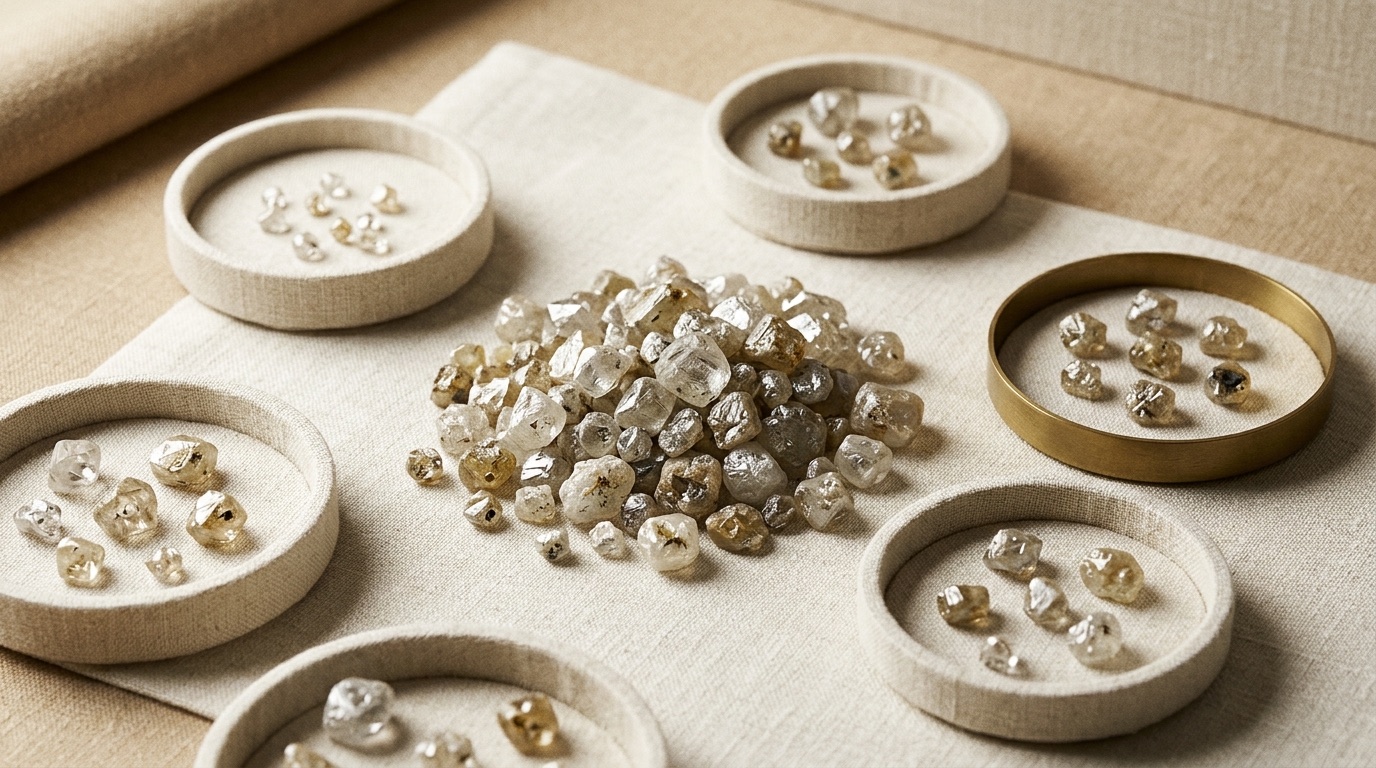
Rough diamond sorting is the process of examining and classifying rough (uncut) diamonds by shape, size, clarity, color, and crystal quality before they're allocated to a specific cutting plan — the step that happens after a rough stone leaves the mining or trading pipeline and before a cutter ever touches it with a saw or laser. Sorting determines which finished shape and quality tier a rough crystal is capable of producing, and it's the single decision point that has the largest effect on a rough stone's eventual value, since the same rough crystal can yield dramatically different results depending on how it's read and planned.
This guide covers what rough diamond sorters actually evaluate, the standard sorting categories used across the trade, how sorting differs between natural mined rough and CVD lab-grown rough, and why sorting accuracy matters as much to a wholesale buyer's finished-goods pricing as cutting skill does.
Why Sorting Happens Before Cutting
A rough diamond crystal's internal clarity, exact crystal shape, and any internal stress or fracture planes are only partly visible from the outside, and every cutting decision — which shape to cut, how large a finished stone the rough can support, where to place facets to avoid an internal inclusion — depends on reading that rough crystal correctly before any material is removed. A cutting decision made on a poorly sorted stone can't be undone once material is cut away, so sorting exists specifically to front-load the expensive judgment calls before any irreversible cutting begins, rather than discovering a problem mid-cut when the options for correcting it are far more limited and costly.
The Core Sorting Criteria
Sorters evaluate rough diamonds against a consistent set of criteria, in roughly this order of impact on eventual value:
- Shape and crystal form — a rough diamond's natural crystal shape (octahedron, dodecahedron, irregular "makeable" shapes) heavily influences which finished cut shapes it can efficiently yield. An octahedral crystal, for instance, is naturally well suited to yielding two round brilliants from a single rough stone with relatively efficient material use.
- Size (rough carat weight) — determines the realistic range of finished carat weights the stone can produce once cutting loss (typically 40-60% of rough weight, depending on shape and inclusion avoidance) is accounted for.
- Clarity characteristics — internal inclusions, fractures, or strain patterns visible under a loupe or microscope, and critically, where they sit within the crystal, since an inclusion near the surface can often be cut away or positioned under a facet in the finished stone, while one at the crystal's core limits every possible cutting plan.
- Color — the rough crystal's body color, assessed to predict where the finished stone will likely land on the color scale, since color is a property of the crystal lattice itself and doesn't change through cutting (aside from very minor perceived shifts from cut proportions).
- Fluorescence — some rough shows visible fluorescence under UV light, a data point carried forward into the finished stone's eventual grading.
Rough Diamond Sorting Categories
| Category | What it describes | Typical downstream use |
|---|---|---|
| Gem-quality makeable rough | Clean enough crystal shape and clarity to yield a faceted gemstone | Cut into standard fancy shapes or round brilliants for loose stone or jewelry use |
| Near-gem / borderline rough | Marginal clarity or shape, could go either direction depending on cutting plan | Often planned for smaller finished stones or melee to work around inclusions |
| Industrial-grade rough | Too included, oddly shaped, or low quality for a gem-quality finished stone | Industrial abrasive and cutting-tool applications, not jewelry |
| Sawable rough | Crystal shape suited to being sawn into two or more pieces before individual cutting | Sawn into multiple rough pieces, each planned and cut separately |
| Cleavable rough | Has a natural cleavage plane a cutter can split along | Split along the cleavage plane rather than sawn, when the crystal structure allows it |
Reading Inclusions and Planning Around Them
One of the most valuable and hardest-to-automate skills in rough sorting is reading exactly where an internal inclusion sits in three dimensions within an opaque or semi-opaque rough crystal, using a combination of magnification, immersion in a refractive-index-matched liquid to improve internal visibility, and experienced judgment about how light travels through the specific crystal shape in hand. A sorter who can accurately map an inclusion's position can plan a cutting orientation that removes it entirely, positions it under an opaque part of the finished setting, or minimizes its visual impact within the finished stone's clarity grade — versus a less precise read that either wastes usable material by cutting overly conservatively around an inclusion that wasn't actually a problem, or produces a finished stone with a visible flaw that a better read would have avoided.
Yield: Why the Same Rough Weight Isn't Worth the Same
Two rough diamonds of identical carat weight can be worth very different amounts once sorted, because sorting determines expected yield — the percentage and quality of finished material a specific rough crystal can realistically produce. An octahedral crystal with clean, well-positioned clarity sorted for two matched round brilliants yields efficiently and predictably. An irregularly shaped crystal with an inclusion sitting in an awkward position might need to be planned around a much smaller finished stone, or split into pieces that individually don't reach as high a finished carat weight, dragging down effective yield even at the same starting rough weight. This is why rough diamond pricing is never a flat rate per carat across all rough — sorting-driven yield expectations are baked into rough valuation from the start.
Sorting Natural vs. CVD Lab-Grown Rough
Sorting principles are broadly similar across natural and CVD lab-grown rough — both need to be evaluated for shape, clarity, color, and cutting plan before facing — but there are real differences in what a sorter is actually looking at. Natural rough arrives with a wide range of crystal shapes and clarity outcomes shaped by geological formation conditions the sorter has no control over, meaning a natural rough parcel typically shows far more variation stone-to-stone. CVD lab-grown rough is grown under controlled reactor conditions that produce more predictable crystal habits and clarity outcomes on average, though individual CVD crystals still vary meaningfully based on growth run parameters and still require the same careful sorting — a controlled growth process narrows the range of outcomes, it doesn't eliminate the need to sort each crystal individually.
Tools Used in Rough Sorting
- Loupe and microscope — standard magnification tools for visual clarity and inclusion assessment, the same core tool used at every stage from initial rough sort through finished-stone grading.
- Immersion cells — a rough stone submerged in a refractive-index-matched liquid becomes far more transparent to visual inspection than it is in air, letting a sorter see internal features that would otherwise be obscured by the rough crystal's naturally frosted, light-scattering surface.
- Diamond scanning and mapping technology — modern sorting increasingly uses 3D scanning and planning software that models a rough crystal's internal structure and simulates multiple cutting plans before a physical cut is made, helping sorters and planners compare yield outcomes across different cutting orientations objectively rather than relying purely on visual judgment.
- Sieves and sizing screens — for melee-scale rough sorted primarily by size before finer clarity/color sorting, used to efficiently batch large volumes of small rough into workable size groups.
Sorting for Melee vs. Larger Stones
Sorting approach shifts meaningfully by rough size. Larger rough crystals (destined for stones roughly 0.30ct and up) get individual attention — each piece assessed, planned, and often scanned individually given the value at stake in getting the cutting plan right. Melee-scale rough (destined for very small finished stones, typically under 0.20ct) is generally sorted in bulk using a combination of sizing screens and batch clarity/color grading, since the per-stone value doesn't support the same individual planning time larger rough gets — melee sorting optimizes for consistent batch quality within a defined size and grade tier rather than maximizing yield on any single crystal.
How Sorting Feeds Into Cutting Decisions
Once sorting is complete, the sorted parcel (or, for higher-value individual stones, the specific cutting plan for that one crystal) moves to the cutting stage, where the sorter's read directly shapes what happens next: a crystal sorted for an emerald cut plan gets sawn and faceted differently than the same rough sorted for a round brilliant, and a crystal flagged for an inclusion near one edge gets oriented so that edge is removed or hidden by the final facet arrangement. Cutting a stone against its sorting plan — treating a stone sorted for a smaller, cleaner finished shape as though it could instead yield a larger stone — is a common source of yield loss and finished-quality problems, which is why experienced operations keep sorting and cutting closely coordinated rather than treating them as fully separate, disconnected stages.
Common Sorting Mistakes and Their Downstream Cost
- Under-reading an inclusion's true position — leads to a cutting plan that either wastes material being overly cautious, or produces a finished stone with a visible flaw a more accurate read would have avoided.
- Sorting for the wrong shape given the crystal's natural form — forcing a shape the rough crystal isn't well suited to often sacrifices yield compared to a shape that works with the crystal's natural geometry.
- Inconsistent color sorting across a batch — matters especially for melee and matched-pair sourcing, where visible color inconsistency across a set of stones intended to look uniform is a direct, visible defect in the finished product.
- Treating sorting as a one-time judgment rather than a plan that gets revisited — modern scanning technology lets a sorting/planning decision be re-evaluated against simulated alternative cutting plans before committing, and operations that skip this step leave yield on the table compared to those that use it.
Why Sorting Quality Matters to a Wholesale Buyer
A wholesale buyer sourcing finished loose diamonds doesn't see the rough sorting stage directly, but its quality shows up in two places that matter directly: consistency of the finished stones in a given quality tier (well-sorted rough produces more predictable, consistent finished outcomes batch to batch), and price competitiveness (a supplier with strong sorting discipline gets better yield from the same rough input, which supports more competitive finished pricing without sacrificing quality). Buyers evaluating a new supplier relationship can ask directly about how rough is sorted and planned — a supplier with a clear, described sorting process is generally a stronger long-term source of consistent inventory than one that treats the question vaguely.
Sorting and Matched Pairs
Sourcing matched side-stone pairs or larger matched sets for jewelry depends heavily on sorting discipline upstream, since matching two or more finished stones on color, clarity character, and cut proportion is far easier when the rough those stones came from was sorted with matching in mind from the start — ideally sourced from rough with consistent crystal quality — rather than assembled after the fact from unrelated finished stones that happen to grade similarly on paper but don't visually match as closely side by side.
How Sorting Technology Has Changed Over Time
Rough diamond sorting was, for most of the trade's history, a purely visual and experience-based skill — a sorter's trained eye under a loupe, supported by immersion techniques, with no way to see inside a rough crystal beyond what light passing through it could reveal. Modern sorting operations increasingly supplement that trained eye with 3D scanning technology that builds an internal model of a rough crystal's inclusions and structure, then runs multiple simulated cutting plans against that model to compare projected yield and finished quality before committing to a physical cut. This doesn't replace an experienced sorter's judgment — reading a scan and translating it into a sound cutting decision is still a skilled task — but it gives sorters a genuinely new source of information (a modeled internal view) that trained eyes and immersion techniques alone couldn't previously provide, and it's meaningfully reduced the rate of costly cutting-plan mistakes on higher-value individual rough stones industry-wide.
Sorting and the Broader Cutting and Polishing Workflow
Sorting doesn't happen in isolation from the rest of the cutting and polishing workflow — it's the first stage in a pipeline that continues through sawing or cleaving (dividing rough into individually plannable pieces where applicable), bruting (shaping the stone's basic outline), faceting (cutting and polishing the actual facet structure), and final quality inspection and grading. Each downstream stage depends on the sorting decision that preceded it: a bruter shapes the stone's outline according to the sorted cutting plan, and a faceter cuts to the proportions that plan specifies, meaning an error introduced at the sorting stage compounds through every stage that follows rather than staying contained to sorting alone. This is why operations with strong, disciplined sorting tend to show measurably better consistency across their entire finished output, not just in the specific stones a sorter personally evaluated.
Sourcing Diamonds Built on Careful Sorting
Guru Diam's CVD lab-grown and natural diamonds — across standard, antique, and exotic shapes — are cut and polished in India from carefully sorted rough before final grading and shipment from Guru Diam's New York and Los Angeles locations, with IGI, GIA, and GCAL certification available. Careful sorting upstream is part of why Guru Diam can offer consistent quality across in-stock inventory that ships same-day (before 6pm EST from New York, before 4pm PST from Los Angeles). Trade buyers can browse certified inventory through certified diamonds, source matched pairs sorted for consistent color and clarity through matching pairs, explore fancy color inventory through fancy color loose diamonds, review sourcing terms at the wholesale hub, or apply for a trade account through trade partner.
Who Does Rough Sorting in the Trade
Rough diamond sorting is typically performed by dedicated sorters and planners working inside a cutting house or a rough-trading operation, roles distinct from the cutters and polishers who handle the physical faceting work downstream. A skilled sorter/planner role usually takes years of hands-on training to develop — reading a rough crystal accurately under magnification and immersion, and translating that read into a cutting plan that actually maximizes value, is a learned skill built on volume of experience across thousands of individual stones, not something reducible to a simple checklist. In larger operations, sorting and planning often happen as a two-step handoff: an initial sorter classifies rough into broad quality/shape/size categories, and a specialized planner then works out the specific cutting orientation for higher-value individual stones within those categories, since planning a single valuable rough crystal for maximum yield warrants more dedicated attention than the initial bulk sort.
Rough Diamond Trading and the Sorting Handoff
In the natural diamond trade specifically, rough sorting often happens more than once as a stone moves through the supply chain: an initial sort at the mine or first point of sale groups rough into broad categories for trading purposes (a step aimed more at establishing a fair trading value for a parcel than at planning individual cutting outcomes), and a second, far more detailed sort happens once a cutting house actually acquires rough intended for its own production, where the goal shifts from valuing a parcel to planning each stone's specific cutting outcome. CVD lab-grown rough generally skips the multi-step trading handoff natural rough goes through, since it's typically grown by or for a specific cutting operation rather than passing through an open rough-trading market the way natural rough historically has — one of several structural differences between the two supply chains beyond the growth process itself.
Sorting for Fancy Color Rough
Sorting fancy color rough (yellow, pink, blue, and green among CVD lab-grown color, and a wider range among natural fancy color rough) adds a layer of judgment beyond clarity and shape: predicting how a rough crystal's color will actually read once faceted, since cut proportions and facet arrangement can meaningfully affect how saturated and even a fancy color diamond's face-up color appears compared to the same material cut with different proportions. A sorter working fancy color rough needs to weigh cutting-plan decisions against both clarity/yield outcomes and color-presentation outcomes simultaneously, which is part of why fancy color sorting and planning is generally treated as a more specialized skill within the broader sorting trade than sorting colorless material, and why fancy color rough commands a sorting and planning premium reflected in its overall production cost.
What to Ask a Supplier About Their Sorting Process
Buyers building a long-term sourcing relationship benefit from asking specific questions rather than accepting a general quality claim at face value: how rough is evaluated for clarity and cutting plan (visual only, or supplemented with scanning/immersion technology), how consistently sorted rough translates into predictable finished-batch quality, and whether the supplier can speak specifically to how a given quality tier or matched set was sourced. A supplier able to answer these questions concretely is demonstrating real sorting discipline, not just repeating a marketing claim about quality control.
Frequently Asked Questions
What is rough diamond sorting?
Rough diamond sorting is the process of examining uncut rough diamonds and classifying them by shape, size, clarity, color, and crystal quality before deciding how each stone will be cut, since these characteristics determine which finished shape and quality tier the rough is capable of producing.
Why does rough diamond sorting matter so much?
Sorting is the point where cutting-plan decisions get made, and those decisions can't be undone once material is cut away. Accurate sorting maximizes yield and finished quality from a given rough crystal, while inaccurate sorting either wastes usable material or results in a finished stone with avoidable flaws.
What tools do sorters use to evaluate rough diamonds?
Loupes and microscopes for magnified visual inspection, immersion cells (submerging rough in a refractive-index-matched liquid) to see internal features more clearly, and increasingly 3D scanning and cutting-plan simulation software to compare yield outcomes across different cutting orientations.
Is rough diamond sorting different for CVD lab-grown diamonds versus natural diamonds?
The core sorting principles are the same, but natural rough typically shows more crystal-to-crystal variation since it forms under uncontrolled geological conditions, while CVD rough grown under controlled reactor conditions tends to produce more predictable, though still individually variable, outcomes.
How does sorting affect the price of rough diamonds?
Sorting determines expected yield — the percentage and quality of finished material a specific rough crystal can realistically produce — which is why rough diamonds of identical carat weight can be priced very differently depending on their sorted shape, clarity, and cutting-plan outcome.
What happens to rough diamonds that don't sort as gem quality?
Rough that's too included, oddly shaped, or otherwise unsuited to a faceted gemstone is typically sorted into industrial-grade categories, used in industrial abrasive and cutting-tool applications rather than jewelry.