Rhodium plating is a thin electroplated layer of rhodium — a rare, extremely hard platinum-group metal — deposited over another metal, most commonly white gold, to give it a bright white, reflective, scratch-resistant surface. Without it, white gold's natural color is a pale, slightly warm gray rather than the icy-bright white customers expect at the jewelry counter. For jewelers and manufacturers, understanding what the plating actually is, how long it holds up, and when it needs to be redone is basic working knowledge — not a footnote, since it shapes sourcing decisions, warranty conversations, and a real recurring service opportunity at the bench.
What Rhodium Plating Actually Is
Rhodium sits in the platinum group of metals, alongside platinum, palladium, ruthenium, and iridium. It's prized in jewelry finishing for three properties at once: it's naturally bright white with a highly reflective, almost mirror-like finish; it's one of the hardest precious metals, which makes it resistant to everyday scratching; and it's chemically inert, meaning it doesn't tarnish, oxidize, or react with skin oils and everyday chemicals the way some base metals do.
Plating, as a manufacturing step, means depositing a thin metallic layer onto the surface of a finished piece through electroplating — the piece becomes the base for a microns-thick coating of a different metal, rather than that metal being used as the piece's structural material. Rhodium is applied this way specifically because it's one of the most expensive precious metals by weight; using it as a coating rather than casting a ring solid in rhodium gets the benefit of rhodium's color and hardness at a small fraction of what a solid-rhodium piece would cost, and a piece cast entirely from rhodium isn't practical for jewelry-making in the first place given how the metal behaves when worked at any real thickness.
Why Rhodium Plating Exists: The White Gold Problem
White gold starts life as yellow gold — the same pure, warm-toned metal used in yellow gold jewelry — alloyed with white metals such as palladium, nickel, manganese, or silver to lighten its color. Even at the highest practical dilution used in fine jewelry, the resulting alloy lands on a pale, slightly warm gray-white, not the crisp, bright white most buyers associate with "white gold" at the counter. That gap between what the alloy naturally looks like and what the market expects it to look like is the entire reason rhodium plating exists as a standard finishing step.
A rhodium-plated white gold piece, fresh off the plating line, reads as a much brighter, cooler, more reflective white than the same piece would look unplated. That's a genuine visual upgrade, not a manufacturing trick — it's simply a surface finish layered over a base alloy that can't achieve that exact look on its own. Manufacturers and jewelers should think of rhodium plating as a standard, expected finishing step for white gold, on the same order as polishing, rather than an optional upgrade or a sign of a lower-quality piece.
Beyond Color: Protection and Scratch Resistance
Color is the most visible reason rhodium plating is used, but it isn't the only one. Rhodium's hardness means a freshly plated piece resists surface scratching better than the softer base alloy underneath would on its own, which matters most in the first months of wear before the plating begins to thin. Plating also puts a chemically inert barrier between the wearer's skin and whatever alloy sits underneath, which is a meaningful consideration for wearers with sensitivity to nickel or other whitening alloys sometimes used in white gold — the rhodium layer, while it lasts, reduces direct skin contact with the base metal.
That protective benefit is time-limited by design, though, since the layer is thin enough to wear through with normal daily contact. It's worth being precise with customers about this: rhodium plating is a genuine functional and cosmetic upgrade while it's intact, not a permanent solution to metal sensitivity, since the base alloy becomes exposed again once the plating wears thin in high-friction areas.
Which Metals Commonly Get Rhodium Plated
White gold is by far the most common candidate for rhodium plating, since it's the metal that most needs the color correction described above. Almost every piece of white gold fine jewelry sold at retail — engagement rings, wedding bands, earrings, pendants — leaves the factory rhodium plated as a standard finishing step, not an add-on.
Yellow gold and rose gold are sometimes rhodium plated too, but for a different reason: not to correct their natural color, but to deliberately give a warm-toned metal a bright white finish as a style choice. This shows up in mixed-metal designs, two-tone pieces where a white accent is wanted without switching the underlying alloy, or fashion pieces chasing a specific white-metal look on a yellow or rose gold base. In these cases the plating is a cosmetic decision rather than a correction, and jewelers should be clear with customers that the piece's true base metal is yellow or rose gold underneath a white finish — worth flagging alongside the guidance in GD's rose gold diamond ring guide for any two-tone build.
Platinum is essentially never rhodium plated, and understanding why matters for anyone specifying finishes. Platinum is already naturally white — it doesn't have the color problem rhodium plating exists to solve, and plating a metal that's already the target color adds cost and a maintenance requirement with no real visual benefit. Platinum's own maintenance profile is different and generally lower-effort than white gold's; that full comparison is covered in GD's platinum vs. white gold guide, which is a useful companion piece since it looks at metal choice broadly while this guide focuses specifically on the plating process itself.
How the Electroplating Process Works
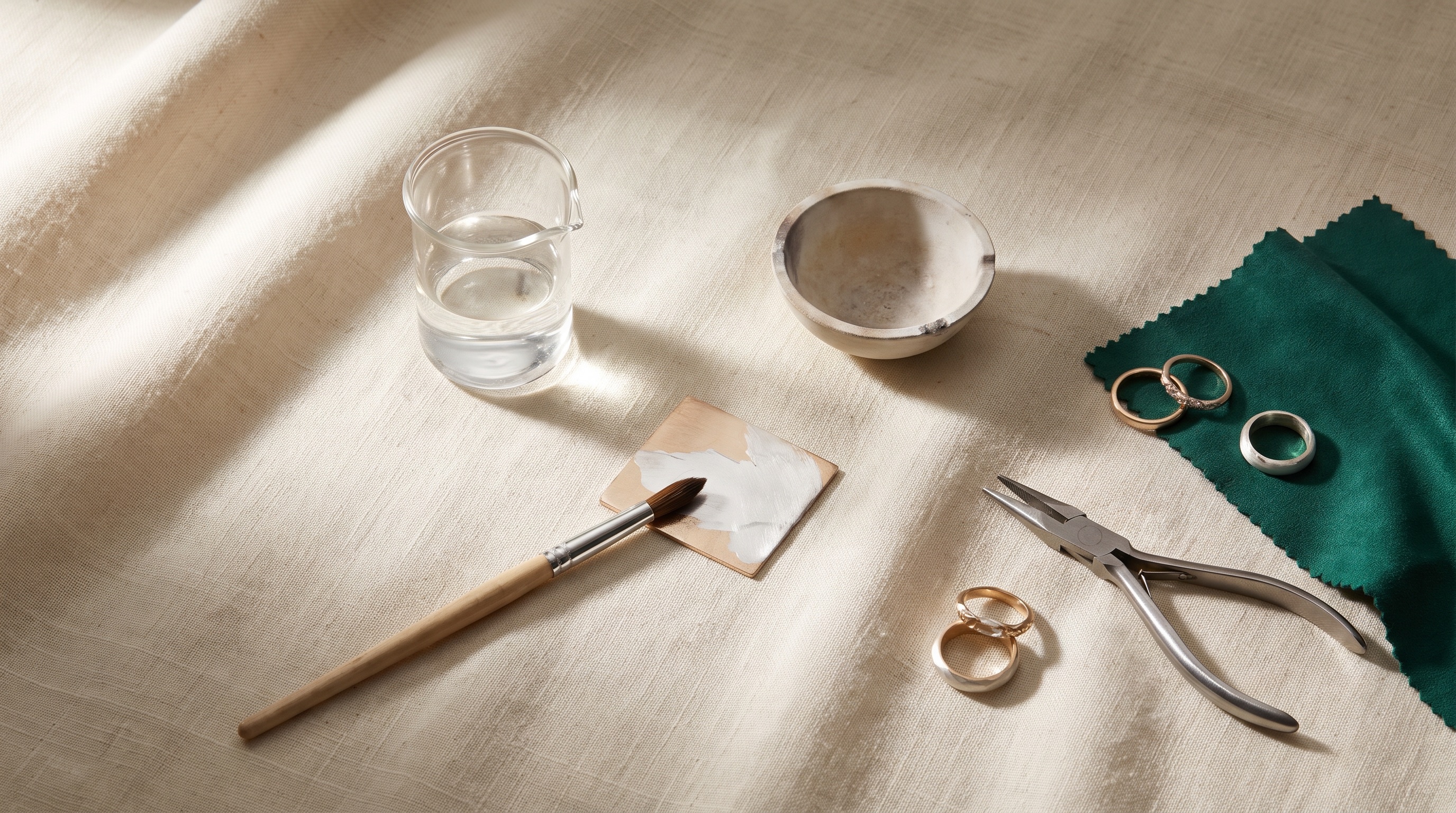
Rhodium plating is done through electroplating, a controlled electrochemical process rather than a painted-on or sprayed coating. At a non-technical level, the sequence looks like this: the piece is thoroughly cleaned and polished first, since any oil, polish residue, or surface imperfection gets sealed under the plating and becomes permanently visible or compromises adhesion. The cleaned piece is then submerged in a rhodium solution along with an electrode, and an electrical current is run through the setup — this causes rhodium ions in the solution to bond to the surface of the piece, building up a thin, even metallic layer.
The resulting layer is measured in microns — a genuinely thin coating, not a substantial layer of metal. That thinness is precisely why the plating eventually wears through with handling: it's a surface treatment sitting on top of the base alloy, not metal fused all the way through the piece. Plating thickness and quality can vary between shops and equipment, which is part of why plating consistency is a real point of differentiation between manufacturers rather than a commodity service where every provider delivers an identical result. After plating, a piece typically goes through a final polish to bring out the full reflective shine of the fresh rhodium surface before it ships.
How Long Rhodium Plating Lasts
There's no fixed lifespan for a rhodium plating job — it depends heavily on how the piece is worn. A ring worn daily on the dominant hand, especially by someone who does manual work, washes hands frequently, or goes to the gym regularly, will show wear on the plating faster than a piece worn occasionally or handled gently. As a general guide, jewelers commonly see white gold rings needing re-plating somewhere in the range of once a year to roughly every couple of years for daily wear, with earrings and pendants — which see far less friction and contact than a ring — typically going much longer between replating cycles.
What actually happens as plating wears is gradual, not sudden: the bright white surface slowly dulls and the underlying alloy's warmer, grayer tone starts to show through, most noticeably at high-contact points like the underside of a ring shank or the tips of prongs. This is normal, expected wear on a maintenance item, not a defect in the piece or a sign of poor manufacturing — the same way a car's tires wearing down after normal driving isn't a manufacturing flaw. Framing it this way to retail customers up front, at the point of sale, heads off a lot of confused or frustrated calls a year or two later when a customer notices their ring "changed color" and assumes something is wrong with it.
Re-Plating as an Ongoing Service
Because rhodium plating is a wear item rather than a one-time treatment, re-plating is a legitimate, recurring service opportunity — not just a repair. A worn piece gets cleaned, re-polished to remove surface scratches accumulated since the original plating, and run back through the same electroplating process to restore the bright white finish. For a jeweler or retailer, offering re-plating (in-house if there's bench capability for it, or through a manufacturing partner if not) keeps customers coming back into the store on a predictable cycle and is a natural moment to also inspect prongs, check stone security, and catch any other maintenance issues before they become bigger problems.
Setting expectations matters here too: customers who understand up front that their white gold piece will need periodic re-plating are far less likely to treat the eventual fading as a complaint, and far more likely to treat it as a normal service they return for. Retailers who are silent on this at the point of sale tend to get the opposite reaction — a customer who feels like something broke, rather than one scheduling routine maintenance.
Plating vs. Solid White Metal: The Real Tradeoffs
The core tradeoff is straightforward once it's laid out plainly: rhodium-plated white gold gets a brighter, whiter look than the base alloy could achieve on its own, at a lower upfront cost than a naturally white solid metal like platinum, in exchange for taking on a recurring maintenance cycle that a naturally white metal doesn't need. Neither option is objectively "better" — they suit different customers and different pieces, and being able to lay out the tradeoff clearly is part of what makes a jeweler or manufacturer a trusted advisor on a metal decision rather than just an order-taker.
A few practical implications worth keeping straight when specifying or quoting a piece: plating adds a real but modest cost to a build, it's not something a customer should expect to last the life of the piece without attention, and it doesn't change the underlying value or purity of the metal itself — a worn-plating white gold ring is not a lower-karat ring, just one due for a service visit.
Rhodium Plating Cost Considerations
Rhodium is one of the more expensive precious metals by weight, which is a direct driver of why it's used as a thin plating layer rather than a structural metal — the cost of plating a piece is a small fraction of what casting that same piece solid in rhodium would run, precisely because only a few microns of the metal are actually used per piece. Plating cost as a line item is generally modest relative to the overall cost of a finished piece, but it isn't free, and re-plating over a piece's lifetime adds up as an ongoing cost of ownership that's worth being upfront about with retail customers comparing white gold to a naturally white metal.
Rhodium's market price can also move more than steadier precious metals, since global supply is concentrated and demand ties partly to industrial uses (catalytic converters, for instance) outside of jewelry. That volatility is mostly a wholesale-sourcing consideration rather than something that needs to be explained to a retail customer at the counter, but it's a real factor manufacturers and jewelers who plate in volume should keep an eye on rather than assuming plating costs are fixed indefinitely.
Comparing the Three Common White-Metal Options
Jewelers fielding a "why does this cost more" or "why does this need maintenance" question benefit from having this comparison ready in simple terms. The table below lines up rhodium-plated white gold against solid platinum and against unplated (bare) white gold — the alloy on its own, before any rhodium finish is applied.
| Factor | Rhodium-Plated White Gold | Solid Platinum | Unplated (Bare) White Gold |
|---|---|---|---|
| Surface color | Bright, reflective white (while plating is fresh) | Naturally white, no plating needed | Pale, slightly warm gray-white |
| Durability of the color/finish | Fades gradually as the thin plating wears | Stable indefinitely — color is the metal itself | Stable, but never reaches a bright white look |
| Cost tier | Mid — base alloy cost plus a modest plating cost | Highest — denser metal, higher per-gram value | Same as plated version, minus the plating cost |
| Ongoing maintenance need | Periodic re-plating to keep the bright white look | Occasional polishing only, no plating cycle | None required, but color never brightens |
| Typical use case | Default finish for retail white gold jewelry | Premium option, high-stress or heirloom pieces | Rare — mostly seen as a piece overdue for service |
What Jewelers Should Know When Sourcing Finished Pieces
When sourcing finished white gold jewelry, plating quality is worth asking about directly rather than assuming every supplier's rhodium finish is equivalent — plating thickness, the cleaning and polishing prep before plating, and quality control on the electroplating line all affect how long a fresh plating job actually holds up before a customer sees fading. A piece with a thin or poorly prepped plating job can start showing wear noticeably sooner than one plated to a proper thickness and standard, even though both leave the factory looking identical on day one.
For custom builds specifically, finish is a specification decision that should be made explicitly at order time, not left as an assumption. Guru Diam's custom engagement ring program, finished in 4-6 days, includes finish and metal specification as part of the build — jewelers placing a custom order can specify rhodium-plated white gold, an alternate finish, or a different base metal directly as part of that order rather than discovering after the fact what finish a piece shipped with. That level of specification control matters most for jewelers building a retail relationship where the customer will eventually come back asking about re-plating, since it's easier to set accurate maintenance expectations on a piece when the finish was a known, deliberate choice from the start.
What Jewelers Should Know Before Offering Re-Plating as a Service
Offering re-plating in-house requires real equipment and process discipline — proper cleaning and polishing setup, a controlled electroplating bath, and quality control on the finished result — so it's worth an honest assessment of whether that capability makes sense to build versus partnering with a manufacturer or specialist plating shop that already runs the process at volume. Either path is workable; what matters is that the finished result meets a real quality bar, since a customer who pays for re-plating expects it to look and perform like the original factory finish, not a visibly inferior redo.
It's also worth setting internal expectations about turnaround and pricing for re-plating as a defined service line, rather than treating each request as a one-off. Customers respond well to a clear, predictable offer — a known price, a known turnaround, and a clear explanation of why the service exists — much more than to an ad hoc "let me check on that" every time a faded ring comes back through the door.
Frequently Asked Questions
Does rhodium plating wear off engagement rings?
Yes — rhodium plating is a thin surface layer, and normal daily wear gradually thins it until the underlying metal's natural color starts to show through, most noticeably at high-friction points like the ring shank and prong tips. This is expected wear on a maintenance item, not a defect, and re-plating restores the original bright white look.
How often should white gold jewelry be rhodium re-plated?
It depends heavily on how the piece is worn, but daily-worn rings for active wearers commonly need re-plating somewhere between once a year and every couple of years, while earrings and pendants that see much less friction typically go longer between plating cycles. Frequent hand-washing, manual work, and regular gym use tend to shorten that interval.
Is rhodium plating the same on yellow gold, rose gold, and white gold?
The plating process itself is the same electroplating method regardless of base metal, but the reason it's used differs — on white gold it corrects the alloy's natural pale gray-white toward a bright white, while on yellow or rose gold it's a deliberate style choice to give a warm-toned metal a white finish rather than a color correction.
Why isn't platinum rhodium plated?
Platinum is already naturally white, so it doesn't have the color problem rhodium plating exists to solve. Plating an already-white metal would add cost and an ongoing maintenance requirement without meaningfully changing its appearance, which is why platinum jewelry is almost never plated.
Does rhodium plating affect a piece's value or karat purity?
No — rhodium plating is a surface finish, not part of the underlying metal's composition, so it doesn't change a piece's karat purity or its underlying metal value. A white gold ring with worn plating is still the same karat gold underneath; it simply needs a service visit to restore the bright white surface.
Can rhodium plating cause an allergic reaction?
Rhodium itself is generally well tolerated and is sometimes used specifically to reduce skin contact with a more reactive base alloy underneath. However, once plating wears thin, skin can come into contact with the base metal again, so a wearer with a known nickel sensitivity should know that plating is a temporary barrier rather than a permanent fix if the base alloy underneath contains nickel.
Putting It Into Practice
Rhodium plating is a routine, well-understood finishing step, not a mysterious or optional add-on — but treating it that way with customers, rather than leaving it unexplained until a piece visibly fades, is what separates a jeweler who fields confused complaints a year after a sale from one who's already booked that same customer in for a routine re-plating appointment. Getting the fundamentals right — knowing which metals need it, how long a plating job realistically lasts, and how to talk about it plainly at the point of sale — turns a wear-and-tear inevitability into a normal part of the customer relationship instead of a surprise.
For jewelers and manufacturers evaluating metal and finish decisions more broadly, GD's carat vs. karat guide and lost wax casting guide cover adjacent fundamentals worth having on hand alongside this one. For sourcing finished pieces or custom builds where finish specification needs to be locked in at order time, GD's custom jewelry program and wholesale hub are the relevant starting points, and trade accounts can get set up through the trade partner page.