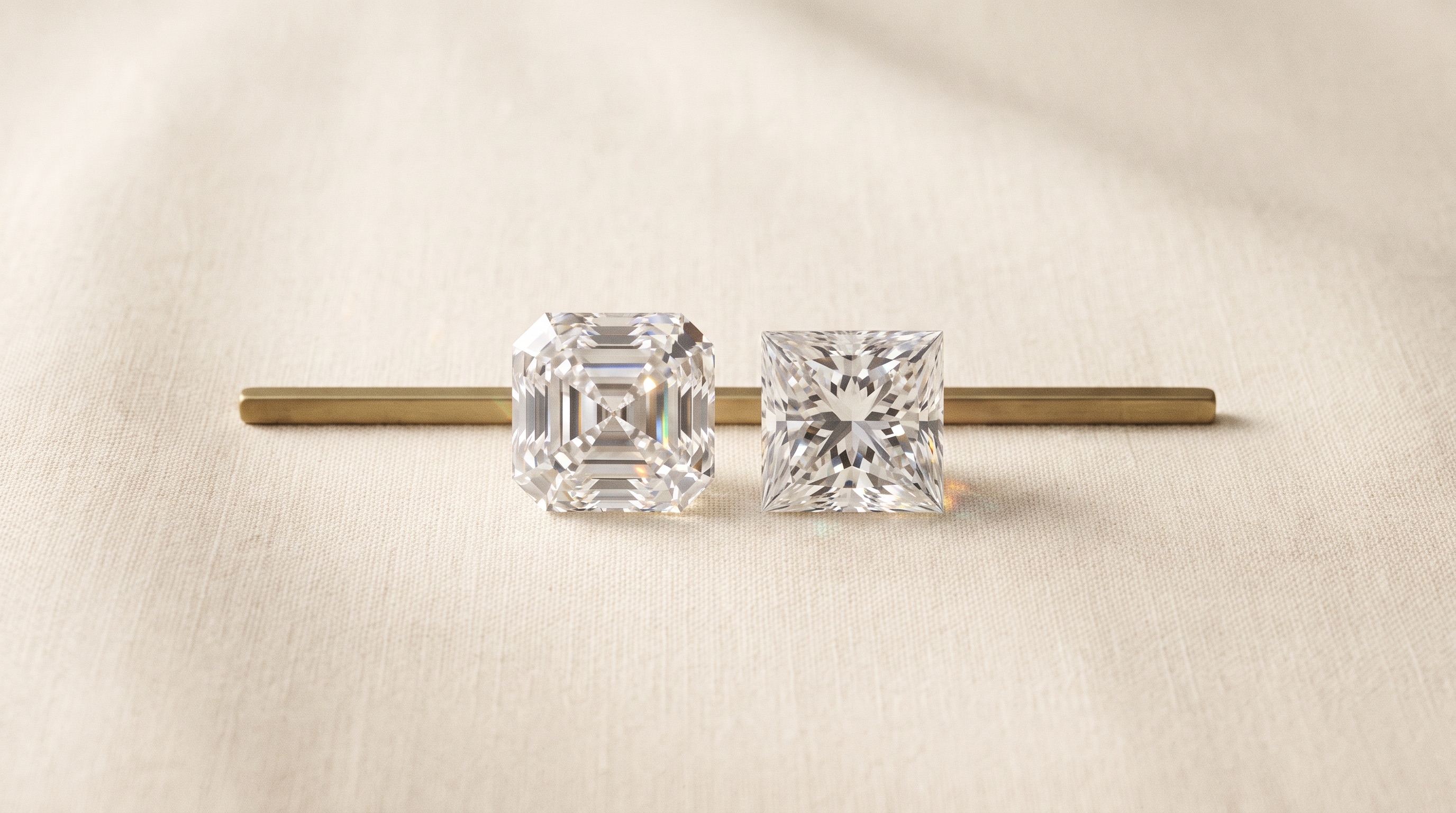
Radiant and princess cut diamonds are both square-to-rectangular, brilliant-faceted fancy shapes, but they differ in corner treatment, facet pattern, and light behavior: a radiant cut has cropped (cut-off) corners and a hybrid facet pattern combining step-cut sides with a brilliant-faceted crown, while a princess cut keeps sharp, uncropped corners and a fully brilliant-cut facet arrangement built on an inverted-pyramid pavilion. The cropped corners are the fastest way to tell them apart at a glance.
This guide compares radiant and princess cut diamonds shape by shape — faceting and outline, light performance, corner durability and setting requirements, carat weight and rough utilization, and pricing — so a wholesale buyer can match the right shape to a specific inventory need or customer request.
What Makes a Radiant Cut Diamond
The radiant cut was developed in the 1970s specifically to combine the elegant rectangular or square outline of an emerald cut with the brilliance and fire of a round brilliant — a shape gap the market didn't have a good answer for until the radiant's hybrid faceting solved it. Its defining visual feature is the cropped corners: the four corners of the rectangle or square are cut off at an angle rather than left sharp, producing an octagonal-ish outline distinct from both the emerald cut's sharp rectangle and the princess cut's sharp square. Underneath, the radiant uses a brilliant-cut facet pattern (typically 70 facets) on the crown and pavilion rather than the emerald cut's parallel step facets, which is what gives it noticeably more sparkle and fire than an emerald cut of similar outline.
What Makes a Princess Cut Diamond
The princess cut is a square, brilliant-faceted shape with sharp, uncropped corners and an inverted pyramid pavilion — a design developed in the 1980s to give buyers a square-outline alternative to round brilliant that still delivered strong brilliance, since earlier square-cut options (like the older square emerald cut) traded brilliance for outline. It's typically cut with around 50 to 58 facets depending on the specific faceting pattern used, and its efficient rough utilization — the square outline requires cutting away comparatively little of an octahedral rough crystal — has made it one of the more cost-efficient fancy shapes to produce, contributing to its long-running popularity as the second most requested shape behind round brilliant in many markets.
Radiant vs. Princess Cut: Side-by-Side Comparison
| Factor | Radiant Cut | Princess Cut |
|---|---|---|
| Outline | Square or rectangular with cropped corners | Square (occasionally slightly rectangular) with sharp, uncropped corners |
| Facet count | Typically ~70 facets | Typically 50-58 facets |
| Facet style | Hybrid — brilliant crown/pavilion over a step-cut-influenced structure | Fully brilliant-faceted, inverted-pyramid pavilion |
| Corner vulnerability | Lower — cropped corners are less exposed | Higher — sharp corners are the most vulnerable point on the stone |
| Clarity forgiveness | High — strong scintillation masks small inclusions well | High — also brilliant-faceted, though the open table can show center inclusions somewhat more |
| Rough utilization | Good, though less than princess | Excellent — among the most efficient shapes for octahedral rough yield |
| Typical setting | Four-prong with prongs positioned to cover the cropped corner facets | Four-prong V-tip or double-prong setting specifically engineered to shield each sharp corner |
| Best suited for | Buyers wanting emerald-style outline with more brilliance and better corner durability | Buyers wanting maximum brilliance in a clean square silhouette at efficient cost |
Light Performance and Sparkle
Both shapes are brilliant-faceted and produce strong scintillation compared to pure step cuts like emerald or asscher, but the character differs slightly. The radiant's hybrid facet structure produces a mix of broader flashes (inherited from its step-cut-influenced structure) and scattered brilliant sparkle, giving it a slightly more complex, layered light pattern. The princess cut's fully brilliant pavilion produces more uniform, scattered sparkle across the whole face of the stone, closer in character to a round brilliant's light behavior than the radiant's is. Neither shape is prone to the pronounced bow-tie shadow effect seen in some elongated shapes like marquise, oval, or pear, since both are cut closer to a square or moderate rectangle proportion.
Corner Durability: The Key Practical Difference
Corner durability is the most consequential practical difference between these two shapes for buyers and end wearers alike. A princess cut's sharp 90-degree corners are the most structurally vulnerable point on the stone — a hard knock at the right angle can chip a corner, which is why princess cut engagement rings and other daily-wear pieces are almost always set with protective V-tip prongs specifically engineered to shield each corner point. A radiant cut's cropped corners remove that sharp vulnerable point entirely, giving it meaningfully better chip resistance for daily wear without requiring the same degree of specialized corner-protective prong engineering, though four-prong settings positioned over the cropped facets are still standard practice.
Carat Weight and Face-Up Size
Both shapes carry weight efficiently and tend to face up close to their actual carat weight, unlike elongated shapes like marquise or oval that can appear larger than their weight due to surface area distribution. Princess cut in particular is known for looking compact and dense for its weight because of its depth, while radiant cut — especially in its rectangular form — can appear to cover slightly more visual surface area at the same weight due to the elongation, similar in principle to how a rectangular emerald cut reads larger than a round of equal weight.
Pricing: Radiant vs. Princess Cut
Princess cut generally carries a modest pricing advantage over radiant cut at comparable size and quality, driven primarily by its superior rough utilization — more finished carat weight recovered per carat of rough input translates into more competitive per-carat wholesale pricing. Radiant cut's more complex hybrid faceting and slightly less efficient rough yield tend to push it marginally higher, though the gap is generally modest compared to the larger premium either shape commands relative to round brilliant of the same quality. Both shapes remain meaningfully more cost-efficient than antique-tier cuts like old mine or old European, which trade at a scarcity and craftsmanship premium unrelated to rough utilization.
Choosing Between Radiant and Princess for Inventory
- Stock princess cut for buyers prioritizing cost-efficient brilliance in a clean square outline, or serving a customer base drawn to the shape's long-standing popularity as a round-brilliant alternative.
- Stock radiant cut for buyers wanting an emerald-adjacent elongated or square outline with more fire and better corner durability than a true step cut, or serving customers who want a square/rectangular stone without a princess cut's sharp-corner durability tradeoff.
- Stock both if serving a broad custom or bridal program — the two shapes overlap in outline enough that having both available lets a jeweler match a customer's exact preference on corner style and light behavior without substituting.
Origins and History of Each Cut
The radiant cut was developed by Henry Grossbard in 1977, specifically engineered to solve a problem the market hadn't fully addressed: buyers wanted the elegant rectangular or square outline associated with step cuts like the emerald, but without sacrificing the brilliance and fire a brilliant-faceted shape delivers. Grossbard's solution — a brilliant facet arrangement layered onto a cropped-corner rectangular or square outline — created what became one of the most commercially successful new diamond cuts of the late 20th century, and its design has remained largely unchanged since, a testament to how well the original engineering solved the brilliance-versus-outline tradeoff it targeted. The princess cut has a less clearly attributed single inventor, with several cutters credited with developing versions of a square brilliant-faceted cut through the 1960s and 1980s, though the shape as commonly cut today converged on the inverted-pyramid pavilion design that became standard by the mid-1980s. Princess cut's efficient rough utilization made it commercially attractive quickly, and it became firmly established as the leading square-shape alternative to round brilliant through the 1990s and 2000s.
Evaluating Cut Quality When No Universal Scale Exists
Neither radiant nor princess cut has a formal, universally applied cut-grade scale the way round brilliant does through GIA's Excellent-to-Poor system, which means evaluating cut quality for these shapes relies more on direct proportion review and visual assessment than on a single certificate field. For princess cut, buyers typically look at table percentage, depth percentage, and girdle thickness relative to established trade proportion ranges, along with visual symmetry of the four corners — an off-center or unevenly sized corner is a quality flag a certificate's numeric data alone won't always surface clearly. For radiant cut, buyers evaluate similar proportion data alongside the evenness of the cropped corners and the overall symmetry between the crown's brilliant faceting and the underlying rectangular or square outline. Some labs, including IGI, have extended formal cut grading to certain popular fancy shapes in recent years, which buyers should check for on a specific certificate rather than assuming the same grading depth GIA applies to round brilliant automatically carries over.
Radiant and Princess Cut in Engagement Ring Trends
Princess cut held a particularly dominant position as the leading non-round engagement ring shape through the 1990s and into the 2000s, valued for delivering strong brilliance at a meaningfully lower price point than round brilliant of comparable size and quality, thanks to its efficient rough utilization. Its market share among fancy shapes has moderated somewhat in more recent bridal cycles as oval and cushion have gained ground, but it remains a consistently requested shape rather than a fading one. Radiant cut has maintained a steadier, smaller but stable share of demand throughout, appealing specifically to buyers wanting emerald-adjacent styling without the step cut's higher clarity requirements and lower light performance — a positioning that has kept it relevant across changing broader styling trends rather than tying its popularity to any single design era.
Matched Pairs and Side Stones in Both Shapes
Both radiant and princess cut are also used as side or accent stones in three-stone rings and other multi-stone designs, in addition to their more common role as center stones. Sourcing a matched pair in either shape for a three-stone setting requires attention beyond simple weight matching — the two side stones need to match the center stone's general outline style and each other's proportions and light performance closely enough that the visual transition across the piece reads as intentional rather than mismatched. This is somewhat more demanding for princess cut, where any inconsistency in corner sharpness or symmetry between paired stones is more visually obvious than a similar inconsistency would be in a more forgiving shape.
Setting Considerations for Both Shapes
Princess cut settings should always use prongs specifically positioned over or near each corner — typically a four-prong V-tip design, sometimes supplemented with a double-prong or bezel-reinforced corner for extra protection in daily-wear pieces. Radiant cut settings are somewhat more flexible since the cropped corners are inherently less vulnerable, but four-prong settings positioned to cover the cropped facets remain standard, and a bezel or half-bezel is a common upgrade for buyers wanting maximum durability in an active-wear piece. Both shapes benefit from a setting that doesn't obscure too much of the outline, since the geometric silhouette is a significant part of each shape's visual appeal.
Metal Pairing and Overall Design Considerations
Both radiant and princess cut perform well in white metals — platinum or white gold — which is the more common pairing for both shapes given their strong brilliance and the way cool white metal complements rather than competes with that brilliance. Yellow or rose gold settings are also used for both shapes, particularly in fashion-forward or vintage-inspired designs, though buyers should note that a warmer metal tone will read more noticeably against a radiant cut's slightly more complex light pattern than against a princess cut's more uniform scattered sparkle, simply because there's more visual complexity in the radiant's light behavior for the metal's reflected color to interact with. Halo settings are popular for both shapes, particularly princess cut, where a square or cushion-shaped halo of smaller diamonds echoes and reinforces the center stone's geometric outline; radiant cut similarly pairs well with halo designs shaped to echo its cropped-corner rectangular or square silhouette.
Common Sourcing Mistakes When Stocking These Shapes
- Treating the two shapes as interchangeable. Buyers occasionally substitute one shape for the other when a specific request comes in, assuming the square-ish outline similarity makes them equivalent — but the corner treatment and light performance differences are meaningful enough to disappoint a customer who specifically wanted one shape's particular look.
- Under-stocking matched pairs. Both shapes see steady demand for three-stone designs, and buyers who stock only single center stones without maintaining some matched-pair inventory in these shapes miss a meaningful segment of demand.
- Assuming princess cut is always cheaper. While princess cut's rough utilization advantage generally holds, the price gap between the two shapes narrows or can even reverse at certain size and quality combinations depending on current market supply for each shape — buyers should check current wholesale pricing rather than assuming a fixed price relationship between the two.
CVD Lab-Grown and Natural Availability
Both radiant and princess cut are cut across Guru Diam's CVD lab-grown and natural diamond catalogs, with the shape and faceting conventions identical regardless of origin — the difference between a lab-grown and natural radiant or princess cut is limited to how the rough diamond formed, not how it's cut, graded, or set. Both shapes are gradable by GIA, IGI, and GCAL, and buyers can source either shape in either origin at the same certification standard.
Sourcing Radiant and Princess Cut Diamonds Wholesale
Guru Diam stocks both radiant and princess cut diamonds across its lab-grown and natural catalogs, along with the rest of Guru Diam's standard, antique, and exotic shape range, natural diamonds, certified loose stones, and finished jewelry. The diamonds are cut and polished in India before final grading and shipment from Guru Diam's New York and Los Angeles locations, with IGI, GIA, and GCAL certification available. In-stock inventory ships same-day (before 6pm EST from New York, before 4pm PST from Los Angeles), and Guru Diam can also source matched pairs in either shape for side-stone programs. Trade buyers can browse certified inventory through certified diamonds, review matched-pair sourcing through matching pairs, check terms at the wholesale hub, or apply for an account through trade partner.
Regional and Market Preference Differences
Demand for radiant versus princess cut can vary meaningfully by region and customer demographic, which is worth factoring into inventory decisions rather than assuming uniform demand across every market a buyer serves. Some markets show stronger historical affinity for princess cut given its long-running popularity through the 1990s and 2000s bridal jewelry era, while others — particularly customer segments drawn to more distinctive or less traditional shapes — have shown growing interest in radiant cut specifically because it's less immediately recognizable as a "standard" fancy shape choice. Buyers serving multiple regional markets or customer segments through a single wholesale account may find it worthwhile to track sell-through data by shape separately for each segment rather than applying a single blended demand assumption across an entire customer base.
How Custom and Bespoke Buyers Approach the Choice
Jewelers and designers working on custom or bespoke pieces often guide customers toward one shape or the other based on specific design goals rather than general shape popularity — a customer wanting a clean, architectural, geometric look with maximum durability for an active lifestyle is often steered toward radiant cut's combination of strong brilliance and better corner resilience, while a customer specifically drawn to princess cut's crisp, sharp-cornered silhouette and willing to accept the corner-protection setting requirement that comes with it is steered toward princess. This kind of design-goal-first conversation, rather than a features-comparison-first conversation, is often how experienced bridal jewelry consultants help customers land on the shape that will actually suit their finished piece and lifestyle.
Frequently Asked Questions
What's the main visual difference between radiant and princess cut diamonds?
Radiant cut has cropped (angled) corners, while princess cut keeps sharp, uncropped square corners. That corner treatment is the fastest visual way to tell the two shapes apart.
Which is more durable for everyday wear, radiant or princess cut?
Radiant cut is generally more chip-resistant because its cropped corners remove the sharp vulnerable point that a princess cut's uncropped corners have, though a well-set princess cut with protective V-tip prongs is still durable for daily wear.
Is radiant cut or princess cut more expensive?
Princess cut is typically slightly less expensive per carat than radiant cut of comparable size and quality, mainly because princess cut achieves more efficient rough utilization during cutting.
Which cut has more sparkle, radiant or princess?
Both are brilliant-faceted and sparkle strongly, though the character differs — radiant's hybrid facet structure produces a mix of broad flashes and scattered sparkle, while princess cut produces more uniform scattered brilliance closer to a round brilliant's light pattern.
Do radiant and princess cut diamonds need special settings?
Princess cut needs corner-protective prongs, typically a four-prong V-tip design, due to its sharp corners. Radiant cut is more setting-flexible given its cropped corners, though four-prong settings positioned over the cropped facets remain standard.
Are radiant and princess cut diamonds available lab-grown?
Yes — both shapes are cut across CVD lab-grown and natural diamond catalogs, with identical faceting and grading standards regardless of origin.
Can radiant and princess cut diamonds be used as side stones?
Yes — both shapes are used as side and accent stones in three-stone and multi-stone ring designs, though matched pairs need close attention to outline proportion and corner symmetry to read as an intentional set rather than a mismatch.
Does regional demand differ between radiant and princess cut?
Yes — some markets lean toward princess cut given its long-standing popularity through the 1990s and 2000s, while other segments have shown growing interest in radiant cut specifically for being a less common fancy-shape choice. Tracking sell-through by region or customer segment helps buyers calibrate inventory accurately.
Who invented the radiant cut diamond?
Henry Grossbard developed the radiant cut in 1977, specifically to combine an elegant rectangular or square outline with the brilliance and fire of a round brilliant, addressing a gap earlier step-cut shapes like emerald cut didn't fill.
Can a radiant cut diamond be square instead of rectangular?
Yes — radiant cut is produced in both square and rectangular proportions, similar to how princess cut is most commonly square but can be cut slightly rectangular. The choice comes down to the rough diamond's original shape and the cutter's yield goals.