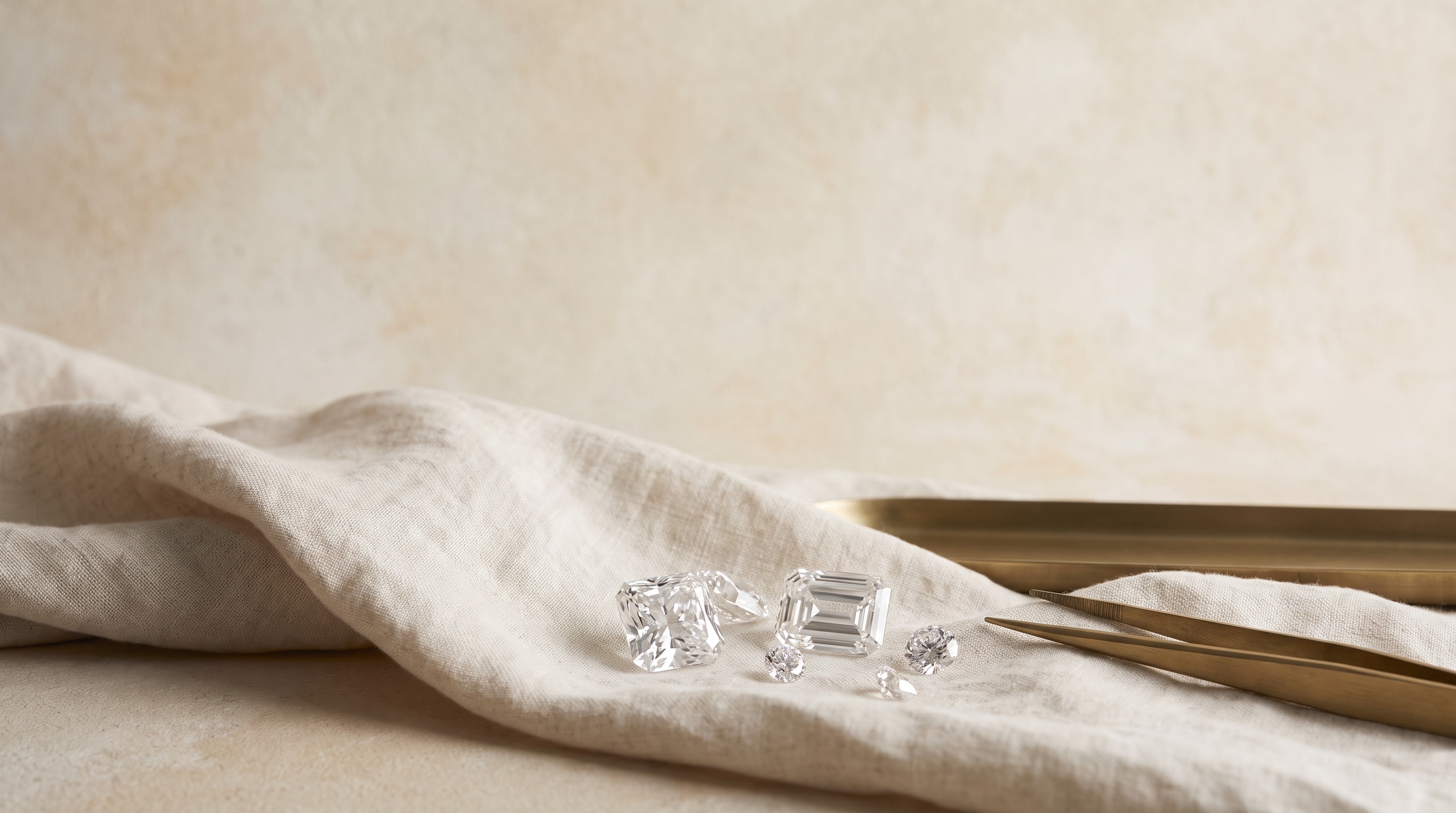
A radiant cut diamond combines a rectangular or square outline with brilliant-style faceting (typically 70 facets) that scatters light into flashes of sparkle, while an emerald cut diamond uses the same rectangular outline but with step-cut faceting — long, parallel, mirror-like facets that produce a quieter, hall-of-mirrors flash instead of scattered fire. Both share a similar silhouette, which is exactly why buyers confuse them, but they behave completely differently on the hand and impose different requirements on the stone underneath.
This guide breaks down what actually separates a radiant cut from an emerald cut, how each performs optically, what that means for color and clarity sourcing decisions, how pricing tends to compare carat for carat, and which cut fits which retail customer — written for jewelers, designers, and manufacturers deciding which one to stock or recommend, not for a single one-off purchase.
Radiant vs. Emerald Cut: The Core Differences at a Glance
Both cuts share a rectangular (or, less commonly, square) outline with trimmed corners, which is the source of most consumer confusion between them. Everything else about how they're cut, how they perform, and what they demand from the rough stone diverges from there.
| Radiant Cut | Emerald Cut | |
|---|---|---|
| Facet style | Brilliant (mixed) — roughly 70 facets | Step cut — long, parallel, rectangular facets, roughly 57 facets |
| Light performance | High sparkle and scintillation, scattered flashes | Broad, mirror-like flashes ("hall of mirrors"), less scintillation |
| Corner treatment | Cropped/trimmed corners, standard | Cropped corners, standard |
| Clarity forgiveness | More forgiving — brilliant facets break up and hide small inclusions | Least forgiving — open table facets expose inclusions clearly |
| Color forgiveness | More forgiving — scattered light performance masks warmer body color | Least forgiving — large open facets show body color, especially in corners |
| Rough yield | Generally efficient, similar to princess cut | Efficient for elongated rough |
| Typical GIA cut grade | Not assigned a standard cut grade (fancy shape) | Not assigned a standard cut grade (fancy shape) |
| Best suited to | Buyers who want maximum sparkle in a rectangular silhouette | Buyers who want a vintage, architectural, understated look |
Facet Structure: Why They Look So Different Up Close
The single biggest driver of every other difference between these two cuts is facet geometry. A radiant cut is a brilliant-style cut, meaning its facets are arranged in triangular and kite-shaped patterns similar to a round brilliant, just adapted to a rectangular or square outline. That facet arrangement breaks incoming light into many small points of reflection, producing the scattered, sparkly flash jewelers call scintillation.
An emerald cut is a step cut. Its facets run in long, parallel rows stepping down from the table to the girdle like the tiers of a staircase, which is where the name "step cut" comes from. Light entering a step-cut stone reflects off these broad, flat planes in large, sheet-like flashes rather than small scattered points — the effect trade buyers describe as a "hall of mirrors." Neither pattern is objectively better; they're simply different optical effects, and a buyer's stated preference for "lots of sparkle" versus "quiet elegance" is usually really a preference between brilliant and step faceting, whether or not they know to phrase it that way.
Light Performance and Why It Matters for Grading
Because a radiant cut's brilliant facets scatter light in many directions, small inclusions and slightly warmer color are harder for the eye to catch — the constant movement of light distracts from imperfections that would otherwise be obvious. An emerald cut's step facets do the opposite: the broad, still planes of light act almost like a magnifying window into the stone, making both inclusions and body color considerably more visible to the naked eye at the same objective grade.
This is the single most important practical takeaway for a wholesale buyer stocking either cut. Two stones with identical GIA clarity and color grades can look meaningfully different once cut into a radiant versus an emerald shape, which means grade alone isn't a reliable enough spec to buy against for either cut — reviewing actual photos or video of the specific stone matters more here than for a round brilliant, where scintillation does more of the visual "hiding" work automatically.
Clarity Requirements: Why Emerald Cut Needs a Cleaner Stone
Because an emerald cut's open step facets expose inclusions directly rather than breaking them up, trade convention is to source noticeably cleaner rough for emerald cuts than for radiant cuts at the same target retail price point. A VS2 emerald cut can show a visible inclusion to the naked eye in a way a VS2 radiant cut typically won't, simply because the radiant's brilliant faceting is doing constant visual camouflage work the emerald cut's faceting isn't built to do.
Buyers stocking emerald cuts for retail resale generally do well to hold a stricter internal clarity floor (commonly VS1 or better for larger center stones) than they would apply to a radiant cut destined for the same price tier, since a radiant cut can often carry a slightly lower clarity grade — SI1 or a clean SI2 — without the inclusion becoming visible to an unaided eye at normal viewing distance.
Color Requirements: The Corner Problem
Color behaves similarly to clarity in both cuts, with one added wrinkle specific to emerald cuts: body color tends to concentrate visibly in the cropped corners of a step-cut stone, since that's where the facet geometry does the least to disperse or hide tint. Trade buyers refer to this informally as the "corner problem," and it's a specific reason experienced emerald-cut buyers examine corner color closely rather than relying on an overall grade alone.
A radiant cut in the same color grade generally shows less visible warmth overall, again because its brilliant facets are constantly scattering light rather than presenting long, still planes that let the eye settle on body color. Practically, this means an emerald cut buyer sourcing for a colorless look typically needs to budget for a grade or two higher on the color scale (G or better, commonly) than a radiant cut buyer chasing the same face-up whiteness would need (where H or even I can still read clean).
Rough Yield and Pricing Implications
Cutting decisions on rough diamond are driven heavily by what shape gets the most retained weight (and therefore value) out of a given piece of rough. Radiant cuts, like princess cuts, tend to yield efficiently from octahedral rough with minimal waste, which is part of why radiant cuts are widely available and don't typically carry a significant per-carat premium over round brilliants at comparable grades.
Emerald cuts are efficient specifically for elongated rough crystals, and cutters favor the shape when a piece of rough's natural proportions suit a rectangular step-cut outline better than a brilliant-style cut would use it. Because emerald cut also requires notably higher starting clarity to avoid visible inclusions (as covered above), the effective cost of a retail-ready emerald cut at a given face-up clarity tends to run higher than a radiant cut at the same nominal clarity grade — the price difference isn't really about the cutting style itself, it's about the cleaner rough the step-cut faceting demands.
Carat Weight and Face-Up Size Comparison
Both cuts read larger face-up than a round brilliant of the same carat weight, since both are elongated rectangular shapes rather than a compact circle, but they don't read identically to each other. A radiant cut, with its brilliant faceting and typically slightly deeper proportions, tends to sit a touch more compact than an emerald cut of the same carat weight, which — with its flatter step-cut profile — spreads more of its weight across the top surface and can appear to cover slightly more finger area for the same weight.
| Carat Weight | Radiant Cut — Approx. Face-Up (mm) | Emerald Cut — Approx. Face-Up (mm) |
|---|---|---|
| 1.00 ct | 6.0 x 5.0 | 7.0 x 5.0 |
| 1.50 ct | 6.9 x 5.7 | 8.0 x 5.7 |
| 2.00 ct | 7.5 x 6.3 | 8.7 x 6.2 |
| 3.00 ct | 8.6 x 7.2 | 10.0 x 7.1 |
These figures are typical, trade-standard ranges rather than fixed values — actual dimensions vary by individual cutter's proportions and by length-to-width ratio, which itself is a customizable spec both cuts offer (a squarer radiant or emerald versus a more elongated one).
Which Cut Suits Which Setting
Radiant cuts handle a wider range of settings comfortably because their brilliant faceting tolerates prong, halo, and pavé accents without competing visually — the extra sparkle from accent stones blends naturally with the center stone's own scintillation. Emerald cuts are more commonly set in simpler architectures — a classic four-prong or a cathedral setting that keeps the eye on the stone's clean lines — because the quiet, geometric elegance of step-cut faceting can be visually diluted by a busy accent-heavy setting.
Both cuts are popular choices for a three-stone design, flanked by trapezoids, baguettes, or half-moons that echo the center stone's geometry — trapezoids pair especially well with emerald cut given the shared step-cut faceting, while baguettes work cleanly with either.
Retail Positioning: Who Actually Buys Each Cut
Radiant cut tends to draw a retail customer who wants a distinctive, non-round silhouette without sacrificing the maximum-sparkle look associated with round brilliants — often a buyer who considered princess cut but wanted softer, rounded corners instead of princess's sharp points. Emerald cut draws a more specific customer: someone drawn to vintage, Art Deco, or architectural aesthetics who explicitly wants a quieter, more sophisticated flash rather than maximum brilliance, and who is often more clarity- and color-conscious as a result of researching the cut's naked-eye visibility characteristics before buying.
Retailers report emerald cut skews toward a slightly older or more design-literate buyer, while radiant cut tends to appeal across a broader range of first-time engagement ring shoppers who want something distinct from round without a steep visual learning curve.
Sourcing Radiant and Emerald Cut Diamonds Wholesale
Because clarity and color requirements diverge meaningfully between these two cuts, stocking both well means sourcing against two different internal grade floors rather than treating "fancy shape inventory" as one undifferentiated category. Guru Diam carries CVD lab-grown radiant and emerald cut diamonds alongside natural stones in both shapes, with IGI, GIA, and GCAL certification available across the range — giving buyers the flexibility to match certification lab to what a specific retail customer or market segment expects.
Same-day shipping applies to in-stock inventory from both the New York location (orders before 6pm EST) and the Los Angeles location (orders before 4pm PST), which matters in particular for emerald cut sourcing, where a buyer often needs to review several stones' actual photos or video before committing rather than buying blind against a spec sheet. For a custom-built ring around either cut, Guru Diam's finished-jewelry builds turn around in 4-6 days, unbranded by default so retailers can resell under their own name.
Common Buyer Mistakes When Choosing Between the Two
The most frequent mistake is buying an emerald cut against the same clarity and color floor a buyer would apply to a radiant cut, then discovering a visible inclusion or corner color the grade report didn't fully convey through numbers alone — a mistake avoided entirely by reviewing actual stone imagery rather than buying strictly against a certificate's printed grades. A related mistake is assuming both cuts carry the same premium or discount relative to round brilliant; in practice, radiant cut pricing tracks closer to round brilliant, while a retail-ready emerald cut at true eye-clean quality often costs more per carat than a same-grade radiant cut, because of the cleaner rough its faceting demands.
A third common error is setting an emerald cut in an overly ornate, accent-heavy setting that fights its quiet, geometric character rather than complementing it — a mismatch that shows up in returns and customer dissatisfaction more than a comparable radiant cut in the same setting typically would.
A Brief History of Both Cuts
Emerald cut is the older of the two by a wide margin. Step-cut faceting dates back to cutting techniques used on colored emerald gemstones centuries ago — the name "emerald cut" comes directly from that original application, later adapted to diamond because the same rectangular, table-forward faceting suited diamond's optical properties well, particularly for showcasing a large, clean stone with minimal waste from elongated rough. The cut became strongly associated with Art Deco jewelry design in the 1920s and 1930s, and that architectural, geometric-era association still shapes how many buyers perceive emerald cut today — as a vintage-leaning, design-literate choice rather than a mainstream default.
Radiant cut is a comparatively recent invention, developed in 1977 by cutter Henry Grossbard specifically to combine a square or rectangular outline with the brilliance of a round cut — Grossbard's stated goal was a shape that would deliver round-brilliant-level sparkle without round's rough-yield inefficiency. That design intent is exactly why radiant cut behaves the way it does relative to emerald cut: it was purpose-built for sparkle and yield, not for the quiet, architectural elegance step-cut faceting produces.
Fluorescence and How It Interacts With Each Cut
Diamond fluorescence — a stone's reaction to ultraviolet light, graded None through Very Strong on a GIA report — can interact differently with brilliant and step-cut faceting. In a radiant cut, strong blue fluorescence occasionally produces a very slight hazy or oily appearance under certain lighting, though this is uncommon and usually only visible at Very Strong fluorescence levels; the brilliant faceting's constant light movement tends to minimize any visible effect at more moderate fluorescence grades. In an emerald cut, the broad, still step facets can make a hazy fluorescence effect somewhat more noticeable when it does occur, for the same underlying reason emerald cut shows inclusions and color more clearly — the facet geometry simply gives the eye a stiller, more revealing view into the stone.
For most buyers, Faint to Medium fluorescence in either cut is a non-issue and, for some color grades, can even make a stone appear slightly whiter face-up. Buyers sourcing Strong or Very Strong fluorescence stones in either shape, particularly emerald cut, should review actual video under varied lighting before committing, the same way they would for clarity and color.
Polish and Symmetry: Why They Matter More for These Two Cuts
Polish and symmetry grades matter for every diamond shape, but they carry outsized importance for both radiant and emerald cut relative to round brilliant. A round brilliant's facet pattern is so standardized that minor symmetry deviations are harder to spot with the naked eye; a fancy shape like radiant or emerald, with more facet variation and a less universally standardized proportion set, can show polish or symmetry issues more readily — a slightly uneven girdle outline, visible facet junction lines, or a table that isn't perfectly centered are all more noticeable on an elongated rectangular stone than on a circular one.
Trade buyers sourcing either cut for retail resale generally do well holding a polish and symmetry floor of Very Good or better, rather than treating those two grades as a secondary consideration behind carat, clarity, and color the way some buyers do for round brilliant, where the shape's inherent symmetry does more of the visual forgiving on its own.
Depth and Table Percentage: Reading a Certificate Correctly
Because neither radiant nor emerald cut receives a standardized numeric cut grade from GIA, depth percentage and table percentage on the certificate become more important reference points for evaluating proportions than they are for round brilliant, where the overall cut grade already synthesizes that information. For radiant cut, a depth percentage in the roughly 61-67% range and a table percentage around 61-69% are generally associated with strong light performance, though exact ideal ranges vary by individual cutter's proportion philosophy. For emerald cut, buyers typically look for a depth percentage in the 61-67% range as well, paired with attention to the specific step-facet arrangement (the number of "steps," sometimes listed as the facet pattern), since step count affects how the stone reads visually more than table and depth percentage alone would suggest.
Because neither cut has a single standardized "ideal," reviewing actual proportions alongside real photos or video remains the most reliable evaluation method — a lesson that applies to sourcing fancy shapes generally, not just this particular pair.
Frequently Asked Questions
Is a radiant cut or an emerald cut more expensive?
Neither cut carries a fixed universal premium over the other. Radiant cut pricing tracks close to round brilliant at comparable grades. Emerald cut, because its open step facets demand cleaner rough to avoid visible inclusions, often ends up costing more per carat than a radiant cut at the same printed clarity grade once you account for the higher effective quality needed for an eye-clean result.
Which cut sparkles more, radiant or emerald?
Radiant cut sparkles noticeably more. Its brilliant-style faceting scatters light into many small points of reflection (scintillation), while emerald cut's step facets produce fewer, broader flashes — often described as a quieter "hall of mirrors" effect rather than all-over sparkle.
Does an emerald cut diamond show inclusions more than a radiant cut?
Yes. Emerald cut's open, mirror-like step facets expose inclusions clearly, while a radiant cut's brilliant faceting breaks up and visually camouflages small inclusions. Two stones with the same clarity grade can look noticeably different once cut into these two different shapes.
What carat weight looks best for an emerald cut diamond?
There's no single "best" weight — it depends on the buyer's target finger coverage and budget. Emerald cut reads slightly larger face-up per carat than a compact shape like round brilliant because of its elongated rectangular outline, which lets many buyers choose a slightly smaller carat weight than they'd otherwise consider for a comparable visual size.
Can you get a lab-grown radiant or emerald cut diamond?
Yes. Both cuts are widely available in CVD lab-grown material, with the same clarity and color considerations applying as with natural stones of either shape. Guru Diam stocks CVD lab-grown radiant and emerald cut diamonds with IGI, GIA, and GCAL certification options.
What setting works best with an emerald cut diamond?
A simple four-prong or cathedral setting is the most common recommendation, since it keeps visual focus on the stone's clean geometric lines rather than competing with them. A three-stone design flanked by trapezoids or baguettes is also a popular choice that echoes the emerald cut's own step-cut faceting.
Browse current radiant and emerald cut inventory, both lab-grown and natural, through the wholesale hub, or explore certified loose stones by grade through certified diamonds. Matched side-stone pairs for three-stone designs in either shape are available under matching pairs. Trade accounts can be set up through trade partner, and custom builds around either cut can start through custom jewelry.