
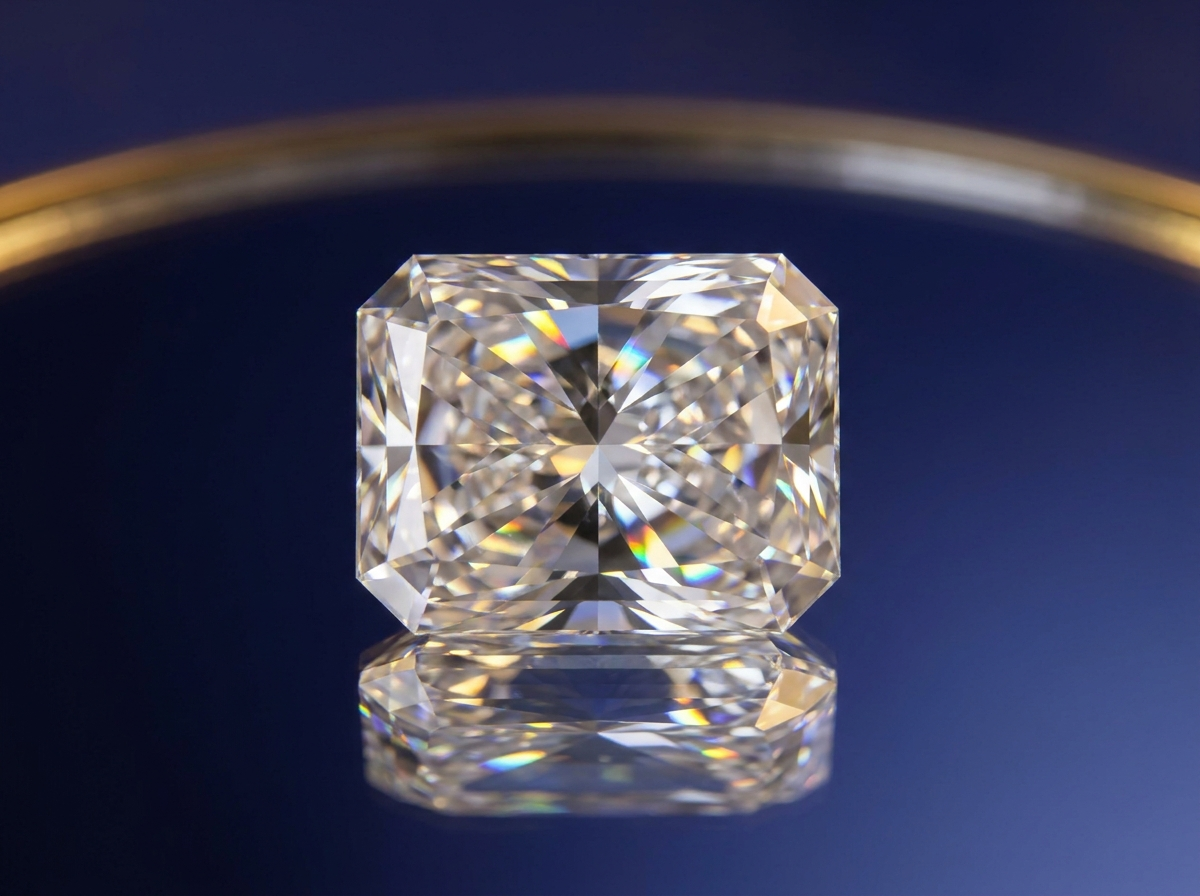
A radiant cut diamond is a rectangular or square outline with trimmed corners and a full brilliant facet pattern — combining an emerald cut's clean silhouette with a round brilliant's fire. Guru Diam stocks 623 IGI-certified, CVD-grown radiant cut diamonds in colorless white, the deepest standard-shape category in our current inventory, in stock now from our New York Diamond District desk.
Radiant is a shape searched constantly and explained rarely. Most listings show a stone and a price with no real breakdown of square-versus-rectangular ratio or why the corners are cut the way they are. This guide covers the shape properly — facet structure, history, grading, pricing, and how it stacks up against cushion and princess — then gets you to in-stock inventory.
What Is a Radiant Cut Diamond?
A radiant cut is a rectangular or square outline with the corners trimmed off, similar to an emerald cut's silhouette, but faceted with a full brilliant pattern — around 70 facets — instead of the emerald's open step facets. That combination is what makes it distinctive: the trimmed corners give it durability closer to a step cut, with fewer vulnerable points than a pointed shape, while the brilliant faceting gives it the fire and sparkle of a round.
Its facet pattern also does a favor for clarity: small inclusions are less visible under brilliant faceting than under an emerald's open step facets, which makes radiant a practical choice at a wider range of clarity grades — a real merchandising advantage, since it opens up a bigger slice of inventory that reads clean without pushing everything into VVS territory.
Radiant sits in what Guru Diam classifies internally as a regular fancy shape — a modern cut in the same production tier as emerald, Asscher, cushion, oval, pear, marquise, princess, and heart. It's not an antique cut, despite sharing a step-cut silhouette with emerald and Asscher; the brilliant faceting places it firmly in the modern category, both in how it's cut and in how it's priced.
The History of the Radiant Cut
The radiant cut is a comparatively recent addition to the diamond-cutting canon — it was developed and patented in the late 1970s, specifically engineered to solve a problem the trade had lived with for decades: buyers wanted the elongated, substantial look of an emerald cut, but emerald's open step facets showed every inclusion and threw comparatively little fire. The radiant's inventor cropped the corners of a rectangular outline and applied a full brilliant facet arrangement to both the crown and pavilion, borrowing structurally from the round brilliant while keeping the outline of a step cut.
The result caught on quickly because it split the difference other shapes couldn't. Cushion softens the corners into curves and loses some of the geometric precision buyers want in a rectangular stone; princess keeps sharp, pointed corners and full brilliance but sacrifices durability at those points. Radiant kept the rectangular geometry, added brilliant-cut fire, and squared off the vulnerable corners into a chamfered edge instead of rounding or sharpening them. By the 1990s it had moved from a novelty patent shape into a mainstream engagement-ring and fashion-jewelry staple, and it has stayed there — search demand for "radiant cut diamond" and "radiant cut engagement rings" today outpaces demand for several older step-cut shapes.
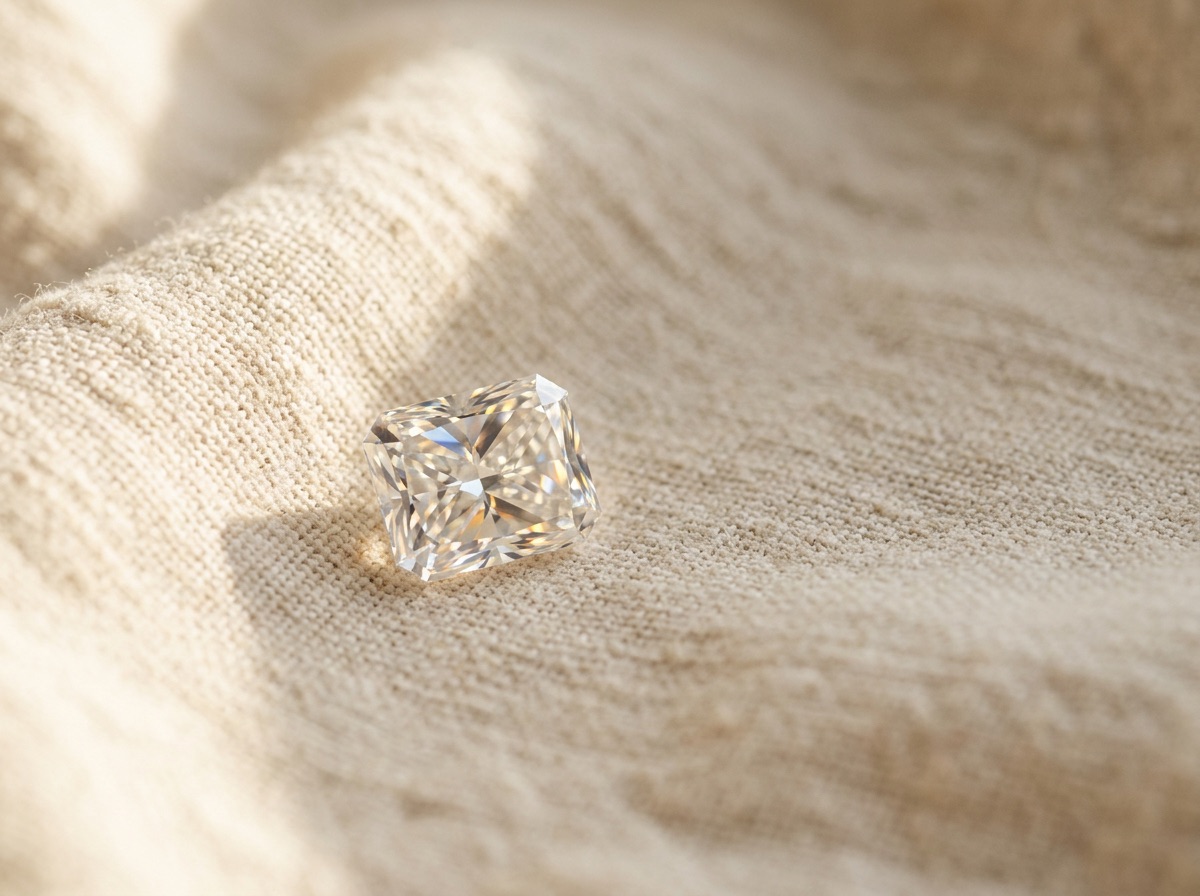
Facet Anatomy: How the Hybrid Cut Works
Understanding radiant's facet structure matters for grading, pricing, and explaining the stone to a retail buyer — it's the reason the shape performs the way it does.
- Outline: a rectangle or square with the four corners truncated at roughly 45 degrees, creating eight sides total instead of four.
- Crown facets: arranged in a brilliant pattern rather than the parallel step facets of an emerald cut — typically star facets, kite facets, and upper-girdle facets fanning out from the table, mirroring round-brilliant geometry but adapted to a rectangular outline.
- Pavilion facets: also brilliant-cut, with lower-girdle facets and pavilion mains arranged to maximize light return rather than the flat, mirror-like step facets an emerald or Asscher relies on.
- Total facet count: around 70, versus roughly 57–58 on a round brilliant and as few as 25 on a classic emerald cut. More facets at this geometry means more light-return paths, which is where radiant's fire comes from.
- Corner facets: small triangular facets at each of the four trimmed corners that both finish the outline visually and function as a structural buffer — see the durability section below.
The practical upshot: a well-cut radiant reads brighter and more forgiving of small inclusions than a step cut of comparable size and clarity, while still photographing with the clean rectangular or square silhouette customers associate with emerald and Asscher.
Square vs. Rectangular Radiant: Which Ratio to Choose
Radiant comes in two ratio families, and the difference is purely visual preference rather than a quality distinction.
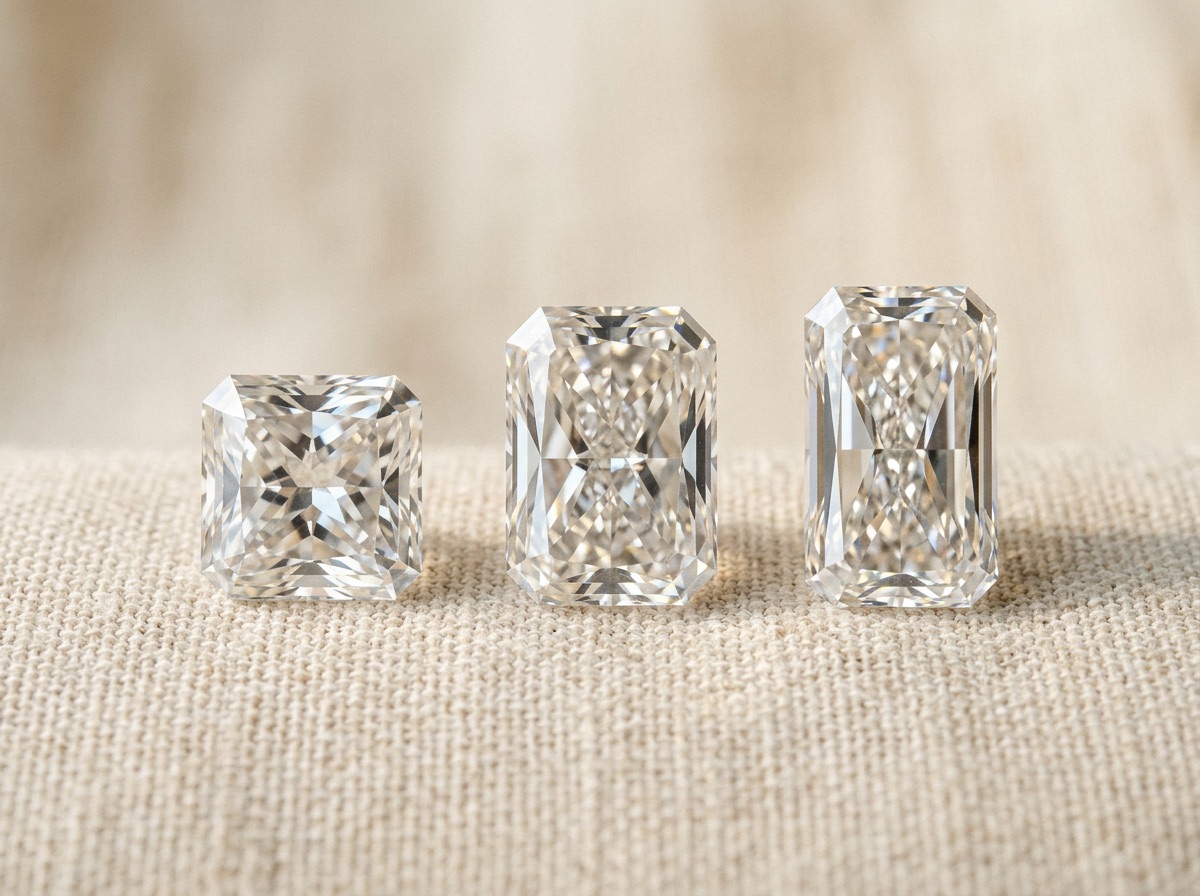
Square radiants run close to a 1.00–1.05 length-to-width ratio and read as a bold, blocky center stone. They're a common request from buyers who want the visual weight of a princess or Asscher cut but with brilliant-cut sparkle instead of a step cut's flatter light return. On a hand, a square radiant sits compact and reads large for its carat weight relative to an elongated shape.
Rectangular radiants run roughly 1.20–1.50 and up, elongating the finger in a way similar to an emerald cut while keeping more brilliance than a step cut offers. Ratios above roughly 1.50 start reading as a distinctly elongated fashion shape rather than a classic proportion, and demand for those extreme ratios is thinner and more design-specific — worth confirming with a client before committing inventory to a custom order.
Neither ratio is objectively better. Ask what look the client wants, then request the exact length-to-width measurements rather than relying on the word "radiant" alone — a 1.02 ratio stone and a 1.65 ratio stone are both correctly labeled "radiant cut" but read as completely different center stones on a finished ring. For matched-pair work (side stones flanking a larger center stone, or a three-stone setting), ratio consistency across the pair matters more than it does for a single center stone.
Durability: Why Trimmed Corners Matter for Trade Buyers
Trimmed corners are a genuine practical advantage on both the square and rectangular version of this cut — a point worth walking retail customers through, since durability sells better than most people expect once it's explained clearly.
A pointed shape like pear or marquise concentrates stress at its tip, making it more prone to chipping in daily wear, especially at the point closest to the hand's contact surfaces. A radiant's cut-off corners spread that stress across a wider edge, similar to the durability profile of an emerald or cushion cut. The corner facets aren't just decorative — they function structurally, distributing impact across a beveled edge instead of a single vulnerable vertex.
This matters most for engagement rings, since a center stone worn daily on a working hand takes more incidental contact than any other piece of jewelry a customer owns. For a jeweler fielding the "will this chip" question at the counter, radiant's answer is straightforward: the corners were engineered around exactly that concern.
Why Radiant Cut Has Become a Mainstream Engagement Ring Choice
The appeal is versatility: the visual heft and clean lines of a rectangular step cut, the forgiveness of brilliant faceting that hides small inclusions better than an emerald's open facets, and daily-wear durability a pointed shape can't match. A round brilliant reads classic and safe; a step cut like emerald or Asscher reads vintage and architectural; radiant reads modern without reading trendy — which is why it holds steady demand across engagement rings, anniversary bands, and fashion earrings rather than spiking and fading the way some fancy shapes do.
Guru Diam's Radiant Cut Sourcing and In-House Cutting
With 623 pieces on hand, radiant is Guru Diam's deepest standard-shape category — enough breadth across ratio, size, and clarity to cover nearly any center-stone request without a made-to-order wait. Guru Diam sources radiant cut diamonds as wholesale, trade-only inventory — no retail markup — from our New York Diamond District desk (36 West 47th Street, Suite 601A) and our Los Angeles office (607 South Hill Street, Suite 241).
Cutting, polishing, and setting are handled in-house rather than outsourced piecemeal across vendors — the difference between a supplier who can adjust a ratio or proportion on request and one who's reselling whatever a third party already produced. For a trade buyer, that in-house control means a custom radiant request doesn't have to route through a chain of intermediaries before it comes back with an answer.
Radiant cut inventory spans white colorless stones in the D–J range as the primary catalog, with fancy color radiant available separately in yellow, pink, blue, and green — the same fancy color palette Guru Diam carries across certified loose stones generally. In-stock white radiant pieces ship same-day from New York (before 6pm EST) or Los Angeles (before 4pm PST). For a custom setting built around a radiant center stone, CAD-to-finished-piece turnaround runs 4–6 days from either desk — that timeline applies to finished jewelry construction, not to sourcing the loose stone itself, which is already on hand.
Grading & Quality Considerations for Radiant Cut
Radiant's brilliant facet pattern changes how you should evaluate a stone compared to a step cut, and it's worth briefing retail-facing staff on the differences.
Color
Because radiant's faceting scatters light more than a step cut's flat mirrored facets, body color is somewhat easier to mask at a given grade than it would be in an emerald or Asscher cut of the same color grade. A radiant in the G–H range often reads whiter face-up than a step cut at the same grade — useful context when a client is comparing a radiant quote against an emerald cut quote and wondering why the color grades look identical but the stones don't look the same in person.
Clarity
This is where radiant earns its reputation as the forgiving brilliant-cut shape. Small feathers, pinpoints, and clouds that would be visible under an emerald cut's open step facets are frequently obscured by radiant's fragmented light return. That doesn't mean clarity stops mattering — inclusions near the culet or under the table can still be visible — but it does mean a SI1 or SI2 radiant is a more viable "eye clean" recommendation than a step-cut stone at the same grade, which matters directly for margin on mid-market orders.
Cut Quality (Proportions)
Unlike round brilliants, neither GIA nor IGI issues a formal cut grade (Excellent/Very Good/Good) for fancy shapes including radiant — cut grading for fancy shapes is proportion-based rather than a single letter grade, and it's assessed through the certificate's proportions diagram and measurements rather than a summary grade box. When evaluating radiant stock, check the length-to-width ratio against the intended use (square vs. rectangular, as covered above), the depth percentage, and symmetry of the corner facets — an uneven corner trim is one of the more common cut-quality flaws to watch for, since it throws off the visual balance of the outline even when the certificate's numeric grades look fine.
Certification
Guru Diam grades radiant cut inventory to IGI as the standard certifying lab, with GIA and GCAL certification available on request for buyers whose retail market has a lab preference. All radiant pieces in the certified catalog are single stones with individual reports — not melee, and not parcel goods.
Pricing Factors for Radiant Cut Diamonds Wholesale
Radiant cut diamonds generally price below round brilliants of comparable carat weight, color, and clarity — a function of cutting yield and lower per-carat retail demand than round. A handful of factors move price within the shape itself:
- Carat weight and size thresholds: pricing steps up at psychological carat breakpoints (1ct, 1.5ct, 2ct, 3ct) the same way it does across every shape — a stone just above a breakpoint commands a real premium over one just below it, even at a marginal weight difference.
- Ratio: square radiants and rectangular radiants aren't priced identically even at the same carat weight, because yield from rough differs by target ratio and demand skews toward certain proportions depending on the season and region.
- Color and clarity combination: because radiant's faceting is more forgiving of both lower color and lower clarity than a step cut, the "sweet spot" combinations — G-H color paired with SI1-SI2 clarity, for example — carry a better price-to-appearance ratio in radiant than they do in emerald or Asscher, which is a genuinely useful upsell point for margin-conscious retail buyers.
- Fluorescence: handled the same way it is across other shapes — strong blue fluorescence can soften a slightly higher color grade's price without a visible downside face-up, though it's worth flagging on the certificate rather than leaving a retail buyer to discover it later.
- Symmetry of the corner trim: as noted in the grading section, uneven corner facets are a real (if subtle) quality issue, and well-proportioned radiant with evenly cut corners trades at a premium over stones with an obviously lopsided outline.
Because Guru Diam sells wholesale with no retail markup layered in, radiant pricing tracks the underlying carat/color/clarity/ratio combination directly — the 623-piece inventory spans a wide enough range on all four variables that most requested price points have several matching stones on hand rather than one.
Styling and Use-Case Guidance
Radiant's versatility shows up most clearly in how many different jewelry contexts it works in without needing a shape-specific setting style.
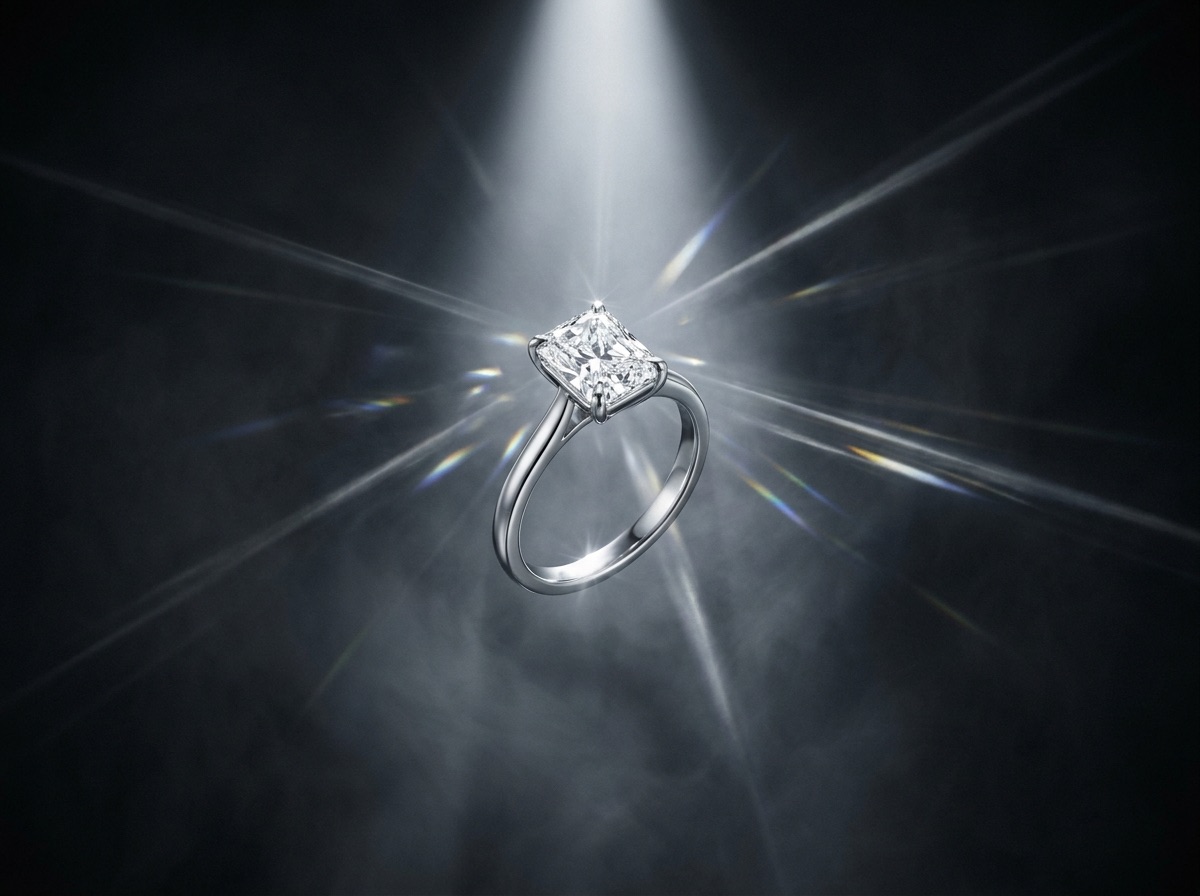
Engagement ring center stones: radiant pairs well with both classic four-prong solitaire settings and more architectural bezel or half-bezel settings, since the trimmed corners give a bezel something clean to wrap around instead of the sharp points a princess cut would present. Halo settings built around a radiant center stone read substantial without the halo needing to do much visual heavy lifting, since the center stone already carries brilliance on its own.
Three-stone settings: radiant's rectangular geometry makes it a natural center stone for a three-stone ring, flanked by trapezoids, tapered baguettes, or smaller radiant or emerald cuts as side stones. Matching ratio between the center stone and side stones — not just matching shape — is the detail that separates a well-executed three-stone radiant setting from one that looks visually mismatched.
Matched pairs: because radiant is cut to consistent, quotable ratios, it's a reliable shape for earring pairs and other symmetrical applications where two stones need to visually match — a request Guru Diam fields regularly given the depth of the current 623-piece inventory.
Pendants and fashion jewelry: radiant's brilliance holds up well in a pendant, where a step cut's flatter light return can look comparatively dull under ambient indoor lighting. It performs consistently across lighting conditions, which matters more for pieces worn day-to-day than for a ring photographed once under studio lighting.
Metal pairing: radiant's brilliant faceting works with both white metals (platinum, white gold) and yellow or rose gold — the fire isn't dependent on a white-metal backdrop the way some step cuts read better cold-toned, giving retail buyers more flexibility against whatever metal trend is moving that season.
Radiant Cut vs. Cushion Cut
These two shapes get compared constantly because they occupy adjacent territory — both are brilliant-faceted, both come in square and elongated ratios, and both sit in the same regular-fancy production and pricing tier. The differences that actually matter for a buying decision:
- Outline: cushion has rounded, pillow-like corners across its entire perimeter; radiant has straight sides with the four corners trimmed at an angle. Cushion reads softer and more romantic; radiant reads more geometric and architectural.
- Facet pattern: both are brilliant-cut, but cushion's facets curve with the rounded outline while radiant's facets meet at sharper transitions along the straight edges and trimmed corners — cushion tends to show a softer, more diffused sparkle pattern, radiant a crisper one.
- Durability: both are solid choices for daily wear, but radiant's angled corner facets distribute stress slightly more predictably than cushion's continuous curve, which has no single hard corner point but also no flat edge to absorb an impact.
- Retail positioning: cushion tends to pull vintage-leaning and romantic-styling customers; radiant pulls customers who want geometric definition with brilliance. They're rarely a direct either/or for the same customer — the styling preference usually decides it before price does.
Guru Diam carries both shapes at comparable depth. The practical advice for a retail floor: keep one of each ratio family on hand — square cushion, elongated cushion, square radiant, elongated radiant — for side-by-side comparison, since customers frequently can't articulate which they want until they've seen both under the same lighting.
Radiant Cut vs. Princess Cut
Radiant and princess get confused more often than they should, since both are square-leaning brilliant-cut shapes with a modern, geometric look. The distinction that matters most:
- Corners: princess cut keeps sharp, pointed corners; radiant trims them off. This is the single biggest visual and structural difference between the two shapes.
- Durability: princess's exposed corners are the most vulnerable point on any commonly sold diamond shape and require a protective prong setting at each corner as standard practice. Radiant's trimmed corners don't carry that same chip risk, which makes it the more forgiving shape for a customer who's hard on jewelry or works with their hands.
- Facet count and pattern: princess cut typically runs 58–76 facets depending on the specific cutting style, in a similar range to radiant's roughly 70, so brilliance between the two is comparable — the choice mostly comes down to whether a customer wants the crisp pointed-corner square look or the softened, trimmed-corner rectangle.
- Ratio flexibility: princess is almost always cut close to square (1.00–1.05); radiant offers the same square option plus the full elongated range up to 1.50+. A customer who wants an elongated squared-off shape has no princess equivalent — radiant is the only brilliant-cut option in that lane.
For a trade buyer stocking both shapes, the differentiator to lead with at the counter is durability: princess demands a protective setting and a careful daily-wear conversation, while radiant's trimmed corners largely sidestep it — a meaningful point of difference between two similarly priced, similarly brilliant shapes.
How to Order Radiant Cut Diamonds Wholesale
Guru Diam sells radiant cut diamonds — and the full catalog across shapes, colors, and finished jewelry — as verified wholesale, trade-only inventory. There's no public retail pricing and no minimum-order friction beyond standard trade-account verification.
- Open a wholesale account at
/signup. Verification confirms trade status (resale certificate or equivalent) before pricing and inventory access unlock. - Book time with a gemologist at
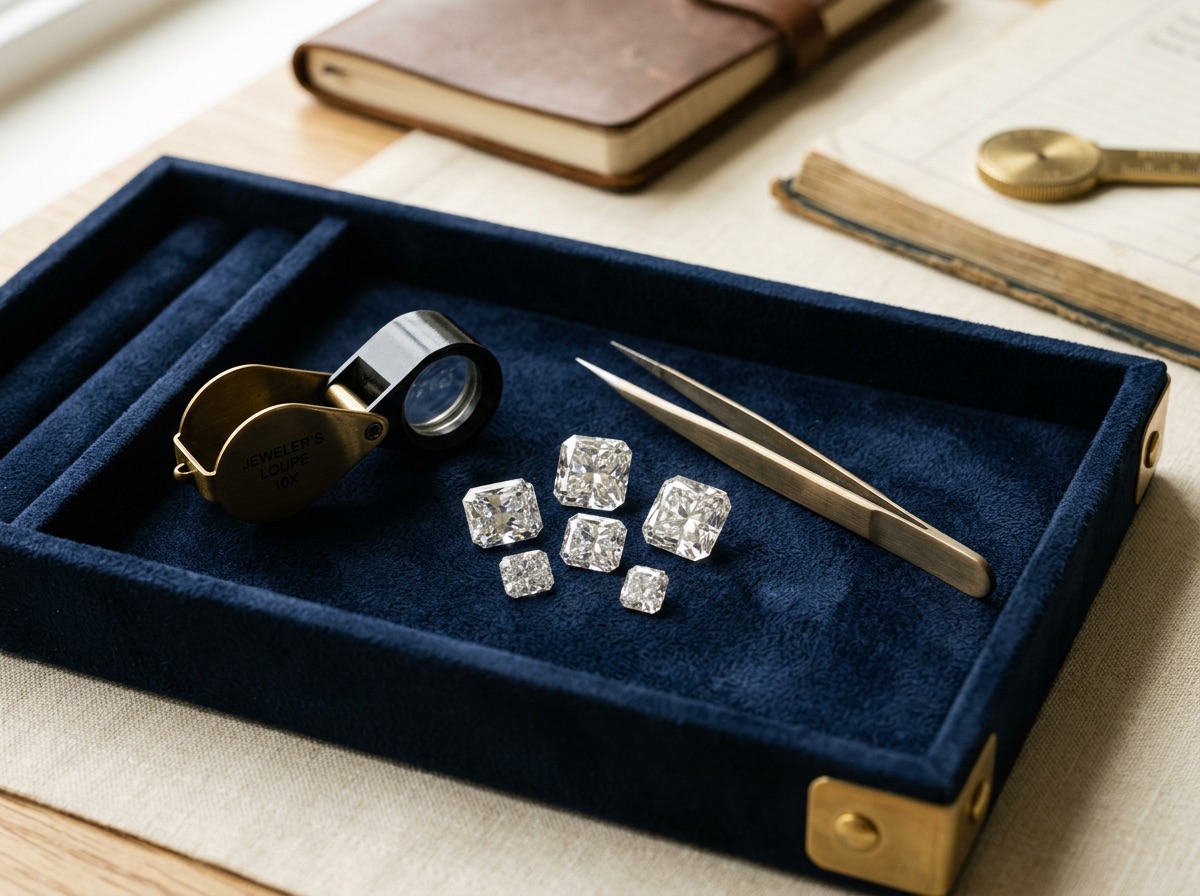
/book-appointmentto review radiant cut stock against a specific spec — ratio, carat range, color/clarity target, certification preference — rather than scrolling a static catalog. - Visit in person at the New York Diamond District desk (36 West 47th Street, Suite 601A) or the Los Angeles office (607 South Hill Street, Suite 241) to view radiant cut stones under a loupe before committing to a center-stone order.
- Order a custom setting built around a chosen radiant center stone — CAD-to-finished-piece turnaround runs 4–6 days once the stone and design are confirmed.
Radiant cut is also available in fancy color for buyers looking to fill out a colored-stone case alongside the standard colorless inventory — yellow, pink, blue, and green radiant cut stones are carried separately from the white catalog described above.
Frequently Asked Questions
What is a radiant cut diamond?
A radiant cut diamond is a rectangular or square outline with trimmed corners and a full brilliant facet pattern, combining an emerald cut's silhouette with a round brilliant's fire. Its brilliant faceting also hides small inclusions better than an emerald cut's open step facets.
What's the difference between a square and rectangular radiant cut?
Square radiants run close to a 1.00–1.05 length-to-width ratio and read as a bold, blocky center stone. Rectangular radiants run roughly 1.20 to 1.50 and up, elongating the finger similarly to an emerald cut while keeping more brilliance. The choice is visual preference, not a quality difference.
Is radiant cut more durable than a pointed shape like pear or marquise?
Yes, generally. A pointed shape concentrates stress at its tip, making it more prone to chipping in daily wear. Radiant's trimmed corners spread that stress across a wider edge, giving it a durability profile closer to an emerald or cushion cut.
How does radiant cut compare to princess cut for everyday durability?
Radiant holds up better in daily wear. Princess cut keeps sharp, exposed corners that are the most chip-prone point on the stone and typically need a protective prong at each corner. Radiant's trimmed corners remove that vulnerable point while offering a comparable facet count and level of brilliance.
Are Guru Diam's radiant cut diamonds lab-grown, and are they certified?
Yes. Guru Diam's radiant cut inventory is CVD-grown and IGI-certified as standard, with GIA and GCAL certification available on request. All pieces are certified single stones, not melee.
How fast can I get a radiant cut stone or a finished custom piece?
In-stock radiant cut pieces ship same-day from New York (before 6pm EST) or Los Angeles (before 4pm PST). For a custom setting built around a radiant center stone, CAD-to-finished-piece turnaround runs 4–6 days once the stone and design are confirmed.