The Providence Jewelry District is a historic manufacturing neighborhood just south of downtown Providence, Rhode Island, where costume and fine jewelry producers, findings makers, and casting houses concentrated from the late 1800s through most of the 20th century, at one point accounting for a large majority of the costume jewelry made in the United States. The neighborhood still carries the name today and remains home to a working cluster of jewelry manufacturers, findings suppliers, and casting operations.
This guide is written for independent jewelers, designers, and manufacturers who work with Providence-area suppliers or are simply trying to understand why the name keeps coming up in the trade. It covers the district's manufacturing history, why Rhode Island became a jewelry hub in the first place, what happened to the neighborhood as manufacturing shifted overseas, what the district looks like today alongside its newer biotech tenants, and — since findings, casting, and stone-setting are only part of building a piece of jewelry — how out-of-state jewelers working with Providence-area manufacturers typically source the diamonds that go into the finished work.
What Is the Providence Jewelry District?
Geographically, the Jewelry District sits just south of downtown Providence, bounded roughly by the Providence River, Interstate 95, and the area around what used to be an elevated stretch of Interstate 195 before that highway was relocated in the 2010s. It's a compact, walkable industrial neighborhood of brick mill buildings, low-rise factory blocks, and converted warehouses — a physical footprint that still reads as an old manufacturing district even though a meaningful share of its buildings now house offices, labs, and residential units rather than jewelry benches.
The name isn't a marketing label applied after the fact; it's a literal description that stuck because it was true for well over a century. Jewelry manufacturing concentrated in this specific pocket of Providence starting in the early 1800s, and by the early-to-mid 20th century the neighborhood and the broader Rhode Island jewelry trade around it had become so dominant nationally that "the Jewelry District" needed no further explanation to anyone in the trade.
Origins: How Providence Became a Jewelry Manufacturing Center
Providence's jewelry industry traces back to the final years of the 18th century, when a small group of local craftsmen began experimenting with techniques for making gold-look jewelry more affordable than solid-gold pieces. The breakthrough that mattered most was what the trade came to call gold-filled or rolled-gold construction — bonding a thin layer of gold to a base-metal core under heat and pressure, producing jewelry that looked and wore like solid gold at a fraction of the material cost. That single innovation is usually credited as the seed of Providence's entire jewelry industry, and it set the template the district would follow for the next century and a half: high-volume, well-engineered, affordably priced jewelry rather than one-off luxury pieces.
Through the 1800s, that seed grew into a genuine manufacturing cluster. Small workshops multiplied around the same few blocks south of downtown, each specializing in a narrow piece of the process — stamping, plating, stone-setting, clasp-making — because concentrating specialists close together let the whole neighborhood work faster than any single vertically integrated shop could on its own. By the turn of the 20th century, Providence wasn't just a city with some jewelry manufacturers in it; it was functionally a single, distributed jewelry factory spread across dozens of buildings, with output moving between specialist shops on the same block before a finished piece ever left the district.
Why Rhode Island Became the Jewelry Hub: Workforce and Infrastructure
Three ingredients explain why this concentration happened in Providence specifically, rather than dispersing evenly across the country the way most manufacturing does.
The first was workforce depth. Generations of skilled metalworkers, platers, stone-setters, diemakers, and designers trained inside the district itself, apprenticing in one shop and eventually opening or staffing another a few doors down. That created a labor pool no other American city could match for this specific trade — a jewelry manufacturer opening in Providence could hire experienced people immediately, where the same manufacturer opening almost anywhere else would have had to train a workforce from scratch.
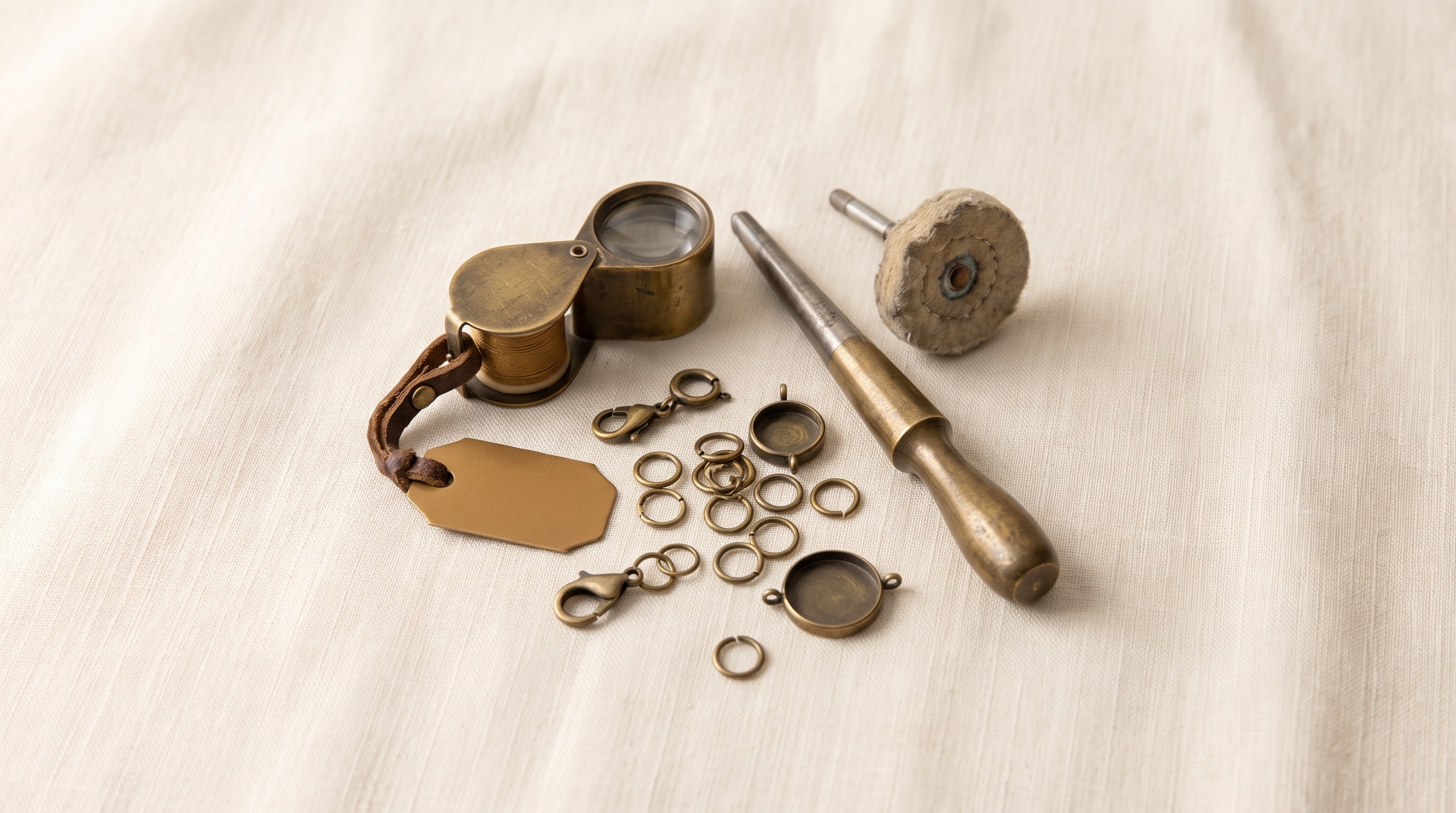
The second was findings and tooling infrastructure. "Findings" is trade shorthand for the small functional components that hold a piece of jewelry together — clasps, jump rings, pin backs, ear-wire components, prong settings, and similar hardware. A jewelry manufacturer doesn't usually make its own findings from raw metal; it buys them from specialist findings houses, the same way a furniture maker buys hinges rather than forging them in-house. Providence developed one of the deepest findings-supply ecosystems in the country, which meant any manufacturer in the district could source virtually every small component it needed without leaving a few square blocks.
The third was casting capacity. Fine and costume jewelry both depend on casting houses — operations that turn a wax or metal master model into a production-ready mold and then cast that shape repeatedly in gold, silver, or base metal. Providence built out enough casting capacity, serving enough manufacturers at once, that even a small independent jewelry maker could access industrial-scale casting without owning a foundry itself. Put together, workforce, findings, and casting infrastructure created a self-reinforcing cluster: each new shop that opened made the district slightly more valuable to the next one, which is the same dynamic that later built places like Silicon Valley around a different industry entirely.
The Peak Years: America's Costume Jewelry Capital
Rhode Island's jewelry industry grew steadily through the early 1900s and accelerated through the middle of the 20th century, as costume jewelry — affordable fashion jewelry using gold-filled metal, base metal, glass, and paste stones rather than fine gold and precious gems — became a mainstream category of American fashion rather than a niche. Providence and the surrounding Rhode Island towns became the country's dominant production base for that category. Historical accounts and industry retrospectives commonly cite Rhode Island as having produced somewhere in the range of two-thirds to nearly nine-tenths of all costume jewelry made in the United States at the industry's mid-20th-century peak, a genuinely dominant share for a single small state to hold in any manufacturing category.
The table below is a simplified overview of the district's manufacturing eras. Exact dates and figures vary by source, and the transitions between periods were gradual rather than sharp cutoffs, but the broad arc is well documented.
| Era | Approximate Period | What Characterized It |
|---|---|---|
| Founding period | Late 1790s – 1860s | Early gold-filled and rolled-gold techniques developed; small specialist workshops establish the district's south-of-downtown footprint |
| Industrial expansion | 1870s – 1910s | Findings houses, casting shops, and stamping mills multiply; Providence becomes a nationally recognized jewelry manufacturing center |
| Peak costume-jewelry era | 1920s – 1960s | Rhode Island becomes the dominant US costume-jewelry production base; district operates at maximum density, with tens of thousands of jewelry-trade jobs across the state |
| Contraction and offshoring | 1970s – 1990s | Overseas manufacturing, changing fashion demand, and broader US deindustrialization steadily shrink the district's manufacturing base |
| Redevelopment era | 2000s – present | I-195 relocation opens land for mixed-use redevelopment; biotech, life sciences, and residential tenants move in alongside a smaller surviving core of jewelry manufacturers |
Understanding Findings, Casting, and Trade Infrastructure
For jewelers newer to the trade, it's worth being explicit about what actually moved through the district at its peak, because "jewelry manufacturing" understates how specialized the ecosystem was. A finished piece of costume or fine jewelry typically passed through several distinct specialist processes: a designer or modelmaker created the master pattern; a casting house turned that pattern into a production mold and cast the base components; a findings supplier provided the clasps, pin backs, ear-wire hardware, and joining components; a plating shop applied gold, rhodium, or other finishes; and a stone-setting shop mounted glass, paste, or genuine gemstones into the finished mounting. Providence's density meant a manufacturer could walk a piece through every one of those steps within the same few blocks, often working with different specialist shops for different product lines simultaneously.
That specialization is also why the district's legacy is still relevant to jewelers today who have nothing to do with costume jewelry specifically. A modern independent jeweler or designer sourcing custom casting, prong and setting components, or production-scale findings from a Rhode Island supplier is drawing on infrastructure and expertise that's directly descended from this same manufacturing tradition, even when the end product is a fine gold engagement ring rather than a piece of mid-century costume jewelry.
Decline: Offshoring, Changing Fashion, and Deindustrialization
The district's contraction from the 1970s through the 1990s followed a pattern familiar to a lot of American manufacturing during that period. Lower-cost overseas manufacturing, particularly in Asia, could produce comparable costume jewelry at a fraction of the labor cost, and as import competition intensified, many Providence-area manufacturers either closed, consolidated, or shifted toward higher-margin fine jewelry and specialty components rather than competing directly on mass-market costume jewelry volume. Changing fashion habits played a role too — costume jewelry's mid-century dominance gave way to shifting trends in how Americans accessorized, which reduced overall demand for the exact product categories the district had built its scale around.
The cumulative effect was a steady thinning of the district rather than a single collapse. Buildings that once housed dozens of specialist jewelry shops emptied out gradually over decades, and by the late 20th century a neighborhood that had once been synonymous with American jewelry manufacturing had a visibly smaller working core, even as a real and still-significant jewelry trade presence remained.
The I-195 Relocation and the District's Redevelopment
A major physical turning point for the neighborhood came with the relocation of Interstate 195. For decades, an elevated stretch of I-195 cut directly through the district, physically dividing it and consuming land that couldn't be used for much else. Rhode Island relocated that highway segment starting in the 2000s, with the project substantially completed in the 2010s, freeing up a meaningful parcel of centrally located urban land right in the historic Jewelry District.
That freed land became the centerpiece of a formal redevelopment effort, generally referred to as the I-195 Redevelopment District, aimed at attracting new investment, new employers, and new construction to a neighborhood that had spent decades losing manufacturing jobs. The redevelopment authority marketed parcels to a mix of institutional, commercial, and residential developers, and new construction — offices, lab space, student and market-rate housing — began filling in land that had sat under an elevated highway for generations.
From Jewelry District to Innovation District
The most visible outcome of that redevelopment has been the arrival of biotech, life sciences, and higher-education tenants, drawing on Providence's proximity to Brown University and other regional research institutions. New lab and office buildings went up on former highway land and adjacent parcels, and the area picked up an informal second identity — sometimes called the Innovation District — that overlaps with, rather than replaces, the historic Jewelry District name.
In practice, both names are used today depending on who's talking and what they're referring to. Real estate listings and economic-development materials increasingly lean on "Innovation District" framing to market the neighborhood's newer knowledge-economy tenants, while the jewelry trade itself, longtime residents, and historical references continue to use "Jewelry District," which remains the name printed on street signs and used in the neighborhood's official planning documents. Neither label is wrong; they describe the same physical footprint from two different angles — one looking at its past and present manufacturing base, the other at its newest wave of tenants.
What the Jewelry District Looks Like Today
Walking the district today, the two identities sit side by side rather than in separate zones. Brick mill buildings that once housed rows of jewelry benches now share blocks with glass-fronted lab buildings, university-affiliated research space, and converted residential lofts. Mixed in among the newer construction, a smaller but genuine working core of jewelry manufacturers, findings suppliers, and casting houses continues to operate, some in the same buildings their predecessors occupied decades earlier.
That surviving core isn't a museum piece — it's active production infrastructure. Casting houses still cast for both costume and fine jewelry clients. Findings suppliers still stock and ship the small components that jewelry manufacturers everywhere depend on. Stone-setting, plating, and finishing shops still serve manufacturers who need production-scale work done reliably and on schedule. Rhode Island as a whole still supports a meaningfully sized jewelry manufacturing sector even though it's a fraction of its mid-20th-century scale, and the Jewelry District itself remains the geographic and institutional center of that surviving industry.
Why the District Still Matters to Independent Jewelers and Designers
For an independent jeweler or designer who has no personal connection to Rhode Island, the natural question is why any of this history matters today. The honest answer is that it matters less as a place to visit and more as a source of specific, still-relevant production capability. Jewelers and designers across the country place orders with Providence-area findings suppliers, casting houses, and small-batch manufacturers precisely because that infrastructure — built up over more than a century of concentrated specialization — still produces components and casting work at a level of consistency and technical depth that's genuinely hard to replicate from scratch elsewhere.
A designer developing a new line of earrings might source ear-wire findings from a Providence supplier. A jeweler scaling up production on a popular ring design might send the master model to a Providence-area casting house rather than building out in-house casting capacity. A manufacturer needing a specific historic finding style — the kind of hardware that was standard in mid-century costume jewelry and is now something of a specialty item — is more likely to find it made correctly by a supplier with roots in that same tradition. In each case, the value isn't nostalgia; it's that the district's manufacturing expertise never actually disappeared, it just got smaller and more specialized.
Findings and Casting Capability vs. Diamond Sourcing: Where the Two Meet
It's worth being precise about what a Providence-area manufacturer, casting house, or findings supplier typically does and doesn't provide, because it's a genuinely different function from where a jeweler sources loose diamonds. The table below lays out that distinction.
| Function | What a Providence-Area Manufacturer / Casting House Typically Provides | What a Wholesale Diamond Supplier Typically Provides |
|---|---|---|
| Core product | Castings, findings, mountings, and finished metalwork | Loose certified diamonds, melee, and matched stone parcels |
| Materials handled | Gold, silver, base metal, plating finishes | Natural and lab-grown diamonds, certification paperwork |
| Typical order | Custom casting runs, findings restocks, prototype models | Individual certified stones, melee parcels, matched pairs for earrings or side stones |
| Certification role | None — metalwork isn't independently certified the way a graded diamond is | IGI, GIA, or GCAL certification on individually graded stones; melee shipped against a quality baseline rather than individual certification |
| Where it fits in production | Builds the mounting the stone will sit in | Supplies the stone that goes into the mounting |
The two functions are complementary rather than overlapping, which is exactly why a jeweler working with a Providence manufacturer for castings and findings still needs a separate, dedicated diamond source for the stones themselves — a manufacturer sourcing findings from Rhode Island doesn't typically also carry loose certified diamond inventory, and shouldn't be expected to.
How Out-of-State Jewelers Source Diamonds for Providence-Made Jewelry
Because casting, findings, and stone-setting expertise concentrated in Providence historically, but diamond sourcing didn't, independent jewelers and designers who work with Providence-area manufacturers today typically maintain a separate wholesale relationship for the stones that go into the finished piece. In practice, that sourcing tends to break down into three categories.
Loose certified stones. For center stones and feature diamonds, jewelers order individually graded loose diamonds — natural or lab-grown, in standard round brilliant, regular fancy shapes like oval, cushion, and emerald, or antique-style cuts such as Old European and Old Mine — with independent certification from IGI, GIA, or GCAL, so the stone's grade and characteristics are documented before it's set. That documentation matters just as much whether the stone is headed to a Providence casting house for mounting or set in-house by the jeweler directly.
Melee. For pavé, halo, and accent work, jewelers order melee — small diamonds, generally in the roughly 0.8mm to 9.0mm range — as parcel goods against a consistent quality baseline rather than individually certified, since certifying each tiny stone individually isn't practical at that scale. Melee needs to arrive calibrated and color- and clarity-consistent enough that a setter can work through a parcel without constantly sorting for outliers, which is exactly the kind of quality control a dedicated wholesale diamond supplier is built around.
Custom stone matching. For symmetrical designs — stud earrings, three-stone rings, side-stone accents flanking a center diamond — jewelers need matched pairs or matched sets: stones cut, sized, and graded closely enough to each other that they read as a true match once set. That's a specialized sourcing task distinct from ordering a single stone, and it's typically handled by a supplier that stocks enough depth in a given size and quality range to actually assemble a matching set on request rather than approximating one.
None of this sourcing has to happen in Rhode Island itself. A jeweler in Providence, or anywhere else in the country working with a Providence-area manufacturer, generally places the metalwork order with the manufacturer and a separate diamond order with a wholesale supplier, then either has the stones shipped directly to the manufacturer for setting or sets them in-house after the mounting arrives. This is where a supplier like Guru Diam fits into a Providence-adjacent workflow: as the diamond side of that split, not as a Rhode Island presence. Guru Diam operates from two US locations — New York (HQ) and Los Angeles — and carries no Providence or Rhode Island office; jewelers working with Providence-area manufacturers order stones the same way any other out-of-state trade buyer does, through a standard wholesale account, with product shipped to wherever the setting work is happening.
On the product side, Guru Diam's certified loose-diamond catalog, browsable through the certified diamonds category, spans natural and CVD lab-grown stones across standard, regular fancy, and antique cut categories, with IGI, GIA, and GCAL certification available depending on the stone. In-stock loose inventory is ready to ship same-day — from New York before 6pm EST and from Los Angeles before 4pm PST — which matters for a jeweler coordinating a stone order against a manufacturer's casting or setting schedule and trying to avoid the piece sitting half-finished while a stone is still in transit. Melee is supplied as calibrated parcel goods against a DEF+/VS+ quality baseline rather than individual certification, matching how melee actually moves through production at scale, and matched pairs for symmetrical settings like stud earrings and side stones are sourced through matching pairs, with colored stones available through fancy color loose diamonds. Trade accounts can review wholesale terms at the wholesale hub or apply directly through trade partner. Cutting, setting, and polishing on Guru Diam's own finished and custom pieces, available through custom jewelry, are handled all in-house, and for a jeweler doing the setting work through a separate Providence-area manufacturer, the relevant piece is simply getting the right graded stones or matched parcel to that manufacturer on a schedule that keeps production moving.
Practical Tips for Jewelers Working with Providence-Area Manufacturers
- Separate the metalwork relationship from the stone relationship early. Decide upfront whether stones will ship to you for setting in-house, ship directly to the Providence manufacturer, or be dropped off in person, and confirm the manufacturer's intake process for received stones before the first order.
- Order certification independently of the casting timeline. A casting or findings order and a certified-stone order rarely need to happen on the same schedule — ordering stones early and confirming certification before the mounting is finished avoids a rush decision on the stone itself.
- Ask for melee parcels sized to your actual setting needs. Requesting a parcel calibrated to the specific mm range and quantity a design calls for, rather than a generic assortment, reduces waste and sorting time at the bench.
- Confirm matched-pair tolerances before ordering. "Matched" can mean different things to different suppliers — ask specifically how closely stones are matched on color, clarity, and cut before committing to a set for a visible symmetrical design.
- Track two separate shipping timelines. A metalwork order and a diamond order are unlikely to ship on the same day even when ordered around the same time, so plan the piece's completion date around whichever leg is slower, not the faster one.
Frequently Asked Questions
What is the Providence Jewelry District?
It's a historic manufacturing neighborhood just south of downtown Providence, Rhode Island, where jewelry manufacturers, findings suppliers, and casting houses concentrated from the early 1800s through most of the 20th century. It remains an active jewelry manufacturing area today, alongside newer biotech and life-sciences tenants.
Why did Rhode Island become such a dominant jewelry manufacturing center?
Three factors reinforced each other: a deep, specialized local workforce trained inside the district itself, dense findings-supply infrastructure that let manufacturers source small components locally, and enough casting capacity that even small operations could access industrial-scale casting without their own foundry.
Is the Providence Jewelry District still called that today, or is it the Innovation District now?
Both names are used and refer to the same neighborhood. "Jewelry District" is the historic name, still used officially and by the surviving jewelry trade, while "Innovation District" has become common shorthand for the newer biotech, life sciences, and research tenants that moved in after the I-195 relocation freed up land in the 2010s.
Can independent jewelers still source findings and casting from Providence today?
Yes. A smaller but genuine working core of jewelry manufacturers, findings suppliers, and casting houses continues to operate in and around the district, and jewelers and designers across the country place orders with them for findings, custom casting, and small-batch production work.
Does Guru Diam have a location in Providence or Rhode Island?
No. Guru Diam operates from two US locations — New York (HQ) and Los Angeles — and does not have a Providence or Rhode Island office. Jewelers working with Providence-area manufacturers source diamonds from Guru Diam the same way any out-of-state trade buyer does, through a standard wholesale account with stones shipped to wherever the setting work happens.
How do jewelers working with Providence manufacturers typically source diamonds?
Most maintain a separate wholesale diamond relationship apart from their casting and findings supplier, ordering certified loose stones for center diamonds, calibrated melee parcels for pavé and accent work, and matched pairs for symmetrical designs like stud earrings, then either shipping stones directly to the manufacturer for setting or setting them in-house after the mounting arrives.