Prong and bezel setting are the two most common ways to secure a diamond or gemstone in jewelry, and they trade off in almost opposite directions: prong setting uses a small number of metal claws to hold the stone with minimal metal coverage, maximizing light exposure and brilliance, while bezel setting encircles the stone's girdle in a continuous metal rim, maximizing protection and durability at the cost of some light exposure and a visually heavier look. Neither setting style is objectively better — the right choice depends on the wearer's lifestyle, the stone's shape and durability, and the look a customer or buyer is after.
This guide compares prong and bezel setting on light performance, security and durability, cost, shape compatibility, and everyday wearability, so a jeweler or wholesale buyer can match the right setting style to a specific stone, customer, or inventory need.
What Is Prong Setting
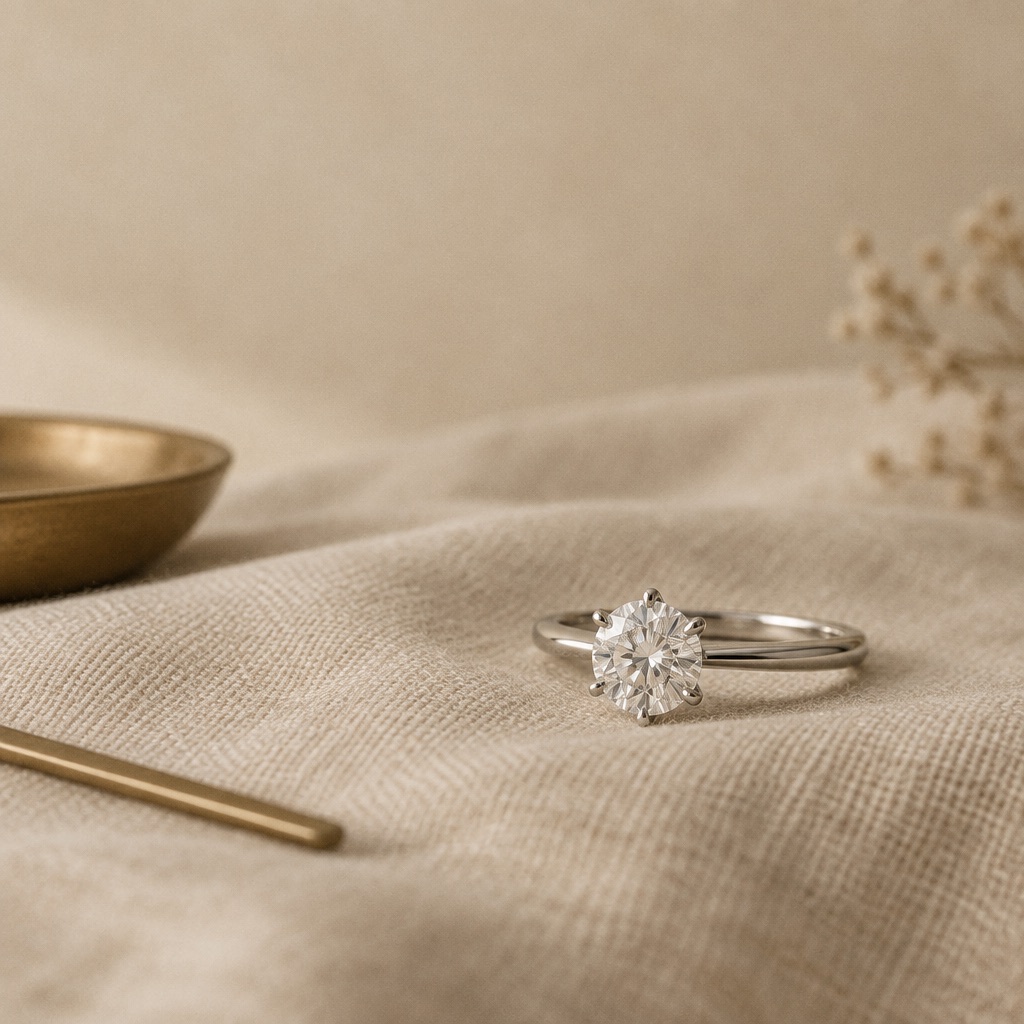
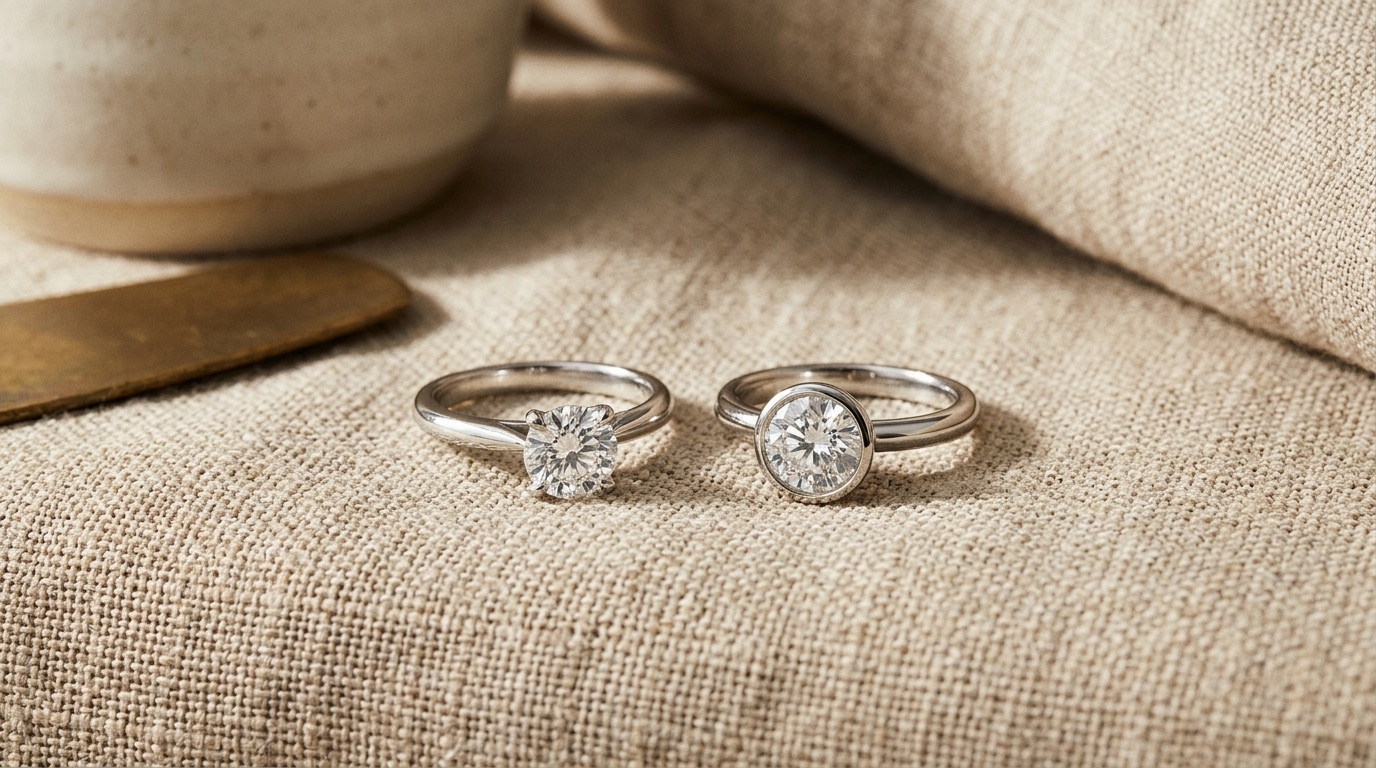
Prong setting holds a stone using a small number of metal claws — most commonly four or six — positioned around the stone's girdle and bent or pushed over the stone's edge to hold it in place. Because prongs cover only a small fraction of the stone's surface, far more light can enter and exit the stone from the sides and underneath than a setting style that covers more of the girdle, which is why prong settings are the standard choice when maximizing a stone's brilliance and light performance is the priority. Prong setting is by far the most common setting style used for center stones in engagement rings and solitaire pieces, largely because it shows off a well-cut stone's light performance more completely than most alternatives.
What Is Bezel Setting
Bezel setting surrounds a stone's entire girdle in a continuous metal rim that's pressed or hammered over the stone's edge to hold it in place, rather than gripping it at a small number of discrete points. This continuous rim provides substantially more physical protection than prongs do, since there's no gap in the metal for the stone's girdle edge to catch on or chip against, and it also means the stone can't work loose the way a prong can bend or wear down over time. The tradeoff is that a bezel covers more of the stone's surface area than prongs do, which reduces light entry from the sides and gives the stone a somewhat more contained, modern look compared to a prong-set stone's more exposed brilliance.
Prong vs. Bezel Setting: Side-by-Side Comparison
| Factor | Prong Setting | Bezel Setting |
|---|---|---|
| Light exposure | High — maximizes brilliance, minimal metal coverage | Lower — full metal rim reduces light entry from the sides |
| Durability/protection | Moderate — girdle edge and corners exposed to impact | High — continuous rim shields the entire girdle from impact |
| Security | Good, but prongs can bend, wear, or snag over time and need periodic inspection | Very high — stone can't work loose the way a prong can |
| Visual look | Classic, stone appears to "float," shows more of the stone's outline | Sleek, modern, more contained look; less of the stone's profile visible from the side |
| Best for | Active-hand wearers prioritizing sparkle, classic engagement ring looks | Daily manual work, active lifestyles, minimalist styling, vulnerable stone shapes/corners |
| Typical cost to manufacture | Generally lower labor per setting for standard 4/6-prong work | Generally higher — requires more precise metal-to-stone fit and more bench time to execute cleanly |
| Stone size perception | Shows the stone's full outline, reads close to actual size | Metal rim can make a stone appear slightly smaller by hiding part of the girdle |
Light Performance: Why Prongs Win on Brilliance
A diamond's brilliance depends heavily on light entering and exiting through the sides and pavilion of the stone, not just the top — light that a prong setting's minimal metal coverage does very little to block, since the vast majority of the stone's girdle and pavilion remains exposed to ambient light from every angle. A bezel's continuous metal rim, by contrast, blocks light from entering or exiting through the entire girdle, which — depending on how deep the bezel wall sits relative to the stone — can measurably reduce the stone's overall light return compared to the same stone prong-set. This is the core reason prong setting remains the default choice for center stones where maximizing sparkle and light performance is the top priority, particularly for round brilliants and other cuts specifically engineered for maximum light return.
Durability and Everyday Wear
Bezel setting's continuous metal rim is meaningfully more protective than prongs in everyday wear, which is why bezel setting is a popular choice for customers with active hands, manual jobs, or lifestyles involving frequent impact risk to a ring. A bezel eliminates the exposed girdle edge and corners that prongs leave vulnerable to chipping against hard surfaces, and it removes the specific failure mode prongs are prone to — a bent, worn, or snagged prong that loosens a stone over time and requires periodic re-tipping or tightening by a jeweler. Prong-set stones aren't inherently insecure, but they do require more routine maintenance attention over years of wear than a bezel-set stone typically does, since prong metal thins and can bend from repeated knocks in a way a solid bezel wall generally doesn't.
Security: How Each Setting Actually Holds the Stone
Prongs hold a stone through mechanical grip at a small number of contact points, meaning the security of the setting depends directly on each prong maintaining its exact bent shape and tension against the stone — wear, bending, or an impact strong enough to flex a prong even slightly can compromise that grip at one point, which is why jewelers routinely check and re-tighten prongs as part of standard ring maintenance. Bezel setting instead relies on continuous metal contact around the entire girdle, distributing holding force across the stone's full circumference rather than a few discrete points, which is inherently more forgiving of minor wear and generally requires less frequent maintenance intervention to remain secure over the same span of years.
Shape Compatibility
Both settings work across most diamond shapes, but there are real compatibility differences worth knowing:
- Round brilliant — works well in both; prong is the more common default for maximizing brilliance, bezel is a popular modern/minimalist alternative.
- Princess, radiant, and other sharp-cornered shapes — bezel setting (or a corner-protecting variant) is often specifically recommended for these shapes since their exposed corners are the single most vulnerable point on the stone, and a full or partial bezel meaningfully reduces chipping risk there.
- Emerald and asscher (step cuts) — prong setting typically uses four prongs positioned over the stone's cropped corners specifically, since step cuts' large open facets already show flaws readily and additional metal coverage from a full bezel would further reduce their signature light performance; a partial bezel or protective corners is sometimes used as a middle ground.
- Oval, pear, and marquise — prong setting is the more common choice to preserve maximum light exposure across these already brilliant-faceted elongated shapes, though bezel is a viable and increasingly popular styling choice for a more minimalist, protected look.
Cost Differences
Bezel setting generally requires more bench time and precision than standard prong setting, since the metal rim needs to be fitted and pressed evenly around the stone's exact girdle contour with no gaps, versus prongs, which — while still a skilled setting task — follow a more standardized process across a wide range of stone sizes within a given shape. This typically translates into a modest labor-cost premium for bezel setting compared to a standard 4- or 6-prong setting of comparable complexity, though the actual cost gap depends on the specific piece's design and the setter's rate, and both styles scale down in per-unit labor cost at production volume the same way other manufacturing labor does.
Visual Style and Sizing Perception
Prong setting shows more of a stone's actual outline and profile than bezel does, since a bezel's metal rim visually absorbs part of the stone's girdle into the setting itself — which means a bezel-set stone can read as very slightly smaller than the same stone prong-set, even though the stone's actual carat weight is identical. This is a genuine consideration for customers or buyers prioritizing maximum apparent size, and it's part of why prong setting remains the more common choice specifically for larger center stones where showing off full size and brilliance is the priority, while bezel's more contained look is often chosen deliberately for its sleek, minimalist aesthetic rather than in spite of the size-perception effect.
Combining Prong and Bezel in One Piece
Many jewelry designs use both setting styles together rather than choosing exclusively one or the other — a common approach pairs a prong-set center stone (maximizing the main stone's brilliance) with bezel-set side or accent stones (maximizing durability on smaller stones that see more incidental contact along a ring's shoulders), giving a design the light-performance benefit of prongs where it matters most and the durability benefit of bezels where accent stones are most exposed to daily wear. This hybrid approach is especially common in three-stone and cluster designs, where side stones positioned closer to the hand's contact surfaces benefit disproportionately from bezel's added protection.
Half-Bezel and Partial Bezel Variants
Between full bezel and standard prong setting sits a range of partial and half-bezel styles — designs that use a bezel-style metal rim to protect only the most vulnerable part of a stone (commonly the corners on a princess or radiant cut) while leaving the rest of the girdle exposed to preserve more light entry than a full bezel would allow. These hybrid approaches are a common middle-ground choice for buyers who want meaningfully better corner protection than plain prongs provide, without fully committing to a full bezel's more contained look and greater light-performance tradeoff.
Maintenance Over Time
Prong-set stones benefit from periodic professional inspection — jewelers commonly recommend checking prong tightness roughly every six months to a year for a ring worn daily, since prong metal thins gradually with repeated wear and impact — and re-tipping or rebuilding worn prongs is routine, expected maintenance rather than a sign of a manufacturing defect. Bezel-set stones require comparatively less routine maintenance attention given their inherently more secure, distributed grip, though the bezel wall itself can wear thin over many years of heavy daily contact and may eventually need rebuilding, just on a considerably longer typical timeline than prong maintenance.
Choosing Between Prong and Bezel for Inventory
Buyers stocking finished jewelry or offering custom setting options benefit from carrying both styles rather than defaulting to one, since they serve genuinely different customer priorities: prong for customers prioritizing maximum brilliance and a classic look, bezel for customers prioritizing durability, an active lifestyle, or a sleek minimalist aesthetic. Jewelers fielding custom orders should ask directly about a customer's daily hand activity and styling preference before defaulting to either setting, since the "right" choice genuinely depends on lifestyle fit as much as aesthetic preference. A well-rounded bridal and fashion jewelry program typically keeps both styles available across popular shapes and metal options, rather than treating one as a default and the other as a niche special-order item, since demand for each shifts by customer segment and doesn't consistently favor one over the other across a broad trade customer base.
Regional and Trend Influence on Setting Preference
Preference between prong and bezel setting has shifted over recent years, with bezel setting seeing a meaningful resurgence in fashion and bridal jewelry driven partly by a broader minimalist styling trend and partly by growing consumer awareness of durability tradeoffs after years of prong-dominant default designs. This shift shows up unevenly across regions and customer segments — some markets have moved toward bezel as a default modern choice, while others remain strongly prong-dominant for traditional bridal purchases specifically. Buyers tracking sell-through by setting style at the segment level, rather than assuming a single blended trend applies evenly across an entire customer base, are better positioned to stock inventory that actually matches regional demand rather than chasing a national trend figure that may not reflect a specific market's real preference.
Origins of Prong and Bezel Setting
Bezel setting is the older of the two techniques by a wide margin — encircling a stone in a metal rim is one of the earliest known ways of securing a gemstone in jewelry, tracing back thousands of years to ancient goldsmithing traditions, where the priority was straightforwardly protecting a valuable stone rather than maximizing its optical performance in the modern sense. Prong setting is a comparatively more recent development, gaining wide popularity as diamond cutting itself advanced — the six-prong "Tiffany setting," introduced in 1886, is widely credited as the design that popularized elevating a diamond above the band on minimal metal specifically to let more light reach the stone, a direct response to advances in round brilliant cutting that made maximizing light return worth designing a setting around. That basic principle — minimal metal, maximum light — has remained the core logic behind prong setting ever since, even as specific prong counts and shapes have evolved.
How Setting Choice Fits Into the Broader Manufacturing Process
Setting style is decided early, at the CAD design stage, since prong and bezel settings require meaningfully different stone-seat geometry, metal thickness, and structural planning around the stone before anything is cast — a piece can't be designed generically and have its setting style swapped late in production the way a metal color or minor sizing detail sometimes can be. Bezel settings in particular demand tighter manufacturing tolerances, since the metal rim needs to fit the stone's exact girdle contour with no visible gap, which is part of why bezel setting tends to carry a labor-cost premium over standard prong work: getting a clean, secure bezel fit takes more precise bench time than seating a stone under four or six prongs, even before accounting for the different skill each setting style demands from an experienced setter.
Customer Conversations: Helping Buyers Choose
Jewelers fielding a customer torn between prong and bezel setting generally get better results asking about the customer's daily hand activity and priorities directly, rather than leading with a technical comparison of light performance versus durability. A customer who works with their hands often, plays sports, or has previously chipped or lost a stone from a prong setting is usually well served by bezel, while a customer prioritizing maximum sparkle and a classic engagement-ring look, without major daily-wear risk factors, is usually well served by prong. This design-goal-first approach mirrors how experienced consultants guide shape decisions more broadly — starting from the customer's actual life and priorities produces a better match than starting from a spec-sheet comparison of setting mechanics.
Sourcing Diamonds and Custom Settings
Guru Diam sources loose diamonds across CVD lab-grown and natural catalogs — standard, antique, and exotic shapes, certified through IGI, GIA, and GCAL — suited to both prong and bezel setting styles, and manufactures custom engagement rings and finished jewelry in either setting style, turned around in 4-6 days. In-stock loose inventory ships same-day (before 6pm EST from New York, before 4pm PST from Los Angeles). Trade buyers can source certified stones through certified diamonds, source matched bezel- or prong-ready side stones through matching pairs, build a custom prong- or bezel-set piece through custom jewelry, and review sourcing terms at the wholesale hub or apply for a trade account through trade partner.
Prong Count and Configuration
Not all prong settings are identical — prong count and configuration meaningfully affect both look and security. Four-prong settings expose slightly more of the stone and are the more common choice for round and cushion shapes prioritizing maximum light exposure, while six-prong settings distribute holding force across more contact points, offering somewhat more security for larger or heavier stones at a small cost to light entry. Shared-prong configurations, where adjacent stones in a row share a single prong between them rather than each getting its own full set, are common in pavé and channel-adjacent designs to save space and keep sightlines clean, though shared prongs need to be sized and positioned carefully since a single failure point affects two stones rather than one. Double-prong and claw-tip variations exist as well, mainly used on larger center stones where a jeweler wants added security without moving to a full bezel and its greater light-performance tradeoff.
Repairing and Replacing Each Setting Style
Repair work differs meaningfully between the two styles, which is worth factoring into a long-term ownership or resale conversation. Prong repair is a routine, well-understood jewelers' task — re-tipping a worn prong or rebuilding a full prong head is a common bench job most jewelers handle quickly and affordably. Bezel repair is a less frequent but more involved job when it's needed: rebuilding a worn bezel wall typically requires removing the stone entirely, fabricating or re-forming the metal rim, and resetting the stone with the same precision the original setting demanded — a less common repair simply because bezels need it far less often, but one that generally takes a jeweler more time and skill to execute well than a routine prong re-tip.
Frequently Asked Questions
What is the main difference between prong and bezel setting?
Prong setting holds a stone with a small number of metal claws, maximizing light exposure and brilliance. Bezel setting surrounds the stone's entire girdle in a continuous metal rim, maximizing durability and security at some cost to light entry.
Which is more durable, prong or bezel setting?
Bezel setting is generally more durable, since its continuous metal rim protects the stone's entire girdle from impact and eliminates the exposed edge prongs leave vulnerable. Prong-set stones are secure but require more routine maintenance over time.
Does bezel setting make a diamond look smaller?
Slightly — a bezel's metal rim visually absorbs part of the stone's girdle, so a bezel-set stone can read as marginally smaller than the same stone prong-set, even though the actual carat weight is identical.
Which setting is better for an active lifestyle?
Bezel setting is generally the better choice for active hands or manual work, since its full metal rim protects the stone's girdle and corners from impact far more effectively than exposed prongs do.
Is prong or bezel setting more expensive?
Bezel setting typically carries a modest labor-cost premium over standard prong setting, since fitting a continuous metal rim evenly around a stone's exact contour requires more precise bench work than standard prong setting.
Can a ring combine both prong and bezel settings?
Yes — many designs pair a prong-set center stone with bezel-set side or accent stones, combining maximum brilliance on the main stone with added durability on the accent stones most exposed to daily contact. Jewelers commonly recommend checking prong tightness roughly every six months to a year for a ring worn daily, while bezel settings generally need far less frequent maintenance given their more secure, distributed grip.