
For most custom builds, the setting decision comes down to four trade-offs: prong gives the most light return and the lowest metal cost but the least edge protection; bezel gives the most durability and the cleanest modern silhouette but adds bench time and slightly dims the stone at the girdle; halo adds the most apparent size per dollar, which matters more on lab-grown centers because the carat budget stretches further; and pavé isn’t a center-stone setting at all — it’s a shank treatment that still needs a prong or bezel head to actually hold the diamond. Get those four distinctions straight and most consultation-table questions answer themselves.
Lab-grown CVD diamonds are optically and physically identical to mined stones at the same cut and clarity — same hardness, same refractive index, same durability profile. Nothing about setting mechanics changes because the stone is lab-grown. What changes is the math: at a lower cost per carat, a customer can afford a bigger center stone or a heavier halo build for the same budget, which is exactly why setting choice deserves a real conversation instead of a default 4-prong solitaire.
The Four Setting Families at a Glance
| Setting | Durability | Apparent size / light effect | Manufacturing complexity | Best-paired shapes |
|---|---|---|---|---|
| Prong (4 or 6-claw) | Moderate — exposed girdle and culet are catch points | Maximizes light entry and brilliance; true-to-carat look | Low — fastest to cast and set | Round, Oval, Pear, Marquise, Cushion |
| Bezel (full or half) | Highest — full metal rim guards the girdle | Slightly reduces light return at the edge; reads modern/minimal | Moderate — precise metal-to-stone fit required | Round, Asscher, Emerald, Heart |
| Halo (single, double, hidden) | Moderate, but melee accent stones are the real wear point | Adds 15-25% apparent size depending on halo width | Highest — accent stone matching and micro-setting take the most bench time | Cushion, Oval, Round, Pear |
| Pavé (shank treatment) | Lowest of the four if worn hard — small stones can loosen over years | Adds sparkle along the band, not to the center stone itself | Moderate to high, scales with stone count | Pairs with any center-stone setting above |
How Each Setting Physically Holds the Stone
The four families look different on a finished ring, but the underlying mechanics are worth separating out, because most durability and repair questions trace back to how few or how many contact points are actually gripping the stone.
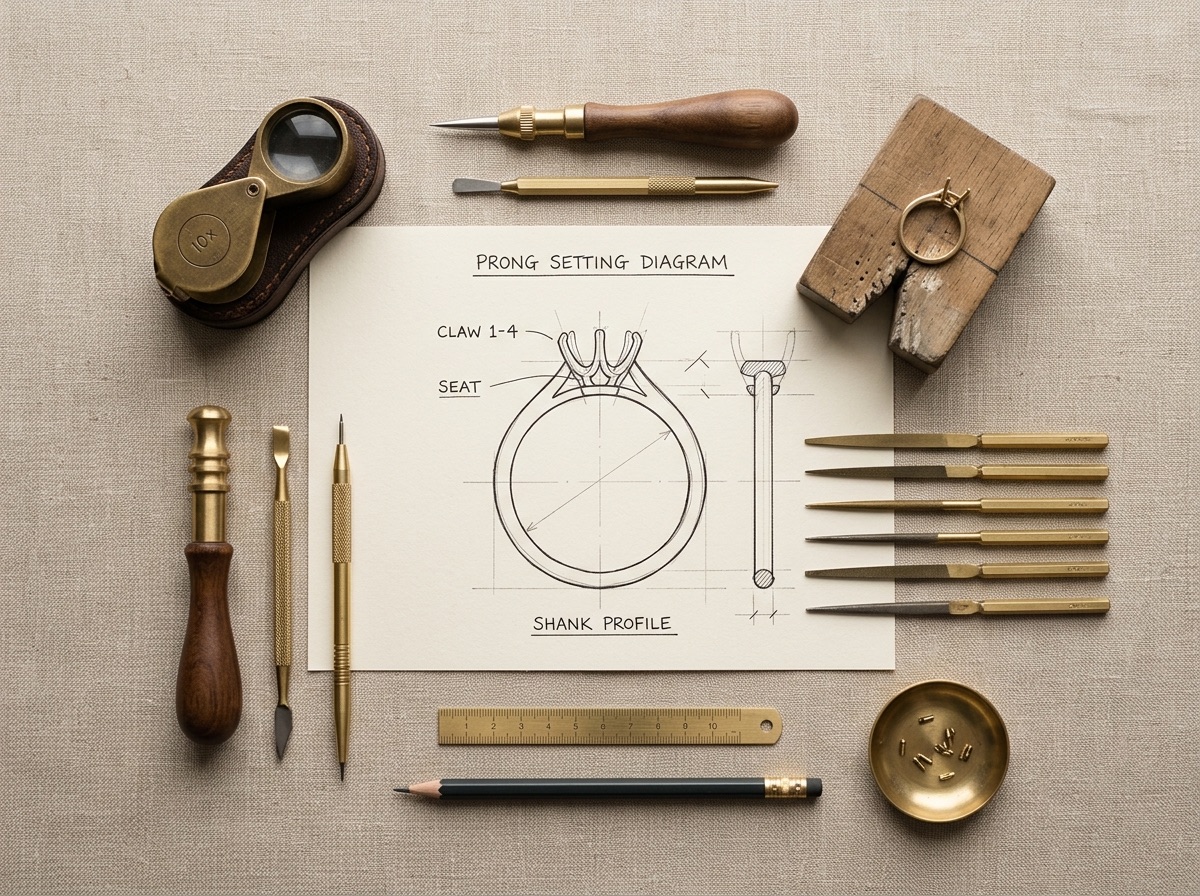
A prong head is a basket of thin metal claws bent or pushed down over the stone’s crown just above the girdle, holding it through compression at four or six isolated points. Everything else — the girdle, the pavilion, the culet — stays exposed to air and light. A bezel replaces those isolated points with a single continuous collar sized to the stone’s exact girdle diameter; the metal edge is burnished down over the stone’s perimeter, so the holding force is spread evenly around the whole circumference rather than concentrated at a handful of claws. A halo starts with a prong or bezel head at the center and adds a second structure around it — a metal band pre-drilled with individual seats, each holding one piece of melee with its own tiny beads or micro-prongs. Pavé takes that same idea further: the metal surface is drilled in a grid, small beads of metal are raised between the holes, and each bead is pushed over the edge of an adjacent melee stone until the stones sit nearly flush with the surface — which is what produces the “paved” look the technique is named for.
Prong Settings: Maximum Light, Minimum Metal
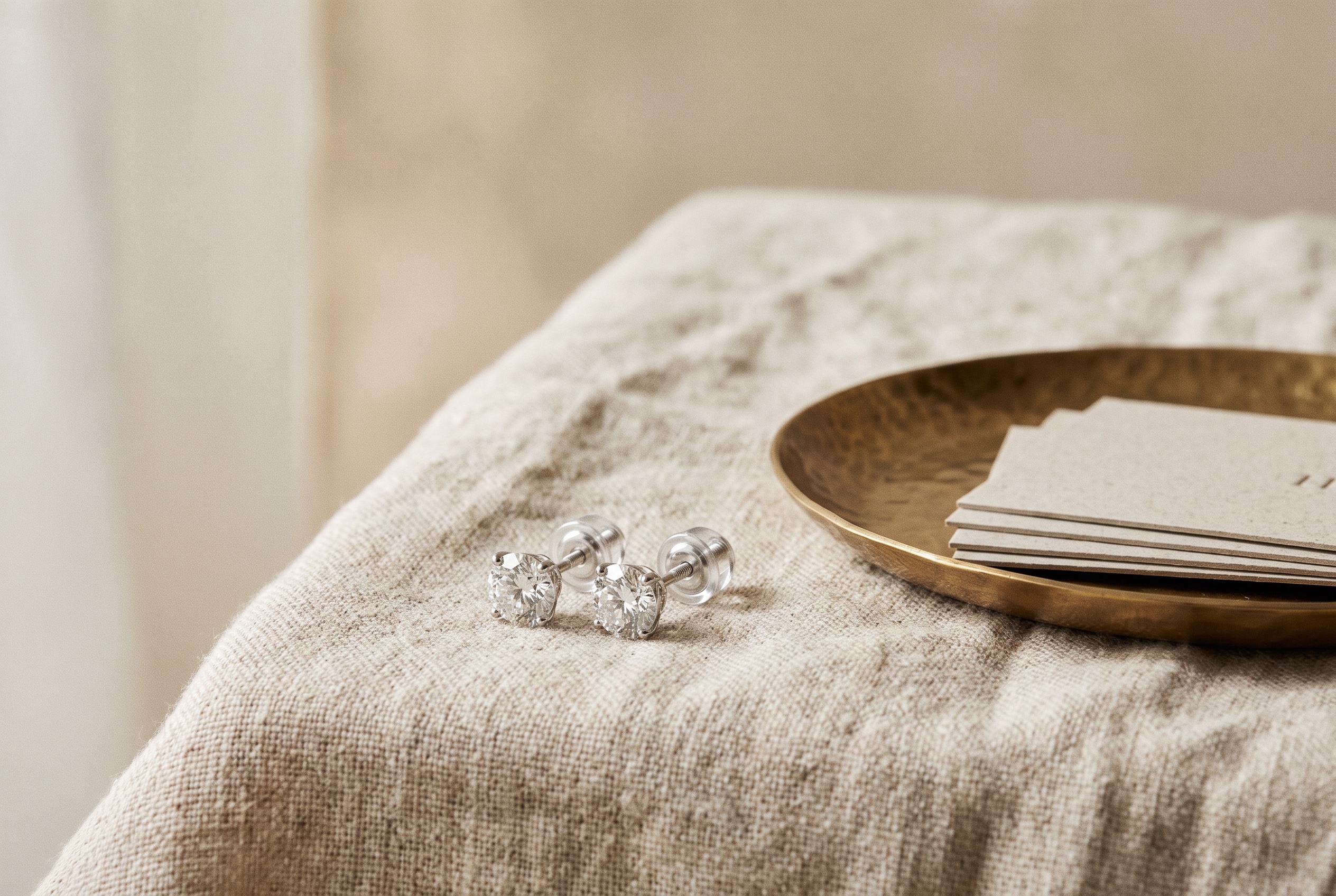
A prong head — four or six thin metal claws — holds the stone with the least metal coverage of any setting family. That’s the whole appeal: light enters from every angle, including through the pavilion, so a lab-grown round or oval reads brighter and larger than the same stone would in a bezel. It’s also the cheapest and fastest setting to produce, which is why it’s the default on most volume engagement ring lines.
The trade-off is exposure. Prongs catch on fabric, hair, and gym equipment, and they’re the first thing to wear thin on a ring worn daily for years. For a customer who works with their hands — nurses, contractors, anyone in food service — six prongs instead of four, or a slightly heavier gauge, is worth the small material cost increase. It’s a five-minute conversation that prevents a stone-loss claim two years out.
Four-prong is the classic solitaire silhouette: the most light entry, the most exposed metal profile, and the lowest cost of any option in this family. Six-prong spreads the same holding force across two additional contact points, which lowers the load any single claw carries and buys a real security margin without jumping all the way to a bezel’s light loss and bench time. It’s a natural middle ground for a customer who wants prong-level brilliance but doesn’t want to think about a retipping visit every few years.
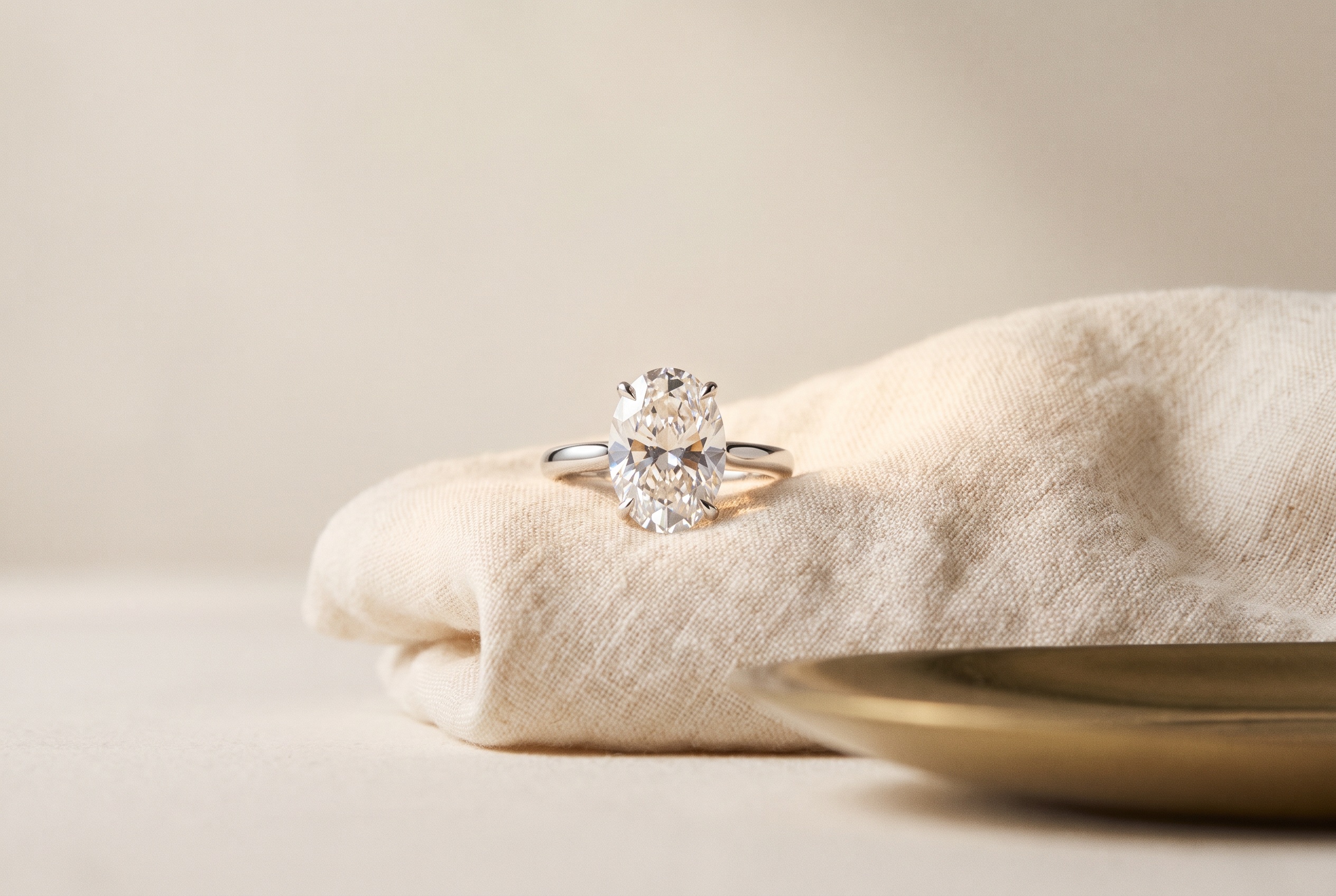
Shape fit: round and oval lab-grown centers do best here because the curved girdle distributes prong pressure evenly. Pear and marquise need V-tipped prongs at the points — a standard claw will chip the tip of either shape under normal wear.
Bezel Settings: Built for the Bench, Not Just the Photo
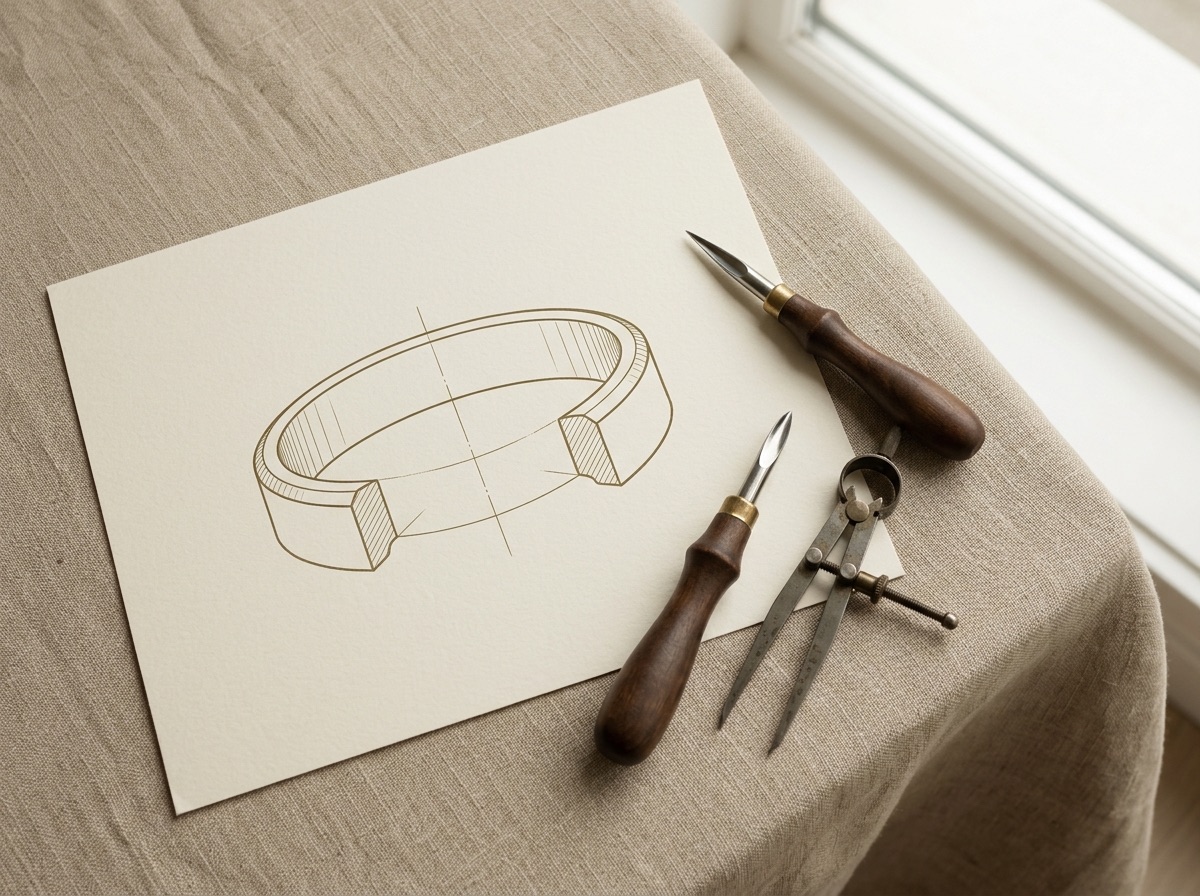
A full bezel wraps the entire girdle in a continuous metal rim; a half bezel leaves the sides open and only protects the top and bottom of the stone. Full bezel is the most durable setting available for a center stone — there’s no exposed edge for a prong to catch or bend, which is why it shows up disproportionately often in orders for customers with active jobs or hobbies.
It comes at a real manufacturing cost. A bezel has to be cut and burnished to the exact girdle diameter of the specific stone going into it — there’s no tolerance for “close enough” the way a prong casting can flex slightly. That means bezel work is typically a custom, stone-matched build rather than a stock mounting, which is part of why in-house cutting, setting, and polishing under one roof matters here: the center stone and the bezel get made to fit each other rather than shipped separately and hoping the tolerances line up.
A half bezel recovers some of the light a full bezel blocks while still guarding the top and bottom of the girdle — the two points a stone takes the hardest direct hits on — leaving the sides open for light and a slightly lower material cost. Bezel edges also sit lower and smoother against the finger than a prong basket does, which is part of why the setting turns up so often on rings meant to be worn under gloves or through repeated hand-washing over a shift.
Shape fit: this is where the regular fancy tier shapes — Emerald and Asscher in particular — actually need the bezel or a reinforced four-prong with corner guards. Step-cut corners are the most chip-prone feature in any diamond shape, lab-grown or mined, and a bare prong at 90 degrees on an Emerald corner is asking for a repair visit. Heart shapes benefit from a half-bezel at the cleft for the same reason.
Halo Settings: Where Lab-Grown Economics Change the Math
A halo rings the center stone with a band of small melee, and it does two things a prong or bezel alone can’t: it adds perceived size, and it adds sparkle at the widest part of the ring where the eye lands first. A well-cut 1-carat center in a tight halo can read close to 1.3-1.5 carats from a normal viewing distance.
This is the setting family where lab-grown pricing changes the conversation the most. Because the cost per carat on a certified loose center stone is lower than mined, customers who might have stretched their whole budget on a bare solitaire in the mined world now have room left over for a halo build — meaning the same budget buys a visually larger ring. That’s a legitimate upsell path, not a gimmick, and it’s worth walking customers through directly rather than assuming they’ve already priced it out.
Manufacturing-wise, halo is the most labor-intensive of the four families. Every melee stone in the ring has to be matched for color and clarity against the same QC baseline, and hand-set one at a time — there’s no shortcut that doesn’t show up as visible inconsistency in the finished piece. Double halos and hidden halos (a halo tucked under the center stone, visible only from the side) add bench time on top of that.
The same mechanics shift again once the center stone is a fancy color rather than white. A white melee halo set tight against a yellow, pink, blue, or green center reads as a deliberate contrast frame — the eye compares the white ring to the color at the center, and the color reads more saturated than it would floating alone on a plain band. A halo cut from melee that echoes the center stone’s own hue does the opposite: it blends the color outward and the piece reads as one larger mass of color rather than a white frame around it. Neither approach is more correct than the other, but it’s a choice worth making on purpose rather than defaulting to white melee simply because that’s what’s already in the case.
Shape fit: cushion and oval centers pair best with halo because the rounded outline follows the halo’s curve without gaps at the corners. A halo around a princess or emerald cut needs corner-fitted melee, which is a different (and pricier) cut of accent stone than the round melee used everywhere else.
Pavé: A Shank Treatment, Not a Center-Stone Mount
This is worth stating plainly because it trips up newer sales staff: pavé is not an alternative to prong, bezel, or halo — it’s melee set into the band itself, and it always sits alongside one of the other three, which is still doing the actual job of holding the center stone. “Pavé setting” as a customer-facing phrase almost always means “prong or halo center, pavé shank.”
The durability consideration is specific to the band, not the center stone. Pavé melee is uncertified, calibrated parcel goods set into small individual seats, and over years of wear those seats can wear thin, especially on the underside of the ring where it contacts a work surface repeatedly. It’s a cosmetic and structural add-on, not a stone-security decision — walk customers through that distinction before they assume “pavé” answers the durability question the same way a bezel does.
Because every stone in a pavé shank sits in its own hand-cut seat, the setter has to grade the melee by size along the curve of the band so the visual line stays continuous — a stone even slightly out of sequence breaks the pattern the eye reads as one unbroken surface of sparkle. That grading and seat-cutting work is why pavé scales in labor cost with stone count rather than with carat weight the way a center-stone setting does.
Which Setting Suits Which Diamond Shape
The table above sorts by setting family; the table below flips the question around and starts from the stone, which is usually how the conversation actually happens on the sales floor.
| Shape | Best-suited setting(s) | Why |
|---|---|---|
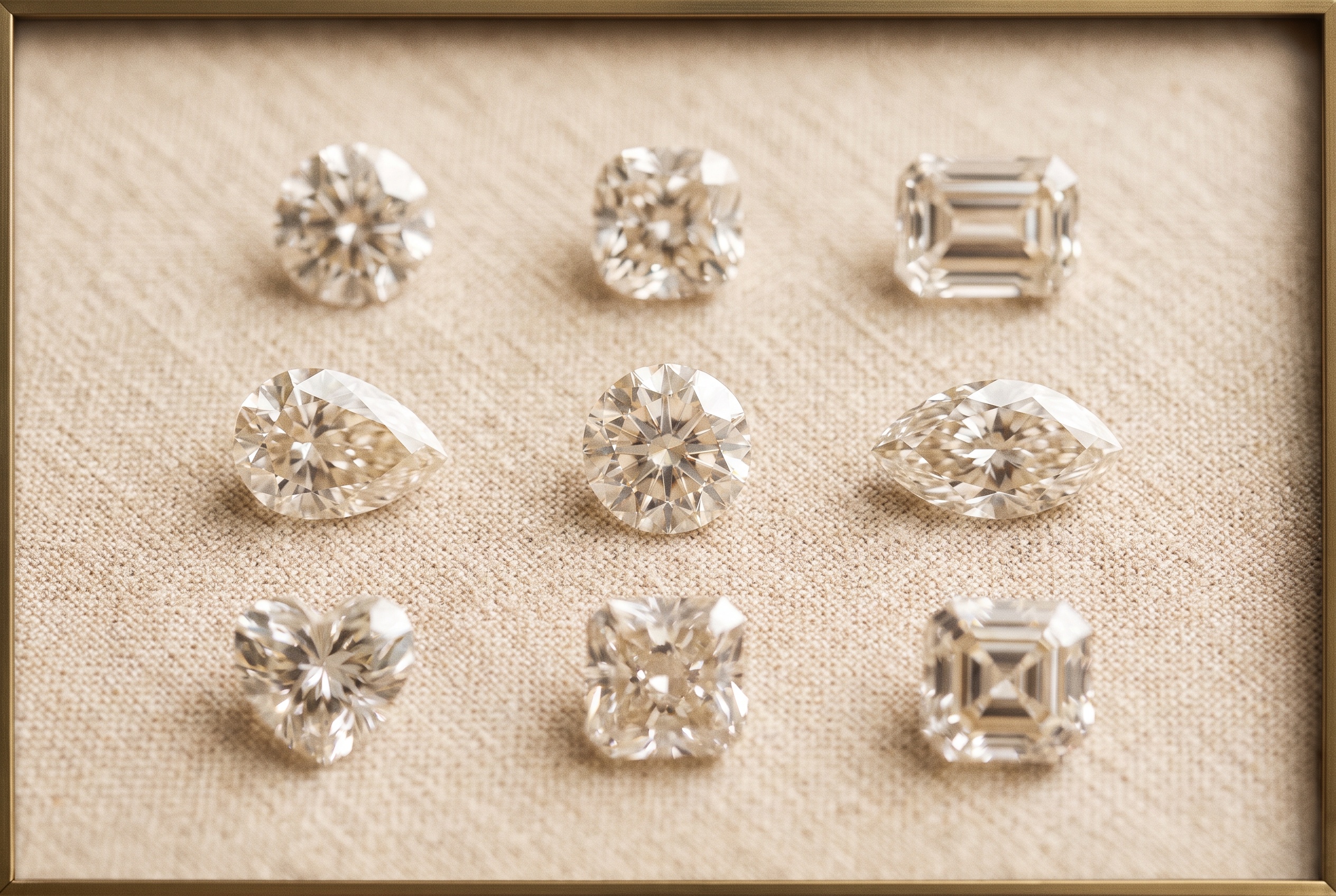
| Round | Prong, bezel, halo, or pavé accent — all work without modification | No corners or points to protect; the most forgiving shape for any setting family |
| Oval | Prong or halo | Curved girdle distributes prong tension evenly; halo follows the outline without gaps |
| Pear | V-tip prong or fitted half-bezel | The point is the single most chip-prone spot on the stone |
| Marquise | V-tip prong or fitted half-bezel | Two points to protect instead of one |
| Cushion | Halo or prong | Rounded corners pair naturally with a halo’s curve |
| Emerald | Bezel or corner-guarded prong | Step-cut corners chip if left bare at 90 degrees |
| Asscher | Bezel or corner-guarded prong | Same step-cut corner exposure as Emerald |
| Heart | Half-bezel at the cleft, prong elsewhere | The cleft is a second chip-prone point beyond the two lobes |
| Princess | Corner-guarded prong (V-tips at each corner) | Four sharp 90-degree corners each need dedicated protection |
| Radiant | Corner-guarded prong or bezel | Cut corners lower chip risk versus Princess but still benefit from guarding |
| Antique tier (Old Mine, Old European, Hexagonal, Moval, Lozenge, Kite, Trillion, Criss-Cut, Padparadscha) | Custom-fitted low-profile prong or fitted bezel | Non-standardized proportions rule out stock mountings regardless of setting family |
Matching Setting to Cut Tier
The table above maps individual shapes; cut tier is a coarser, faster lens for the same conversation when a customer hasn’t settled on a shape yet. Here’s how they typically pair up on the bench:
- Commodity tier (Round Brilliant): Works in every setting family without modification. Default choice when a customer has no strong shape preference.
- Regular fancy tier (Emerald, Asscher, Cushion, Oval, Pear, Marquise, Radiant, Princess, Heart): Step-cut corners (Emerald, Asscher) need bezel or corner-guarded prongs; pointed shapes (Pear, Marquise, Heart) need V-tip prongs or a fitted half-bezel; Cushion and Oval are the two shapes that pair most naturally with halo.
- Antique tier (Old Mine, Old European, Hexagonal, Moval, Lozenge, Kite, Trillion, Criss-Cut, Padparadscha): These cuts have less standardized proportions than modern calibrated shapes, so mountings are effectively always custom-fitted rather than stock. A low-profile prong or a fitted bezel that echoes the period silhouette both work; what doesn’t work is dropping an antique cut into a stock modern halo mounting sized for calibrated shapes — the fit will be visibly off.
Durability and Maintenance by Setting Type
None of this is unique to lab-grown centers — it’s true of any diamond in any setting — but it’s worth stating plainly because customers sometimes assume the stone itself dictates the maintenance schedule. It doesn’t. The metal and the setting geometry do.
- Prong: the claws are the wear item, not the stone. A periodic check for thinning or a claw that’s bent slightly off the crown catches most problems before a stone actually falls out; re-tipping or re-pronging once wear is visible is routine maintenance, not a sign of a bad original setting.
- Bezel: close to maintenance-free day to day, since there’s no exposed edge to catch or bend. The trade-off shows up at resize time — reforming a collar that’s burnished tight to a specific stone’s girdle is a different, more involved job than cutting and resizing a plain shank, and it’s worth setting that expectation at the point of sale.
- Halo: the center stone in a well-made basket usually outlasts the melee around it. The thing actually worth checking periodically on a ring worn daily for years is whether any halo stone has started to sit loose in a worn seat — a much smaller repair than a lost center stone, but one that’s easy to miss without a deliberate look.
- Pavé: the highest ongoing attention item of the four, since each melee stone depends on a comparatively small bead of metal to hold it in place. The underside of the ring — the part that contacts a countertop, a steering wheel, or a keyboard repeatedly — is where pavé wears first, and it’s worth flagging that spot specifically if a customer works with their hands.
Guru Diam’s In-House Setting and CAD Capabilities
Setting complexity is the single biggest driver of bench time on a custom build, more than the center stone sourcing itself once the stone is in hand. Prong solitaires are the fastest to produce; full bezels and halos take longer because of the stone-matched fitting and hand-setting involved. That difference is exactly why having cutting, setting, and polishing in-house matters for a jeweler quoting a customer a delivery date — finished custom rings still move in 4-6 days regardless of setting family, because the fitting and setting steps happen under one roof instead of being routed between separate vendors.
For a jeweler building a quote, the practical sequencing question is usually: lock the shape and carat weight first, then let the setting choice follow from how the customer actually lives with the ring, not the other way around. A customer-facing custom build that starts with “how do you want this to hold up in five years” gets to the right setting faster than one that starts with a photo pulled off Pinterest.
A CAD render before casting is the last checkpoint where setting choice can still be adjusted for free. It’s the first time a customer sees the actual proportions of the chosen setting against their actual stone’s dimensions rather than a stock photo of a different stone in the same mounting style. For anything past a stock four-prong solitaire — a full bezel, a halo, or a custom-fitted antique-cut mounting — walking the customer through the CAD rather than a catalog image is what keeps the finished ring from becoming a surprise at pickup.
How to Advise Customers on Setting Choice by Lifestyle
When a customer can’t decide between the four, these questions — asked in order, before any mountings come out of the case — usually settle it:
- “What do you do with your hands all day?” — manual work or frequent glove use points toward bezel; office or low-contact work leaves prong or halo open.
- “Do you want it to look bigger than the carat weight, or true to size?” — halo for perceived size, prong for true-to-carat brilliance.
- “Is the shape a step cut or does it have points?” — step cuts and pointed shapes need corner or tip protection regardless of which family the customer prefers.
- “Is this a stock mounting or a from-scratch build?” — antique cuts and non-standard shapes are custom-fitted by default; that’s a bench-time and cost conversation to have up front, not after the CAD is approved.
- “Is this a ring worn every day for years, or an occasion piece?” — a ring that never comes off wears through prongs and pavé faster than one worn selectively, which shifts the durability math toward bezel or six-prong.
- “Could this stone ever get reset into a different mounting later?” — a bezel is the hardest of the four to un-set and reuse elsewhere; prong and halo baskets come apart more easily if a future re-mount is even a possibility worth planning around.
Setting-Selection Checklist for Retailers
- Confirm the diamond shape and cut tier before discussing setting families — a step cut or a pointed shape rules out a bare prong regardless of what else the customer prefers.
- Ask the lifestyle questions above before showing mountings, not after a customer has already fallen for a photo.
- For antique cuts or any non-standard shape, set expectations for a custom-fitted mounting and a CAD proof up front — never quote a stock setting price against a non-standard stone.
- For halo or pavé builds, confirm the melee is matched against a consistent color and clarity baseline before quoting, not after the ring is already on the bench.
- Review the CAD render together with the customer before approving casting — it’s the last chance to catch a setting-and-shape mismatch.
- For bezel or any fitted work, flag resizing expectations at the point of sale, since reforming a bezel collar is a different service than resizing a plain shank.
- Reconfirm turnaround expectations against the setting family chosen — complexity changes bench time even when the finished-ring delivery window stays the same.
Frequently Asked Questions
Does a lab-grown diamond need a different setting than a mined diamond?
No. CVD lab-grown diamonds share the same hardness, refractive index, and wear characteristics as mined diamonds of the same cut and clarity, so setting choice is driven by the stone’s shape and the customer’s lifestyle, not by where the diamond originated.
Which setting is most durable for daily wear?
A full bezel offers the most protection because it wraps the entire girdle in metal, eliminating the exposed edges that catch and bend on prongs. It’s the setting most often recommended for customers with active jobs or hands-on daily routines.
What setting makes a smaller lab-grown center stone look bigger?
A halo. Ringing the center stone with matched melee typically adds 15-25% to its apparent size, and because certified lab-grown center stones cost less per carat, customers often have budget room left to add a halo that a comparable mined-stone budget wouldn’t have covered.
Is pavé an alternative to a prong or bezel setting?
No. Pavé refers to melee set into the ring’s band or shank — it’s a decorative and structural treatment for the ring itself, not a way to hold the center stone. Every pavé ring still uses a prong, bezel, or halo head to secure the center diamond.
Can antique cuts like Old Mine or Kite go into a halo or bezel setting?
Yes, but they’re effectively always custom-fitted rather than dropped into a stock mounting, since antique cuts don’t share the standardized proportions of modern calibrated shapes. A low-profile prong or a fitted bezel built around the specific stone’s dimensions is the standard approach.
Does setting choice affect how fast a custom ring can be delivered?
Setting complexity affects bench time more than almost any other factor in a custom build, but with cutting, setting, and polishing handled in-house, finished custom rings still move in 4-6 days from CAD approval regardless of which setting family is chosen.