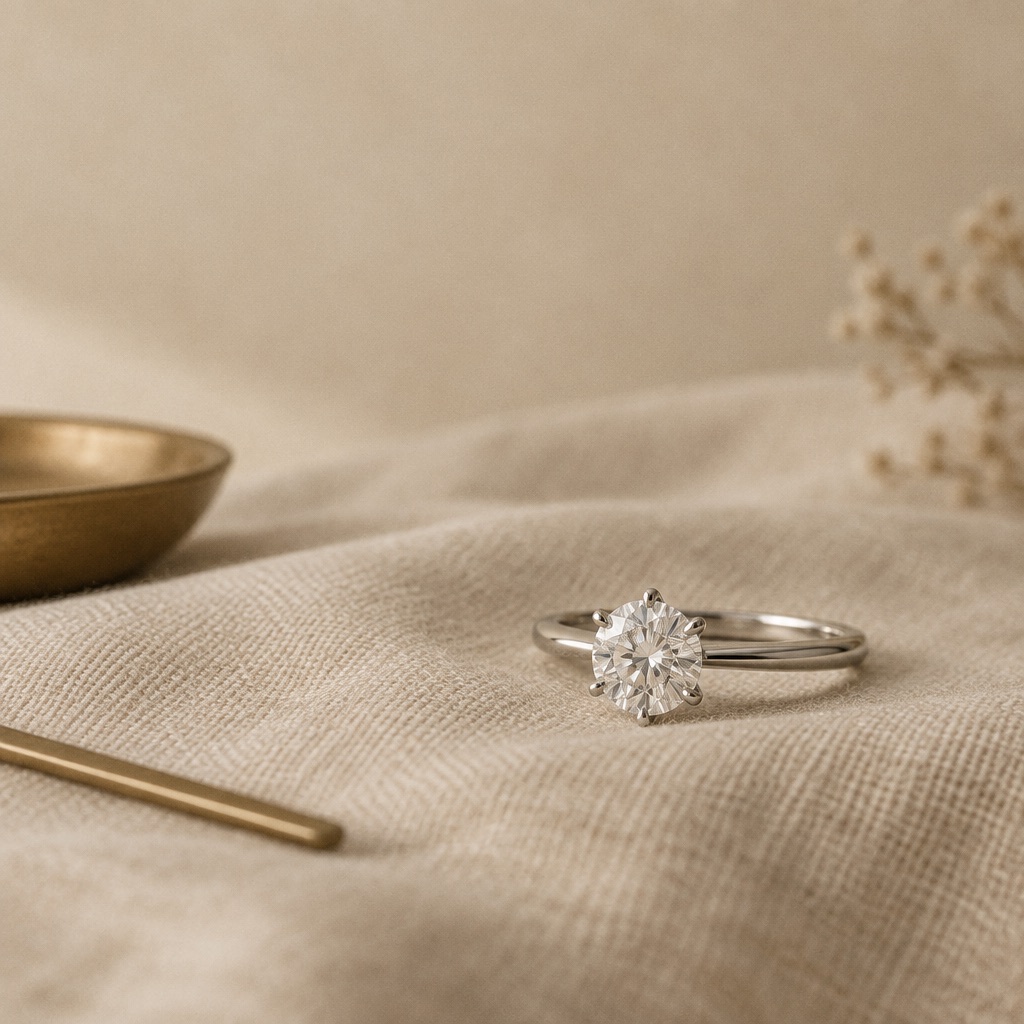
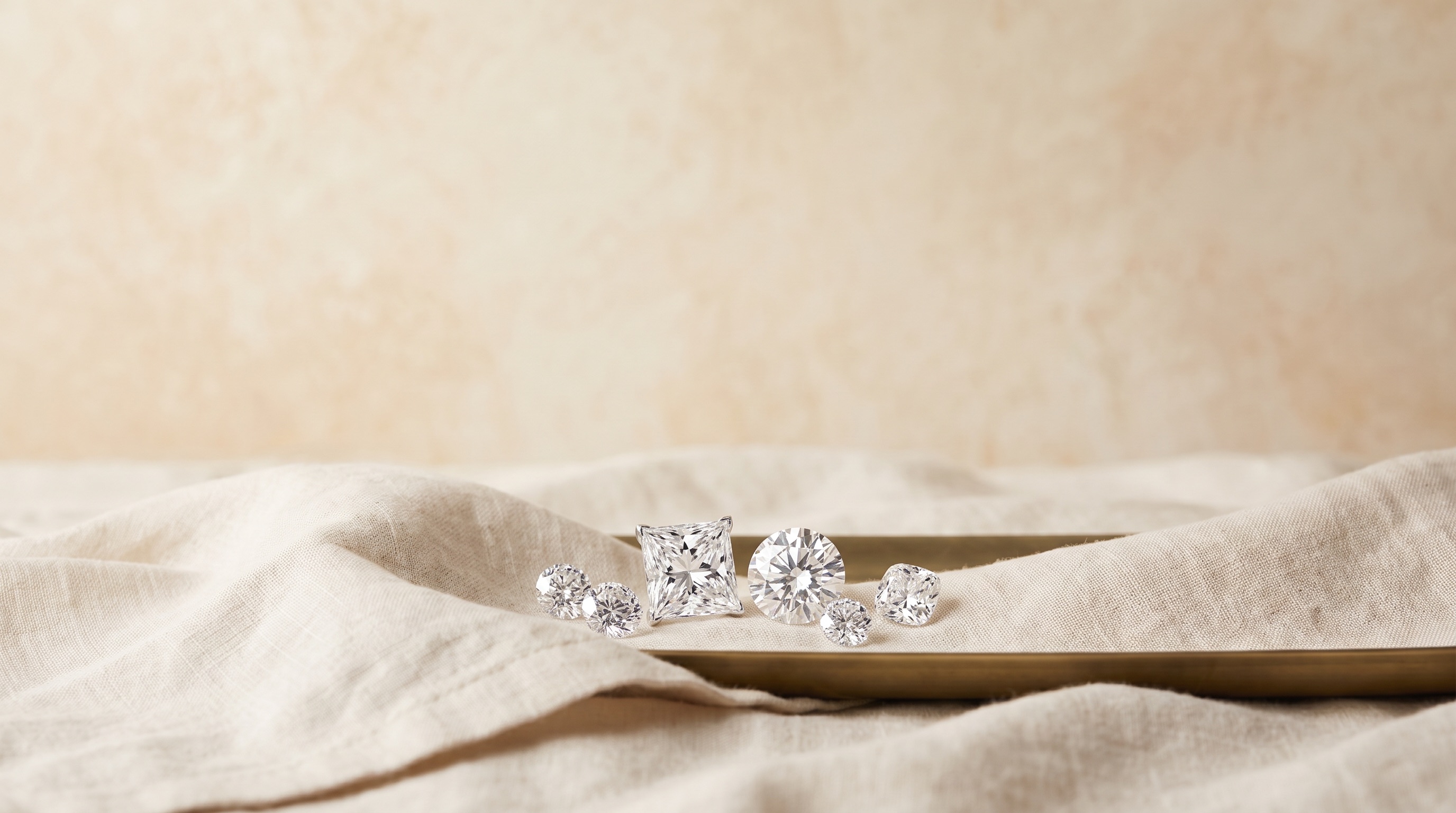
A princess cut diamond is a square, brilliant-faceted cut with sharp, uncropped corners and roughly 76 facets, while a round cut (round brilliant) is a circular brilliant cut with roughly 58 facets and no corners at all. Both are brilliant-style cuts built to maximize sparkle, but the square outline and pointed corners of a princess cut introduce durability, setting, and pricing tradeoffs that round brilliant simply doesn't have to manage.
This guide compares princess and round cut diamonds across the factors that actually matter to a wholesale buyer: facet performance, corner durability, rough yield and pricing, clarity and color requirements, and setting considerations — for jewelers and manufacturers deciding which cut fits a given order or retail customer.
Princess vs. Round: Quick Comparison
| Princess Cut | Round Brilliant | |
|---|---|---|
| Outline | Square (or slightly rectangular) | Circular |
| Facet count | ~76 facets | ~58 facets |
| GIA cut grade | Not assigned a standard cut grade (fancy shape) | Assigned (Excellent through Poor) |
| Corner durability | Sharp, uncropped corners — vulnerable to chipping if unprotected | No corners — no chip-point vulnerability |
| Rough yield | High — one of the most efficient shapes to cut from octahedral rough | Lower — significant rough waste from a circular outline |
| Typical price vs. round | 10-25% less per carat at comparable grades | Reference point, typically highest per-carat price of any shape |
| Best suited to | Buyers wanting a modern, geometric square silhouette at better value | Buyers wanting the safest, most universally recognized brilliant cut |
Facet Structure and Light Performance
Both princess and round cuts are brilliant-style cuts, meaning both use triangular and kite-shaped facet patterns engineered to scatter incoming light into scintillation rather than the broad, mirror-like flashes a step cut produces. Round brilliant's circular symmetry allows the most refined, mathematically optimized version of this faceting — over a century of research (most notably Marcel Tolkowsky's 1919 analysis) has gone into perfecting round brilliant proportions specifically, which is why it remains the benchmark for light performance among all diamond shapes.
Princess cut adapts the same brilliant faceting logic to a square outline, and while it doesn't quite match round brilliant's light performance at the very top end, a well-cut princess still delivers strong sparkle — meaningfully more than a step-cut shape like emerald or asscher, and broadly comparable to other well-cut brilliant fancy shapes. The practical difference between princess and round in everyday light performance is smaller than the difference between either of them and a step-cut shape.
The Corner Durability Issue
Princess cut's defining visual feature — sharp, pointed, uncropped corners — is also its single most important practical vulnerability. Unlike shapes with trimmed or cropped corners (radiant, emerald, cushion), a princess cut's corners come to a genuine point, which concentrates stress at that point and makes it more susceptible to chipping from a hard knock than a rounded or cropped-corner shape would be.
This isn't a reason to avoid princess cut, but it is a reason setting choice matters more for princess than for round. A princess cut set in a setting that fully protects its corners — a V-tip prong setting is the trade-standard solution, using specially shaped prongs that cover and reinforce each corner point — largely mitigates the risk. A princess cut set in an exposed, minimal-prong setting that leaves corners unprotected carries meaningfully more chip risk over years of daily wear than the same stone properly protected. Buyers and retailers should treat V-tip (or equivalent full-corner-coverage) prongs as close to mandatory for princess cut, not an optional upgrade.
Rough Yield and Pricing
Princess cut is one of the most efficient shapes to cut from typical octahedral rough diamond crystal, often cited as retaining more of the original rough's weight than almost any other shape, including round brilliant. Round brilliant's circular outline, by contrast, wastes considerably more rough material during cutting, since a circle inscribed inside an octahedral crystal leaves substantially more material unused than a square shape does.
That yield difference is the primary reason princess cut typically prices 10-25% lower per carat than round brilliant at comparable clarity and color grades — a cutter recovers meaningfully more finished carat weight from the same rough diamond with princess cut, and that efficiency gets reflected in the finished stone's price. For a wholesale buyer optimizing cost per carat at a given quality tier, princess cut offers a genuine value advantage over round brilliant, similar in scale to what radiant or oval offer relative to round.
Clarity and Color Requirements
Princess cut's dense brilliant faceting does meaningful work hiding small inclusions, similar to round brilliant, though the concentration of facets near the pointed corners can occasionally make an inclusion near a corner slightly more visible than the same inclusion positioned centrally. In practice, princess cut and round brilliant can generally be sourced against similar clarity floors — SI1 or a clean SI2 typically reads eye-clean in both shapes at mainstream price points, a meaningfully more forgiving standard than a step-cut shape like emerald requires.
Color performs similarly between the two — both shapes' brilliant faceting scatters light enough to mask moderate body color reasonably well, and buyers can typically source H-I color for a face-up colorless look in either shape without the visible warmth issue that concentrates specifically in a step cut's open facets.
Carat Weight and Face-Up Size
Princess cut and round brilliant read differently per carat because of their different outlines. A square shape covers more surface area for a given "spread" than a circle does, which means a princess cut can appear to cover a comparable or slightly larger visual footprint than a round of the same carat weight, though the difference is less dramatic than the size difference oval or emerald show relative to round.
| Carat Weight | Round Brilliant — Approx. Diameter (mm) | Princess Cut — Approx. Face-Up (mm) |
|---|---|---|
| 1.00 ct | 6.4 | 5.5 x 5.5 |
| 1.50 ct | 7.4 | 6.2 x 6.2 |
| 2.00 ct | 8.1 | 6.8 x 6.8 |
| 3.00 ct | 9.3 | 7.8 x 7.8 |
Setting Considerations
Round brilliant is the most setting-flexible shape in the trade — it pairs cleanly with essentially any prong count, halo style, or accent arrangement without any shape-specific structural requirement to manage. Princess cut requires more deliberate setting choices specifically because of its corner vulnerability: a four-prong V-tip setting is the standard, trade-recommended approach, and a bezel or half-bezel setting that fully encloses the corners is an even more protective (if less common) alternative for a customer who wears their ring in physically demanding conditions.
Both shapes work well in a three-stone design, though princess cut is more commonly flanked by trapezoids or baguettes that echo its square, geometric lines, while round brilliant pairs comfortably with nearly any side-stone shape.
Retail Positioning: Who Buys Each Cut
Round brilliant remains the default, safest choice for the broadest range of engagement ring buyers — it's the most universally recognized shape, carries no shape-specific durability conversation a retailer needs to proactively manage, and delivers the strongest light performance available in any cut. Princess cut appeals to a buyer who wants a distinctly modern, geometric silhouette and values the meaningful cost savings per carat, and who is generally comfortable with (or actively wants) a square rather than round outline as part of the ring's identity.
Princess cut saw its strongest popularity in the 1990s and 2000s and has moderated somewhat since as oval and cushion have drawn a larger share of the "distinctive but not round" market, but it remains a consistently requested shape, particularly among buyers who specifically want sharp geometric lines that softer cushion-cornered shapes don't offer.
Insurance and Appraisal Notes for Princess Cut
Appraisers and insurers are generally aware of princess cut's corner vulnerability, and a thorough appraisal for a princess cut piece should note the setting style and corner protection in place, since that detail is relevant to future claims assessment in a way it typically isn't for round brilliant. A customer filing a chip claim on a princess cut stone set without adequate corner protection may find the claims process more scrutinized than an equivalent round brilliant claim, since a missing or inadequate V-tip setting can be read as a preventable risk factor rather than pure accidental damage. Jewelers selling princess cut pieces do their customers a genuine service by documenting the corner-protective setting clearly on the original sales paperwork and appraisal, giving both the customer and any future insurer a clear record that the recommended durability precautions were followed from the start. This same documentation habit also gives a retailer useful cover if a customer later modifies or reset the stone into a different, less protective setting elsewhere and then returns with a chip claim on the original piece.
Sourcing Princess and Round Cut Diamonds Wholesale
Guru Diam stocks both princess and round brilliant cut diamonds in CVD lab-grown and natural material, with IGI, GIA, and GCAL certification available across the range. Same-day shipping applies to in-stock inventory from New York (orders before 6pm EST) and Los Angeles (orders before 4pm PST). For a princess cut custom build, Guru Diam's finished-jewelry team defaults to V-tip corner-protective prong settings unless a buyer specifically requests an alternative, finishing custom rings in 4-6 days and unbranded by default for retailer resale.
Common Buyer Mistakes
The most consequential mistake with princess cut is pairing it with a setting that doesn't adequately protect the corners — a decision that shows up months or years later as a chip claim rather than as an obvious problem at the point of sale, which makes it easy for a retailer to underweight the risk if they haven't seen the downstream consequence firsthand. A second common mistake is assuming princess cut's lower per-carat price signals lower quality rather than better rough-cutting yield; a well-cut princess at a given grade is not an inferior stone to a round brilliant at the same grade, it's simply a shape that costs less to produce from the same rough.
A Brief History of Both Cuts
Round brilliant's modern proportions trace to Marcel Tolkowsky's 1919 mathematical analysis of how facet angles maximize a round diamond's light return, a body of research refined over subsequent decades into the "ideal cut" standard that underlies today's GIA Excellent cut grade. That century of dedicated optimization, applied to one specific circular shape, is the core reason round brilliant remains the light-performance benchmark every fancy shape is implicitly compared against.
Princess cut is far more recent, generally credited to cutters Basil Watermeyer and Arpad Nagy in the 1960s and 1970s, who developed square brilliant-faceted cuts aimed at combining round brilliant's sparkle with a geometric, corner-pointed outline and meaningfully better rough yield. The specific "princess cut" name and its now-standard proportions were further refined through the 1980s, and the cut reached peak mainstream popularity in the 1990s and early 2000s, becoming for a period the second-most-requested engagement ring shape after round brilliant.
Symmetry and Proportions: What to Check on Each Cut
Round brilliant's standardized GIA cut grade (Excellent through Poor) gives buyers a single, reliable synthesis of proportion, symmetry, and polish — an Excellent-cut round brilliant can generally be trusted to perform well without independently verifying every underlying measurement. Princess cut, like other fancy shapes, receives no equivalent overall cut grade, which puts more weight on reviewing individual proportions directly: depth percentage (commonly in a 65-75% range for princess cut, notably deeper than round brilliant's roughly 58-62%) and table percentage, along with corner treatment and girdle thickness near the points specifically, since girdle thickness at the corners has a direct bearing on chip resistance.
Polish and symmetry grades still appear on a princess cut certificate and are worth holding to a Very Good or better floor — asymmetry is more visible on a square shape with pointed corners than on a circular one, where minor irregularities are harder for the eye to catch.
Durability Comparison Beyond the Corners
While corner vulnerability is princess cut's headline durability consideration, girdle thickness matters for both shapes and deserves separate attention. A girdle that's cut too thin risks chipping around its entire circumference (for round) or edge (for princess) during setting or daily wear, while one cut too thick adds unnecessary weight without improving durability or appearance. This is a standard grading report field (Extremely Thin through Extremely Thick) for both shapes, and buyers sourcing either cut should hold a Thin-to-Slightly-Thick girdle range as a general floor, with princess cut buyers paying particular attention to how girdle thickness is maintained specifically at the corner points, where it matters most.
Round brilliant, having no corners and a continuously curved girdle, doesn't carry this point-specific durability consideration — its girdle thickness matters evenly around the stone's circumference rather than concentrating risk at a few specific locations the way princess cut's does.
Choosing Between Princess and Round for a Specific Customer
A useful framework for retail staff: a customer who wants the safest, most universally recognized shape with the strongest possible light performance and no shape-specific setting requirements to manage is best served by round brilliant. A customer drawn to a modern, geometric, distinctly square silhouette — and who's willing to accept (or specifically wants) the corner-protective setting princess cut requires — is well served by princess cut, particularly when the cost savings per carat matters to their budget. Retail staff should proactively explain the V-tip prong recommendation to any customer choosing princess cut, rather than leaving it as an unstated assumption, since a customer who understands the setting reasoning upfront is far less likely to be surprised by a chip years later.
Certification Considerations for Each Shape
Round brilliant's standardized GIA cut grade means a certificate alone conveys most of what a buyer needs to know about how the stone will perform, since cut, color, and clarity together reliably predict its face-up appearance. Princess cut's certificate carries color and clarity data but no equivalent cut grade, which means proportion and symmetry review — depth percentage, table percentage, and polish/symmetry grades specifically — matters more for evaluating an individual princess cut stone than it does for round brilliant, where the single overall cut grade already does that synthesis.
This is a genuine, if modest, extra diligence step wholesale buyers should build into their princess cut sourcing process: reviewing the underlying proportion fields on the certificate directly rather than assuming a strong clarity and color grade alone guarantees strong visual performance, since — unlike round brilliant — no single number on a princess cut certificate confirms that for you.
Market Demand Trends for Princess vs. Round
Round brilliant has held the position of most-requested diamond shape across nearly every market for decades, a status reinforced by its unmatched light performance, zero shape-specific setting or durability considerations, and near-universal customer recognition. Princess cut reached its peak popularity in the 1990s and early 2000s, when it briefly became the clear second-most-requested shape behind round, before demand for "distinctive but not round" buyers began diversifying across a wider range of fancy shapes — cushion, oval, and radiant among them — that offered different tradeoffs between softness, sparkle, and cost.
Princess cut remains a consistently requested shape today rather than a declining one, particularly among buyers who specifically want sharp, geometric lines that softer cushion-cornered shapes don't provide, and its meaningful cost advantage over round brilliant continues to make it a reasonable shape for wholesale buyers to stock proactively rather than only sourcing against specific customer requests.
Prong Count and Setting Design Specifics
Princess cut's standard four-prong V-tip setting places one specially angled prong over each corner, engineered so the prong's metal fully covers and reinforces the point rather than leaving it exposed the way a conventional round-brilliant-style claw prong would. Some manufacturers offer an eight-prong variant for larger princess cut center stones, adding an additional prong along each side edge for extra support beyond the four corner prongs — a reasonable upgrade for stones above roughly two carats, where the added weight and surface area benefit from the extra hold.
Round brilliant, needing no corner-specific protection, sees far more setting variety in practice without any single style functioning as a near-mandatory baseline the way V-tip prongs do for princess cut — four-prong, six-prong, bezel, tension, and halo settings are all common choices for round brilliant, selected primarily on aesthetic grounds rather than a structural durability requirement.
Frequently Asked Questions
Is a princess cut diamond cheaper than a round cut diamond?
Yes, typically. At comparable carat weight, clarity, and color, a princess cut diamond usually costs 10-25% less per carat than a round brilliant, mainly because princess cut is one of the most efficient shapes to cut from rough diamond crystal, wasting less material than round brilliant's circular outline does.
Do princess cut diamonds chip easily?
Princess cut's sharp, uncropped corners are more vulnerable to chipping than a rounded or cropped-corner shape if left unprotected in a setting. A V-tip prong setting, which covers and reinforces each corner, substantially reduces this risk and is the trade-standard recommendation for princess cut.
Which sparkles more, princess cut or round cut?
Round brilliant delivers the strongest light performance of any diamond shape, reflecting over a century of optimization specifically for that shape. Princess cut, also a brilliant-style cut, still sparkles strongly and outperforms step-cut shapes like emerald, but doesn't quite match round brilliant's light return at the very top end.
What setting is best for a princess cut diamond?
A four-prong V-tip setting is the standard recommendation, since it's specifically designed to cover and protect each of the princess cut's sharp corners. A bezel or half-bezel setting offers even more corner protection for buyers who want maximum durability.
Does a princess cut diamond look bigger than a round diamond of the same carat weight?
Princess cut can appear to cover a comparable or slightly larger visual footprint than a round of the same carat weight because of its square outline, though the difference is more modest than the size advantage shapes like oval or emerald show relative to round.
Can you get a lab-grown princess or round cut diamond?
Yes. Both shapes are widely available in CVD lab-grown material with the same clarity, color, and (for princess) setting considerations that apply to natural stones. Guru Diam stocks both in CVD lab-grown and natural material with IGI, GIA, and GCAL certification options.
Browse current princess and round cut inventory, lab-grown and natural, through the wholesale hub, or review certified stones by grade through certified diamonds. Matched side-stone pairs for three-stone designs are available under matching pairs. Set up a trade account through trade partner, or start a custom build through custom jewelry.