

Price a band program off two variables, not one: stone coverage (full, three-quarter, or half eternity) and metal weight by size and karat, then hold both constant across every unit in a reorder. Full eternity runs the highest per-unit diamond cost because the stones wrap the entire shank; three-quarter and half eternity step down in roughly the same proportion as the stone coverage drops; plain wedding bands are priced on metal and labor alone. The part retailers underestimate isn’t the pricing math — it’s that bands get compared side by side on a display card in a way a one-off custom ring never does, so manufacturing consistency across a reorder matters as much as the unit price itself. Everything below breaks down how the pricing scales, how melee gets sourced and matched at that volume, and how to structure a program — production, certification, and turnaround — so the tenth unit matches the first.
Eternity and Wedding Bands Are One Product Family
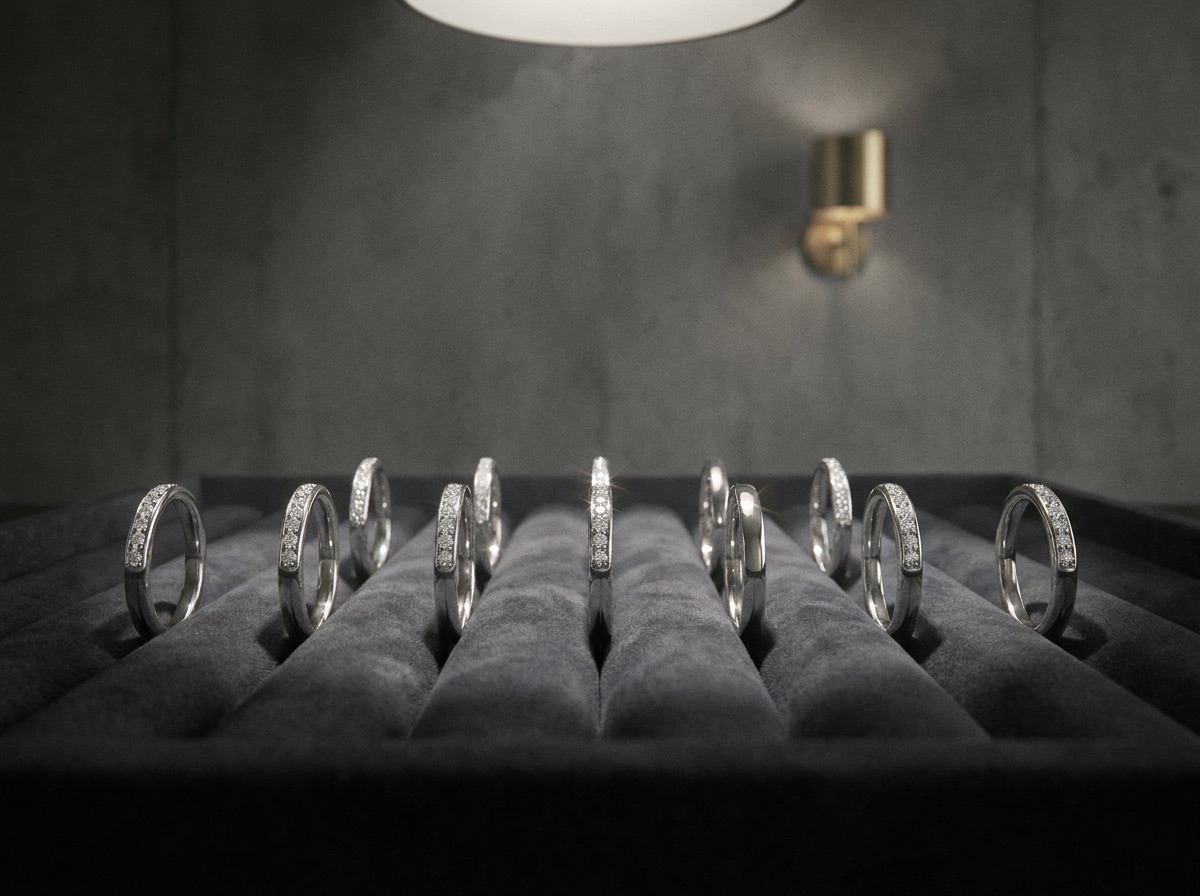
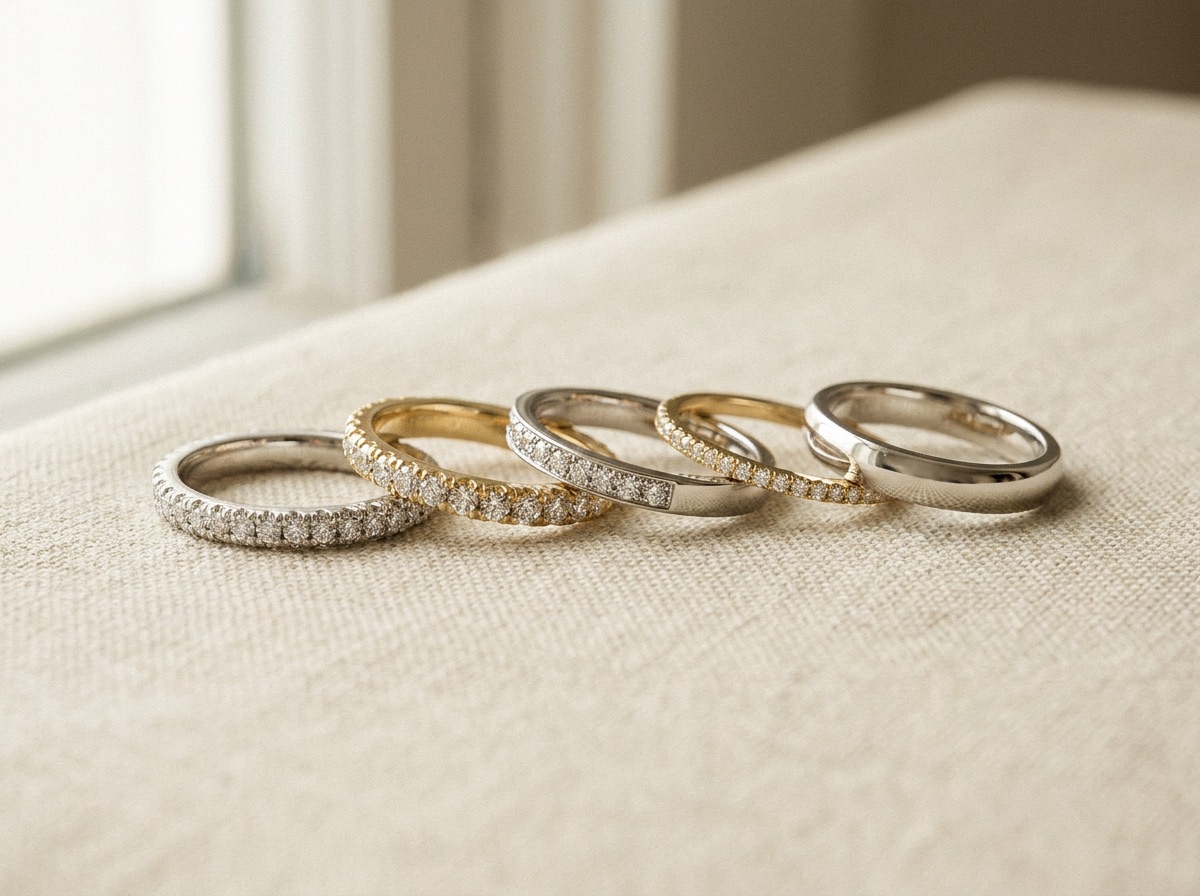
Retailers sometimes treat “eternity band” and “wedding band” as two separate categories with two separate sourcing conversations. They aren’t. Both are variants of the same base product — a diamond-set or plain metal band — differentiated by how much of the shank carries stones:
- Full eternity — stones set continuously around the entire band, front and back
- Three-quarter eternity — stones set around the front and sides, plain metal at the back where the ring contacts the palm
- Half eternity — stones set across the top half only, visible from the front
- Diamond wedding band — a lighter stone treatment, often a single row across the top third or a channel/pavé accent rather than full coverage
- Plain wedding band — no stones, priced on metal and finish alone
Treating these as sub-variants of one build — rather than five separate SKUs sourced five different ways — is what makes a band program scale. The CAD file, the shank profile, the prong or channel style, and the sizing logic are largely shared across the family. What changes between variants is how much of the shank gets a stone-setting pass and how many stones that requires. That’s a manufacturing parameter, not a different product.
Ring sizing follows the same logic: a program typically runs sizes 3 through 13, including half sizes, weighted toward sizes 6 through 9 where most volume sits — a sizing-curve decision, not a separate sourcing conversation per size.
How Pricing Scales With Stone Coverage
Stone cost is the dominant driver of price difference between eternity variants — coverage translates almost directly into stone count and carat weight per unit. Metal cost moves much less across the family, since a given size and karat weighs close to the same in grams whether the band is full eternity or plain.
Here’s how the coverage tiers typically stack against each other on a same-size, same-karat basis:
| Variant | Stone coverage | Relative stone cost | Relative total unit cost |
|---|---|---|---|
| Full eternity | ~100% of shank | Highest | Highest |
| Three-quarter eternity | ~75% of shank | High | High |
| Half eternity | ~50% of shank | Moderate | Moderate |
| Diamond wedding band | Single row / accent only | Low | Low-moderate |
| Plain wedding band | None | None | Lowest (metal + labor only) |
Metal Cost by Size and Karat
Metal cost scales with ring size (larger sizes carry more metal by weight) and karat. 18K’s higher gold content makes it slightly softer to cast and polish than 14K, which shows up more in labor time than raw material cost. White gold adds a cost layer yellow and rose skip: rhodium plating, which needs periodic reapplication. Platinum sits in a different bracket — denser than gold, so a platinum band carries meaningfully more metal weight and cost than the same size in 14K or 18K, independent of the stone side.
Stone and Setting Labor by Coverage Tier
Setting labor moves with coverage the same way stone cost does, but it’s easy to underweight since it doesn’t show up as its own line item. A full eternity band in shared-prong construction needs continuous prong work around the entire shank; half eternity covers roughly half that labor, and channel-set trades prong work for a different, not necessarily faster, process. Lock the setting style — shared-prong, channel, pavé, or bead-set — when the CAD file is locked, since switching styles mid-program changes labor cost and the finished look enough that a reorder won’t visibly match the original.
The stones across every coverage tier are almost always melee — small, calibrated goods matched in volume rather than individually selected and certified, covered in the next section. That has a direct pricing consequence: melee is uncertified parcel goods, sold against a color/clarity QC baseline, not certified stone by stone. A cost sheet that treats band melee like it carries IGI or GIA paper will be wrong in both directions depending on the size run.
Melee Sourcing and Matching at Scale
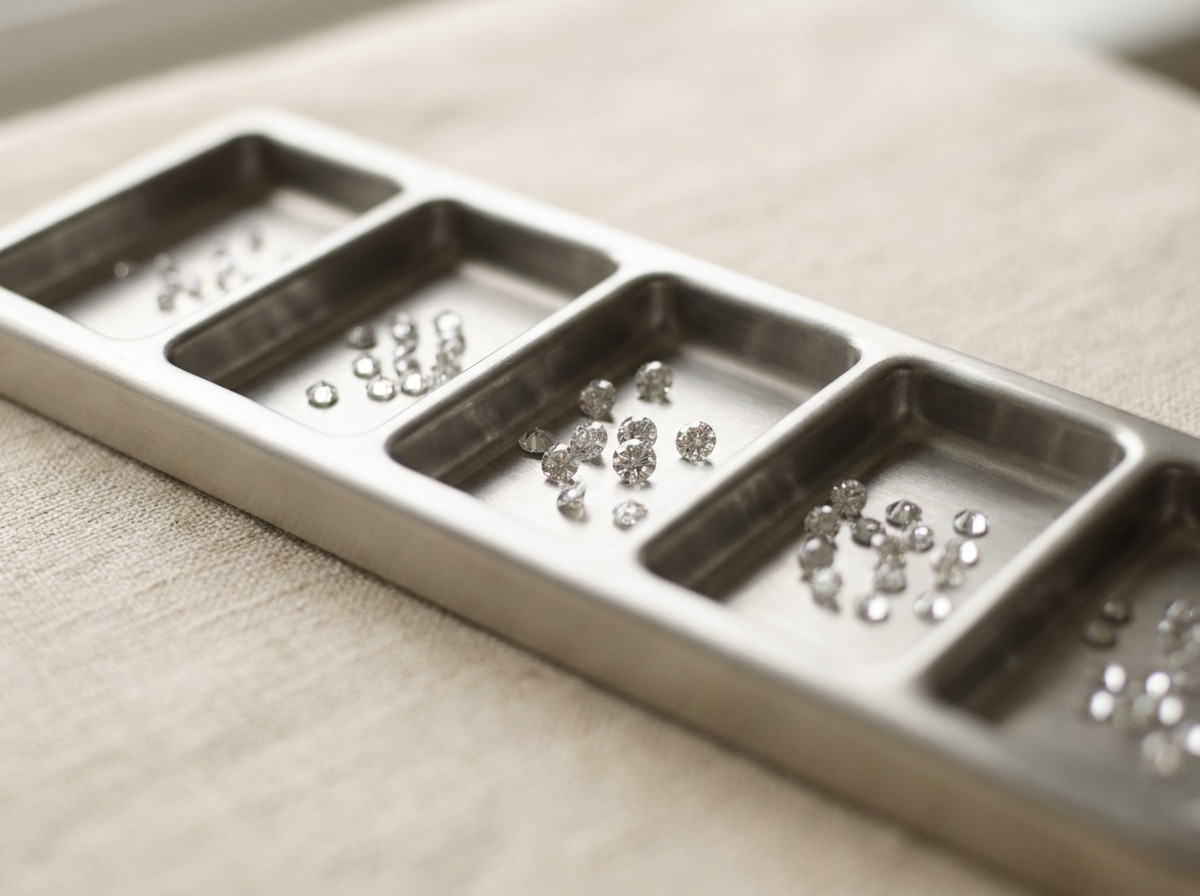
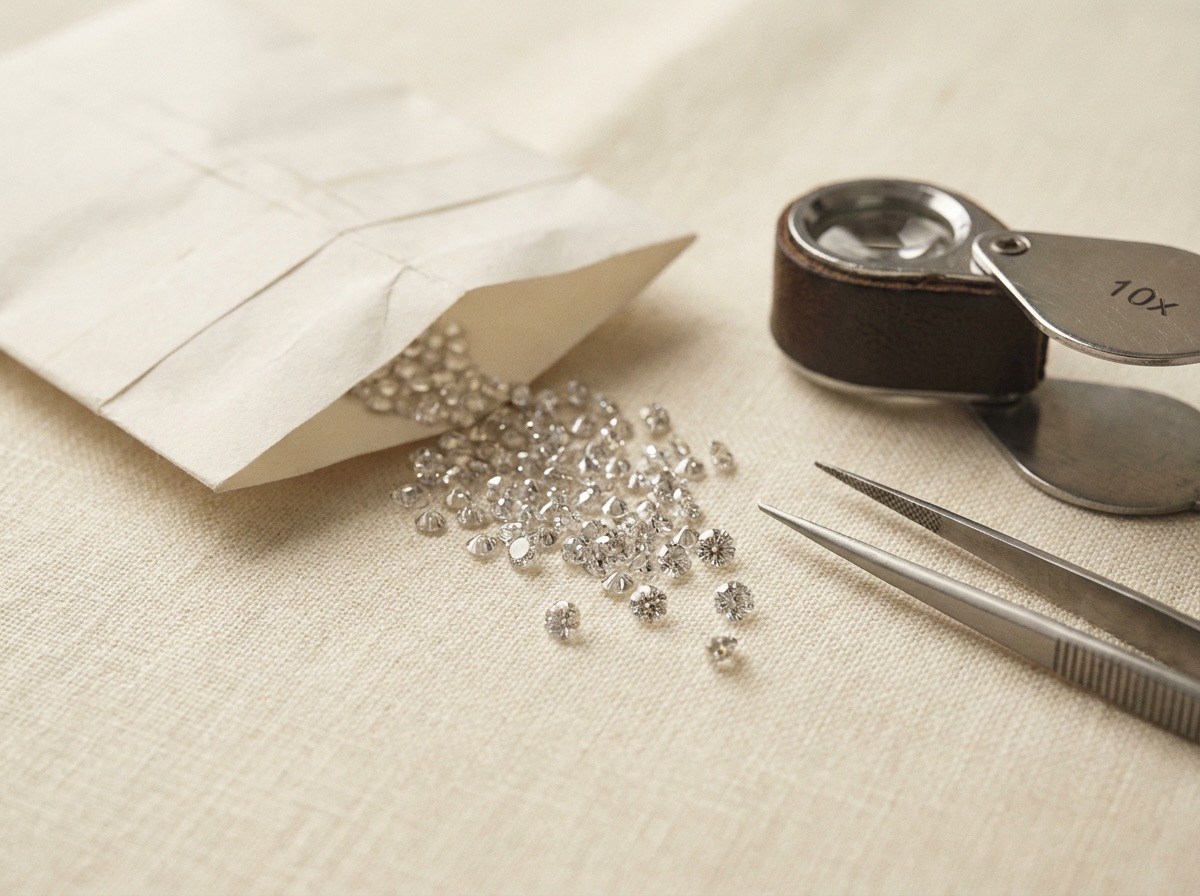
Every eternity or wedding band program lives or dies on melee — the small, calibrated stones that carry the coverage. A single full eternity band can call for 40 to 80-plus stones depending on ring size and stone diameter; a program stocking a dozen sizes across three coverage tiers runs into the thousands of stones per reorder. At that volume, sourcing isn’t about picking stones one at a time — it’s about matching parcels to a spec and holding that spec across every reorder.
Melee is graded differently than a certified center stone: no lab report per stone, just a QC baseline — a color range (D–H is common for white goods, tighter D–F or looser G–H depending on price point) and a clarity range (VS or better is standard for eternity coverage, since inclusions in a 1.5–2mm stone read differently than in a one-carat stone). Size is graded by millimeter on a sieve, not carat weight per stone, since that’s what determines whether a stone sits flush in a channel or prong built to spec.
Matching has to hold at two points: within a single parcel, where stones need to read as uniform side by side, not just fall within the same graded range — and across time, since a reorder six months out needs to match the original order’s parcel, not just the spec sheet’s stated range. Two batches both nominally “G–H VS+” can still look different set side by side if matching wasn’t held as tightly the second time. Mixed fluorescence in a parcel is worth checking too — it can throw a visible color cast under retail case lighting that isn’t apparent at the sourcing stage.
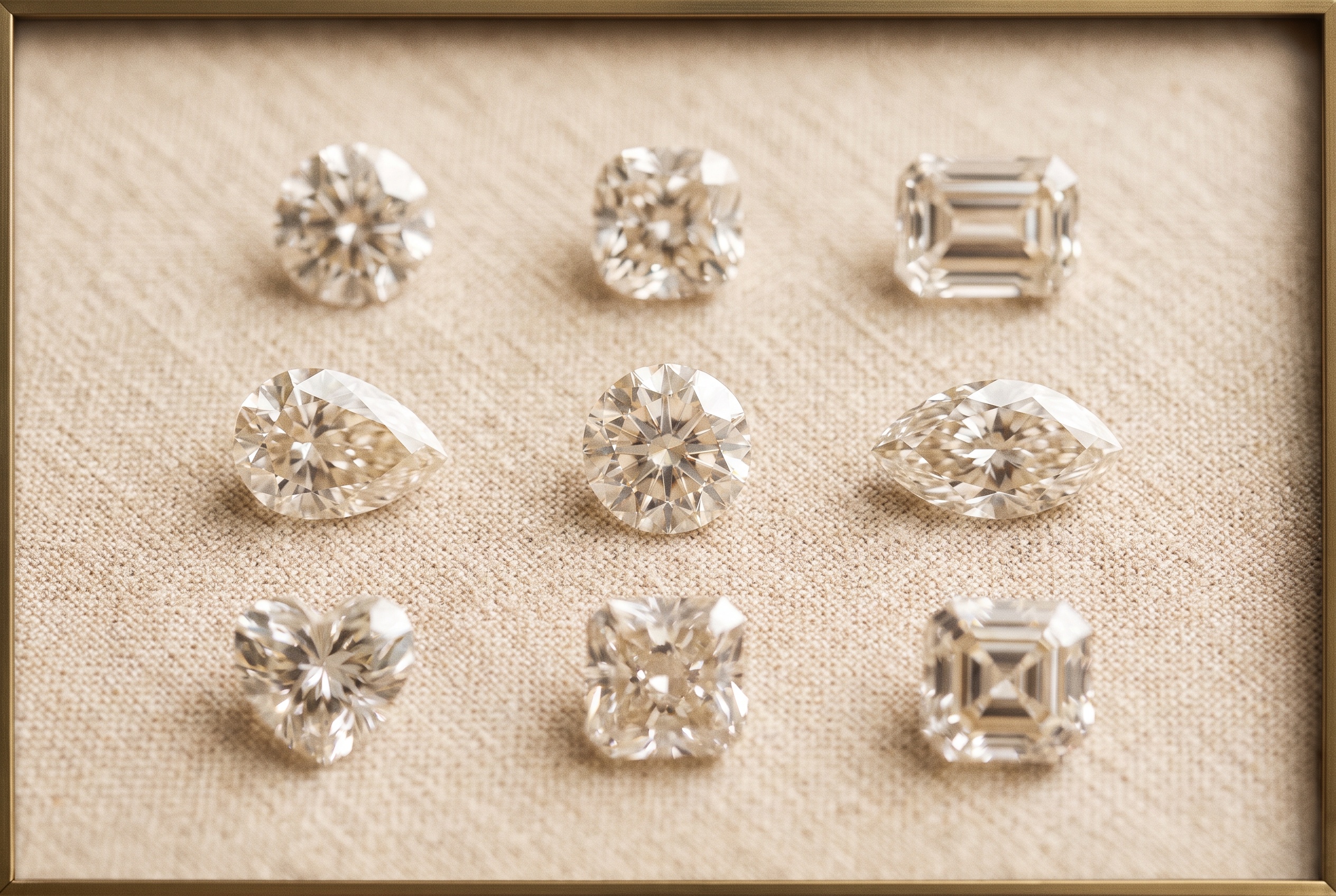
Shape matters as much as size for coverage-heavy variants. Melee is available in Round Brilliant and calibrated fancy shapes — Emerald, Radiant, Pear, Marquise, and others on request — sourced against a consistent DEF+/VS+ baseline. Fancy color melee (Yellow, Pink, Blue, or Green) is a separate sourcing line for a colored-stone build — quote and match it on its own spec rather than folding it into a white-goods cost sheet.
None of this shows up on the finished band. It shows up in the tenth unit of a reorder still looking like the first.
Why Consistency Matters More Here Than on One-Off Work
A custom engagement ring gets evaluated on its own. A customer looking at one ring doesn’t have a second unit sitting next to it to compare against. Eternity and wedding bands don’t get that luxury. They sit in a case, in a tray, or in a display book as a run of near-identical units, and customers — and sales staff — compare them directly against each other. A slight shift in stone size, a visible gap in coverage, or an inconsistent polish between unit three and unit eight in the same order is far more noticeable in a band program than it would ever be on a one-off custom piece, because the comparison is built into how the product is sold.
This is where manufacturing consistency becomes a sourcing requirement, not a nice-to-have. A few things worth confirming with any manufacturing partner before committing to a band program:
- Stone-size tolerance within a run. Melee set into eternity coverage should be calibrated tightly enough that unit-to-unit variation isn’t visible when two bands sit side by side.
- Consistent setting style across the reorder. If the first order used a shared-prong setting, a reorder that quietly shifts to channel-set (or vice versa) will read as an inconsistency to anyone who’s seen both.
- Repeatable CAD across sizes. The same base file should scale cleanly across a size run without the coverage proportion visibly drifting at the largest or smallest sizes.
- One production standard, not a patchwork. When casting, stone-setting, and polishing all happen in-house under one quality standard, a reorder six months out should match the original order — rather than drifting because a different subcontractor picked up part of the batch, which is a real risk with manufacturing spread across multiple outsourced partners.
None of this shows up on a spec sheet the way stone size or metal karat does, but it’s the difference between a band program that looks like one coherent line in the case and one that looks like it was restocked from three different sources.
Production Process: CAD, Casting, Setting, and QC In-House
A band program moves through the same core steps as a one-off custom ring — CAD, casting, stone-setting, polishing, finishing — just repeated at volume against a locked file and locked spec instead of adjusted piece by piece.
The CAD file anchors the whole program. Once a retailer approves a shank profile, prong or channel style, and stone-coverage proportion at one size, that file becomes the template every other size scales from — not a fresh design pass per size. A well-built file scales the coverage proportion cleanly across the run; a poorly scaled one thins coverage at the largest sizes or crowds it at the smallest, one of the more common places a program’s consistency breaks down unnoticed.
Casting, stone-setting, and polishing in-house under one production standard is what keeps a reorder matching an original order months later. When manufacturing splits across outsourced partners — one shop casting, a different bench setting, a third handling polish — each handoff is a point where the spec can drift, with no single team accountable. One line running CAD through final QC doesn’t eliminate variation entirely, but it means one set of hands and one set of tolerances governs the whole run, not three.
Quality control on a program checks things a one-off piece doesn’t need to worry about: stone count against spec for that tier (a full eternity band meant to carry 48 stones shouldn’t ship with 44 or 52), pre- and post-setting weight against the cost sheet’s metal assumption, and a visual pass across the whole size run to catch coverage or color drift that only becomes visible when units sit side by side.
Certification Options for Diamond Wedding Bands and Center Accents
Melee itself doesn’t carry certification — true across the trade, not a supplier-specific limitation, worth restating since it comes up on nearly every band-program cost conversation. A full or half eternity band set entirely in melee ships against the QC baseline described above, not a lab report.
Where certification does enter the picture is on diamond wedding bands or bridal sets pairing a certified center stone with a melee-set band — a solitaire alongside a matching wedding band, or one built with a larger accent stone rather than uniform melee. Any stone 0.30 carat and up can carry lab certification, and IGI, GIA, and GCAL are all available depending on what a retailer’s customers expect on paper. Quote that certified stone as its own line item, separate from the band’s melee cost — blending the two is a common way a cost sheet ends up wrong on both.
For documentation on the melee side, a QC or matching spec sheet — color range, clarity range, and size tolerance a parcel was sourced against — serves the purpose a lab report serves on a larger stone: the reference a reorder gets checked against.
Volume-Order Considerations for a Band Program
Stocking bands as a recurring category is a different planning exercise than ordering a handful of one-off custom pieces. A few things worth deciding before the first order, not after the second reorder exposes a gap:
Decide the size curve up front. Bands sell across a size range, and a retailer stocking a program needs a defined curve (how many units per size, weighted toward the sizes that actually move) rather than ordering a flat quantity per size. Get this from your own sales history if you have it; if this is a new category, ask your manufacturing partner what curve other band programs typically run, and adjust after the first sell-through cycle.
Standardize the variant mix, not just the size mix. A program that stocks full eternity, half eternity, and a diamond wedding option needs a defined ratio between those variants too — not just a size curve within one variant. This is a merchandising decision as much as a sourcing one, and it should be set before the first order so the reorder math is simple.
Reorder against the same spec, every time. The biggest risk in a recurring band program isn’t the first order — it’s the fifth. Reordering against a verbal description (“like the last batch, but a few more in size 7”) is how coverage, stone size, or setting style drift over time. Reorder against the original CAD file and spec sheet, not a memory of what the last batch looked like.
Consolidate the whole program through one vendor. A band program touches multiple SKUs, sizes, and coverage variants running simultaneously — which multiplies the coordination overhead if stones and manufacturing come from separate sources. Sourcing the melee, the metal, and the setting labor from a single vendor turns a program with a dozen moving parts into one shipment and one invoice to reconcile, rather than a stone bill from one supplier checked against a manufacturing bill from another every time a reorder goes out.
Confirm branding terms once, for the whole program. Custom and program pieces from an outsourced manufacturing partner are typically delivered unbranded by default, so a retailer can present the whole band line under their own name. Confirm this once at program setup rather than per-order, since it affects packaging and any stamped marks inside the shank.
Turnaround for Band Programs vs. Custom Rings
Turnaround works differently for a program than a single custom piece — worth separating so a retailer doesn’t plan a bulk reorder against the wrong benchmark. A single custom ring or one-off band, once approved, can move through CAD, casting, setting, and finishing in 4–6 days — well inside the two-to-six-week window typical for custom work sourced through a multi-vendor supply chain, because the whole build runs in-house on one line rather than passing between separate vendors.
A program’s first order carries the same production steps plus a CAD approval cycle up front — sign-off on shank profile, coverage, and size curve before production starts. A reorder against an already-approved file skips that cycle; production starts directly from the locked spec, meaningfully faster than the first order, though clock time still depends on run size and coverage mix — exactly why locking the CAD file early matters.
One distinction worth keeping straight: the loose melee in a band program is on-hand inventory, sourced and matched ahead of production — not quoted on the 4–6 day finished-jewelry timeline, since raw material and a finished piece are different product categories with different fulfillment models.
Putting the Cost Sheet Together
A simple way to structure a band program cost sheet is to treat coverage tier as the primary axis and build everything else as a modifier on top of it:
- Base metal cost by size and karat (shared across all variants at that size/karat)
- Stone cost by coverage tier (full, three-quarter, half, accent-only, none)
- Setting labor by coverage tier
- Program-level costs (CAD file amortized across the order, any custom packaging or branding work)
Price each coverage tier off its own landed cost rather than applying a single blended markup across the whole family — a full eternity band and a plain wedding band in the same size don’t carry the same cost structure, and a flat markup will overprice the plain bands relative to the market while underpricing the full eternity units relative to their actual stone cost.
Program-level costs are easy to bury inside a single unit’s price instead of amortizing them properly. A CAD file, once approved, is a one-time cost against the whole program — spread it across the first order’s unit count rather than re-charging it on every reorder.
How Guru Diam Supports Bulk Band Orders
A band program touches more moving parts than most categories a retailer sources — multiple sizes, coverage variants, melee matched across an entire run, and a reorder cadence that has to hold for years, not one season. Guru Diam runs CAD, casting, stone-setting, and polishing in-house under one production standard, so a program’s first order and its fifth reorder come off the same line rather than a memory of the last batch.
Melee for band coverage is sourced against a DEF+/VS+ baseline across Round Brilliant and calibrated fancy shapes, with fancy color melee (Yellow, Pink, Blue, Green) available as a separate line. Certified center or accent stones are available with IGI, GIA, or GCAL paper — a retailer isn’t locked into one lab because a customer base has a preference.
Custom and program pieces ship unbranded by default, so a program carries the retailer’s own name, not a manufacturer’s mark. Melee, metal, and setting labor move through one vendor, reconciling a dozen SKUs against a single shipment and invoice per reorder cycle instead of separate stone and manufacturing bills. Guru Diam works with more than 2,000 active customer accounts across New York and Los Angeles, on the same production standard regardless of coast.
Frequently Asked Questions
Are eternity bands and wedding bands really the same product category?
Yes. Full eternity, three-quarter eternity, half eternity, diamond wedding, and plain wedding are sub-variants of one base product distinguished by stone coverage, not five separate categories. They typically share the same CAD approach, shank profile, and sizing logic — what changes between them is how much of the band carries stones and how that affects stone cost and setting labor.
Why does a full eternity band cost so much more than a half eternity band in the same size?
Stone coverage is the main driver. A full eternity band sets stones continuously around the entire shank, while a half eternity band covers roughly the front half. That difference translates almost directly into stone count, total carat weight, and setting labor per unit — metal cost barely changes between the two at the same size and karat, so the price gap is almost entirely a stone-and-labor gap.
Is the melee used in eternity bands certified?
No. The small calibrated stones used for eternity and wedding band coverage are uncertified parcel goods, priced and sourced against a color/clarity QC baseline rather than certified individually or as a parcel. Loose stones 0.30 carat and up carry IGI, GIA, or GCAL certification, but that’s a separate sourcing category from band melee and should be priced as a separate line item on any cost sheet.
What matters more for a band program: unit pricing or manufacturing consistency?
Both, but consistency is the one retailers underweight. Bands get compared side by side in a case or display tray in a way a one-off custom piece never does, so a visible shift in stone size, coverage, or finish between units in the same order — or between an original order and its reorder — is far more noticeable here than on individual custom work. Reordering against the original CAD file and spec, rather than a verbal description of the last batch, is what keeps a program consistent over time.
How should a retailer plan quantities when starting a band program?
Set a size curve and a variant mix (the ratio of full eternity, half eternity, diamond wedding, and plain wedding units) before placing the first order, rather than ordering a flat quantity per size and figuring out the mix later. Use existing sales history if available, or ask your manufacturing partner what curve comparable programs typically run, then adjust the ratio after the first sell-through cycle.
Does sourcing the whole band program from one vendor actually save money, or just time?
Mainly coordination overhead, which has a real cost of its own. A band program running multiple sizes and coverage variants at once means reconciling a stone invoice against a manufacturing invoice for every reorder if they come from separate sources. Sourcing melee, metal, and setting labor through one vendor turns that into a single shipment and a single invoice per reorder cycle.