Platinum and white gold both look like a bright, cool-white metal at the counter, but they behave very differently once a ring is on a hand every day: platinum is a naturally white, denser metal that holds a setting under constant pressure with minimal maintenance, while white gold is a yellow-gold alloy plated with rhodium to look white, which means the plating wears and needs periodic reapplication. For jewelers quoting a custom engagement ring, that maintenance difference — not just the upfront price gap — is usually the deciding factor a customer should hear about before they choose.
What Each Metal Actually Is
Platinum is used in fine jewelry at 90-95% purity (typically stamped Pt900 or Pt950), alloyed with a small amount of another platinum-group metal such as ruthenium or iridium for workability. It's naturally white — the color comes from the metal itself, not a coating — and it doesn't tarnish, discolor, or require any surface treatment to stay white over decades of wear.
White gold starts as yellow gold (typically 14k or 18k, meaning 58.3% or 75% pure gold) alloyed with white metals like palladium, nickel, or silver to lighten its color. Even at the highest achievable gold-alloy dilution, the result is a pale, slightly warm-toned gray-white, not a true bright white — which is why nearly all white gold jewelry is finished with a thin rhodium plating to achieve the bright white look customers expect. That plating is a surface treatment, not part of the underlying metal, and it wears thin with handling and friction over time.
Durability and Daily Wear
Platinum is denser and tougher than gold, meaning it resists deformation under impact better and doesn't chip or fracture the way a harder, more brittle metal can. When platinum scratches, it typically displaces metal rather than removing it — a process called patina — so the metal stays on the ring rather than wearing away, and a polish restores the original finish without a meaningful loss of material over the ring's lifetime.
White gold is harder than platinum on a pure hardness scale, which makes it more scratch-resistant in the short term, but each scratch actually removes a small amount of metal. Over years of daily wear, this gradual metal loss can thin a setting's prongs enough to matter, particularly on rings worn constantly without regular jeweler inspection. For a security-critical setting — full bezel, tension, or channel builds that already put continuous stress on the metal — the practical durability difference favors platinum, since a bezel or channel wearing thin from repeated micro-abrasion increases the risk of a stone loosening over the years a customer expects it to be worn without incident.
The Maintenance Difference: Rhodium Plating
This is the single biggest practical difference between the two metals, and the one most likely to surprise a customer who hasn't owned white gold before. White gold's bright white surface is a rhodium plating over the yellow-toned gold-alloy base, and that plating wears down with normal handling — typically needing rhodium replating every 12-18 months for a daily-worn ring, sooner for people with more abrasive daily routines (frequent hand-washing, manual work, regular gym use). Once the plating wears through, the ring's underlying warm, slightly yellow-gray tone becomes visible, and it needs replating to look bright white again.
Platinum requires no plating and no equivalent recurring service. A platinum ring loses its factory-polish shine to a soft, matte patina over years of wear (which some customers actually prefer as a sign of a well-loved piece), but it never needs a chemical replating treatment to stay white — polishing alone restores the original finish. Over a ring's full lifetime, this maintenance gap meaningfully narrows the total cost-of-ownership difference between the two metals, even though platinum costs more upfront.
Cost Comparison
Platinum costs significantly more than white gold at the same ring size and design, for two compounding reasons: the raw metal itself trades at a higher price per gram than gold, and platinum's higher density means a platinum ring uses more metal by weight than the same design cast in gold. An 18k white gold ring typically costs roughly 30-40% less than the same design in platinum, and a 14k white gold ring costs even less, since 14k gold contains a lower proportion of pure gold than 18k.
That upfront gap narrows — though it rarely fully closes — once ongoing rhodium replating is factored into the comparison over a ring's expected lifetime of daily wear. Retailers quoting a custom build should present both the sticker price and this maintenance consideration together, rather than only comparing the two metals' quoted prices, since a customer choosing white gold purely to save money should understand that some of that savings gets spent back over time on replating service.
Color and Look
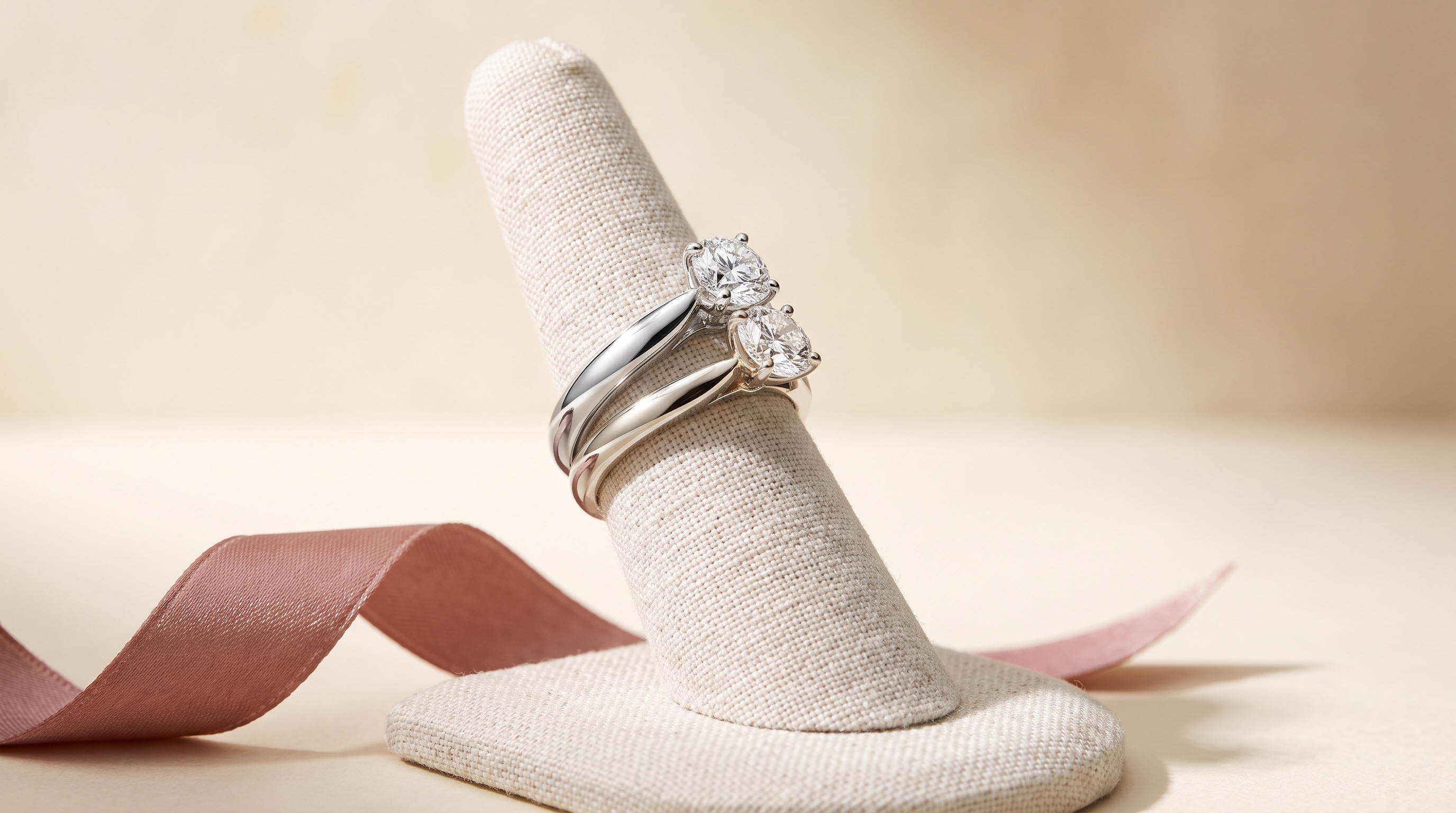
Platinum's natural white has a slightly cooler, grayer cast than a freshly rhodium-plated white gold ring, which reads as a brighter, more brilliant white immediately after plating. Some customers prefer platinum's understated, naturally cool tone; others prefer the higher-contrast bright white that fresh rhodium plating gives white gold, at least until the plating begins to wear. Because the two metals' natural colors do differ slightly, a platinum ring and a white gold ring worn together (for example, an engagement ring and a wedding band from a different metal) can show a visible, if subtle, tone mismatch — worth flagging to customers building a ring stack in stages rather than as a single matched set.
Weight and Everyday Feel
Platinum's higher density gives a platinum ring a noticeably heavier, more substantial feel on the hand than the same design in white gold — a quality many customers read as a signal of quality and value, though a small number of customers with sensitivity to ring weight (particularly larger or more elaborate designs) prefer gold's lighter feel for all-day comfort. This is worth raising during a fitting, since weight preference is subjective and doesn't correlate with the metal's actual quality or durability.
Hypoallergenic Considerations
Platinum is close to pure at typical jewelry purities and contains no nickel, making it the safer choice for customers with metal sensitivities or diagnosed nickel allergies. White gold's alloy composition varies by manufacturer: some white gold uses nickel as the whitening alloy, which can trigger reactions in sensitive wearers, while palladium-alloyed white gold avoids nickel entirely. Retailers sourcing white gold for customers who mention any metal sensitivity should confirm the specific alloy composition with their metal supplier rather than assuming all white gold is equivalent on this point.
Resizing and Repair
Both metals can be resized and repaired by a competent bench jeweler, but platinum's higher melting point and different working properties mean it requires platinum-specific tools, torches, and solder — a jeweler set up only for gold work generally can't service platinum without additional equipment. This matters for retailers directing customers to third-party repair after a sale: confirming a repair shop actually works in platinum, not just gold, avoids a customer being turned away or, worse, having platinum serviced incorrectly with gold-alloy solder.
Insurance and Appraisal Considerations
Both platinum and white gold rings should be appraised and insured based on their actual metal content and total diamond value, but the two metals differ slightly in how that appraisal reads over time. Platinum's stable, higher per-gram material value tends to hold up more predictably on a replacement-cost appraisal, since the metal itself doesn't change. A white gold ring's replacement estimate should account for the fact that a worn, unplated ring photographed for a claim can look visibly different from its original bright-white condition — appraisers familiar with the metal know to look past surface wear to the underlying gold content, but it's worth flagging to customers that an unmaintained ring might photograph less impressively than its actual insured value. Neither difference affects the underlying insurance math meaningfully, but it's a detail worth mentioning when a customer asks why their appraisal doesn't reference the plating at all — plating is a maintenance item, not an insured material.
Two-Tone and Mixed-Metal Builds
Some custom designs deliberately combine platinum and gold — a platinum head holding the center stone set into a gold shank, for example — to balance platinum's superior stone security against gold's lower cost for the majority of the ring's metal volume. This hybrid approach is worth knowing about for budget-conscious customers who specifically want platinum's durability at the point where it matters most (the prongs actually gripping the stone) without paying for an entire platinum band. Mixed-metal builds do require a bench jeweler comfortable working in both metals and soldering or fusing them together correctly, which not every shop offers, so it's worth confirming that capability before quoting a two-tone build to a customer.
Common Misconceptions Worth Correcting
A few points come up often enough with retail customers that they're worth addressing proactively rather than waiting for a complaint. First, "white gold" is not a separate type of gold in the way yellow and rose gold are — it's standard yellow gold alloyed and plated to look white, and that plating is a maintenance item, not a manufacturing defect, when it eventually wears. Second, platinum's higher price doesn't mean it's a better-quality diamond mounting in a structural sense for every setting — a well-made 18k white gold prong setting holds a stone just as securely as platinum for most standard designs, and the real durability gap only shows up clearly in high-stress settings or over many years of hard daily wear. Third, "platinum-plated" or "platinum-finished" jewelry (sometimes seen in lower-cost fashion jewelry) is not the same product as solid platinum jewelry and shouldn't be represented or priced as such — genuine platinum fine jewelry is solid platinum alloy throughout, stamped Pt900 or Pt950, not a plating over a base metal.
Environmental and Sourcing Notes
Platinum is considerably rarer than gold in the earth's crust and is mined in far fewer locations globally, which contributes to its higher and sometimes more volatile market price relative to gold. Neither metal's mining footprint is a differentiator retailers typically need to raise proactively with customers, but it's worth being accurate if asked: platinum's rarity is a genuine driver of its cost premium over gold, not simply a branding choice, and that scarcity is part of why platinum content, unlike gold-alloy dilution in 14k versus 18k gold, doesn't get diluted down to a lower-purity "budget" platinum tier in the same way gold does.
A Simple Decision Checklist for Retail Staff
- Budget-sensitive customer, standard prong solitaire: white gold performs well and costs meaningfully less upfront.
- High-stress setting (bezel, tension, channel): lean platinum for long-term setting security, especially on a stone the customer considers irreplaceable.
- Known nickel or metal sensitivity: platinum by default, or confirm a palladium-alloyed (nickel-free) white gold if the customer prefers gold's price point.
- Customer explicitly dislikes recurring maintenance appointments: platinum avoids the rhodium replating cycle entirely.
- Customer wants maximum bright-white contrast at time of purchase: freshly plated white gold reads slightly brighter than platinum's natural tone, though that contrast fades as plating wears.
Which Metal Suits Which Setting
Setting style interacts with this metal choice directly. High-stress settings — full bezel, tension, and channel builds that hold a stone under continuous mechanical load — perform best in platinum's tougher, more deformation-resistant structure, as covered in GD's engagement ring settings guide. Simpler prong settings are more forgiving of metal choice, since the load is distributed across a few discrete points rather than concentrated in a continuous rim or spring-tension mechanism, making white gold a perfectly durable choice for a standard four- or six-prong solitaire.
Platinum vs. White Gold at a Glance
| Factor | Platinum | White Gold (14k/18k + rhodium) |
|---|---|---|
| Natural color | Naturally white, no plating needed | Pale gray-white base, plated white with rhodium |
| Ongoing maintenance | Occasional polish only | Rhodium replating every 12-18 months |
| Upfront cost | Highest | Lower (roughly 30-40% less at 18k, more at 14k) |
| Density/weight | Heavier, denser feel | Lighter |
| Scratch behavior | Displaces metal (patina), doesn't wear away | Removes small amounts of metal over time |
| Hypoallergenic | Yes, virtually pure | Depends on alloy (nickel vs. palladium) |
| Best for high-stress settings | Yes — bezel, tension, channel | Best for simpler prong settings |
Talking Customers Through the Choice
Most customers default to comparing sticker price alone, so the most useful thing a retailer can do is frame the decision around how the ring will actually be worn. A customer with an active job, a preference for low maintenance, or a known metal sensitivity is generally better served by platinum despite the higher upfront cost. A customer working within a tighter budget, comfortable with periodic replating service, and choosing a simpler prong-based design is well served by white gold. Neither metal is a wrong choice — they simply carry different tradeoffs that are worth walking through explicitly rather than letting price alone decide.
How This Choice Affects Custom Build Timing
Platinum and white gold don't differ meaningfully in casting or setting turnaround for a standard custom build — both can be finished on a comparable timeline once the design and stone are finalized. Where timing does diverge slightly is at the finishing stage: a white gold piece needs its rhodium plating applied as a final production step before it ships, which is a quick, standard part of the process rather than a delay, while platinum's finishing is limited to polishing. Neither adds meaningful time to a well-run custom order, but it's worth knowing the plating step exists as part of white gold's production sequence in case a customer asks why a "simpler" metal still has a finishing step at all.
Current Retail Demand Trends
Platinum has seen renewed retail interest in recent years, partly driven by customers researching metal durability more thoroughly before a major purchase and partly by a broader taste shift toward understated, naturally-toned finishes over high-contrast bright white. White gold remains the higher-volume choice overall, largely on price, and continues to dominate among budget-conscious first-time engagement ring buyers. Mixed-metal and two-tone builds combining platinum heads with gold shanks have also grown as a middle option, letting retailers offer platinum's durability at the stone-security point that matters most without pricing out budget-conscious customers on the rest of the ring. Tracking which of these three paths a given customer leans toward early in a consultation — pure budget, pure durability, or a hybrid — tends to shorten the overall sales conversation considerably.
Sourcing Platinum and White Gold Builds Through Guru Diam
Guru Diam builds custom engagement rings in both platinum and white gold (along with yellow and rose gold), finished in 4-6 days and unbranded by default so retailers can resell as their own. Because metal choice, setting style, and diamond sourcing happen through the same account, jewelers can spec a platinum bezel build or a white gold prong solitaire — or anything between — without coordinating a separate metal supplier and stone vendor. Loose diamonds for a custom build, including CVD lab-grown stones with IGI, GIA, or GCAL certification, are sourced through the same order.
Start a custom build through custom jewelry, or browse loose stones sized for a specific setting through the wholesale hub. Trade accounts can be set up through trade partner. Jewelers deciding on a setting style before finalizing metal choice should also review GD's engagement ring settings guide and tension setting ring guide for how setting mechanics interact with metal durability. Certified loose stones for any custom metal build are available under certified diamonds.
Frequently Asked Questions
Is platinum better than white gold for an engagement ring?
"Better" depends on priorities. Platinum is more durable, hypoallergenic, and needs no plating maintenance, but costs meaningfully more upfront. White gold costs less initially but needs rhodium replating every 12-18 months to keep its bright white color. Neither is objectively better — they suit different budgets and maintenance preferences. A retailer's job is usually less about declaring a winner and more about making sure the customer understands the tradeoff before they commit to years of wearing the ring day to day.
How often does white gold need to be replated?
Roughly every 12-18 months for a ring worn daily, sooner for people with more abrasive routines like frequent manual work or heavy hand-washing. Once the rhodium plating wears through, the ring's underlying warm gray-white gold tone becomes visible until it's replated.
Does platinum turn yellow over time like white gold can?
No. Platinum is naturally white all the way through and doesn't rely on any plating, so it can't reveal a yellow undertone the way white gold does as its rhodium plating wears. Platinum develops a soft matte patina from wear instead, which is easily restored with a polish.
Is platinum worth the extra cost for a daily-worn engagement ring?
For settings under continuous mechanical stress (bezel, tension, channel) or customers who want minimal ongoing maintenance, most jewelers consider it worth it. For a simple prong solitaire on a tighter budget, white gold performs perfectly well and the savings can be meaningful.
Can platinum and white gold rings be worn together in a stack?
Yes, but their natural tones differ slightly — platinum reads cooler and grayer, freshly-plated white gold reads brighter and whiter — so a stack combining both metals can show a subtle tone mismatch, more noticeable once the white gold's plating begins to wear.
Is white gold hypoallergenic?
It depends on the alloy. Some white gold uses nickel as its whitening metal, which can trigger reactions in people with metal sensitivities; palladium-alloyed white gold avoids nickel. Platinum is close to pure and virtually always hypoallergenic, making it the safer default for customers with a known sensitivity.
Does the metal choice affect how big a diamond looks?
Not directly — apparent size is driven mainly by the diamond's shape, cut proportions, and setting style (a halo, for instance, boosts perceived size regardless of metal). Metal color has a secondary effect: a warmer metal like yellow or rose gold can make a diamond with lower color grades look slightly warmer by contrast, while platinum and white gold's neutral, bright tone tends to make a stone's actual color grade read more accurately.