
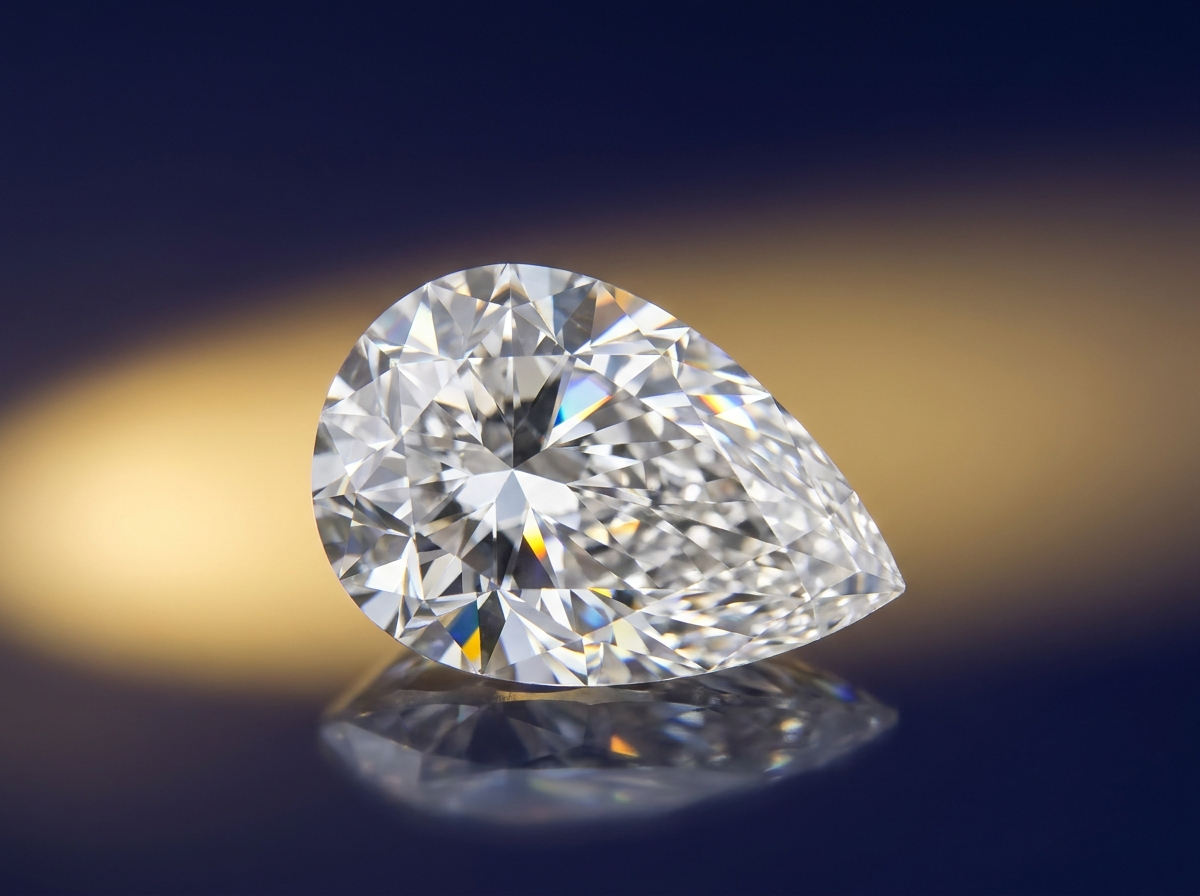
A pear shape diamond is a teardrop-outline brilliant cut — one rounded end like a round brilliant, tapering to a single point like a marquise — faceted for fire rather than the broad flat planes of a step cut. Guru Diam stocks 487 IGI-certified, CVD-grown pear shape diamonds in colorless white, in stock now from our New York Diamond District desk.
Pear is one of the most-searched diamond shapes in the trade, and most of what turns up for it is a bare product listing — a photo and a price, no real explanation of ratio, point alignment, or what actually separates a well-cut pear from a mediocre one. This guide covers the shape properly: where it comes from, how it's faceted, what to check before you buy sight-unseen, what actually moves price, how it compares to oval and heart, and how to order it wholesale.
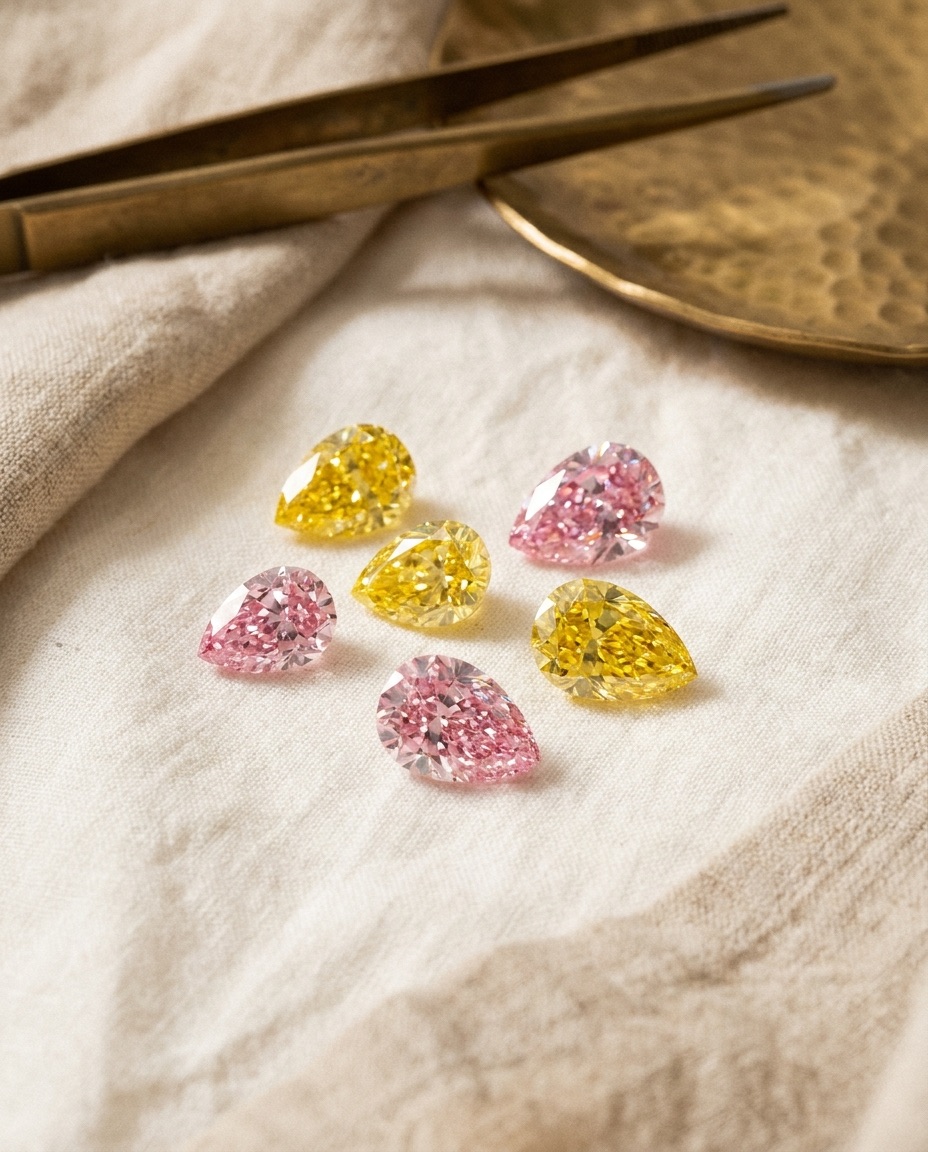
What Is a Pear Shape Diamond?
A pear shape (also called a teardrop) combines the rounded end of a round brilliant with the single point of a marquise, faceted in a full brilliant pattern — typically 58 facets — for maximum fire and scintillation. It reads differently depending on orientation: point-down in a pendant or drop earring pulls the eye downward and elongates the piece; point-up (toward the hand) in a solitaire ring is the more common bridal setting, where the taper visually elongates the finger.
Ratio drives how the shape reads. A "classic" pear sits around a 1.50–1.70 length-to-width ratio; slimmer stones run higher, plumper ones lower. Neither is objectively correct — it's buyer preference — but the exact ratio matters more than the shape name alone when you're sourcing sight-unseen. Two stones both labeled "pear shape, 1.00ct" can look meaningfully different depending on where in that ratio band they fall, which is why serious buyers ask for the millimeter measurements, not just the carat weight.
Where the Pear Cut Comes From
The pear cut is one of the oldest fancy shapes in diamond cutting, generally traced back to 15th-century Flanders and the diamond-cutting workshops that developed the scaif — the horizontal polishing wheel that made symmetrical faceting possible for the first time. Before the scaif, cutters could only knock down the natural crystal faces of a rough stone; once controlled, repeatable polishing existed, cutters started experimenting with asymmetric outlines instead of just point-cuts and table-cuts, and the pear was one of the earliest results — essentially a round brilliant pulled to a point on one side.
The shape has stayed in continuous production ever since because it solves a real design problem step cuts and round brilliants don't: it gives jewelry designers a single stone with two visually distinct ends, which is useful for pendants, drop earrings, and asymmetric settings where a round stone would just look like a smaller round stone. That utility, not fashion cycling, is why pear has never really gone out of production in the trade — it shows up in three-stone rings, halo pendants, and statement earrings across every decade of jewelry design because the shape itself does something a symmetric outline can't.
Facet Structure and Optics: Why a Pear Faces Up the Way It Does
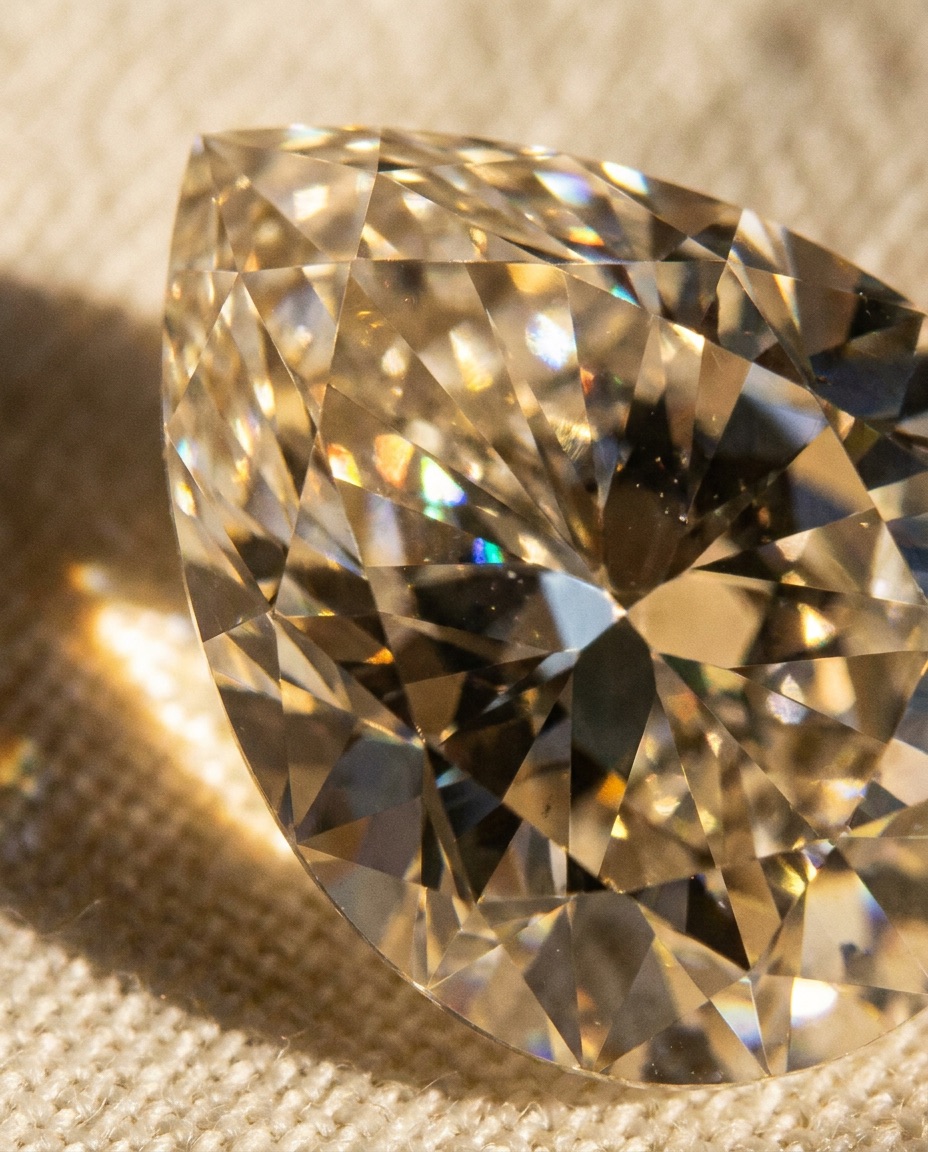
A standard pear shape is cut as a modified brilliant, not a step cut, which is the single biggest reason it reads brighter and more "sparkly" than an emerald or Asscher of comparable size. The crown typically carries a table, 8 star facets, 8 bezel (kite) facets, and 16 upper-girdle facets; the pavilion carries 8 main pavilion facets plus 16 lower-girdle facets, sometimes with a small culet at the point end for durability. Add it up and you land around 58 facets total on a well-cut stone — the same base count as a round brilliant, just distributed around an asymmetric outline instead of a circular one.
That facet count is what produces the light performance: more facet junctions than a step cut means more internal light paths, which means more scintillation (the flash-and-sparkle you see when the stone or the viewer moves) rather than the broad, mirror-like flashes a step-cut emerald or Asscher produces. It's a genuine trade-off — step cuts show off color and clarity more transparently because the open table lets you see straight into the stone; brilliant-faceted pear hides minor inclusions better but gives you less of a clean "window" view. For a buyer choosing between shapes for a client, that's usually the deciding factor: pear (and other brilliant-faceted fancy shapes) forgive lower clarity grades better than step cuts do, which matters when you're trying to hit a price point.
Grading a Pear Shape: Point Alignment, Wing Symmetry, and Bow-Tie
Two things separate a well-cut pear from a mediocre one: point alignment and bow-tie shadowing. A third — wing symmetry — is less talked about but equally visible face-up.
- Point alignment. The point should sit exactly on the centerline of the rounded end. Even a slight left-right skew is visible face-up and reads as a cutting flaw, not a design choice.
- Bow-tie effect. Like oval and marquise, pear is an elongated brilliant shape, so it can show a dark, bow-tie-shaped shadow across the center when pavilion angles aren't cut evenly. A well-proportioned stone minimizes this — ask for a face-up photo or video before committing to a stone you haven't seen in person.
- Wing symmetry. The curved sides between the point and the rounded end ("shoulders" or "wings") should mirror each other. A bulge or flat spot on one side throws off the whole silhouette even when the point and ratio are correct.
Why bow-tie happens
Bow-tie isn't a certificate-graded defect — it won't show up as a line item on an IGI or GIA report — which is exactly why it trips up buyers who source purely off paper specs. It's an optical effect caused by the viewer's own head blocking light from directly overhead, combined with pavilion facets that are angled just steeply enough (or shallowly enough) to stop returning light back to the eye at the stone's midpoint. Every elongated brilliant shape — pear, oval, marquise, and to a lesser extent radiant — can show some degree of it. The question isn't whether a stone has any bow-tie at all (nearly all elongated shapes show a trace), it's whether the shadow is faint and soft or dark and hard-edged. That's a judgment call you make from a photo or video, not from the grading report.
Certification: IGI, GIA, and GCAL
None of the above — point alignment, bow-tie, wing symmetry — is something a cut grade on a certificate fully captures, because IGI, GIA, and GCAL all grade proportions, symmetry, and polish as numeric or letter grades, not as a face-up photo assessment. Two stones can both carry "Excellent" symmetry and still show noticeably different bow-tie severity in person. That's why we treat the lab report as a floor, not a substitute for actually looking at the stone: use the certificate to confirm color, clarity, carat, and cut grade, then use a face-up photo or video to judge the things a grading report can't quantify. Guru Diam issues pear shape stones with IGI certification as standard; GIA and GCAL are both available on request for buyers who need a specific lab for their market or their client.
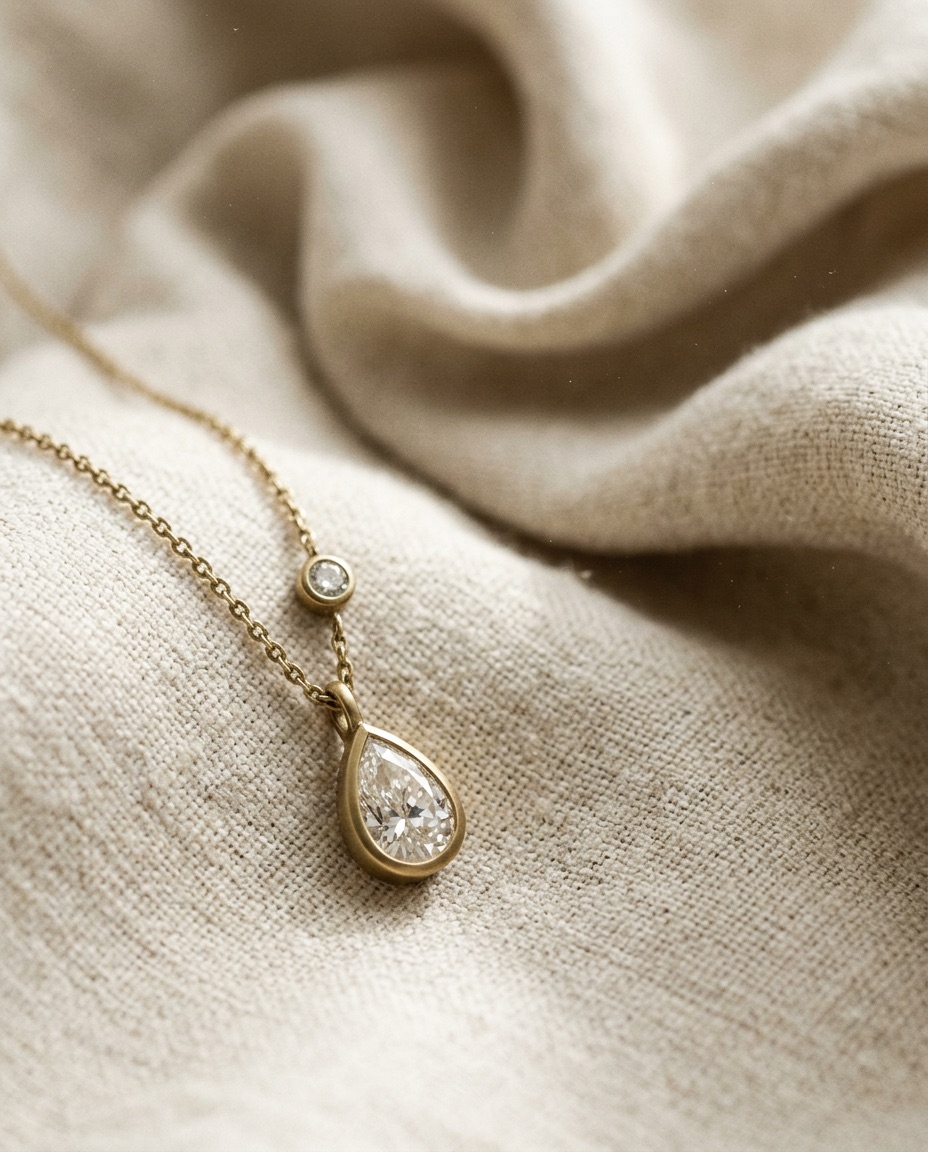
Pear Shape: Spec and Availability
| Spec | Detail |
|---|---|
| Outline | Teardrop — one point, one rounded end |
| Facet style | Full brilliant (~58 facets) |
| Typical L:W ratio | 1.50–1.70 (classic); 1.45–1.75 range |
| Color | Colorless, D–J range (fancy color available separately) |
| Growth method | CVD-grown |
| Certification | IGI standard; GIA and GCAL available on request |
| Stone type | Certified single stones (not melee) |
| Melee / calibrated goods | Pear also ships as calibrated melee (0.8mm–9.0mm, DEF+/VS+) for accent and pavé work — uncertified parcel goods, priced separately from certified single stones |
| On-hand count | 487 pieces |
| Typical uses | Solitaire rings, drop pendants, dangle earrings, three-stone settings |
How Guru Diam Sources and Cuts Pear Shape Diamonds In-House
Guru Diam's pear shape inventory is CVD-grown and cut, set, and polished in-house — we control the cutting process end to end rather than buying finished goods off a broker's list, which is what lets us hold depth in a specific ratio band instead of one or two stones per size. For a buyer, that distinction matters at the reorder stage: when you find a ratio and quality combination that sells for your case, you want a supplier who can produce more of exactly that, not just restock whatever happens to come in next.
That in-house control also means we can respond to a specific ask — a slightly higher ratio for an east-west setting, a particular point sharpness for a three-stone design — rather than only offering what's already polished and sitting in a parcel. For made-to-order requests outside the standard 1.45–1.75 ratio range, expect a quoted lead time rather than same-day fulfillment; in-stock pieces within the standard range ship immediately.
What Drives Price on a Pear Shape Diamond
Carat weight is the obvious lever, but it's not the only one, and it's not always the biggest one at a given size. A handful of factors move price on a pear shape more than buyers coming from round-brilliant sourcing usually expect:
- Ratio precision. Stones cut to the classic 1.50–1.70 band carry the deepest inventory and the most predictable pricing because that's where cutting yield from rough is most efficient. Extreme ratios — very slim (1.80+) or very plump (below 1.40) — are harder to produce consistently and typically carry a premium relative to demand, even though they're not "better" stones.
- Symmetry and cut quality. Because bow-tie and point alignment aren't fully captured on a certificate, well-executed symmetry commands a real premium in the trade even between two stones with identical certificate grades — buyers pay for the face-up look, not just the paper.
- Color and clarity, same as any shape. Pear's brilliant faceting hides inclusions somewhat better than a step cut, but clarity still needs to be clean specifically at the point — inclusions concentrate visual attention there more than anywhere else on the stone.
- Certification lab. IGI, GIA, and GCAL price similarly at the wholesale level for CVD-grown stones, but lab choice can matter for resale in specific markets — ask your supplier which labs they carry before assuming.
- Carat-weight breakpoints. Like every shape, pricing steps up disproportionately at psychological thresholds — 0.50ct, 0.75ct, 1.00ct, 1.50ct, 2.00ct — where a stone just over the line prices meaningfully higher than one just under it, even for a fraction of a carat difference.
Styling and Setting Guidance
Pear's two-ended silhouette gives it more setting flexibility than a symmetric shape, but it also means orientation is a real design decision, not just a formality.
Solitaire and Three-Stone Rings
Point-up (toward the hand) is the standard bridal orientation — it visually elongates the finger and keeps the point protected under the hand rather than exposed at the fingertip, where it's more prone to chipping in daily wear. A plain solitaire in a four-prong or six-prong setting lets the outline speak for itself; a three-stone setting with round or trapezoid side stones is the more traditional pairing for pear centers, since the side stones balance the asymmetric silhouette.
Pendants and Drop Earrings
Point-down is standard here — the taper pulls the eye downward along the neckline or earlobe, which is the whole visual point of choosing pear over round for these categories. A simple bail-set pendant or a single dangle earring lets the teardrop read clearly; halo settings work too, but a heavy halo can compete with the point instead of framing it, so proportion matters more than on a ring.
East-West Settings
Setting a pear sideways — point toward one shoulder of the ring instead of up or down — is a specific design choice that reads as more editorial and less traditional-bridal. It works best on longer ratio stones (1.65+) where the elongation reads clearly even rotated 90 degrees; a plumper pear loses its distinctive silhouette in an east-west orientation and can start to look like an off-center oval, so ratio selection matters even more for this setting style than for a standard point-up ring.
Pear Shape vs. Oval: Which to Stock
Pear and oval are cut from the same brilliant-faceting family and get compared constantly because they solve overlapping problems — both elongate visually, both throw more fire than a step cut, both work well as a stand-alone solitaire. The difference is the single point.
| Pear | Oval | |
|---|---|---|
| Outline | One point, one rounded end | Fully symmetric, no point |
| Orientation decision | Point-up or point-down changes the design | No orientation decision — reads the same either way |
| Bow-tie risk | Present, typically milder than oval at the same ratio | Present, often more visible due to the fully open silhouette |
| Best use case | Pendants, drop earrings, asymmetric settings, three-stone rings | Solitaire rings, especially for buyers who want elongation without an asymmetric silhouette |
| Setting flexibility | Higher — the point gives designers two distinct visual anchors | Lower — symmetric outline limits orientation-based design choices |
For a buyer stocking both, the practical rule of thumb is: oval sells better as a straightforward elongated solitaire because there's no orientation risk for the setter or the customer, while pear sells better anywhere the piece needs a directional element — a pendant that should point down, a three-stone ring where the point needs to nest against the shoulder stones, an earring that should taper toward the ear. If your case is mostly bridal solitaires, weight oval heavier; if it's mixed bridal and fashion jewelry, pear earns its shelf space on the directional pieces oval can't do.
Pear Shape vs. Heart: Which to Stock
Heart is pear's more extreme sibling — same brilliant faceting family, but with a cleft cut into the rounded end instead of leaving it smooth, and typically a shorter, plumper ratio to keep the heart outline readable. The two shapes get confused by customers more often than buyers expect, especially at smaller carat weights where a heart's cleft can read as a soft double-bump rather than a clear notch.
Heart is a harder cut to execute well — the cleft and the two lobes both need to be symmetric on top of everything a pear already needs (point alignment, wing symmetry, minimal bow-tie), so well-cut hearts are scarcer and command a bigger symmetry premium than well-cut pears at the same carat weight. From a sourcing standpoint, pear is the deeper, more liquid category — it moves in more design contexts (bridal, pendant, earring, three-stone) where heart is more narrowly a statement or gift-occasion shape (anniversaries, Valentine's-adjacent gifting, sentimental pieces). Stock pear as a core, always-available shape; stock heart as a smaller, occasion-driven complement rather than a comparable-depth category.
Fancy Color Pear Shape Diamonds
Pear shape is also available in fancy color, in the same colorless-family sourcing and cutting pipeline as our white pear inventory. Certified fancy color pear shape loose stones are available in yellow, pink, blue, and green — the same four-color range Guru Diam carries across all fancy color shapes, certified the same way as our colorless inventory (IGI standard, GIA and GCAL on request). Fancy color pear tends to move fastest in yellow, since it's the most widely wearable and the easiest for a jeweler to sell to a customer who wants something distinctive without a full fancy-color commitment — pink, blue, and green move more as special-order or statement pieces.
For a designer building a fancy color piece, pear's elongated silhouette does something round fancy-color stones can't: it maximizes visible color across the face of the stone relative to its carat weight, because more of the stone's surface area sits close to the outline where saturation reads strongest to the eye. That's part of why fancy color and elongated shapes pair so often in high-end colored-stone jewelry — the cut is doing work for the color, not just the color for the cut.
Sourcing Pear Shape Diamonds Wholesale
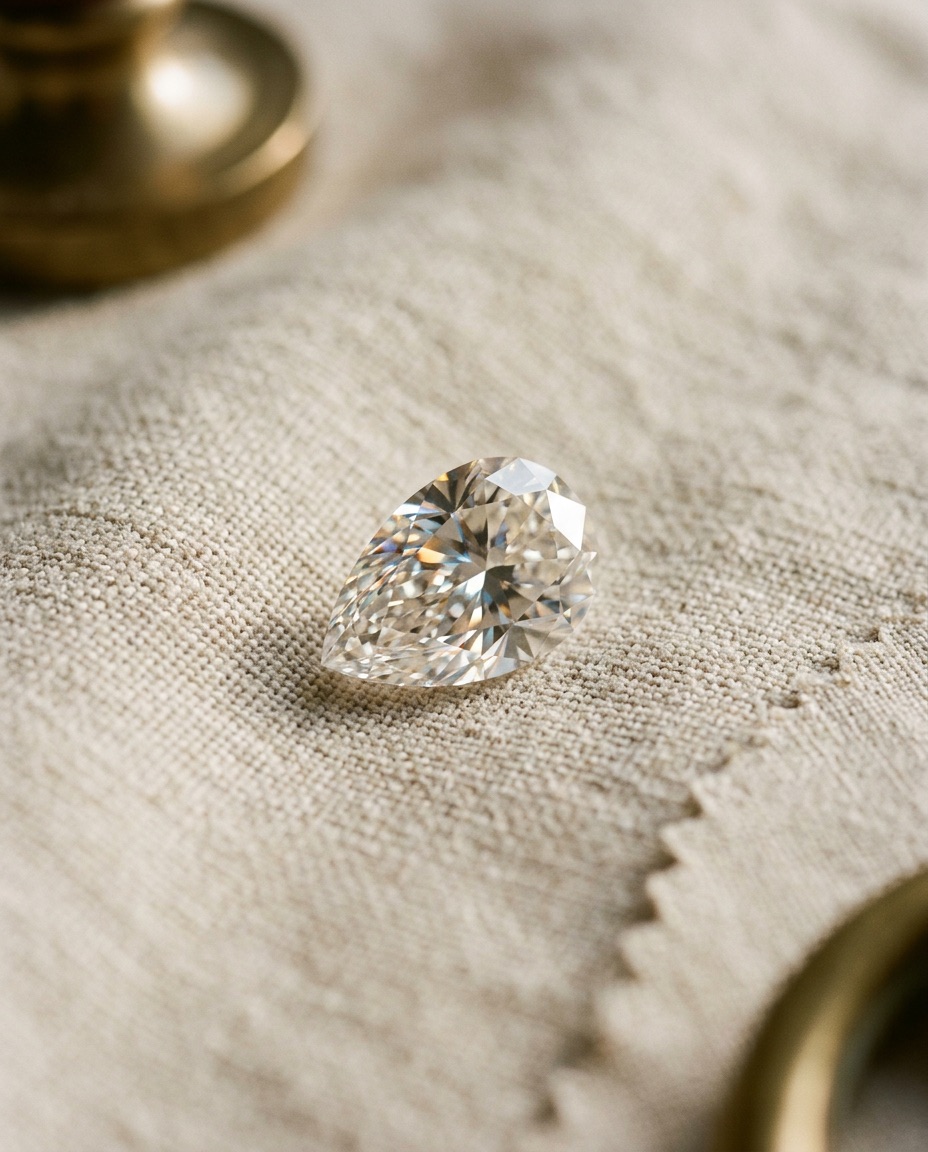
With 487 pieces on hand, pear is one of Guru Diam's deepest standard-shape categories — enough range in size and ratio to fill most ring, pendant, and earring requests without a made-to-order wait.
Guru Diam sources pear shape diamonds as wholesale, trade-only inventory — no retail markup — from our New York Diamond District desk (36 West 47th Street, Suite 601A) and our Los Angeles office (607 South Hill Street, Suite 241). In-stock pieces ship same-day from New York before 6pm EST, or same-day from Los Angeles before 4pm PST. For a custom setting, CAD-to-finished-piece turnaround runs 4–6 days. Pear is also available as fancy color — see above — and as calibrated melee for accent and pavé work.
Guru Diam serves 2,000+ active wholesale accounts across antique cuts, fancy colors, fancy color melee, custom engagement rings, and finished jewelry — one vendor, one shipment, one relationship, rather than splitting a pear-shape order across a separate melee supplier or a separate custom-setting shop. For sight-unseen buying, ask for a face-up photo or short video of any pear shape stone before confirming — it's the fastest way to check bow-tie severity and point alignment yourself rather than relying on the certificate alone.
Ready to buy? Open a verified wholesale account at /signup and book time with a gemologist at /book-appointment.
Frequently Asked Questions
What is a pear shape diamond? A pear shape (or teardrop) diamond combines the rounded end of a round brilliant with the single point of a marquise, faceted in a full brilliant pattern for fire and scintillation. It can be set point-up or point-down depending on the piece.
What length-to-width ratio should I look for in a pear shape diamond? Most buyers favor a classic ratio between 1.50 and 1.70, though the acceptable range runs from about 1.45 to 1.75. A lower ratio reads plumper, a higher one reads slimmer and more elongated — ask for exact measurements rather than relying on the shape name alone.
What is bow-tie effect in a pear shape diamond, and how do I avoid it? Bow-tie is a dark, bow-tie-shaped shadow that can appear across the center of any elongated brilliant shape, including pear, oval, and marquise, when pavilion angles aren't cut evenly. It won't show up as a line item on a grading certificate. Well-proportioned stones minimize it; request a face-up photo or video before buying a pear shape sight-unseen.
Are Guru Diam's pear shape diamonds lab-grown, and are they certified? Yes. Guru Diam's pear shape inventory is CVD-grown, cut and polished in-house, and IGI-certified as standard, with GIA and GCAL certification available on request. All pieces are certified single stones, not melee; calibrated pear melee is available separately as uncertified parcel goods.
How does pear shape compare to oval or heart for a bridal collection? Oval is the safer straightforward-solitaire choice since it has no orientation decision. Pear earns its place on anything directional — pendants, drop earrings, three-stone rings — where the point does design work oval can't. Heart is a narrower, occasion-driven category best stocked as a smaller complement rather than a comparable-depth line.
How fast can I get a pear shape stone or a finished custom piece? In-stock pieces ship same-day from New York before 6pm EST or from Los Angeles before 4pm PST. For a custom setting, CAD-to-finished-piece turnaround runs 4–6 days from our New York and Los Angeles desks.