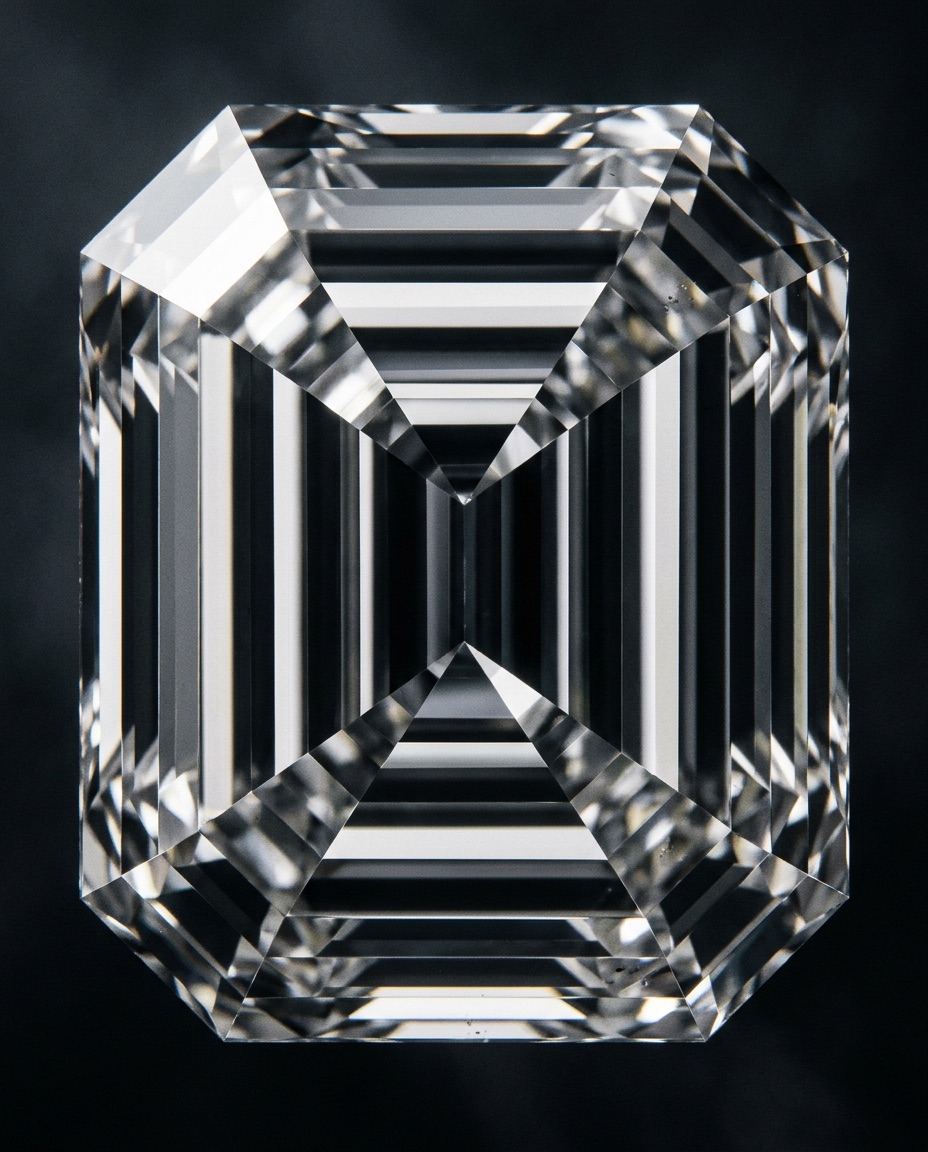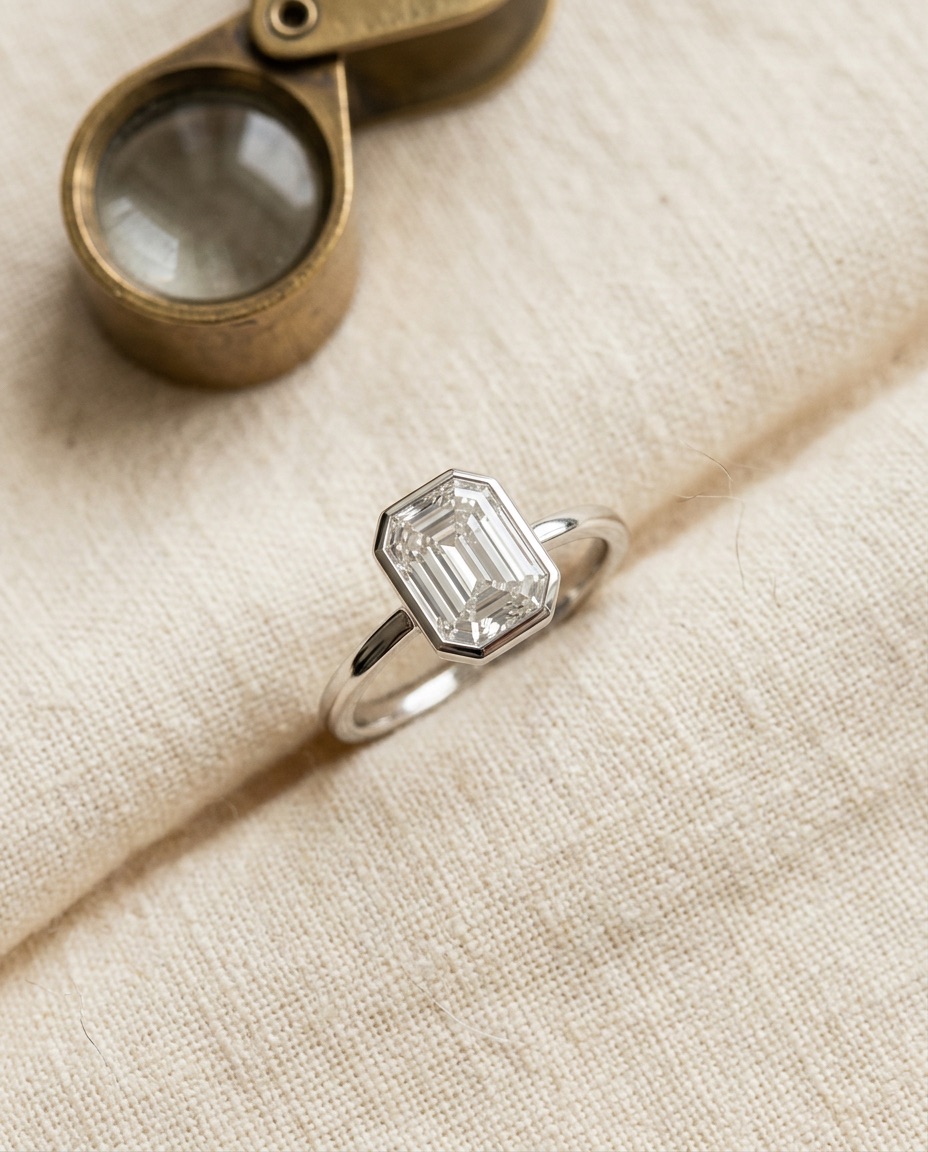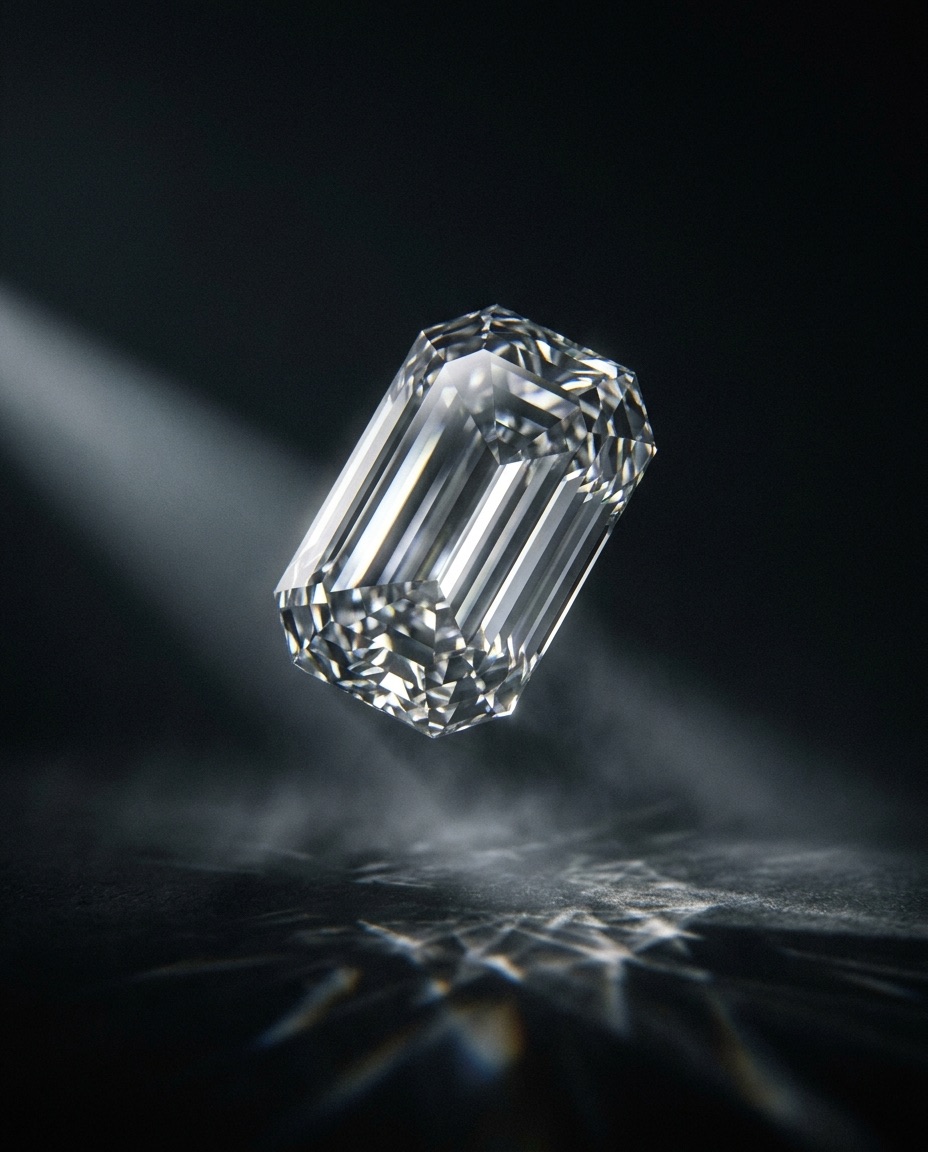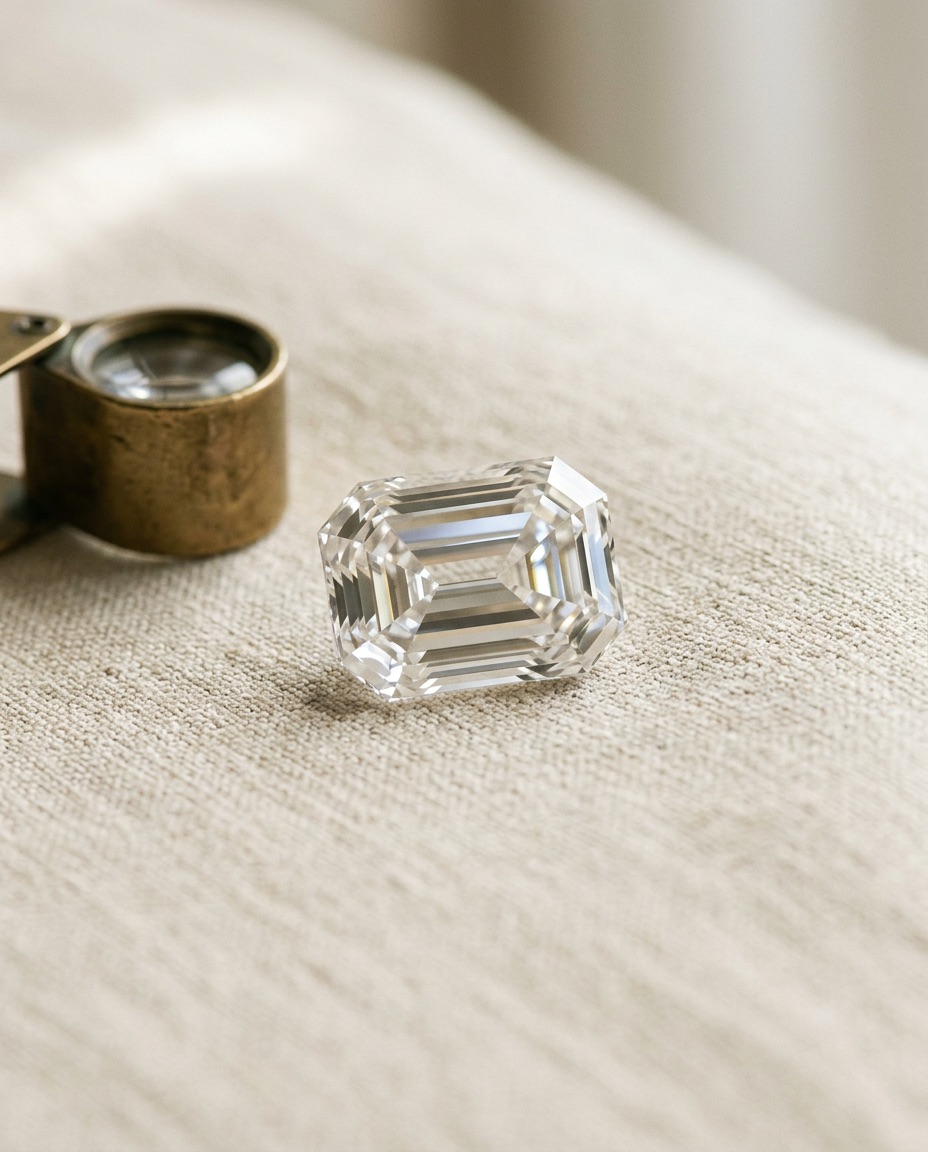

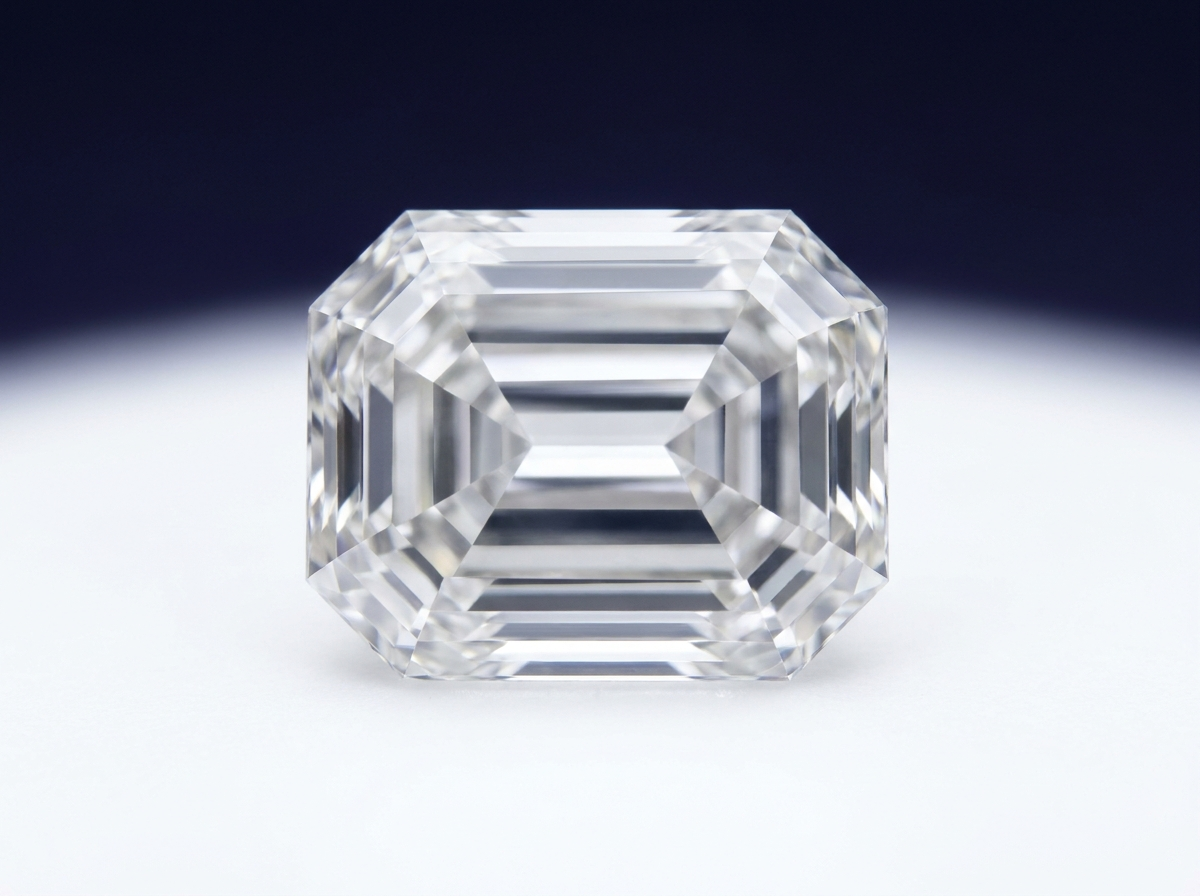
An Octagon cut diamond is an eight-sided step-cut shape — essentially an emerald cut with each corner opened into a full, symmetrical facet instead of a small clipped corner, giving it a distinctly geometric outline. Guru Diam stocks Octagon cut as IGI-certified lab-grown loose diamonds, cut in-house, with 40 pieces currently on hand.
What is an Octagon cut diamond?
Start from an emerald cut: a rectangular step cut with the four corners trimmed off as small clips so the stone doesn't chip at sharp points. An Octagon cut takes that same trim and opens it into a full-length facet on each corner, so the outline reads as eight distinct sides instead of a rectangle with the corners knocked off. The step faceting itself — broad, flat, parallel planes — stays the same, which means an Octagon cut throws the same quiet, hall-of-mirrors flash as an emerald cut. What changes is the silhouette: more geometric and architectural, less classic-rectangular.
That makes Octagon a good fit for settings built around clean, repeating geometry — bezel work, Art Deco-style mountings, and pieces where the stone's outline is meant to read as a shape in its own right rather than disappear into a standard rectangular profile.
The name follows the same logic as every other cut in the step-cut family. "Emerald cut" describes a faceting style originally developed to protect the fragile corners of emerald rough — sharp points chip easily on any stone, diamond included, so cutters replaced them with a small trimmed facet. Octagon simply pushes that trim further: instead of a short diagonal clip, the corner becomes a full-length side, roughly a third to a half the length of the long edges. The result sits visually between an emerald cut and a true regular octagon — elongated, not symmetric like a stop sign, with four long sides and four shorter corner facets.
Facet structure and proportions: how an Octagon cut is built
Step cuts are built differently from brilliant cuts, and understanding that difference is what lets a jeweler explain the stone to a customer with confidence instead of reaching for "it's like an emerald cut, but different."
Step faceting vs. brilliant faceting
A round brilliant is faceted in kite- and triangle-shaped panels that radiate outward from the culet, breaking light into many small, high-contrast flashes — that's the sparkle and scintillation people associate with a "brilliant" stone. A step cut, Octagon included, is faceted in long, flat, rectangular or trapezoidal panels arranged in concentric rows parallel to the girdle, like the steps of a staircase seen from above. Light bounces in broad sheets rather than pinpoints — fewer, larger flashes, with more visible contrast between light and dark zones as the stone moves. Trade shorthand calls this the "hall-of-mirrors" effect, and it's the same optical signature on Octagon, emerald, and asscher alike.
Corner facet count and outline
Where a standard emerald cut has four truncated corners (each a short single facet or a small pair of facets), an Octagon cut carries a full corner facet at each of the four corners, generally sized so the corner reads as a true side of the polygon rather than a clip. Total facet count on a well-cut Octagon runs close to a standard emerald cut — commonly in the mid-to-high 50s across crown, pavilion, and girdle — since the step arrangement doesn't multiply facets, it reshapes the outline.
Length-to-width ratio and depth
Emerald cuts are typically sold in length-to-width ratios from roughly 1.30:1 up to 1.50:1 or more for a noticeably elongated look. Octagon reads differently at the same ratio because the corner facets visually shorten the long sides — a stone cut to a 1.30–1.40:1 ratio looks more balanced and less rectangular as an Octagon than the same ratio would on an emerald cut. Buyers sourcing for a specific setting should ask for length-to-width ratio and table percentage alongside carat weight, not carat weight alone — two Octagon stones at the same carat can face up noticeably different sizes depending on depth and ratio.
Octagon vs. Emerald vs. Asscher
| Spec | Octagon | Emerald | Asscher |
|---|---|---|---|
| Outline | 8 distinct sides | Rectangle, small clipped corners | Square, small clipped corners |
| Faceting | Step-cut | Step-cut | Step-cut |
| Proportions | Elongated, corners as full facets | Elongated rectangle | Square |
| Light behavior | Hall-of-mirrors, geometric flash | Hall-of-mirrors | Hall-of-mirrors, more concentrated |
| Clarity visibility | High — step facets show inclusions | High | High |
Because step-cut facets are large and flat, clarity matters more on an Octagon cut than it does on a brilliant shape of the same carat weight — inclusions that a brilliant cut would hide are more visible through broad, open facets. Ask for clarity grade alongside carat weight when quoting, not carat weight alone.
All three shapes come out of the same step-cut family and share the same core trade-off: quieter fire than a brilliant cut, in exchange for a bolder, more graphic outline and a more transparent read on the stone itself. Asscher is the most concentrated of the three — a nearly square outline with a higher crown and a step arrangement that produces a tighter, more contained hall-of-mirrors pattern, almost like looking down a shallow staircase. Emerald is the most elongated and the most commonly stocked, which is exactly why Octagon is worth carrying alongside it: a buyer who wants the emerald look but a more architectural, less conventional outline has almost nowhere else to go once emerald and asscher are exhausted. For jewelers building a step-cut offering, the three shapes function as a family — same setting logic, same clarity and color guidance, different silhouette for different design briefs.
Grading and certification: what to check before you buy
Certified grading reports treat step cuts a little differently from round brilliants, and it's worth knowing the distinction before quoting a customer.
Clarity and color
Neither IGI nor GIA assigns an overall cut grade to fancy shapes the way they do to round brilliants — cut grade on a certificate is a round-brilliant-only field. For an Octagon cut, the report will carry color, clarity, symmetry, and polish, and those four are what actually drive how the stone performs. Clarity carries more weight than on a brilliant cut of the same size, for the reason already covered: broad, flat step facets act like windows, and inclusions that would scatter and hide inside a brilliant's small facet pattern sit in plain view here. Most trade buyers work an SI1-and-up floor for Octagon and step cuts generally, moving up to VS2/VS1 for anything that needs to read eye-clean face-up at a glance. Color behaves similarly — step-cut facets pool and concentrate body color more visibly than a brilliant's broken-up facet pattern does, so many buyers tighten their color floor by a grade or two versus what they'd accept in a round brilliant of the same size, particularly toward the corners and ends of the stone where color tends to show first.
Symmetry and polish
Symmetry matters more on a step cut than on almost any other shape. A brilliant cut's radiating facet pattern disguises minor misalignment; a step cut's parallel rows make any unevenness in the corner facets or the step spacing immediately visible face-up, especially on a shape like Octagon where four extra corner facets have to line up cleanly against the four long sides. When quoting Octagon cut, ask for the symmetry and polish grades on the certificate, not just color and clarity — a stone with a soft symmetry grade will look visibly off even if the 4Cs numbers are strong.
Certification itself should come from one of three labs: IGI, GIA, or GCAL. Guru Diam issues Octagon cut inventory as IGI-certified by default, with GIA or GCAL certification available on request for buyers who standardize on a specific lab for their own resale documentation.
How Guru Diam sources and cuts Octagon diamonds
Guru Diam's Octagon cut inventory is CVD lab-grown and cut in-house against the same spec discipline used across the antique and fancy-shape catalog — proportions, symmetry, and corner-facet alignment checked before a stone is certified and listed, not left to whatever the rough happens to yield. Cutting, setting, and polishing are all handled in-house, which is what makes a request-driven shape like Octagon practical to stock in depth rather than one-off: the same cutting capability that produces a standing Octagon inventory can also turn a made-to-order size or a fancy-color request without routing through a separate outside cutter.
In-stock pieces are ON-HAND INVENTORY, ready to ship same-day. For sizes or specs outside current stock, made-to-order cutting is available — and if that stone is going into a finished piece, custom jewelry built around it (CAD to finished ring) typically turns in 4–6 days once the design is approved. That 4–6 day window applies to the finished jewelry build, not to sourcing a loose stone on its own.
Fancy color Octagon: what's available and what isn't
Most Octagon cut demand is for white, colorless-to-near-colorless goods — that's the bulk of standing inventory and the default assumption on a quote. Fancy color Octagon can be cut to request, but only within Guru Diam's fancy color loose-stone range: yellow, pink, blue, and green. Champagne and cognac are not part of the certified fancy-color loose catalog, so a request for a champagne or cognac Octagon should be redirected to a different color family rather than quoted against a color that isn't stocked.
For accent stones under roughly 0.30 carat — an Octagon-cut side stone flanking a larger center stone, for example — calibrated melee can be cut to size against the standard DEF+/VS+ melee quality baseline. Melee ships as uncertified parcel goods, consistent with how all calibrated melee is sold; it's the 0.30ct-and-up loose stones that carry individual IGI, GIA, or GCAL certification.
Pricing factors that move the wholesale price on Octagon cut
Octagon cut prices against the same core variables as any certified fancy shape, with a few points that matter more here than on a brilliant cut:
- Carat weight — the baseline driver, same as any shape, but face-up size on a step cut depends heavily on depth and ratio, so two stones at identical carat weight can price differently once proportions are factored in.
- Clarity — carries a heavier weight in the quote than it would on a round brilliant of the same carat, because step facets expose inclusions more readily. A jump from SI1 to VS2 moves the price more on an Octagon than the same jump would on a brilliant shape.
- Color — similarly weighted up, since step-cut facets concentrate visible body color, especially toward the corners.
- Symmetry and corner-facet precision — a stone with clean, evenly sized corner facets and true parallel step alignment commands a premium over one that's technically within grade tolerances but visually uneven face-up. This is harder to shortcut on Octagon than on emerald, because there are twice as many corner facets that need to match.
- Length-to-width ratio — buyers sourcing for a specific setting often have a target ratio in mind, and stones that land outside the commonly requested 1.30–1.45:1 range can sit longer in inventory, which shows up in how they're priced to move.
- Size availability — because Octagon isn't standing inventory everywhere the way emerald and asscher are, larger or unusual carat sizes are more often made-to-order than pulled from stock, which adds cutting lead time to the equation even when it doesn't change the certified price per carat.
None of this makes Octagon inherently more expensive than emerald or asscher at the same carat, color, and clarity — it means the quote is more sensitive to the secondary specs, so a buyer comparing two Octagon stones on price alone, without checking symmetry and ratio, is comparing incomplete numbers.
Setting and styling guidance for jewelers
Octagon's eight-sided outline changes what a setting has to do compared to a standard rectangular emerald cut, and it's worth briefing customers on the difference before they commit to a mounting.
Bezel settings are the most natural fit — a full or partial bezel follows the octagonal outline cleanly and reinforces the architectural read that makes Octagon distinct from emerald in the first place. It also protects the corner facets, which on a step cut are functionally corners even though they're cut as full sides.
Prong settings need more planning than they do on a rectangular stone. A standard four-prong emerald-cut setting places one prong per corner; Octagon's extra facets mean a jeweler either needs six or eight prongs to secure every corner cleanly, or has to accept that some corner facets sit unprotected between prongs. Six-prong is the common middle ground — enough coverage without crowding the outline.
Art Deco and geometric mountings are where Octagon earns its keep. The shape was made for settings built around repeating geometric motifs, milgrain edges, and step detailing that echoes the stone's own faceting — a rectangular halo or a straight-line channel setting undersells an Octagon center stone by fighting its outline instead of following it.
Three-stone and East-West layouts work well because Octagon's balanced proportions (compared to a more elongated emerald cut) hold up when rotated 90 degrees, something a long, narrow emerald cut often can't do without looking oddly proportioned.
Side stones and accents — smaller Octagon or hexagon-family melee alongside a center Octagon stone reinforces the geometric theme without introducing a competing shape language. Mixed-shape side stones (round or brilliant accents next to an Octagon center) work fine too, but the strongest Octagon pieces tend to keep the geometry consistent throughout the setting.
Who buys Octagon cut: positioning it to retail customers
Octagon sits in a useful gap for a retail jeweler's floor: customers who've already looked at emerald and asscher and want something adjacent but less common. It's a strong fit for three customer types in particular. Vintage- and Art Deco-revival shoppers respond to the architectural outline immediately — it reads as period-appropriate without being a literal antique reproduction. Customers building a non-traditional engagement ring who want a shape their friends and family won't immediately recognize get real differentiation from Octagon in a way that a fourth cushion-cut ring on the sales floor can't offer. And fashion/right-hand-ring buyers — customers shopping a statement piece rather than a bridal set — respond well to the bold, geometric outline in a cocktail ring or pendant setting.
The sell is straightforward once a jeweler understands the shape: Octagon gives a customer the quiet, sophisticated flash of an emerald cut with a silhouette that stands apart from what's already common on the floor, at the same certification and quality standards as any other step cut.
It also works as a case-building tool for the jeweler, not just a one-off sale. A step-cut case that runs emerald, asscher, and Octagon side by side gives a customer an easy way to compare outlines under the same faceting logic — most shoppers can't articulate why one step cut appeals more than another until they see three variations on the same theme next to each other. Stocking Octagon alongside the two more familiar step cuts turns a single-shape conversation into a category conversation, which tends to raise the average ticket rather than just adding one more SKU to the case.
Sourcing Octagon wholesale
Most wholesalers who carry step cuts stock emerald and asscher as standing inventory and treat Octagon as a one-off request, which is why it's hard to find in depth from a single source. Lab-grown production removes the reason for that gap — an Octagon cut is cut to the same spec discipline as an emerald or asscher, just with the corners carried out as full facets, so it's just as sourceable as either of those shapes once a cutter has the template.
Guru Diam stocks Octagon cut as CVD lab-grown, IGI-certified inventory — 40 pieces on hand now, with made-to-order cutting available for sizes outside current stock. In-stock pieces ship same-day from New York; made-to-order cutting plus a finished custom piece (CAD to jewelry) runs 4–6 days.
How to order Octagon cut diamonds wholesale from Guru Diam
Guru Diam carries Octagon cut as IGI-certified lab-grown loose inventory from our New York and Los Angeles desks, with real-time online inventory and API/CSV feed access for trade accounts. Buyers checking specs before committing can filter live inventory by carat, clarity, color, and length-to-width ratio, and pull certificate numbers directly against IGI, GIA, or GCAL reports before placing an order — no waiting on a static PDF list or a one-off email reply.
For a buyer who needs a size or spec that isn't currently on hand, made-to-order cutting runs against the same in-house process as standing inventory, so a custom Octagon spec doesn't mean stepping down to a different production standard than what's already in stock. Guru Diam supports 2,000+ active trade accounts across antique cuts, fancy shapes, fancy color melee, and custom jewelry — Octagon cut is quoted and fulfilled through the same account, catalog, and gemologist support as the rest of the inventory, not a separate request process.
Ready to buy? Open a verified wholesale account at /signup and book time with a gemologist at /book-appointment.
Frequently Asked Questions
What is an Octagon cut diamond? An Octagon cut diamond is an eight-sided step-cut shape — essentially an emerald cut with each corner cut as a full facet rather than a small clip, giving it a distinctly geometric, eight-sided outline instead of a rectangle with trimmed corners.
How is an Octagon cut different from an Emerald cut? Both use the same step-cut faceting and the same broad, hall-of-mirrors light behavior. The difference is the corners: an emerald cut has small clipped corners on an otherwise rectangular outline, while an Octagon cut carries those corners out as full, symmetrical facets, so the stone reads as eight distinct sides.
Are Octagon cut diamonds certified? Yes. Guru Diam's Octagon cut inventory is CVD-grown and IGI-certified, with GIA or GCAL certification available on request.
Does clarity matter more for an Octagon cut than a brilliant shape? Yes. Step-cut facets are broad and flat, which shows inclusions more readily than a brilliant cut's many small facets would at the same carat weight. It's worth asking for clarity grade alongside carat weight when sourcing.
What settings work best for an Octagon cut center stone? Bezel settings follow the octagonal outline most cleanly and protect the corner facets. Six-prong settings are the common alternative when a customer wants more of the stone visible. Art Deco-style mountings with geometric or milgrain detailing tend to complement the shape better than a plain rectangular halo, which fights the stone's outline instead of echoing it.
Can Guru Diam cut a custom Octagon size or a fancy color Octagon on request? Yes. Made-to-order cutting is available for sizes outside current stock, using the same in-house process as standing inventory. Fancy color Octagon can be cut within the certified fancy color range — yellow, pink, blue, and green.