A nature-inspired diamond ring is a piece designed around organic motifs drawn from the natural world — florals, leaves, vines, branches, and occasionally celestial or animal imagery — rather than the geometric symmetry of a standard solitaire or halo. For jewelers, the category spans a wide design range, from a single stylized leaf accent on a simple band to an elaborate botanical cluster mimicking a full flower head, and building it well starts with understanding which specific motifs and construction techniques actually drive customer demand.
This guide covers the motifs that define nature-inspired design, the diamond shapes and settings best suited to each, metal and color considerations, how the category overlaps with and differs from vintage-style sourcing, and how to source and price nature-inspired pieces at wholesale.
What Defines Nature-Inspired Jewelry Design
Nature-inspired design uses organic forms and imagery as its core visual language, in direct contrast to the clean geometric lines of contemporary minimalist or Art Deco styling. The category isn't a single dateable design era the way Art Deco or Edwardian are — it's a recurring design impulse that has appeared across multiple historical periods (most heavily in Victorian and Art Nouveau jewelry) and remains a strong, ongoing contemporary category in its own right, independent of any specific historical revival.
Common Nature-Inspired Motifs
| Motif | Typical Application | Construction Notes |
|---|---|---|
| Floral / flower head | Center cluster design, halo shaped as petals | Often uses a cluster of smaller stones arranged radially around a center stone to suggest petals |
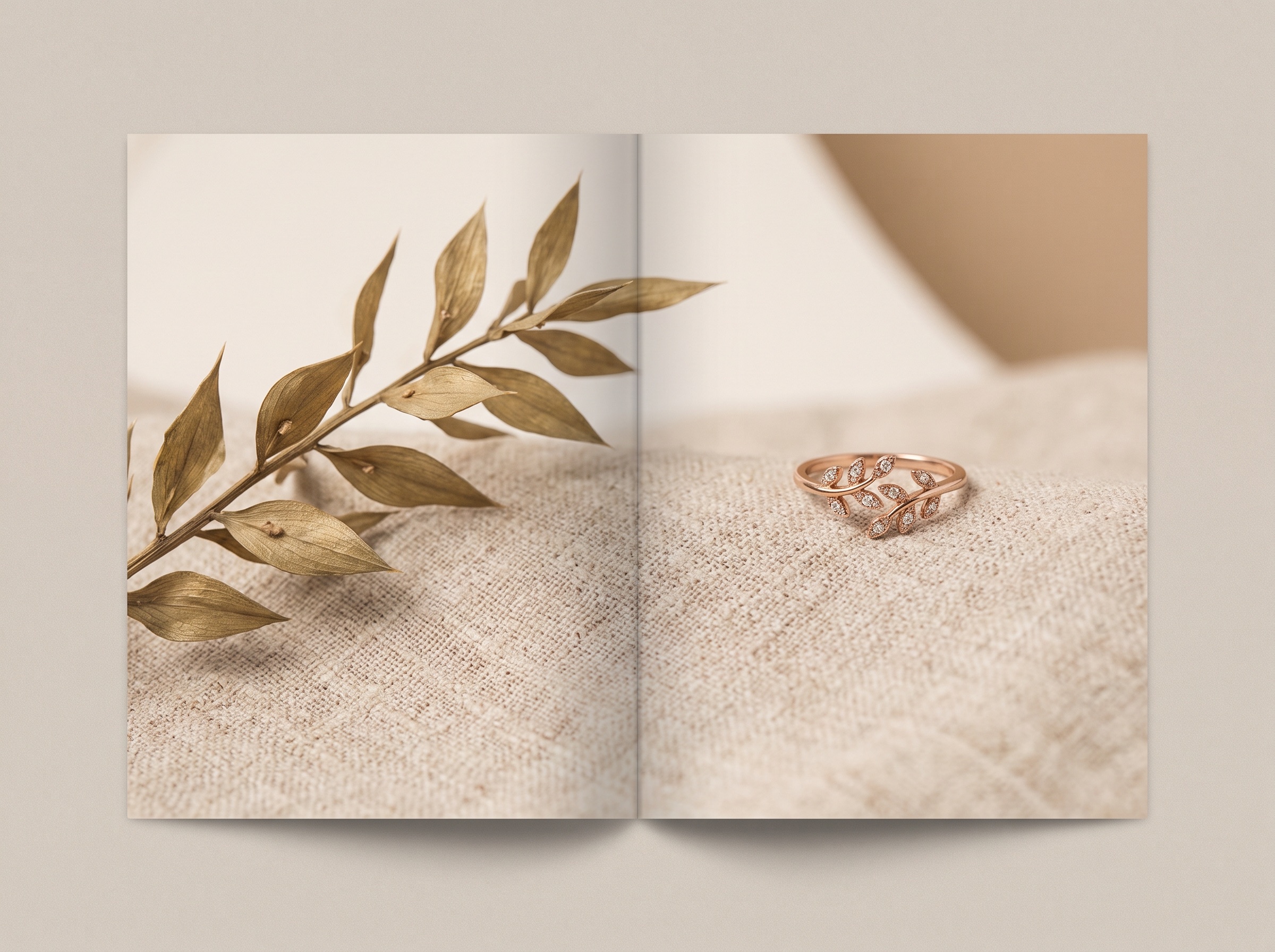
| Leaf | Side accents, band detailing | Sculpted metalwork with pavé or channel-set stones along a leaf's vein lines |
| Vine / branch | Wraparound bands, ring shoulders | Curving metal line with small accent stones set at intervals, mimicking a climbing vine |
| Twig / branch texture | Band surface texture | Hand-engraved or cast bark-like texture on the metal surface itself, often paired with an organic, asymmetric stone setting |
| Celestial (star, moon) | Accent clusters, pendant-style ring tops | Adjacent category, sometimes grouped with nature-inspired design though technically a distinct motif family |
Diamond Shapes Best Suited to Nature-Inspired Design
Certain diamond shapes lend themselves naturally to organic motifs because their outlines already echo forms found in nature:
- Marquise. The elongated, pointed-oval outline reads naturally as a petal or leaf shape, making it a frequent choice for floral cluster and leaf-motif designs.
- Pear. A teardrop silhouette works well as a single petal accent or as the terminal stone at the end of a vine-motif band.
- Oval. A softer, rounded alternative to marquise for petal-style clusters, delivering a gentler, less angular floral read.
- Round brilliant. The most versatile choice for a flower's center stone or for small pavé accents scattered along vine and branch motifs, where uniform calibrated sizing matters more than a distinctive outline.
- Fancy cuts generally. Custom or less common cuts are sometimes used for a truly bespoke botanical design, though at meaningfully higher sourcing complexity and cost than standard shapes.
Settings for Nature-Inspired Rings
- Cluster settings. Grouping several smaller stones together to form a flower head or dense botanical accent is one of the most common construction methods in this category, since it lets a design build significant visual size and floral shape without a single large center stone.
- Halo settings shaped as petals. Rather than a standard round or cushion halo, some designs shape the surrounding accent stones into a scalloped, petal-like outline around the center stone.
- Pavé for texture. Small pavé-set stones along leaf veins, vine lines, or branch textures add sparkle without disrupting the organic linework of the underlying design.
- Prong setting for single-stone leaf or petal accents. A simple prong setting works well for individual marquise or pear accent stones placed as discrete leaf or petal elements along a band.
Color Considerations in Nature-Inspired Design
While colorless and near-colorless white diamonds remain the default for most nature-inspired pieces, fancy color stones can meaningfully strengthen a botanical theme when used intentionally: a green diamond accent reads naturally as foliage within a floral cluster, and a yellow diamond center stone can evoke a flower's natural color at its core. These fancy color applications work best as deliberate, limited accents rather than throughout an entire piece, both for cost reasons and because a small, well-placed color accent typically reads as more sophisticated than an overall colored design.
Metal Choices for Nature-Inspired Pieces
Rose gold and yellow gold are the most frequently requested metals for nature-inspired design, since their warm tones align naturally with organic, botanical imagery in a way that cooler white metals don't communicate as directly. White gold and platinum remain workable choices, particularly for a more restrained or contemporary take on a nature motif, but a jeweler merchandising the category should expect warm-toned metal requests to dominate demand, especially for floral and vine designs specifically.
Nature-Inspired Design vs. Vintage-Style Sourcing
Nature-inspired motifs overlap meaningfully with vintage-style demand, since Victorian and Art Nouveau design both leaned heavily on floral, vine, and animal imagery as a defining feature of those eras specifically. The distinction that matters for sourcing is that "nature-inspired" as a category isn't tied to a specific historical period the way "vintage style" or "Art Deco" are — a nature-inspired piece can be built with an entirely contemporary design sensibility, sharp modern manufacturing tolerances, and no antique-cut stones at all, while a piece marketed specifically as Victorian-revival nature-inspired design would call for period-appropriate elements like filigree metalwork and antique diamond cuts. A jeweler should clarify which of these two directions a customer actually wants before sourcing, since the input costs and design vocabulary differ meaningfully between a modern botanical design and a period-accurate Victorian floral revival piece.
Custom CAD Work for Organic Shapes
Nature-inspired designs, particularly leaf, vine, and branch-texture pieces, rely more heavily on custom CAD modeling and hand-finishing than standard geometric ring styles, since organic curves and asymmetric botanical forms don't reduce to the standardized proportions a stock ring mounting is built around. A jeweler sourcing nature-inspired inventory at meaningful volume should expect longer design lead times and higher per-piece CAD costs than for a standard solitaire or halo build, and should factor that into both pricing and customer timeline expectations from the outset. Working with a manufacturing partner experienced specifically in organic and botanical CAD work, rather than one whose CAD library is built primarily around standard geometric mountings, meaningfully reduces revision cycles on this kind of custom order.
Merchandising Nature-Inspired Inventory
- Group by motif, not by a single generic "nature" case. Separating floral, leaf/vine, and branch-texture pieces helps customers self-select toward the specific look they're picturing, similar to how a vintage-style case benefits from era-specific grouping.
- Lead with the specific motif in display copy. "Floral cluster halo" or "vine-wrap band" communicates more to a browsing customer than "nature-inspired" alone.
- Show scale honestly. Cluster and floral designs can look larger in a photo than they read in person — clear sizing information helps set accurate customer expectations for this category specifically.
Nature-Inspired Rings Beyond Engagement
While botanical and floral motifs appear frequently in engagement ring design, the same design vocabulary works naturally across other categories: anniversary bands using a simplified vine or leaf motif, fashion rings built entirely around a floral cluster without a traditional center-stone hierarchy, and stacking rings that combine multiple simple nature motifs (a single leaf, a small flower) worn together. Building out this adjacent range gives a jeweler more ways to serve customers drawn to the aesthetic generally, not only those specifically shopping for an engagement ring.
Common Mistakes in Nature-Inspired Sourcing
- Underestimating CAD and hand-finishing time. Organic, asymmetric forms take meaningfully longer to model and finish well than standard geometric mountings — quoting standard turnaround times on a botanical custom build sets an inaccurate expectation.
- Over-relying on photography to sell scale and dimension. Cluster and floral pieces photograph differently than they read in person; clear physical measurements matter more here than for a simple solitaire.
- Treating "nature-inspired" and "vintage-style" as interchangeable. They overlap but aren't the same category — clarifying which the customer actually wants avoids sourcing the wrong stone cuts or metal palette.
- Overcrowding a single design with too many motifs. Combining floral, vine, and branch-texture elements into one piece can read as busy rather than intentional — most successful nature-inspired designs commit to one primary motif.
Pricing Nature-Inspired Pieces at Wholesale
Nature-inspired builds carry a few input costs beyond a standard contemporary ring's 4Cs-driven pricing: custom CAD design work for organic, asymmetric forms adds meaningful labor cost relative to a stock mounting, cluster settings require more individual stones (each with its own setting labor) than a single center-stone design, and hand-finishing or engraving for branch-texture surfaces adds bench time beyond a simple polished band. These input costs are worth pricing in and communicating clearly to a customer rather than applying a standard solitaire-ring cost template to a category with genuinely different, more labor-intensive production requirements.
Durability Considerations for Nature-Inspired Designs
Delicate leaf and vine motifs, particularly designs with fine, sculpted metalwork or stones set at the outer edge of an organic silhouette, can carry different daily-wear durability considerations than a standard solid-band ring. A jeweler should set accurate expectations with a customer about which specific nature-inspired design elements hold up best to daily wear versus which are better suited to occasional-wear fashion pieces, and should flag any design element (an especially thin vine section, a stone set with minimal surrounding metal for an organic look) that may need more frequent professional inspection than a standard mounting would.
Sourcing Nature-Inspired Diamonds at Wholesale
Guru Diam carries the full range of standard and fancy diamond shapes used in nature-inspired design — including marquise, pear, and oval for petal and leaf motifs — alongside fancy color stones for botanical color accents, natural diamonds, certified loose stones, and finished jewelry. Custom nature-inspired pieces are finished in 4-6 days, with CAD design, cutting, setting, and polishing all handled in-house.
Buyers can source calibrated accent stones for cluster and pavé work through matching pairs, browse fancy color accents through fancy color loose diamonds, and build a complete custom piece through custom jewelry. Certified center stones are available through the certified diamonds category. Trade accounts can review terms at the wholesale hub or apply through trade partner.
Why Nature-Inspired Demand Has Stayed Consistent
Unlike a single trend cycle tied to one design era, nature-inspired jewelry draws on an essentially permanent source of visual inspiration, which gives the category more staying power than a look tied to a specific decade's fashion. Customer interest shifts somewhat between specific motifs over time — floral clusters trending relative to vine-wrap bands in a given season, for instance — but the broader category has remained a consistent, reliable segment of bridal and fashion demand rather than a passing fad, making it a reasonable ongoing category for a jeweler to maintain rather than one to stock only opportunistically.
Talking to Customers About Nature-Inspired Design
Customers drawn to this category arrive with a wide range of specificity — some know exactly which flower or motif they want reproduced, while others simply know they're drawn to an "organic" or "botanical" look without a precise vocabulary for it. Showing a small, well-organized range of motif examples (a floral cluster, a leaf accent, a vine-wrap band) helps a less specific customer identify what they're actually picturing far more effectively than an open-ended custom design conversation starting from a blank page, and gives a jeweler a faster, more concrete starting point for the CAD process that follows.
Sourcing Botanically Accurate Reference Material
A nature-inspired design reads as convincing and intentional when it draws from accurate botanical or organic reference material rather than a generic, stylized approximation of "a flower" or "a leaf." Jewelers working with a CAD designer benefit from providing specific reference imagery — a particular flower species with a recognizable petal count and arrangement, or a specific leaf shape rather than a generic outline — since this level of specificity is what separates a design that reads as a deliberate, well-executed botanical piece from one that reads as a vague, non-specific "nature" gesture. Customers requesting a design tied to personal significance (a wedding flower, a meaningful plant) particularly benefit from this attention to botanical accuracy, since the design's emotional resonance often depends on it being recognizably tied to the specific reference rather than a generic stand-in.
Balancing Organic Design With Wearability
A central design tension in nature-inspired jewelry is balancing an organic, asymmetric aesthetic against the practical wearability expectations of a piece meant for daily use. A fully naturalistic, irregular branch or vine shape can look striking in a rendering but create real practical problems on a worn ring — an uneven band profile that sits uncomfortably, or delicate protruding elements more prone to catching or bending. Experienced designers typically introduce a degree of intentional stylization and structural reinforcement even into a highly organic-looking design, smoothing out elements that would otherwise compromise daily wearability while preserving the overall naturalistic visual impression. A jeweler should discuss this balance explicitly with a customer requesting a highly naturalistic design, since managing expectations about the gap between a fully organic concept sketch and a wearable finished piece avoids disappointment later in the process.
Nature-Inspired Motifs in Wedding and Eternity Bands
Beyond center-stone engagement ring designs, nature motifs translate readily into wedding and eternity band construction — a simplified vine pattern winding around a band, small leaf-shaped links alternating with round accent stones, or a continuous branch texture serving as the band's primary visual feature rather than a backdrop to a center stone. These band-focused applications tend to require less complex CAD work than a full floral cluster center design, since the repeating, simplified motif format lends itself to a more standardized production approach once the initial design is finalized, making nature-inspired wedding bands a somewhat more scalable wholesale category than fully custom botanical engagement rings.
Layering and Stacking Nature-Inspired Pieces
Because individual nature motifs — a single leaf, a small flower, a thin vine band — often work well as standalone minimal pieces, the category lends itself naturally to layering and stacking, where a customer combines several simple nature-themed rings or bands rather than wearing one larger statement piece. This stacking approach gives a jeweler a way to introduce customers to the nature-inspired category at a lower individual price point than a full custom botanical engagement ring, building a broader ongoing customer relationship around a growing personal collection rather than a single one-time purchase. Merchandising a curated stacking system — several simple, complementary nature-motif bands designed to be worn together — is worth considering as a lower-commitment entry point into the category alongside more elaborate custom commissions.
Seasonal and Regional Variation in Nature-Inspired Demand
Interest in specific nature-inspired motifs can shift with regional and seasonal factors more noticeably than some other jewelry categories, since the underlying imagery draws on natural forms that carry different cultural or seasonal associations depending on the market. A floral motif tied to a specific bloom associated with spring engagements may see a seasonal demand bump in that window, while vine and branch motifs tend to read as more evergreen, less tied to a specific season, across most markets. Jewelers stocking or merchandising this category benefit from tracking which specific motifs perform best with their own customer base over time rather than assuming demand is evenly distributed across every nature-inspired sub-style year-round.
Photography and Presentation for Botanical Designs
Because much of a nature-inspired piece's appeal comes from fine sculptural detail — vein lines on a leaf, the layered depth of a floral cluster — photography and in-person presentation both matter more for this category than for a simple solitaire, where the center stone alone typically carries most of the visual interest. Macro photography that captures fine metalwork detail, along with multiple angles showing how a cluster or vine design reads from the side rather than only from directly above, helps a customer browsing online form an accurate impression of a piece's actual dimensional character before an in-person viewing. Jewelers presenting nature-inspired inventory primarily through flat, single-angle product photography risk underselling exactly the design detail that makes the category worth its added production cost in the first place.
Frequently Asked Questions
What makes a diamond ring "nature-inspired"?
It's a ring designed around organic motifs from the natural world — florals, leaves, vines, branches, or occasionally celestial imagery — rather than standard geometric solitaire or halo styling. It spans a wide range of specific looks rather than one fixed design.
What diamond shapes work best for nature-inspired rings?
Marquise and pear shapes read naturally as petals or leaves due to their pointed, elongated outlines. Oval offers a softer floral read, and round brilliant is the most versatile choice for cluster centers and small pavé accents.
Is nature-inspired the same as vintage-style jewelry?
They overlap but aren't identical — Victorian and Art Nouveau design used nature motifs heavily, but "nature-inspired" as a category isn't tied to any specific historical period the way "vintage style" is. A nature-inspired piece can be built with an entirely contemporary design sensibility.
Do nature-inspired rings take longer to source or manufacture?
Often yes — organic, asymmetric forms typically require more custom CAD design and hand-finishing time than a standard geometric mounting, so buyers and customers should expect longer lead times than for a stock solitaire or halo design.
What metals work best for nature-inspired designs?
Rose gold and yellow gold are the most commonly requested, since their warm tones suit botanical and organic imagery. White gold and platinum remain workable for a more contemporary or restrained take on the same motifs.
Can fancy color diamonds be used in nature-inspired designs?
Yes — a green diamond accent can suggest foliage, and a yellow diamond center stone can echo a flower's natural color. These work best as deliberate, limited accents rather than used throughout an entire piece.
How should a jeweler price a custom nature-inspired commission?
Beyond standard 4Cs-driven diamond cost, factor in custom CAD design labor for organic, asymmetric forms, the added per-stone setting labor a cluster design requires compared to a single center stone, and any hand-finishing or engraving needed for branch-texture surfaces. Communicating these added input costs clearly to the customer upfront avoids pricing friction later in a custom commission.