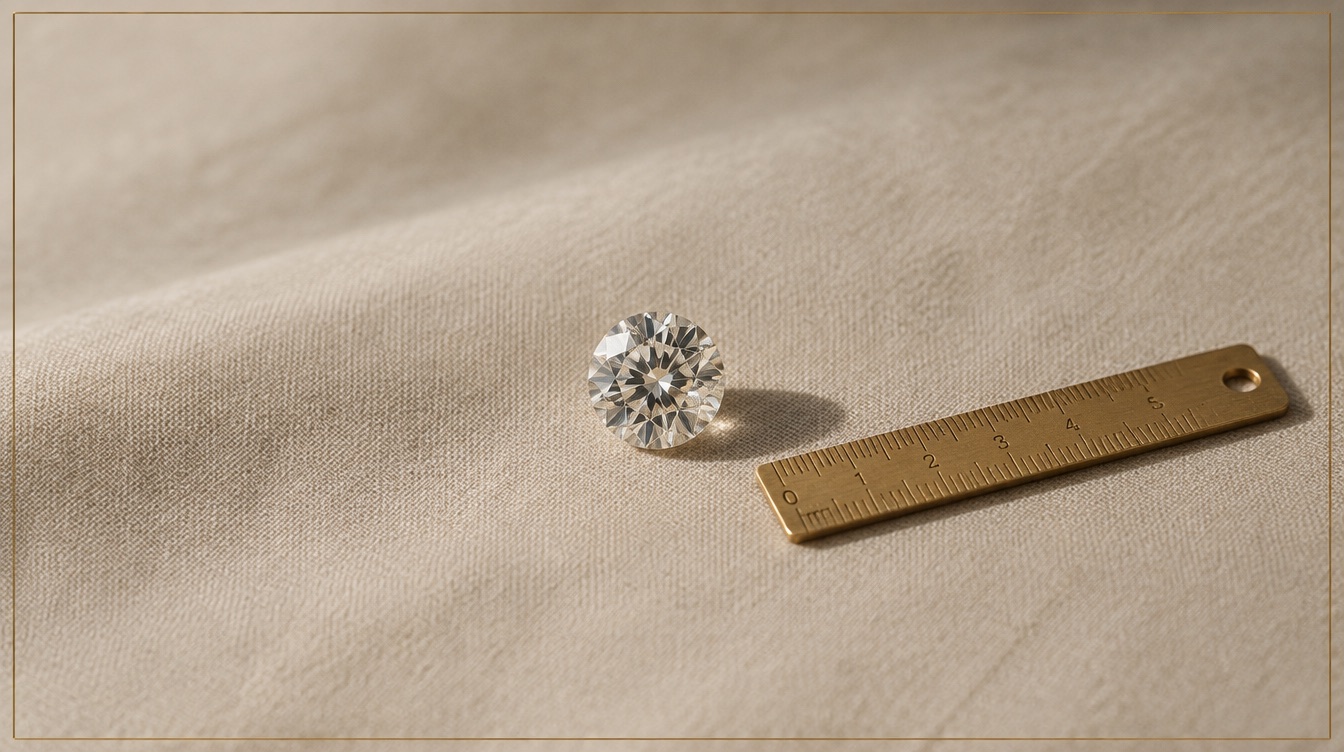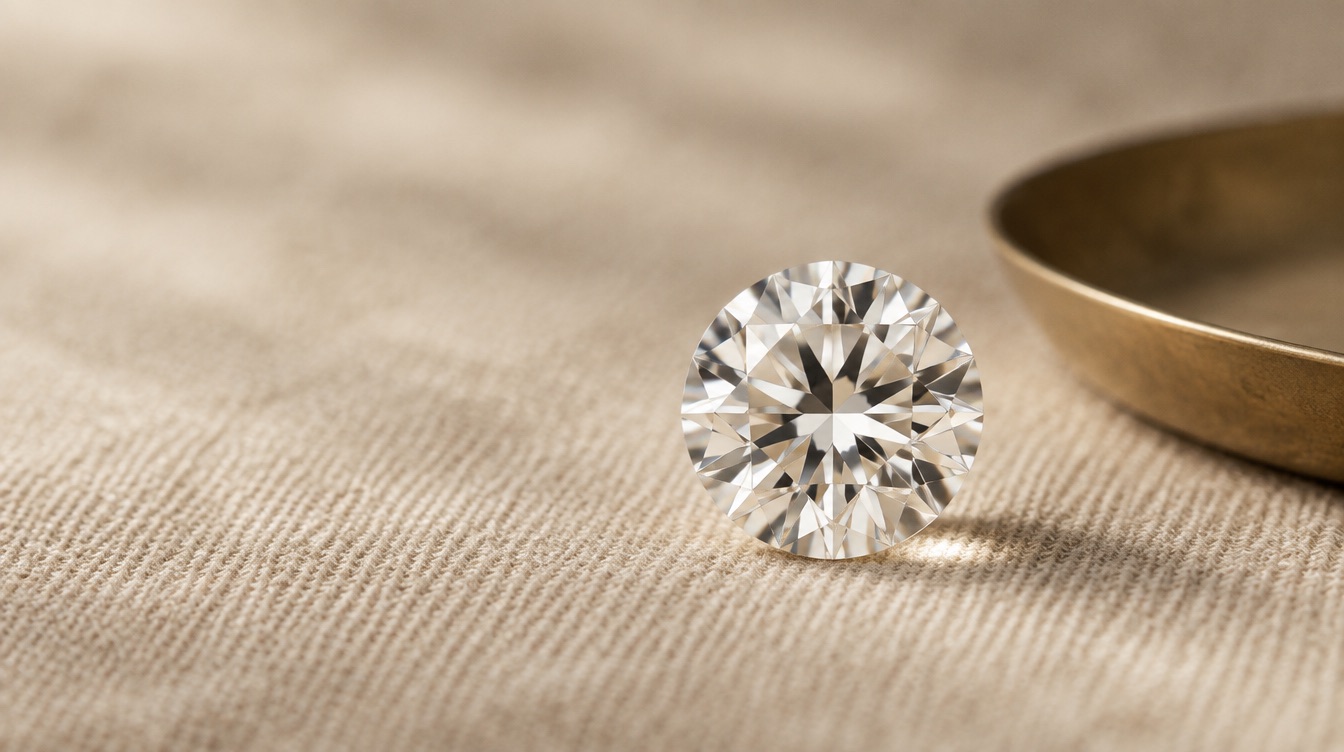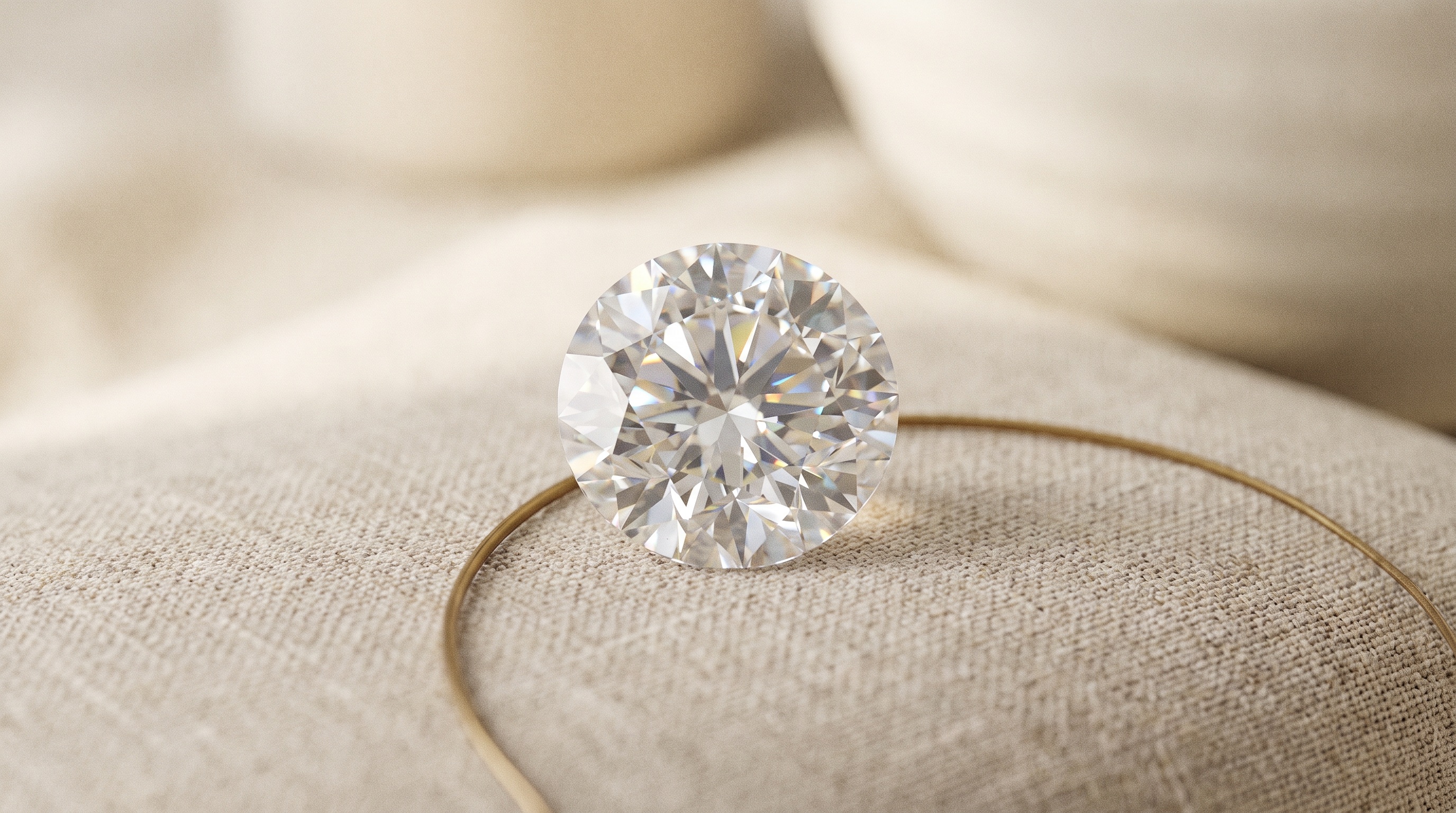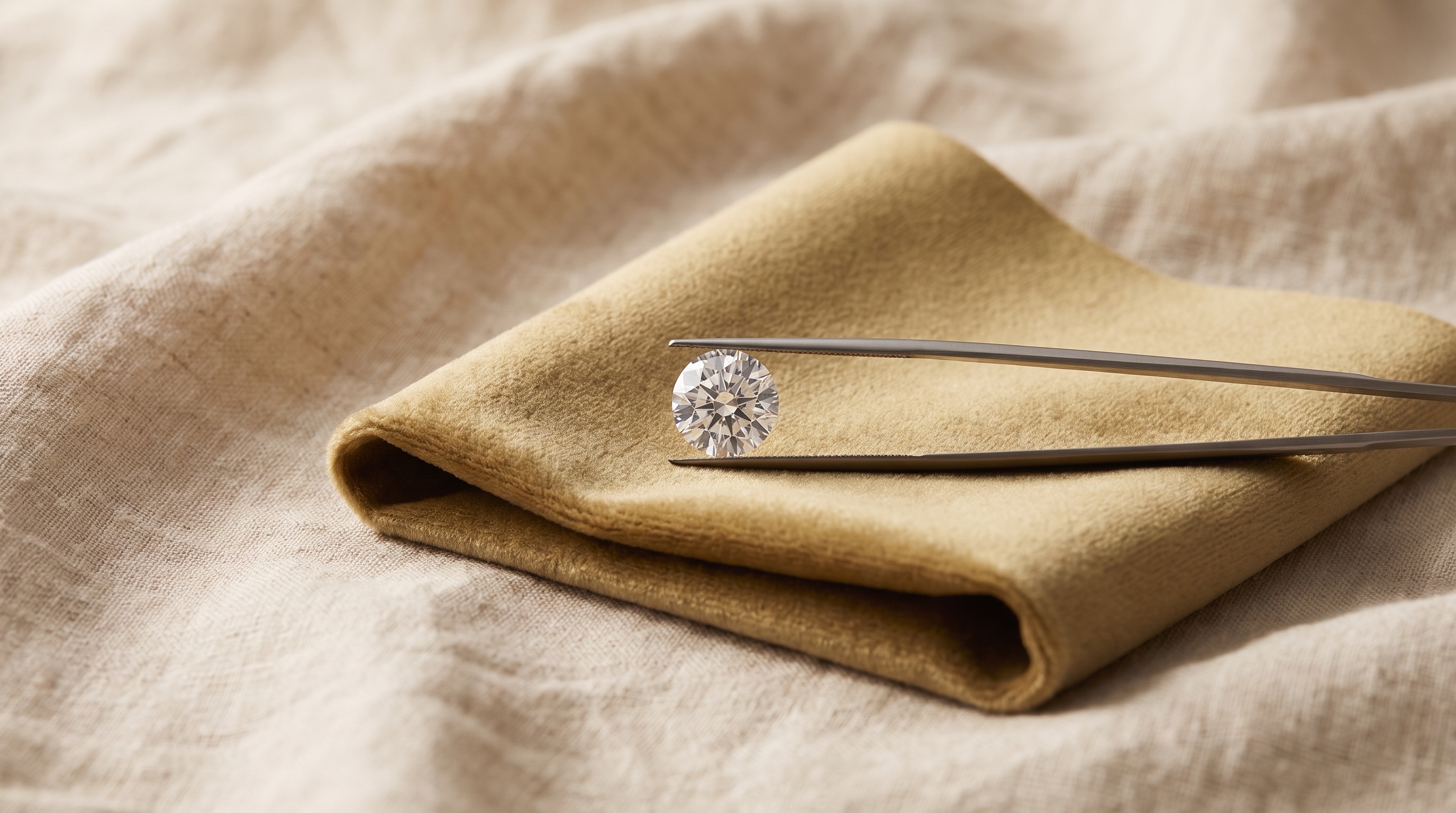
A natural round diamond is a mined diamond cut into the round brilliant shape — 57 or 58 facets arranged to maximize light return — as opposed to a round diamond grown in a lab. It is the single most common and most standardized diamond shape in the trade, and because its proportions are so well studied, round is also the shape where cut grade, certification, and price transparency matter most to a buyer's evaluation.
This guide focuses on what's specific to natural round brilliant diamonds: why round dominates natural diamond demand, how grading works differently for round than for fancy shapes, what drives natural round pricing, how that pricing compares to lab-grown round at equivalent specs, what certification looks like for round stones specifically, and how round compares to fancy natural shapes on rarity and price per carat. For general natural-diamond fundamentals — formation, provenance, and Kimberley Process sourcing — see our natural loose diamonds guide; this post stays specific to the round shape.
Why Round Brilliant Is the Most Common Natural Diamond Shape
Round brilliant accounts for the largest share of both natural and lab-grown diamond demand, and for natural stones specifically that dominance has a long history behind it. The modern round brilliant cutting pattern — refined over the 20th century into the standardized proportions used today — was developed specifically to maximize a round diamond's light return, giving it the most consistent, most studied light-performance profile of any shape. Because natural rough diamond most commonly forms as an octahedral crystal, a shape that lends itself reasonably efficiently to a round brilliant cut, cutters have historically had a steady, predictable supply of rough suited to round — unlike some fancy shapes, where rough suitability is more variable and cutting decisions depend more heavily on the specific piece in hand. That combination of deep buyer familiarity, standardized light performance, and consistent rough supply is why round remains the default shape most buyers reach for first, and why it carries the deepest, most liquid natural inventory of any single shape in the wholesale market.
Natural Round Diamond Grading: Why Cut Grade Matters Most Here
All natural diamonds are graded on the 4Cs — carat, cut, color, clarity — but round brilliant is the one shape where cut grade carries outsized weight in the evaluation, for a structural reason specific to the shape. GIA assigns an overall cut grade (Excellent, Very Good, Good, Fair, Poor) to round brilliant diamonds, evaluating proportions, symmetry, and polish together against a standardized model of how those proportions affect brightness, fire, and scintillation. Fancy shapes — oval, marquise, pear, cushion, and the rest — do not receive this same overall cut grade from GIA, because their proportions vary too widely by design intent for a single standardized model to apply. Round is the exception precisely because its proportions are so consistent across the market that a standardized cut-grade model works reliably for it. Practically, this means a round brilliant's certificate tells a buyer more about the stone's actual light performance, sight unseen, than a fancy-shape certificate can — a real advantage for wholesale buying at volume, where physically viewing every stone before purchase isn't always practical.
GIA Cut Grades for Round Brilliant: What Each Tier Means
| Cut Grade | What It Reflects | Typical Wholesale Use |
|---|---|---|
| Excellent | Proportions, symmetry, and polish optimized for maximum brightness, fire, and scintillation | Standard target for center stones, especially in D-H color where light performance is most visible |
| Very Good | Strong light performance with only minor proportion deviation from ideal | Common, value-conscious choice — visually very close to Excellent at a lower price point |
| Good | Noticeably more light leakage than Very Good; still a legitimately cut, sellable stone | Budget tier, best suited to smaller stones or accent placements where light performance is less critical |
| Fair / Poor | Significant proportion issues that visibly reduce brightness and fire | Rarely stocked for retail resale; mostly relevant in recut or repair contexts |
Because round is the shape GIA grades this way, a buyer sourcing natural round diamonds can filter directly on cut grade with confidence that the label reflects actual, standardized light-performance criteria — a level of certainty that simply isn't available when sourcing fancy natural shapes, where cut quality has to be assessed stone by stone instead.
Color and Clarity Considerations Specific to Round
Round brilliant's faceting pattern is the most efficient at both showing off a stone's brilliance and masking faint body color, which shifts how buyers typically approach color grading on round compared to a step-cut or elongated shape. A natural round diamond in the G-H range often reads close to colorless face-up because the brilliant-cut facets scatter light in a way that obscures faint tint more effectively than a shape with larger, more open facets. That gives round buyers a bit more flexibility to source slightly lower on the color scale without a visible tradeoff — a meaningful cost lever at wholesale volume. Clarity works similarly: round's small, numerous facets are good at hiding minor inclusions, so an SI1 or SI2 natural round stone frequently faces up eye-clean, whereas the same clarity grade in a shape with larger open facet planes is more likely to show an inclusion visibly. Buyers sourcing natural round inventory at scale should weigh this facet-masking effect directly against certificate grade rather than assuming grade alone dictates visual quality.
What Drives Natural Round Diamond Pricing
Natural round pricing follows the standard 4Cs framework, but because round is the deepest, most standardized, most actively traded shape in the market, it's also the shape with the most transparent, most closely tracked pricing of any natural diamond category — trade price lists for natural round diamonds are published and updated more frequently, and with tighter quote-to-quote consistency, than for any fancy shape. That transparency is a double-edged reality for wholesale buyers: it makes round pricing easy to benchmark and negotiate against a known baseline, but it also means round carries comparatively thinner margin opportunity than a fancy or antique shape does, since every buyer in the market is working from roughly the same reference pricing. Carat weight remains the single largest price driver, with the well-known jump at whole and half-carat thresholds (a 0.99ct stone pricing meaningfully below a 1.00ct stone of otherwise identical grade) applying to round more predictably than to any other shape, since round demand concentrates so heavily around round-number carat weights for engagement center stones specifically.
Natural vs. Lab-Grown Round: Where the Price Gap Is Widest
Round is the single shape where the natural-versus-lab-grown price gap is most visible and most frequently quoted, precisely because it's the most commoditized, most price-transparent shape on both sides of the natural/lab-grown divide. A buyer can compare a natural round diamond against a CVD lab-grown round at genuinely matched carat, color, and clarity more directly than with almost any fancy shape, where proportion variation between individual stones makes an apples-to-apples comparison harder to pin down.
| Carat Tier | Natural Round (approx. price/ct range, G-H, VS-SI) | CVD Lab-Grown Round (approx. price/ct range, same specs) |
|---|---|---|
| 0.50ct | Moderate premium over lab-grown; steady, deep supply | Substantially lower per carat; broad, consistent availability |
| 1.00ct | Clear step up at the whole-carat threshold; still well-stocked | Lower per carat, with the same whole-carat pricing jump present but far less pronounced |
| 2.00ct | Meaningfully higher per carat; supply thins compared to sub-1ct tiers | Lower per carat than natural at this size, with production able to scale to meet demand |
| 3.00ct+ | Premium widens further; increasingly sourced to order rather than pulled from open stock | Still notably lower per carat than natural at this tier, though absolute prices rise with size on both sides |
The gap widens, rather than narrows, as carat weight climbs — natural round supply at larger sizes is fundamentally limited by what mining actually produces, while lab-grown production can be steered toward larger carat weights more readily. For a buyer stocking both categories, round is usually the clearest, easiest shape to explain that price differential to a retail customer, since the two stones being compared are genuinely alike in every dimension except origin — a much cleaner comparison than trying to explain the same gap across a fancy shape where proportion differences complicate the picture.
Certification for Natural Round Diamonds: GIA, IGI, GCAL
Natural round diamonds at 0.30ct and above should carry independent certification from GIA, IGI, or GCAL, documenting carat weight, the standardized cut grade discussed above, color, clarity, and a clarity plot mapping the stone's specific inclusions, along with disclosure of any treatment. Because round is the one shape where the certificate's cut grade genuinely substitutes for in-person visual assessment of light performance, certification carries somewhat more practical weight for round than it does for fancy shapes, where a buyer typically wants direct or video viewing regardless of what the certificate says about proportions. That doesn't mean skipping visual review on round stones is advisable — polish and symmetry notations, fluorescence, and specific inclusion location still matter — but a well-certified natural round stone is closer to a reliable sight-unseen purchase than almost any other shape in the catalog, which is part of why round remains the easiest shape to source at volume for a trade buyer working from certificate data alone.
Sourcing and Supply Chain for Natural Round Diamonds
Round brilliant's deep, consistent global supply means sourcing natural round inventory at wholesale is generally more straightforward than sourcing fancy or antique shapes, where rough suitability and cutter specialization narrow the pool of available stock. Most natural round diamonds move through a cutting and polishing stage before reaching final grading and distribution — at Guru Diam, that cutting and polishing happens in India before the finished stones are graded and shipped from our New York and Los Angeles locations, a standard part of how natural round supply moves through the trade. For a wholesale buyer, the practical sourcing question isn't really about availability of round stock itself, which is broad, but about supplier consistency: whether a given supplier can deliver the same cut-grade and color/clarity combination reliably across repeat orders, since round is often the shape a retailer reorders most frequently against a standing spec.
This reorder pattern is worth planning around directly. A retailer that sells engagement rings, for instance, tends to move through natural round center stones in a narrower band of specs (commonly G-H color, VS-SI clarity, 0.90-1.50ct) far more often than any single fancy-shape spec, which makes round the shape where a consistent, dependable reorder relationship with a single supplier pays off the most over time. A supplier who can quote the same spec combination reliably, order after order, without meaningful drift in cut quality or color consistency, is a more valuable sourcing relationship for round specifically than for a shape purchased more occasionally.
Natural Round vs. Fancy Natural Shapes: Price-per-Carat and Rarity
Because round is the deepest and most standardized shape in natural diamond supply, it typically prices lower per carat than most fancy natural shapes at comparable color and clarity — a counterintuitive point for buyers used to thinking of round as the "default," presumably higher-demand, choice. Round rough yield from a typical octahedral crystal is well understood and consistently plannable, which keeps round supply deep relative to demand even though demand itself is high. Fancy shapes like marquise, pear, and oval, by contrast, depend more on the specific shape of the rough a cutter has in hand, which constrains supply in a way that pushes per-carat pricing higher for a given grade, particularly at larger sizes. Antique cuts — Old Mine, Old European, Kite, Hexagonal — sit at the far end of this spectrum: genuinely rarer in natural stock, often recut from period rough or custom-cut to order, and priced accordingly above both round and standard fancy shapes. For a buyer weighing shape strategy, round remains the most reliably available, most price-competitive natural option at any given grade — the tradeoff is that round also carries the least differentiation, since every wholesale supplier in the market has ready access to natural round stock at broadly similar pricing.
Carat Tiers and Availability for Natural Round
- Under 1 carat. The deepest, most liquid tier of the natural round market — broad availability across every color, clarity, and cut-grade combination, and the tier where round's price advantage over fancy shapes is most pronounced.
- 1-2 carats. Still a well-stocked, standard trade tier and the range covering the bulk of natural round center-stone demand for engagement rings specifically, given how strongly demand concentrates around the 1.00ct threshold.
- 2-3 carats. Supply thins noticeably compared to sub-2ct tiers, and buyers should expect a wider quote-to-quote price range even within round, historically the shape with the tightest pricing consistency.
- 3 carats and above. Increasingly a to-order tier rather than open stock, with individual stone pricing driven by the specific color/clarity combination rather than a standard per-carat rate — though even at this tier, round remains more consistently available than most fancy natural shapes of equivalent size.
Matching and Pairing Natural Round Diamonds
Round's standardized proportions make it the easiest natural shape to source in visually matched sets — for stud earrings, a three-stone ring's side stones, or a symmetrical pavé layout — since two natural round stones of the same carat, color, and clarity grade will read as far more consistent to the eye than two fancy-shape stones at the same nominal grades, where proportion variation between individual pieces of rough can produce a visibly different look even at matching certificate numbers. This is one of round's clearest practical advantages for a trade buyer building matched-pair or multi-stone programs: less hand-matching effort, faster turnaround, and lower risk of a visibly mismatched pair reaching a finished piece.
Common Mistakes When Sourcing Natural Round Diamonds
- Treating cut grade as optional. Because round is the one shape with a reliable, standardized GIA cut grade, skipping it in favor of color and clarity alone wastes the single most useful data point the certificate provides for this specific shape.
- Ignoring the whole-carat pricing jump. A 0.90-0.98ct natural round stone can offer meaningfully better value than a 1.00ct stone of the same underlying grade, since the price step at the round-number threshold reflects demand concentration, not a proportional quality difference.
- Assuming natural round pricing is negotiable the way fancy-shape pricing sometimes is. Round's price transparency across the trade means quotes cluster tightly — a supplier quoting well outside the visible market range on round specifically is worth double-checking rather than assuming a genuine bargain.
- Skipping fluorescence and symmetry review because the cut grade looks good. A strong overall cut grade doesn't fully capture fluorescence haze or minor symmetry issues — both still worth checking directly on the certificate.
- Underestimating how much supply thins above 3 carats. Even though round is the deepest shape overall, buyers sourcing larger natural round center stones should still expect longer lead times than sub-2ct sourcing implies.
Sourcing Natural Round Diamonds Through Guru Diam
Guru Diam is a trade-only wholesale diamond supplier with locations in New York and Los Angeles, carrying natural round diamonds alongside our CVD lab-grown catalog, calibrated melee, and finished jewelry, across every standard, antique, and exotic shape — never positioned as a lab-grown-only manufacturer. Natural round inventory ships with full grading documentation from IGI, GIA, or GCAL, and in-stock natural round stones are ready to ship, not made to order — orders placed before 6pm EST out of New York or 4pm PST out of Los Angeles go out same-day. For buyers building matched-pair or multi-stone programs around natural round center or accent stones, our team works directly on sourcing consistent cut-grade and color/clarity combinations across repeat orders. Custom pieces built around a natural round center stone are finished in 4-6 days once a design is approved. Browse certified natural round inventory through certified diamonds, source matched sets through matching pairs, compare against natural fancy color options through fancy color loose diamonds, review trade terms at the wholesale hub, apply through trade partner, or start a custom design through custom jewelry.
Frequently Asked Questions
What is a natural round diamond?
A natural round diamond is a mined diamond cut into the round brilliant shape — typically 57 or 58 facets designed to maximize light return — as opposed to a round diamond grown in a lab via CVD. The two are chemically and visually identical at equivalent grade; what differs is origin, rarity, and price.
Why is round the most common natural diamond shape?
Natural rough diamond most commonly forms as an octahedral crystal, which lends itself efficiently to a round brilliant cut, giving cutters a steady, predictable rough supply for round. Combined with round's standardized light performance and deep buyer familiarity, this has made round the default, most heavily stocked shape across the natural diamond trade.
Does cut grade matter more for natural round diamonds than other shapes?
Yes. GIA assigns an overall cut grade (Excellent through Poor) to round brilliant diamonds specifically, based on a standardized model of proportions, symmetry, and polish — something it doesn't do for fancy shapes like oval or marquise, where proportions vary too widely for one standard to apply. That makes cut grade a more reliable, sight-unseen data point for round than for any other shape.
Is natural round more expensive than lab-grown round at the same specs?
Yes, and the gap is typically the widest and easiest to observe of any shape, since round is the most price-transparent, most commoditized shape on both the natural and lab-grown sides. The gap widens further at larger carat weights, where natural supply thins while lab-grown production can scale more readily.
What certification should a natural round diamond have?
Natural round diamonds at 0.30ct and above should carry independent certification from GIA, IGI, or GCAL, documenting carat, the standardized cut grade, color, clarity, and a clarity plot, along with any treatment disclosure. Report numbers should be verifiable directly through the issuing lab.
Why does the 1.00 carat mark affect natural round diamond pricing so much?
Buyer demand concentrates heavily around round-number carat weights, particularly 1.00ct, for engagement center stones. That demand concentration creates a price step at the threshold — a 0.90-0.98ct natural round stone often offers better relative value than a 1.00ct stone of the same underlying grade.