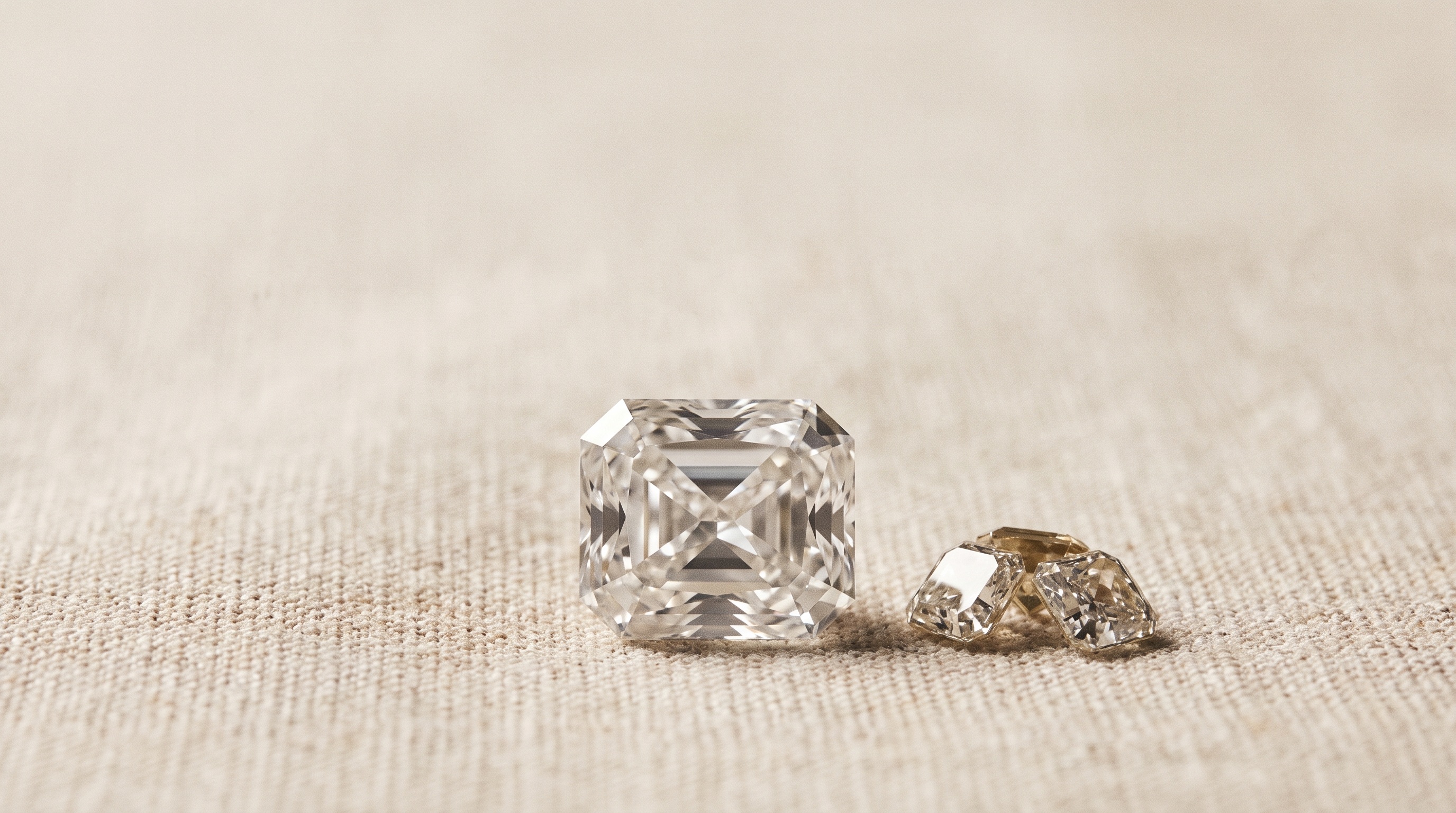
A natural radiant cut diamond is a mined diamond cut into a cropped-corner rectangular or square shape that combines step-cut facets along the crown with a full brilliant-cut faceting pattern underneath — a hybrid structure designed to deliver more fire and sparkle than a pure step cut while keeping the clean, geometric outline of a rectangular stone. It sits in the regular-fancy cut tier alongside emerald, asscher, cushion, oval, pear, marquise, princess, and heart shapes, distinct from the antique-cut category that includes old mine, old European, and hexagonal cuts.
For buyers evaluating radiant against its closest rectangular and square relatives — or weighing a natural radiant stone against a lab-grown one — this guide covers the shape's facet structure, how it compares to emerald, asscher, princess, and cushion cuts, why trade buyers reach for natural radiant specifically, natural-versus-lab-grown pricing and availability dynamics, certification standards, and what to check when sourcing natural radiant inventory at wholesale.
What Is a Radiant Cut Diamond?
The radiant cut was developed in the early 1980s by diamond cutter Henry Grossbard, who set out to solve a specific problem: step-cut shapes like emerald and asscher show off a stone's clarity and color beautifully through their broad, mirror-like facets, but that same open facet structure does relatively little to scatter light into fire and scintillation. Grossbard's solution was to keep the rectangular or square outline and trimmed corners associated with step cuts, but rebuild the facet arrangement underneath using a brilliant-cut pattern — the same triangular and kite-shaped facet logic used in round brilliant cutting, adapted to a rectangular or square footprint.
The result is a cut that reads, at a glance, like a cropped-corner rectangle or square, but that sparkles noticeably more than a true step cut when it moves under light. This dual identity — step-cut silhouette, brilliant-cut interior — is the single defining characteristic of the radiant cut, and it's the reason the shape is often described in trade literature as a hybrid cut rather than belonging cleanly to either the step-cut or brilliant-cut family.
The Anatomy of a Radiant Cut: Crown, Pavilion, and Corner Facets
A radiant cut typically carries around 70 facets, considerably more than an emerald or asscher cut's step-cut arrangement, which is the structural reason it produces more brilliance. The crown (the upper portion of the stone, above the girdle) uses a brilliant-style faceting pattern rather than the long, parallel step-cut facets seen on an emerald or asscher. The pavilion (the lower portion, below the girdle) follows the same brilliant-cut logic, with facets angled to maximize light return back up through the crown rather than the flat, mirror-like planes a step cut uses to showcase clarity.
The cropped corners — trimmed at roughly 45 degrees on a rectangular or square outline — serve a practical purpose beyond aesthetics. Trimming the corners removes the most vulnerable points on a rectangular stone, points that would otherwise be prone to chipping in daily wear, and this is one of the reasons radiant is generally considered a more durable everyday-wear shape than a sharp-cornered rectangular or square cut. Radiant is cut in both rectangular and square outlines, with the more elongated rectangular version sometimes marketed separately and the square version occasionally blurring into cushion-cut territory depending on the specific proportions and corner treatment a given cutter uses.
How Radiant Compares to Similar Cuts
Radiant is most often compared against the other rectangular and square shapes buyers consider for a similar silhouette. Each comparison below focuses on the specific structural and visual difference that matters most for a sourcing or design decision.
Radiant vs. Emerald Cut
Emerald is a pure step cut — long, parallel facets running the length of the stone, cropped corners, and an open table that shows off color and clarity clearly, sometimes described as a "hall of mirrors" effect. Radiant shares the cropped-corner rectangular outline but replaces the step-cut interior with brilliant-cut faceting, trading some of that clarity-forward transparency for meaningfully more fire and scintillation. A buyer who wants the elongated rectangular look but more sparkle typically moves from emerald toward radiant; a buyer who prioritizes a clean, high-clarity, understated look typically stays with emerald.
Radiant vs. Asscher Cut
Asscher is essentially a square-outline step cut with a distinctive stepped, almost octagonal-reading silhouette from the trimmed corners and a higher crown than emerald. Like emerald, it's clarity-forward rather than fire-forward. Radiant's square variant sits closest to asscher in overall outline but, again, swaps the step-cut interior for brilliant faceting — the square radiant will show noticeably more sparkle in motion than a square asscher, at some cost to the crisp geometric "hall of mirrors" look asscher buyers specifically seek out.
Radiant vs. Princess Cut
Princess is a square brilliant cut with sharp, uncropped corners and an inverted pyramid pavilion, and it's the shape radiant is most frequently confused with by buyers who haven't seen both side by side. The clearest distinguishing feature is the corners: princess corners are sharp points, while radiant corners are trimmed. That difference matters practically — princess corners are the most vulnerable point on any commonly cut diamond shape and require protective prong settings, while radiant's cropped corners are inherently more chip-resistant. Princess also tends to show a slightly more graphic, faceted-square look, while radiant's step-cut corner trim softens the outline.
Radiant vs. Cushion Cut
Cushion is a square or rectangular cut with rounded corners and a "pillow" outline, historically descended from the old mine cut and built around a brilliant facet pattern with a softer, more romantic look than radiant's crisper geometry. The corner treatment is the key visual difference: cushion corners are rounded, radiant corners are trimmed at an angle. Cushion also tends to run in a broader range of facet-pattern variations (including modified and crushed-ice styles) than radiant, which is cut to a more standardized brilliant pattern. Buyers choosing between the two are usually weighing cushion's softer, vintage-adjacent look against radiant's cleaner, more architectural lines.
Radiant, Emerald, Asscher, and Cushion at a Glance
| Factor | Radiant | Emerald | Asscher | Cushion |
|---|---|---|---|---|
| Facet style | Brilliant-cut (crown & pavilion), ~70 facets | Step-cut, long parallel facets | Step-cut, square with cropped corners | Brilliant-cut, softer facet pattern |
| Corner treatment | Cropped at an angle | Cropped at an angle | Cropped at an angle | Rounded |
| Typical outline | Rectangular or square | Rectangular | Square | Square or rectangular ("pillow") |
| Light performance priority | Fire and scintillation | Clarity and color display | Clarity and color display | Fire and scintillation, softer look |
| Inclusion visibility | Moderate — facets help mask some inclusions | High — open table shows inclusions clearly | High — open table shows inclusions clearly | Moderate to low, depending on facet pattern |
| Cut tier (Guru Diam taxonomy) | Regular fancy | Regular fancy | Regular fancy | Regular fancy |
Why Buyers Choose Natural Radiant Specifically
Radiant's core appeal in the trade is that it splits the difference between two buyer priorities that usually pull in opposite directions. A buyer drawn to emerald or asscher for their rectangular or square outline, but who finds a pure step cut too subdued or too clarity-demanding for a given budget, often lands on radiant as a middle path: the same general silhouette, considerably more brilliance, and — because the brilliant facet pattern helps mask small inclusions more effectively than a step cut's open table does — somewhat more forgiving clarity requirements at a given price point.
On the natural side specifically, this matters in a practical way. A step-cut natural diamond with any visible inclusion in the table area is immediately noticeable, which pushes buyers toward higher, more expensive clarity grades to get a clean look. A natural radiant stone's brilliant faceting breaks up the light path more, which can let a buyer work with a slightly lower clarity grade — SI1 or SI2, for example — and still get a face-up clean stone, a real practical advantage when sourcing natural inventory against a budget. This is a qualitative sourcing consideration, not a guarantee that applies to every individual stone; inclusion type, size, and position still matter more than clarity grade alone.
Cut Tier Classification: Radiant Is a Regular Fancy Cut
It's worth being precise about where radiant sits in the broader diamond-cut hierarchy, because the terminology gets used loosely in consumer content. Radiant is a modern cut, developed in the 1980s, and it belongs in the regular-fancy tier alongside emerald, asscher, cushion, oval, pear, marquise, princess, and heart — all mainstream, mid-market shapes that make up the bulk of everyday bridal and fashion demand. It is not an antique cut. Antique-style cuts — old mine, old European, hexagonal, moval, lozenge, kite, trillion, criss-cut, and padparadscha among them — are a separate category defined by historical faceting styles, generally hand-cut or cut to replicate pre-modern proportions, and priced and positioned differently in the trade than regular fancy shapes like radiant. A buyer sourcing radiant should expect regular-fancy pricing and availability dynamics, not the premium, harder-to-source positioning that applies to true antique cuts.
Natural vs. Lab-Grown Radiant: Rarity, Pricing, and Availability
Radiant is cut in both natural and lab-grown (CVD) material, and the underlying difference between the two comes down to origin rather than any difference in the cutting process itself — the same faceting logic applies whether the rough started as mined crystal or was grown in a lab. Natural radiant rough is subject to the same mining-output and rough-yield constraints that affect any natural fancy shape: a cutter working a piece of natural rough weighs radiant against other possible outcomes for that specific piece, so natural radiant availability at any given moment reflects both current mining supply and individual cutting decisions, rather than being a fixed, predictable share of total output.
Lab-grown radiant, by contrast, is grown to a planned outcome from the outset, which generally makes size, color, and clarity combinations more predictable and repeatable to source in volume. The practical result for buyers: natural radiant carries meaningfully higher per-carat pricing than comparable lab-grown radiant, reflecting natural rarity and the rough-yield variability described above, and natural radiant sourcing — particularly for larger stones, unusual color-clarity combinations, or matched pairs — should generally be expected to take more lead time and quote-to-quote variation than lab-grown sourcing does. Neither of these is a fixed number; they're sourcing realities a buyer should plan around rather than precise figures to quote to a client.
Certification Considerations for Natural Radiant Diamonds
For natural radiant diamonds at 0.30ct and above, independent certification from IGI, GIA, or GCAL is standard trade practice, documenting carat weight, color, clarity, measurements, and any comments on treatment. As with other fancy shapes, GIA does not assign an overall cut grade (Excellent through Poor) to radiant the way it does for round brilliant, so a certificate alone doesn't fully capture how well a given radiant stone has been proportioned or how its facets are performing. Buyers should look at the stone's actual measurements and length-to-width ratio relative to their design intent, and ideally view the stone in person or via detailed video to judge brilliance and any bow-tie effect (a shadow that can appear across the table on elongated brilliant-style cuts) directly, rather than relying on certificate numbers alone.
Treatment disclosure matters here as it does on any natural diamond — confirm directly and in writing whether a stone has been laser drilled or fracture filled, and don't assume clean origin from grade alone.
Color and Clarity Nuances Specific to Radiant Cut
Because radiant's brilliant facet pattern breaks up light more than a step cut's open table does, it tends to mask both faint body color and small inclusions somewhat more effectively than emerald or asscher at the same nominal grade — a genuine practical advantage for buyers sourcing against a budget, and part of why radiant appeals to buyers who like the rectangular or square silhouette but don't want to pay step-cut-level premiums for top color and clarity. That said, radiant still shows color and inclusions more readily than a small, tightly faceted shape would, and buyers targeting white-metal settings typically still favor G-H or better for a clean look, with I-J and below remaining a reasonable, budget-conscious option for warmer-toned gold mountings. On clarity, SI1 and SI2 natural radiant stones frequently face up clean depending on inclusion type and position, but as with any fancy shape, inclusion location relative to the corners and center of the table matters more than the grade alone — a small inclusion tucked near a cropped corner is generally less visually disruptive than the same inclusion sitting centrally under the table.
Sourcing Natural Radiant Diamonds at Wholesale: What to Check
- Length-to-width ratio for the intended outline. Radiant is cut in both square and rectangular proportions — confirm the specific ratio against the design before committing, since "radiant" alone doesn't specify square versus elongated.
- Certification and treatment disclosure. IGI, GIA, or GCAL certification should be standard for any natural radiant stone at 0.30ct or above, with treatment status confirmed in writing.
- Visual confirmation of cut quality. Given the lack of a formal GIA cut grade for fancy shapes, request in-person or video review to assess brilliance, symmetry, and any bow-tie effect directly.
- Realistic lead times for larger stones or matched pairs. Natural radiant availability depends on mining output and cutting decisions on a given batch of rough, so buyers working toward a deadline — particularly for matched side-stone pairs — should build in extra sourcing time compared to lab-grown stock.
- Inclusion location, not just clarity grade. As covered above, position relative to the corners and table center affects visibility more than the grade number alone.
Setting and Styling Pairings for Radiant Cut Diamonds
Radiant's clean, geometric outline and strong brilliance make it a versatile center stone across a range of setting styles. A classic four-prong solitaire lets the cut speak for itself and is the most common choice for a radiant engagement ring, with the cropped corners typically covered by the prong tips for additional protection during daily wear. Halo settings — a ring of smaller accent stones surrounding the center radiant — add perceived size and additional sparkle that complements rather than competes with the center stone's own brilliance, a pairing that works particularly well with slightly lower color grades since the halo's white accent stones create a brightening effect around the center.
Three-stone designs pairing a radiant center with trapezoid or baguette side stones echo the center stone's geometric lines, while a plain, low-profile bezel or cathedral setting suits buyers who want a more minimalist, everyday-wear-friendly mounting. Radiant also pairs well as a side stone itself, in matched pairs flanking a round or oval center in a three-stone ring, or as calibrated accents in a fancy-shape halo — sourcing considerations for that kind of matched-pair work generally track the same natural-versus-lab-grown availability dynamics covered above, with natural matched pairs requiring more careful hand-matching for color, clarity, and proportion than lab-grown accent stones typically do.
Sourcing Natural Radiant Diamonds at Guru Diam
Guru Diam is a trade-only wholesale diamond supplier with locations in New York and Los Angeles, carrying natural radiant diamonds alongside its CVD lab-grown catalog, calibrated melee, and finished jewelry, across every standard, antique, and exotic shape. Natural radiant loose stones at 0.30ct and above ship certified — IGI, GIA, or GCAL, buyer's choice — and in-stock inventory goes out same-day, before 6pm EST from New York or before 4pm PST from Los Angeles, listed as IN STOCK NOW and READY TO SHIP rather than held to a build timeline. Our team works directly with trade accounts on matched natural radiant pairs for side-stone and three-stone designs, including advising on realistic sourcing windows when a specific length-to-width ratio, color, or clarity combination isn't already sitting in current stock. Custom pieces built around a natural radiant center stone are finished in 4-6 days once a design is approved. Browse certified natural radiant inventory through certified diamonds, source matched side-stone pairs through matching pairs, review fancy color loose stones alongside white radiant options at fancy color loose diamonds, or start a custom setting build at custom jewelry. Trade accounts can review wholesale terms at the wholesale hub or apply directly through trade partner.
Frequently Asked Questions
What is a natural radiant cut diamond?
A natural radiant cut diamond is a mined diamond cut into a cropped-corner rectangular or square shape that combines a step-cut-style outline with a full brilliant-cut faceting pattern on the crown and pavilion. It's designed to deliver more fire and scintillation than pure step cuts like emerald or asscher while keeping a similar geometric silhouette.
Is radiant cut an antique diamond cut?
No. Radiant is a modern cut developed in the early 1980s and belongs in the regular-fancy cut tier alongside shapes like emerald, asscher, cushion, oval, pear, marquise, princess, and heart. True antique-style cuts — old mine, old European, hexagonal, kite, trillion, and similar — are a separate, distinct category.
What's the difference between radiant and princess cut?
The clearest difference is the corners: princess is a square brilliant cut with sharp, uncropped corners, while radiant has corners trimmed at an angle. That trim makes radiant more chip-resistant in daily wear than princess, whose sharp points are the most vulnerable spot on the stone and typically need protective prong settings.
Is natural radiant more expensive than lab-grown radiant?
Yes, typically substantially more per carat for comparable color and clarity, reflecting natural rarity and the rough-yield and mining-output variability that affects natural fancy-shape availability generally, compared to a lab-grown crystal grown to a planned, repeatable outcome.
Does GIA assign a cut grade to radiant diamonds?
No. As with other fancy shapes, GIA doesn't assign an overall cut grade (Excellent through Poor) to radiant the way it does for round brilliant diamonds. Buyers should evaluate proportions, symmetry, and brilliance directly, ideally through in-person or video review, rather than relying on the certificate alone.
Can you get a good-looking natural radiant diamond at a lower clarity grade?
Often, yes. Radiant's brilliant facet pattern breaks up light more than a step cut's open table, which tends to mask small inclusions more effectively — many SI1 and SI2 natural radiant stones face up clean depending on the specific inclusion's type and position. Inclusion location matters more than the grade number alone, so visual or video confirmation before purchase is still worthwhile.