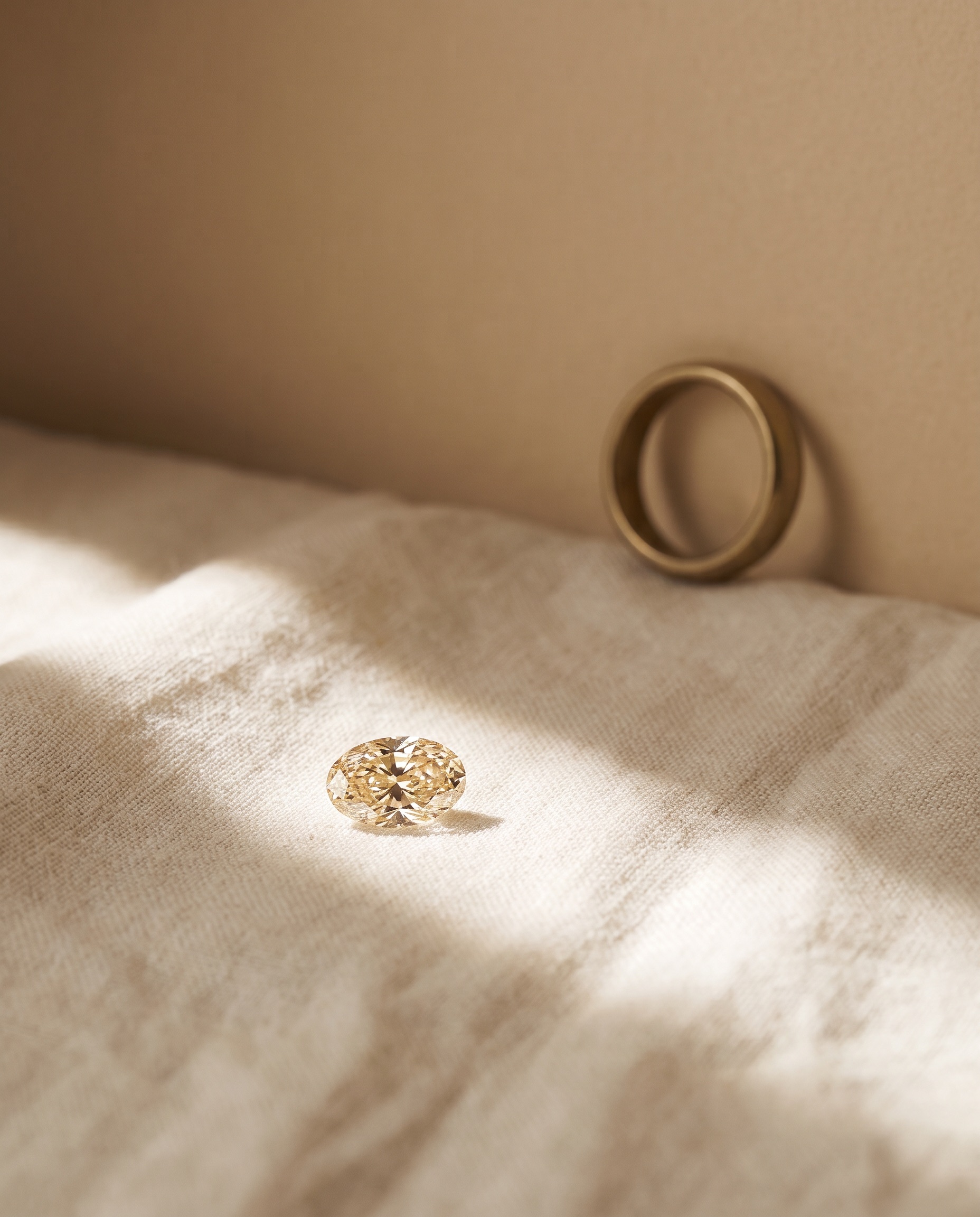
A natural oval diamond is an elongated brilliant-cut diamond formed by geological processes over millions of years, shaped into a symmetrical oval outline with rounded ends and no sharp corners. It shares the round brilliant's faceting logic — the same general facet count and arrangement — stretched into an elongated shape that reads as more elongating on the finger than a round stone of equal carat weight.
Oval is one of the most consistently popular fancy shapes in the natural diamond market, valued for combining a round brilliant's strong light performance with a shape that visually elongates the finger and tends to look larger per carat than a round of equal weight. Its enduring popularity across decades of shifting engagement ring trends, without the shape ever falling out of favor the way some fashion-driven shapes have, is a large part of why it remains a dependable, in-demand choice for both buyers and the jewelers sourcing for them. This guide covers what actually defines a natural oval diamond, how it's cut and evaluated, the bow-tie effect every buyer should understand before purchasing, length-to-width ratio and how it changes the stone's look, the 4Cs applied specifically to oval's quirks, how natural oval compares to lab-grown oval, setting considerations, and what to check before buying.
What Defines a Natural Oval Diamond
"Natural" specifically means the diamond's carbon crystallized under heat and pressure deep in the earth over geological time, then was mined, cut, and polished — as opposed to a lab-grown diamond, whose identical crystal structure is grown in a controlled chamber over weeks rather than millions of years. Both are chemically, optically, and physically real diamond; "natural" refers strictly to origin, not to any difference in what the stone is made of. The oval shape itself is a modified brilliant cut, first popularized in its modern form by cutter Lazare Kaplan in the 1960s, using a facet arrangement derived from the round brilliant but adapted to an elongated outline with no corners to protect or chip, unlike pear, marquise, or heart shapes.
Anatomy and Faceting of a Natural Oval Diamond
| Feature | Description |
|---|---|
| Facet count | Typically 56-66 facets, similar in spirit to a round brilliant's 57-58 but adapted to the elongated outline |
| Outline | Symmetrical along the long axis, with two rounded ends — no corners at any point around the perimeter |
| Length-to-width ratio | The single most defining visual variable for oval, typically ranging from about 1.30 to 1.60, with no universally "correct" ratio — a matter of buyer preference |
| Bow-tie zone | A shadow that appears across the stone's center width due to the elongated shape's facet geometry — present to some degree in essentially every oval, discussed in detail below |
| Culet / pavilion | Structured to maximize light return along the stone's length, similar in principle to a round brilliant's pavilion but adapted to the non-round outline |
The Bow-Tie Effect: What Every Oval Buyer Should Understand
Every oval diamond — along with other elongated brilliant shapes like pear, marquise, and cushion — shows some degree of a "bow-tie," a darker, shadow-like band across the stone's center width, visible from the top-down face-up view. It happens because the elongated shape's facets at the center can't be angled to return light to the viewer's eye as efficiently as the facets closer to the rounded ends, creating a shadow zone shaped roughly like a bow tie.
- Some bow-tie is normal and unavoidable. Because it's a structural consequence of the elongated shape's geometry, no oval diamond is entirely free of it — the real question for a buyer is severity, not presence or absence.
- Severity ranges from barely noticeable to visually distracting. A well-cut oval shows a faint, soft bow-tie that most viewers won't consciously register; a poorly cut oval can show a dark, sharply defined bow-tie that's immediately noticeable even to a casual viewer.
- Bow-tie isn't captured by a certificate's grade summary. GIA and other labs don't assign a specific bow-tie grade on standard reports, which means it has to be evaluated by looking at the actual stone (in person or in a genuine, non-edited photo/video) rather than relied on from paperwork alone.
- Cut quality, not carat weight or clarity, drives bow-tie severity. A well-proportioned oval with good symmetry and appropriate depth minimizes the effect; a shallow or poorly symmetrical stone tends to show a more pronounced one, independent of the stone's color or clarity grade.
Length-to-Width Ratio: How It Changes the Look
| Length-to-Width Ratio | Visual Character |
|---|---|
| 1.30-1.40 | Rounder, softer oval, closer in overall impression to a round brilliant with slightly elongated ends |
| 1.40-1.50 | The most commonly chosen range — a balanced, classic oval silhouette that most buyers picture as the "standard" look |
| 1.50-1.60 | More noticeably elongated and slender, a popular choice for buyers specifically wanting a finger-lengthening visual effect |
| 1.60+ | Distinctly slim and elongated, a more dramatic, fashion-forward look that departs further from a "classic" oval proportion |
There's no objectively correct ratio — it's a matter of personal preference, and different ratios can also affect bow-tie severity and how the stone's carat weight appears to spread across the finger. Viewing several ratios side by side, in person where possible, is the most reliable way for a buyer to identify which proportion actually matches their taste rather than choosing based on a number alone. A jeweler or supplier who can show a range of ratios against the same hand or a comparable reference photo makes this comparison meaningfully easier than trying to judge proportion from certificate measurements alone.
Evaluating the 4Cs for Natural Oval Diamonds
- Cut. The most important factor for oval specifically, since cut quality directly drives both bow-tie severity and overall brilliance. GIA doesn't issue an overall cut grade for oval the way it does for round brilliant, so buyers rely more heavily on proportions (length-to-width ratio, depth percentage, table percentage) and direct visual inspection.
- Color. Oval's elongated shape and larger open facets can make body color slightly more visible toward the pointed ends than in a round brilliant of the same grade, particularly for stones in the lower colorless-to-near-colorless range (I and below) — buyers wanting a fully "white" look sometimes choose a grade or two higher than they would for a round of equal carat weight, while buyers comfortable with a slightly warmer look have more flexibility to save on color grade without a visible penalty.
- Clarity. Because oval is a brilliant cut rather than a step cut, it hides inclusions more effectively than an emerald or Asscher cut of comparable clarity — VS2 or SI1 is a reasonable practical range for a clean face-up appearance without paying for a top clarity grade.
- Carat. Oval's elongated shape tends to look larger per carat than a round of the same weight, since more of the stone's surface area spreads across the finger's visible width rather than concentrating in a compact circular footprint.
Natural Oval vs. Lab-Grown Oval Diamonds
| Factor | Natural Oval | CVD Lab-Grown Oval |
|---|---|---|
| Origin | Formed in the earth over geological time, then mined | Grown in a controlled chamber over several weeks |
| Physical/optical properties | Identical crystal structure and light performance to lab-grown of the same cut quality | Identical crystal structure and light performance to natural of the same cut quality |
| Bow-tie effect | Present, same as any oval — driven by cut, not origin | Present, same as any oval — driven by cut, not origin |
| Price per carat | Generally higher than lab-grown at comparable size and quality, reflecting rarity and mining costs | Generally lower than natural at comparable size and quality |
| Certification | GIA, IGI, GCAL all available | IGI, GIA, and GCAL all available |
Because bow-tie severity, brilliance, and overall cut quality are governed entirely by faceting and proportions rather than by whether the carbon formed naturally or in a lab, a well-cut natural oval and a well-cut lab-grown oval of equivalent proportions look effectively identical to the eye. The meaningful differences between the two are price and the natural stone's geological rarity, not any optical distinction visible in the finished cut.
Setting Considerations for Natural Oval Diamonds
- Prong placement at the rounded ends. While oval has no sharp corners the way pear or marquise does, the narrower curve at each end still benefits from secure prong coverage — typically four to six prongs positioned to protect the ends without obstructing too much of the stone's face.
- Orientation. Oval is almost always set with its long axis running lengthwise along the finger, maximizing the shape's finger-elongating visual effect — a design decision so standard that off-axis settings are rare and mostly seen in fashion-forward or asymmetric designs.
- Setting style and bow-tie visibility. A halo setting can help visually soften a mild bow-tie by adding surrounding brilliance that draws the eye outward, while a plain solitaire setting puts the stone's cut quality, bow-tie included, on full display with nothing to distract from it.
- East-west settings. A more fashion-forward alternative, orienting the oval's long axis across the finger rather than lengthwise — a deliberate style choice rather than a standard default.
- Pairing with side stones. Tapered baguettes, trapezoids, or pavé shoulders are common companions for an oval center stone, generally chosen to echo or gently frame the oval's elongated silhouette rather than compete with it visually.
Common Mistakes Buyers Make with Natural Oval Diamonds
- Judging cut quality from a certificate alone. Because GIA doesn't issue an overall cut grade for oval, relying purely on paperwork misses the bow-tie and overall brilliance assessment that requires actually viewing the stone or a genuine video.
- Choosing a length-to-width ratio without viewing it in person or on video. A ratio that looks appealing as a number can read very differently once actually seen on the hand — viewing options side by side avoids a mismatch between expectation and the finished look.
- Ignoring bow-tie until after purchase. Buyers unfamiliar with the term sometimes only notice a pronounced bow-tie after the stone is already set, when it's too late to easily reconsider — understanding the effect and checking for it up front avoids this. Asking a supplier directly whether they've reviewed a specific stone's bow-tie severity before shipping is a simple way to catch an issue before it becomes a returned or unhappy purchase.
- Assuming a higher color grade matters as much as it would on a round. Because oval can show body color slightly more readily than round, a buyer aiming for a maximally colorless look should factor that in — but buyers comfortable with a warmer, faint tint don't need to over-correct on color grade just because of the shape.
Why Buyers Choose Oval
Oval consistently ranks among the most popular fancy shapes for a combination of practical and aesthetic reasons: it delivers brilliance and fire close to a round brilliant's performance, it visually elongates the finger in a way a round stone can't, it tends to look larger per carat than a round of equal weight, and — because it has no corners — it avoids the corner-chipping vulnerability that shapes like princess, emerald, and marquise have to manage with additional protective prong coverage. That combination of strong light performance, flattering proportion, and structural simplicity is what has kept oval a consistently in-demand shape across changing engagement ring trends, rather than any single passing fashion moment. It's also a practical shape for jewelers to keep well stocked, since demand for it tends to stay steady rather than spiking and fading the way some more fashion-driven fancy shapes do.
A Brief History of the Oval Cut
The modern oval cut is generally credited to cutter Lazare Kaplan, who developed and popularized the shape's specific facet arrangement in the 1960s, building on the round brilliant's already well-established optical principles but adapting them to an elongated outline. Earlier oval-ish diamond shapes existed in various historical periods, but they lacked the precise, calculated faceting Kaplan applied — his version was specifically engineered to preserve as much of a round brilliant's fire and brilliance as possible despite the shape's elongation, rather than being a simple stretched round with no optical recalculation. That engineering work is part of why oval has held up as a serious, light-performance-competitive shape rather than a purely decorative variation on round, and why it has remained one of the most consistently chosen fancy shapes across the decades since its modern introduction.
Certification and What to Look for on a Report
Because GIA doesn't issue an overall cut grade for oval and other fancy shapes the way it does for round brilliant, a certificate for a natural oval diamond carries somewhat different information than a round brilliant's report, and buyers benefit from knowing what to actually check:
- Measurements (length, width, depth). These three numbers let a buyer calculate the exact length-to-width ratio themselves rather than relying on a marketing description of "classic" or "elongated" proportions.
- Depth and table percentage. While there's no single mandated ideal range for oval the way there is for round, depth percentages roughly in the 58-62% range and table percentages roughly in the 53-63% range are commonly cited practical benchmarks associated with good brilliance and a controlled bow-tie.
- Symmetry and polish grades. Both are graded and reported for oval, and both meaningfully affect how clean and even the stone's light return looks — a stone with excellent polish and symmetry generally shows a softer, less distracting bow-tie than one with lower grades in either category, even at similar proportions.
- Color and clarity grades, evaluated the same way as any other shape, though with the shape-specific practical considerations on visibility covered above.
Because the certificate alone can't fully capture bow-tie severity or overall face-up brilliance, pairing the paperwork with an actual look at the stone — in person or via genuine video — remains the most reliable way to evaluate a specific oval before committing to it.
Pricing Dynamics: Oval vs. Round
Oval diamonds are generally priced somewhat lower per carat than round brilliants of comparable color, clarity, and carat weight, primarily because oval rough utilization from a given piece of rough diamond tends to be more efficient than round — cutters can often retain more carat weight from the same rough crystal cutting to oval than cutting to round, which affects wholesale pricing dynamics across the market. Combined with oval's tendency to look larger per carat than round due to its elongated shape spreading more visibly across the finger, this pricing pattern is part of why many buyers see oval as offering strong visual value relative to its cost, on top of the shape's own aesthetic appeal.
Sourcing Natural Oval Diamonds at Wholesale
Because bow-tie severity and overall brilliance vary meaningfully stone to stone within the oval shape, sourcing decisions benefit from being able to review individual proportions and, ideally, video rather than relying on carat weight and grade alone. Guru Diam supplies certified natural loose diamonds across oval and the full range of standard, fancy, and antique shapes, with GIA, IGI, and GCAL certification all available. Buyers evaluating natural oval stones can browse the certified diamonds category, with matched melee and side stones for oval-centered designs — tapered baguettes, trapezoids, or pavé rows — available through matching pairs. For custom oval engagement rings, the custom jewelry program handles cutting, setting, and polishing all in-house, with finished pieces delivered in 4-6 days. Buyers exploring fancy color options alongside a natural white oval center stone can review fancy color loose diamonds. Trade accounts can review terms at the wholesale hub or apply through trade partner. For jewelers stocking oval alongside other fancy shapes, requesting proportion and video documentation as a standard part of the intake process — rather than only for stones flagged as unusual — keeps quality consistent across an inventory rather than relying on spot checks.
Frequently Asked Questions
What is a natural oval diamond?
A natural oval diamond is an elongated brilliant-cut diamond, formed geologically in the earth and then mined and cut, sharing a facet arrangement derived from the round brilliant but adapted to a symmetrical oval outline with rounded ends and no corners.
What is the bow-tie effect on an oval diamond?
The bow-tie is a shadow-like band that appears across the center width of an oval (and other elongated shapes like pear and marquise), caused by the elongated facet geometry not returning light as efficiently at the stone's center as it does near the ends. Every oval shows some degree of it; the key question is severity, which is driven by cut quality.
What length-to-width ratio should I choose for an oval diamond?
There's no universally correct ratio — 1.30-1.40 reads rounder and softer, 1.40-1.50 is the most commonly chosen balanced look, and 1.50+ is more distinctly elongated and slender. It's a matter of personal preference best confirmed by viewing a few ratios in person or on video.
Does a natural oval diamond look different from a lab-grown oval diamond?
No — a well-cut natural oval and a well-cut CVD lab-grown oval of equivalent proportions look effectively identical, since both share the same crystal structure and light performance. The main practical differences are price and geological origin, not anything visible in the finished cut.
Is oval a good shape for hiding inclusions?
Reasonably good — as a brilliant cut, oval hides inclusions more effectively than a step cut like emerald or Asscher. VS2 to SI1 clarity is a practical range for a clean face-up look without paying for a top clarity grade the shape doesn't strictly require.
Why do people choose oval over round diamonds?
Oval delivers brilliance close to a round's performance while visually elongating the finger and tending to look larger per carat than a round of the same weight. It also has no corners to protect from chipping, unlike princess, emerald, or marquise shapes.
Why are oval diamonds often priced lower per carat than round diamonds?
Oval shapes generally allow cutters to retain more carat weight from a given piece of rough diamond than cutting to round does, which affects wholesale pricing across the market. Combined with oval's tendency to look larger per carat due to its elongated shape, many buyers see it as offering strong visual value relative to cost.