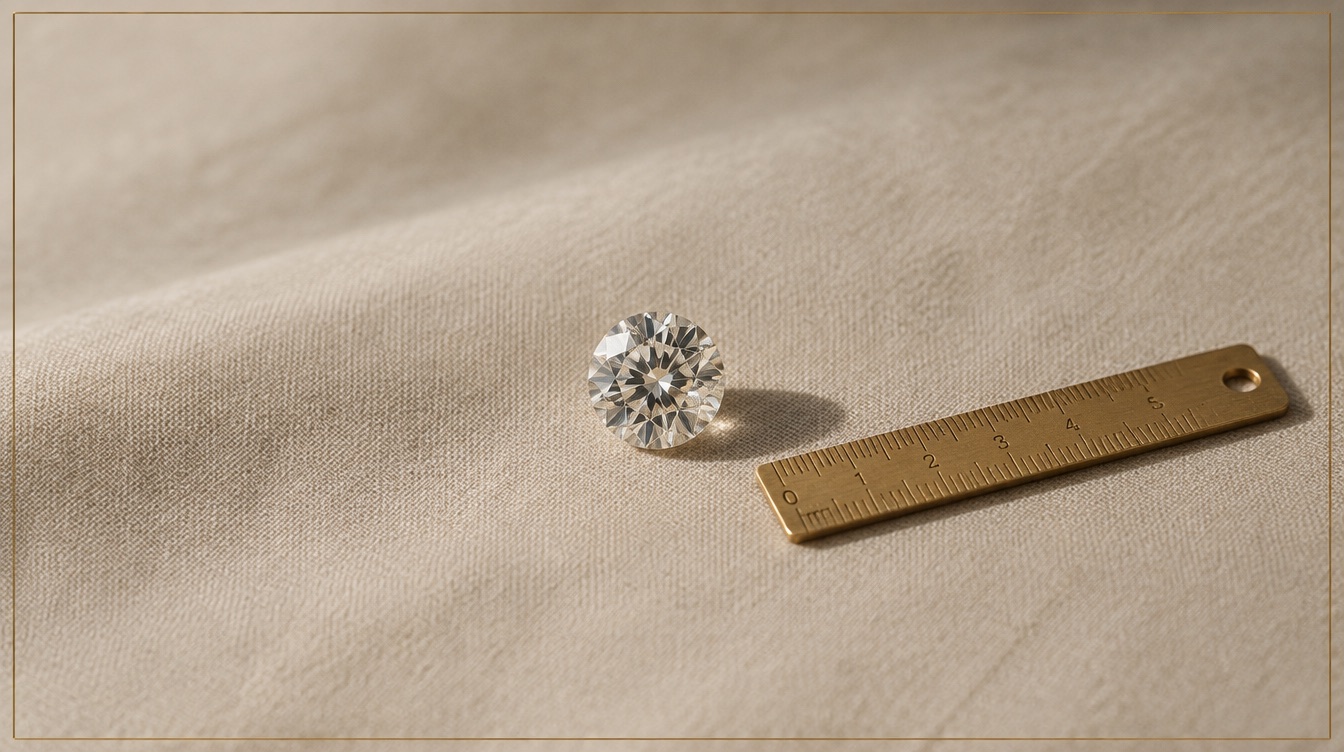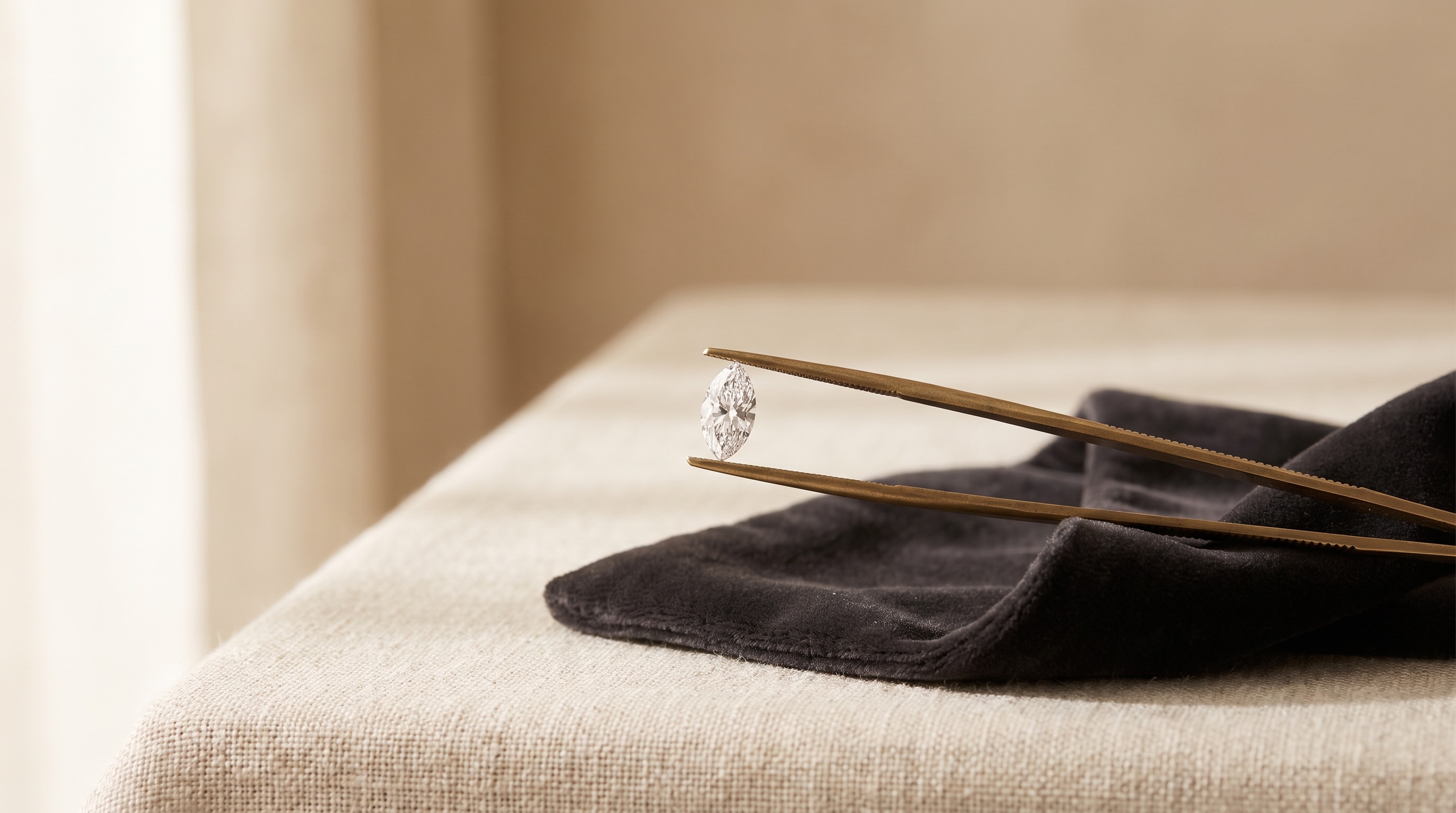
A natural marquise diamond is a mined, elongated boat-shaped diamond with two pointed ends, cut from natural rough rather than grown in a lab — the same distinctive silhouette covered in our general marquise diamond buying guide, but with sourcing, grading, and pricing dynamics specific to natural stock that a buyer comparing the two categories needs to understand separately.
This guide focuses on what's specific to natural marquise diamonds: how the shape relates to natural rough crystal habits, what grading and certification look like for natural stock, how natural marquise pricing and availability compare to lab-grown, and what a buyer sourcing natural marquise inventory at wholesale should check before committing. For the shape's general anatomy, bow-tie effect, length-to-width ratio guidance, and setting styles — all of which apply equally to natural and lab-grown marquise stones — see the general marquise guide linked above.
Why Marquise Is a Historically Efficient Cut for Natural Rough
The marquise shape's popularity in the trade isn't purely aesthetic — it also has a practical, rough-yield origin. Natural diamond rough often forms as elongated crystals, and a specific twinned crystal form called a macle (a flattened, triangular twin crystal) is a common natural rough shape that cutters have long recognized as well-suited to an elongated fancy cut like marquise, since cutting an elongated shape from elongated or triangular rough retains more of the original crystal's weight than forcing that same rough into a round brilliant would. This rough-yield relationship is specific to natural stone sourcing — a lab-grown crystal is grown to a planned shape and size from the outset, so a CVD marquise doesn't carry the same weight-retention logic that has historically made marquise a practical, not just fashionable, choice for cutters working with natural rough.
Natural Marquise Rough Supply and Rarity
Because not every rough crystal is well-suited to an elongated cut, and because cutters weigh multiple possible finished shapes against each other when planning how to cut a given piece of rough, natural marquise availability at any given moment reflects both current mining output and the specific cutting decisions made on that output — it isn't a fixed percentage of total production the way a simpler commodity metric might suggest. Buyers sourcing natural marquise at scale, particularly in larger carat weights or for matched pairs, should expect availability to fluctuate more than it does for round brilliant, where cutters can plan rough allocation toward the shape with the most consistent, predictable demand.
Grading Natural Marquise Diamonds
Natural marquise stones are graded on the same 4Cs framework as any other natural diamond, with a few shape-specific nuances worth understanding:
- Cut grade limitations. GIA does not assign an overall cut grade (Excellent through Poor) to fancy shapes like marquise the way it does for round brilliant — buyers evaluating cut quality on a natural marquise stone need to assess proportions, symmetry, and polish individually, and ideally view the stone in person or via detailed video to judge bow-tie severity and light performance directly, rather than relying on a single summary cut grade the certificate won't provide.
- Treatment disclosure. As with any natural diamond, a marquise stone may have undergone clarity or color treatment — see our clarity-enhanced diamond guide for how laser drilling and fracture filling are disclosed on a certificate, and confirm treatment status explicitly on any natural marquise purchase.
- Fluorescence. Fluorescence effects are visible across a marquise's full elongated face-up area in the same way they are on any larger, more open-faceted shape — worth checking directly on the certificate and, where fluorescence is Strong or Very Strong, viewing the stone in person before finalizing a purchase.
A Note on the Marquise Cut's Natural Diamond Trade Origins
The marquise shape's roughly two-and-a-half-century history in the trade — commonly traced to 18th-century France — predates lab-grown diamond production entirely, meaning every historical marquise diamond in circulation for most of that history was, by definition, cut from natural rough. This matters for one practical reason beyond trivia: antique and estate marquise pieces that come through the resale and auction market are inherently natural stones, often cut with older faceting styles and proportions (frequently a fuller, less elongated ratio than the 1.75-2.00 range preferred in modern cutting) that a buyer sourcing from estate inventory should expect to differ visually from a newly cut natural or lab-grown marquise stone cut to contemporary proportion standards.
Color Grade Considerations for Natural Marquise
Natural marquise stones, like any natural diamond, occur across the full D-Z color range, and commercial-tier goods in the lower-mid range of that scale sometimes carry a faint natural brownish or yellowish body tint, particularly in stones from certain rough sources historically described in the trade using the term "cape series." A marquise's brilliant faceting does a reasonably good job of masking faint color, similar to round or oval, though — as with any larger or more elongated stone — color becomes somewhat more visible than in a smaller, more compact shape. Buyers sourcing natural marquise for white-metal settings typically target G-H or better for this reason, while I-J and below remain a reasonable, more budget-friendly choice for yellow or rose gold mountings where a touch of warmth reads as intentional rather than as an off-color flaw.
Clarity Considerations for Natural Marquise Specifically
Because a marquise diamond's two points are both its most visually prominent feature and its most structurally vulnerable one, inclusion location relative to the points matters more here than clarity grade alone would suggest. A natural stone with a small inclusion positioned near a point carries a double concern: it may be more visible in that location than the same size inclusion would be centrally, and depending on depth and severity, it can also represent a structural weak point in an area already under more setting-related stress than the rest of the stone. Buyers evaluating natural marquise clarity should ask specifically about inclusion location near the points, not just the overall clarity grade shown on the certificate.
Wholesale Pricing Structure for Natural Marquise Diamonds
Natural marquise pricing follows the same 4Cs-driven framework as any other natural diamond shape, but buyers should expect a wider quote-to-quote variation than they would sourcing round brilliant, given the rough-yield and availability factors covered above. A supplier quoting natural marquise inventory should be able to explain pricing in terms of the specific stone's proportions and rarity within the shape, not just its raw carat weight and standard 4Cs grade, since two natural marquise stones at the same nominal grade can carry a real price difference if one has notably better proportions or bow-tie control than the other.
Comparing Natural Marquise to Other Natural Elongated Shapes
As covered in the general marquise guide's shape comparison, marquise, oval, and pear are the three shapes buyers most often weigh against each other for an elongated silhouette. On the natural side specifically, oval and pear rough-yield considerations are similar in principle to marquise's — all three shapes benefit from elongated natural rough in ways round brilliant doesn't — though marquise's two points make it the most rough-yield-efficient of the three for certain elongated crystal shapes, at the cost of being the most structurally delicate of the three in a finished setting. Buyers deciding between natural marquise, oval, and pear should weigh this durability tradeoff alongside the aesthetic preference covered in the general shape guide.
Certification Standards for Natural Marquise Stones
For natural marquise diamonds at 0.30ct and above, independent certification from IGI, GIA, or GCAL is standard trade practice, documenting carat weight, color, clarity, and measurements along with any comments on treatment or notable inclusions. Given the cut-grade limitation on fancy shapes described above, a certificate for a natural marquise stone should be read alongside an in-person or video review of the stone's actual proportions and bow-tie severity, not treated as a complete substitute for visual evaluation the way a round brilliant's certificate more fully can be.
Natural vs. Lab-Grown Marquise: Pricing and Availability Comparison
| Factor | Natural Marquise | CVD Lab-Grown Marquise |
|---|---|---|
| Price per carat | Higher, reflecting natural rarity and rough-yield variability | Substantially lower for comparable color and clarity |
| Availability consistency | Fluctuates with mining output and cutters' shape decisions | More predictable — grown to planned shape and size |
| Matched-pair sourcing | More difficult and time-consuming, given natural variation between rough pieces | Generally easier to source closely matched pairs |
| Rough-yield relationship to shape | Elongated and macle-twinned rough historically well-suited to marquise cutting | Not applicable — crystal is grown to the target shape |
The matched-pair consideration matters in particular for buyers sourcing marquise side stones for earrings or a three-stone ring design — natural marquise stones require more careful hand-matching for color, clarity, and proportion consistency than lab-grown stock does, which is a real, practical sourcing consideration beyond price alone.
Sourcing Natural Marquise at Wholesale: What to Check
- Ratio and proportion consistency for multi-stone orders. Because natural rough varies piece to piece, a supplier quoting a run of natural marquise stones for a bridal or fashion line should be asked explicitly how closely proportions will be matched across the order.
- Treatment disclosure. Confirm directly whether any stone in an order has been laser drilled or fracture filled, and expect that disclosure documented in writing.
- Realistic lead times for larger or higher-grade stones. As covered above, natural marquise availability fluctuates with both mining output and cutting decisions — buyers working toward a deadline should build in extra sourcing time compared to round brilliant, where supply is deeper and more predictable.
- Certification and independent verification. IGI, GIA, or GCAL certification should be treated as standard practice for any natural marquise stone at 0.30ct or above.
Natural Marquise in Matched-Pair and Custom Programs
Marquise side stones — flanking a round or oval center stone in a three-stone design, or forming a pair for earrings — are a common natural marquise use case, and matched-pair sourcing is where the natural-versus-lab-grown difference in consistency shows up most practically. A supplier experienced in hand-matching natural marquise pairs for color, clarity, and proportion is a meaningfully different sourcing relationship than one simply pulling loose natural marquise stock without that matching discipline, and buyers building a custom program around natural marquise side stones should confirm this capability explicitly before committing to an order.
Setting Considerations Specific to Natural Marquise
The point-protection and setting-style guidance covered in our general marquise guide (V-prong or double-prong protection at the points, east-west orientation, three-stone and halo settings) applies equally to natural and lab-grown marquise stones, since it addresses the shape's structural characteristics rather than anything specific to how the stone was produced. The one natural-specific consideration worth flagging: because natural marquise rough yield varies, a natural stone's exact proportions may require more setting customization to fit a standard mounting cleanly than a lab-grown stone cut to a precisely planned, repeatable proportion would.
Working With a Jeweler on a Natural Marquise Design
Given how much natural marquise proportions and bow-tie behavior can vary between individual stones, buyers benefit from involving a jeweler or designer before finalizing a stone purchase, particularly for a custom three-stone or east-west design where the marquise's exact length-to-width ratio and point orientation affect how the whole piece reads. A designer reviewing detailed video of the actual candidate stones, rather than working only from certificate numbers, can flag which specific stone will sit best in a given design and where extra point protection or a slightly adjusted prong layout may be worth building in from the outset.
Common Mistakes When Sourcing Natural Marquise Diamonds
- Assuming certificate grade alone captures cut quality. As covered above, GIA doesn't assign an overall cut grade to marquise — always request visual confirmation of proportions and bow-tie severity.
- Underestimating matched-pair sourcing time. Natural marquise pairs for earrings or three-stone settings take longer to source well-matched than lab-grown equivalents, given natural variation between individual stones.
- Treating natural marquise availability as constant. Because supply depends on both mining output and cutters' shape decisions on a given batch of rough, buyers should confirm current availability rather than assuming a specific grade combination is reliably in stock.
- Skipping treatment verification. Given the value at stake in larger natural marquise stones specifically, treatment disclosure should always be confirmed directly and in writing.
Fluorescence and Its Practical Effect on Natural Marquise
Fluorescence — the visible glow some diamonds emit under ultraviolet light — appears across a marquise stone's full elongated face in a way that's worth checking directly rather than inferring from grade alone. In most stones, fluorescence has no visible effect under normal lighting, but Strong or Very Strong blue fluorescence can occasionally produce a subtle haze, particularly in higher color grades where the effect is more likely to be noticed against an otherwise very white stone. Because a marquise's open, elongated face-up view gives more surface area for any haze to register across than a smaller or more compact shape would, buyers sourcing natural marquise stones in the D-F color range specifically should request a direct viewing or detailed video under a range of lighting conditions before finalizing a purchase, rather than relying on the fluorescence grade alone.
Insurance and Appraisal for Natural Marquise Center Stones
As with any natural diamond used as a center stone, a natural marquise piece above roughly one carat warrants a dedicated insurance policy backed by a current independent appraisal, distinct from the grading certificate — the certificate documents the 4Cs, while the appraisal assigns the specific replacement value an insurer uses to set coverage. Because natural marquise proportions and bow-tie quality vary meaningfully stone to stone, as covered throughout this guide, an appraisal for a natural marquise piece should reference the stone's specific characteristics rather than relying purely on a generic per-carat estimate for the shape, and should be refreshed periodically as market values shift. See our diamond appraisal guide for more on how that process works.
Sourcing Natural Marquise Diamonds at Guru Diam
Guru Diam is a trade-only wholesale diamond supplier with locations in New York and Los Angeles, carrying natural marquise diamonds alongside its CVD lab-grown catalog, calibrated melee, and finished jewelry, across every standard, antique, and exotic shape. Natural loose stones ship with full grading documentation from IGI, GIA, or GCAL, and our team works directly with trade accounts on matched-pair sourcing for earrings and three-stone designs, including advising on realistic timelines when a specific grade and proportion combination needs to be located rather than pulled from existing stock. Custom pieces built around a natural marquise center stone are finished in 4-6 days once a design is approved. Browse certified natural inventory through certified diamonds, source matched pairs through matching pairs, and review trade terms at the wholesale hub or by applying through trade partner.
Frequently Asked Questions
What is a natural marquise diamond?
A natural marquise diamond is a mined diamond cut into the elongated, boat-shaped marquise silhouette with two pointed ends, as opposed to a marquise cut from lab-grown rough. The shape itself is identical between natural and lab-grown versions; what differs is the stone's origin, rarity, and sourcing dynamics.
Why is marquise a common cut for natural rough specifically?
Natural diamond rough often forms as elongated crystals, and a twinned crystal form called a macle is a common natural rough shape well-suited to an elongated cut like marquise — cutting marquise from this kind of rough retains more original weight than forcing it into a round brilliant would. This weight-retention logic doesn't apply to lab-grown crystals, which are grown to a planned shape.
Does GIA assign a cut grade to natural marquise diamonds?
No. GIA doesn't assign an overall cut grade (Excellent through Poor) to fancy shapes like marquise the way it does for round brilliant. Buyers need to evaluate proportions, symmetry, and bow-tie severity directly, ideally through in-person or video viewing.
Is natural marquise more expensive than lab-grown marquise?
Yes, typically substantially more per carat for comparable color and clarity, reflecting natural rarity and the rough-yield variability covered above, compared to a lab-grown crystal grown to a predictable, planned outcome.
Is it harder to source matched natural marquise pairs?
Yes. Natural rough variation makes hand-matching color, clarity, and proportion across two or more marquise stones more time-consuming than sourcing comparably matched lab-grown pairs, which are grown to more consistent, repeatable specifications.
What should I check before buying a natural marquise diamond?
Confirm independent certification (IGI, GIA, or GCAL), request treatment disclosure in writing, view the stone in person or via video to assess bow-tie severity and cut quality directly, and build in extra sourcing time if you need a specific grade combination or a matched pair. Working through this checklist before committing to a purchase avoids most of the common sourcing mistakes covered earlier in this guide.
Can natural marquise diamonds be clarity-enhanced?
Yes — like any natural diamond, a marquise stone may have undergone laser drilling or fracture filling. This should always be disclosed on the certificate; confirm it directly before purchasing.
Does fluorescence matter more on a natural marquise diamond?
Fluorescence's visual effect, when present, shows across a marquise's full elongated face-up area, giving it more surface area to register across than on a smaller or more compact shape. Buyers targeting higher color grades (D-F) should request direct or video viewing under varied lighting before purchase, rather than relying on the fluorescence grade alone.
Do older or antique marquise diamonds look different from newly cut ones?
Often, yes. Because marquise predates lab-grown production entirely, antique and estate marquise stones are inherently natural and were frequently cut to fuller, less elongated proportions than the 1.75-2.00 length-to-width ratio preferred in modern cutting, so buyers sourcing from estate inventory should expect a visually different look from a newly cut stone.
Why does inclusion location matter more on a natural marquise diamond?
A marquise's two points are both its most visually prominent feature and its most structurally vulnerable one, so an inclusion positioned near a point can be more visually noticeable and sit in an area already under more setting-related stress than the rest of the stone. Buyers should ask about inclusion location specifically, not just the overall clarity grade.