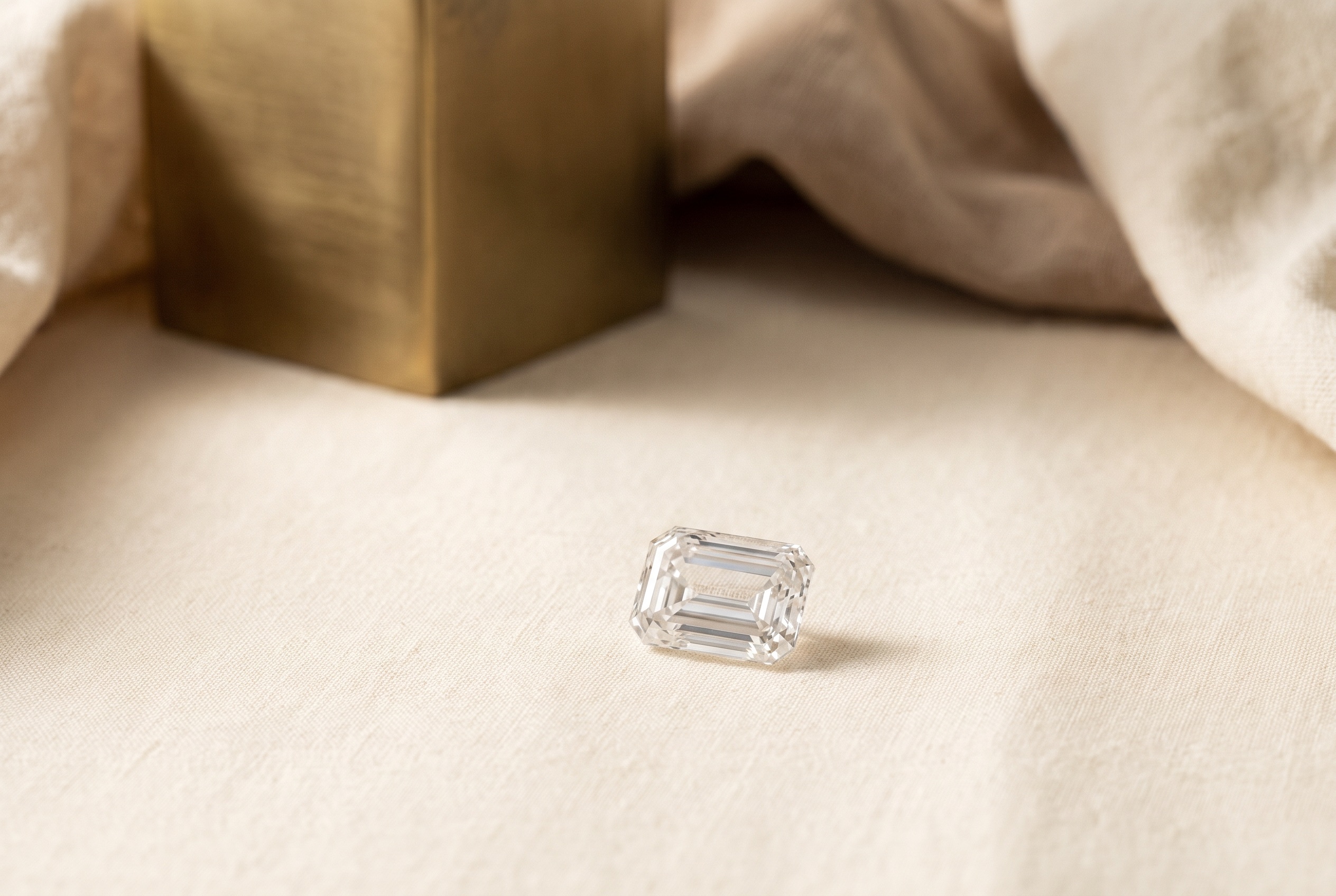
A natural emerald cut diamond is a mined diamond faceted into the emerald cut's signature rectangular, step-cut silhouette — broad, open facets running parallel to the stone's edges, with the corners trimmed square. It's the same distinctive shape covered in general emerald cut guides, but sourced from natural rough rather than grown in a lab, which changes grading nuances, rough-yield economics, and pricing in ways a wholesale buyer comparing natural and lab-grown emerald cut stock needs to understand separately.
This guide covers what's specific to natural emerald cut diamonds: how the shape relates to natural rough crystal habits, grading and clarity considerations unique to a step-cut natural stone, how natural emerald cut pricing and availability compare to lab-grown, and what to check before sourcing natural emerald cut inventory at wholesale.
Why Emerald Cut Is a Historically Efficient Shape for Natural Rough
The emerald cut's roots trace back to the step-cutting techniques originally developed for colored gemstones (hence the name), later adapted to diamond. One practical reason it endured in the natural diamond trade is rough yield: natural diamond rough often forms as roughly rectangular or cubic octahedral crystals, and a rectangular step cut can retain more of that original crystal's weight than forcing the same rough into a round brilliant, which requires carving away significantly more material to achieve a circular outline. This weight-retention logic is specific to natural rough sourcing — a lab-grown crystal is grown to a planned shape and size from the outset, so a CVD emerald cut doesn't carry the same yield-driven cutting rationale that has made the shape a practical, not just aesthetic, choice for cutters working with natural octahedral or cubic rough.
Natural Emerald Cut Rough Supply and Availability
Not every piece of rough is well suited to a rectangular step cut, and cutters weigh multiple possible finished shapes against each other when planning how to cut a given stone. Because of this, natural emerald cut availability at any given time reflects both current mining output and the specific cutting decisions made across that output, rather than a fixed, predictable share of total production. Buyers sourcing natural emerald cut stones at scale — particularly in larger carat weights, in closely matched color and clarity ranges, or as matched pairs — should expect somewhat more variability in available inventory than for round brilliant, where cutters can plan rough allocation toward the shape carrying the steadiest, most consistent demand.
Grading Natural Emerald Cut Diamonds
Natural emerald cut stones are graded on the same 4Cs framework as any other natural diamond, with several shape-specific considerations that matter more here than on a round brilliant:
- No summary cut grade. GIA does not assign an overall cut grade (Excellent through Poor) to fancy shapes, including emerald cut, the way it does for round brilliant. Buyers need to evaluate proportions, symmetry, and polish individually, and ideally view the stone in person or via detailed video to judge light performance and window effect directly rather than relying on a single summary grade the certificate won't provide.
- Clarity visibility. The emerald cut's broad, open step facets and large table act like a hall of mirrors for inclusions — clarity characteristics that would be well hidden by a round brilliant's smaller, more scattered facet pattern are often considerably more visible in an emerald cut, particularly anything near the center of the table. This makes clarity plot review more important on natural emerald cut stones than shape alone would suggest from the grade number.
- Treatment disclosure. As with any natural diamond, an emerald cut stone may have undergone clarity or color treatment — see our clarity-enhanced diamond guide for how laser drilling and fracture filling are disclosed on a certificate, and confirm treatment status explicitly before buying.
Color Grade Considerations for Natural Emerald Cut Stones
Natural emerald cut diamonds, like any natural diamond, occur across the full D-Z color range, and the shape's large, open table makes body color somewhat more visible than it would be on a brilliant-cut stone of comparable size, since there's less facet-driven light scatter to help mask a faint tint. Buyers sourcing natural emerald cut stones for white-metal settings typically target G-H or better for this reason — a step or two stricter than the color range often considered acceptable for round brilliant — while I-J and below remains a reasonable, more budget-friendly choice for yellow or rose gold mountings, where warmth reads as intentional rather than as an off-color flaw.
Clarity Considerations Specific to the Step Cut
Because the emerald cut's open facets don't hide inclusions the way a brilliant cut's smaller, more numerous facets do, clarity grade alone doesn't tell the full story for this shape. Two stones with the same clarity grade can look meaningfully different face-up depending on where their inclusions sit — a small inclusion tucked near the girdle is far less visually disruptive than the same size inclusion sitting under the table's center, where it's essentially framed by the shape's largest, clearest facet. Buyers evaluating natural emerald cut clarity should review the clarity plot directly, or view the stone itself, rather than relying on the grade number in isolation — a practice worth applying to any natural stone but especially important here.
Length-to-Width Ratio and Proportions
Emerald cut diamonds are cut across a range of length-to-width ratios, from close to square (around 1.30-1.40:1) to more elongated (1.50:1 and beyond), and natural rough shape plays a direct role in which ratio a given piece of rough supports well. A cutter working from more elongated natural rough will often lean toward a correspondingly elongated finished ratio to preserve weight, while more equant rough tends toward a squarer finished stone. Buyers with a specific ratio preference for a particular design should expect natural sourcing to involve somewhat more searching or waiting for matching rough than lab-grown, where the crystal can be grown with the target shape planned in from the start.
Windowing and Light Performance in Natural Emerald Cuts
"Windowing" — a see-through effect where light passes straight through the stone rather than reflecting back to the viewer, visible as a washed-out or glassy area, usually near the center — is a known consideration for step cuts generally, natural and lab-grown alike, and depends primarily on pavilion depth and angle rather than natural origin specifically. That said, natural rough's variable starting shape can push a cutter toward proportions that prioritize weight retention over ideal light performance more often than a lab-grown crystal, which carries no such rough-shape constraint, might. Buyers evaluating a natural emerald cut stone for light performance should view it directly or via detailed video under varied lighting, checking specifically for a washed-out center, rather than assuming clarity and color grades alone predict how lively the stone will look face-up.
Wholesale Pricing Structure for Natural Emerald Cut Diamonds
Natural diamond pricing follows a per-carat framework driven by the four Cs, with rarity compounding at higher clarity and color combinations the way it does for any natural stone. Relative to lab-grown emerald cut diamonds of comparable size, color, and clarity, natural stones typically carry a meaningfully higher price per carat, reflecting the fundamental difference in production economics between mined and grown stock, plus the added rarity premium on well-matched rough suited to a clean rectangular step cut. Buyers building assortments across both categories should expect a wider price spread between natural and lab-grown emerald cut goods than between natural and lab-grown round brilliants of the same specs, since the natural side carries an additional rough-yield scarcity factor the round shape doesn't face to the same degree.
Natural vs. Lab-Grown Emerald Cut: A Comparison
| Factor | Natural Emerald Cut | Lab-Grown (CVD) Emerald Cut |
|---|---|---|
| Origin | Mined rough, cut to shape | Grown in a controlled lab environment, cut to shape |
| Rough-yield influence on ratio | Significant — rough shape often drives final ratio | Minimal — crystal is grown toward the planned shape |
| Availability in exact matched specs | More variable, especially at larger sizes or in pairs | More predictable and consistent |
| Price per carat (comparable grade) | Higher | Lower |
| 4Cs grading framework | Same GIA/IGI/GCAL framework | Same GIA/IGI/GCAL framework |
| Certification available | GIA, IGI, GCAL | GIA, IGI, GCAL |
Certification for Natural Emerald Cut Diamonds
Natural emerald cut stones should be sourced with full third-party certification — GIA, IGI, or GCAL — confirming the 4Cs, proportions, and any treatments. Given the shape's clarity-revealing nature and the wider natural color range in circulation, a detailed certificate with a clarity plot (rather than a summary-only report) is particularly useful for this shape specifically, since it lets a buyer assess inclusion location before committing, not just the overall clarity grade.
Setting Considerations for Natural Emerald Cut Stones
Emerald cut diamonds, natural or lab-grown, are typically set with trimmed or notched corners in mind — the shape's cut corners are its most vulnerable point structurally, similar to how a marquise or pear's tips concentrate stress. Prong settings for emerald cuts usually place a prong directly over or near each corner for protection, and a bezel or half-bezel setting offers additional corner protection where heavier daily wear is expected. See GD's engagement ring settings guide for how corner protection factors into setting selection for step-cut shapes generally.
Sourcing Natural Emerald Cut Diamonds at Wholesale
Buyers sourcing natural emerald cut inventory should expect a somewhat longer lead time or narrower selection window than for lab-grown, particularly when targeting a specific combination of size, ratio, color, and clarity simultaneously. Building relationships with suppliers who carry natural stock across a range of cut ratios — rather than a single standard proportion — gives more flexibility when matching a specific design or a retail customer's exact preference. Matched pairs for earrings present an additional sourcing challenge on natural emerald cuts specifically, since finding two natural stones with closely matched proportions, color, and clarity from independently sourced rough is inherently harder than matching two lab-grown stones grown to identical specifications.
Natural Emerald Cut Diamonds in Estate and Antique Jewelry
The emerald cut's roughly century-long popularity in fine jewelry — it became especially fashionable during the Art Deco period — means a meaningful share of emerald cut diamonds circulating through the estate and resale market are natural stones cut with older proportions, sometimes deeper or with different faceting arrangements than contemporary cutting standards favor. Buyers sourcing from estate inventory or working with reset heirloom stones should expect natural emerald cuts from earlier eras to differ somewhat in proportion and light performance from a newly cut natural or lab-grown stone cut to modern standards, and should evaluate them against period-appropriate expectations accordingly.
Fluorescence Considerations for Natural Emerald Cut Diamonds
Fluorescence — the visible glow some diamonds emit under UV light, most commonly blue — is worth checking specifically on natural emerald cut stones because the shape's large, open table displays fluorescence effects across a bigger unbroken visual area than a brilliant cut's smaller, more scattered facets would. In most stones, faint to medium blue fluorescence has no negative visual effect and, in stones with a faint natural yellowish tint, can even make the stone appear marginally whiter face-up. Strong or very strong fluorescence occasionally produces a hazy or oily appearance in some stones, though this effect is inconsistent and doesn't occur in every strongly fluorescent stone. Given the emerald cut's large, revealing table, buyers sourcing natural emerald cut stones with strong fluorescence noted on the certificate should view the stone directly, or via detailed video in daylight-equivalent lighting, before finalizing a purchase, rather than relying on the fluorescence grade alone to predict its visual effect.
Matching Natural Emerald Cut Diamonds for Pairs and Multi-Stone Pieces
Sourcing two or more natural emerald cut diamonds that match closely in size, ratio, color, and clarity — for earrings, a three-stone ring, or a symmetrical multi-stone design — is meaningfully harder on natural stock than on lab-grown, for the same rough-variability reasons covered above. Each natural stone is cut from independently sourced rough with its own starting shape, color, and clarity characteristics, so finding two that align closely across all four grading factors, and that present visually similar face-up, often requires sourcing from a larger available pool rather than a small batch. Buyers building a matched natural emerald cut pair should expect this to take longer than sourcing a single stone, and should prioritize visual matching (checking the two stones side by side under consistent lighting) alongside matching the certificate specifications, since two stones with identical grades on paper can still present somewhat differently face-up due to proportion differences a grade alone doesn't fully capture.
Natural Emerald Cut Diamonds and Treatment Disclosure
Because the emerald cut's open facets make inclusions more visible than they would be in a brilliant cut, some natural emerald cut stones in the market have undergone clarity enhancement — laser drilling to access and lighten a dark inclusion, or fracture filling to reduce the visibility of a feather — specifically to improve how clean the stone reads face-up in this revealing shape. Any such treatment must be disclosed on a legitimate grading certificate, and a treated stone should be priced accordingly, well below an untreated stone of the same visual clarity. Buyers should check the certificate's comments or treatment section explicitly on any natural emerald cut purchase, since the shape's clarity-revealing nature makes treated stones a more common consideration here than on shapes that hide inclusions more effectively.
Recutting and Repolishing Natural Emerald Cut Diamonds
Because natural emerald cut stones sometimes come to market through estate or resale channels, buyers occasionally encounter older-cut natural emerald cuts with outdated proportions — a deeper pavilion, a less standardized ratio, or a girdle finish that doesn't match contemporary cutting norms. Recutting such a stone can improve its light performance and bring its proportions closer to current standards, but it comes at the cost of some carat weight, since achieving cleaner modern proportions generally requires removing material. Whether recutting makes sense depends on the specific stone: a stone with genuinely poor light performance and enough size to absorb some weight loss may benefit meaningfully, while a stone that's already performing reasonably well is often better left as-is rather than risking weight and value for a modest proportion improvement. This is a decision worth making with an experienced cutter's assessment of the specific stone rather than a blanket rule.
Natural Emerald Cut Diamonds and Resale Considerations
When a natural emerald cut diamond is evaluated for resale or appraisal, the same shape-specific factors that matter at purchase — clarity characteristics visible through the open table, color grade relative to the shape's lower color-masking ability, and how closely the stone's ratio matches current market preference — remain relevant to its value later on. A natural emerald cut stone with excellent clarity in visually clean positions, strong color for its intended metal, and a well-balanced ratio tends to hold value more predictably than one with a compromised ratio driven by rough-yield constraints at the time of cutting. This is one more reason buyers sourcing natural emerald cut inventory for resale-conscious retail customers should weigh these shape-specific factors carefully rather than relying on carat weight and overall clarity grade alone.
Comparing Natural Emerald Cut to Other Natural Step Cuts
Buyers evaluating natural emerald cut inventory often weigh it against other natural step-cut options, particularly asscher cut, which shares the same broad, open facet structure but in a square rather than elongated rectangular outline. The clarity and color visibility considerations covered throughout this guide apply essentially identically to natural asscher cut stones, since both shapes share the same step-cut faceting logic. The main practical difference for a wholesale buyer is rough-yield fit: elongated natural rough tends to favor emerald cut's rectangular ratio, while more equant rough favors asscher's square outline, so a cutter's decision between the two often comes down to what a specific piece of rough naturally supports rather than a stylistic preference alone.
Sourcing Natural Emerald Cut Diamonds Through Guru Diam
Guru Diam carries natural loose and certified diamonds alongside its CVD lab-grown catalog, spanning round, fancy, and antique shapes — natural emerald cut stones are sourced and graded with the shape-specific clarity and proportion considerations covered above factored in directly, not treated as an afterthought to round-brilliant sourcing norms. IGI, GIA, and GCAL certification are all available depending on the stone, and buyers building out both natural and lab-grown assortments can source across both categories through the same relationship.
Browse certified natural and lab-grown stones through certified diamonds, or set up a trade account through trade partner to review current inventory directly. Stones intended for a specific custom setting can be sourced and built together through custom jewelry, and matched pairs for earrings can be browsed under matching pairs. For general wholesale sourcing, start at the wholesale hub.
Frequently Asked Questions
What is a natural emerald cut diamond?
A natural emerald cut diamond is a mined diamond faceted into the emerald cut's rectangular, step-cut shape with trimmed corners, as opposed to a lab-grown (CVD) stone cut to the same shape.
Are natural emerald cut diamonds more expensive than lab-grown?
Yes, typically meaningfully more, for a comparable carat weight, color, and clarity. Natural rough scarcity, combined with the additional rarity of rough well suited to a clean rectangular step cut, drives a wider price gap between natural and lab-grown for this shape than for round brilliant.
Do inclusions show more in an emerald cut diamond?
Yes. The emerald cut's broad, open step facets and large table make inclusions considerably more visible than they would be in a round brilliant of the same clarity grade, which is why reviewing the clarity plot — not just the grade number — matters more for this shape.
What color grade should I choose for a natural emerald cut diamond?
Because the shape's open table makes body color more visible, buyers targeting white-metal settings generally choose G-H or better, a step stricter than what's often considered acceptable for round brilliant. I-J and below remains a reasonable, budget-friendly option for yellow or rose gold settings.
Does GIA assign a cut grade to natural emerald cut diamonds?
No. GIA only assigns an overall cut grade (Excellent through Poor) to round brilliant diamonds. For emerald cut and other fancy shapes, buyers need to evaluate proportions, symmetry, and polish individually, ideally by viewing the stone directly.
Why is natural emerald cut inventory harder to source in exact matched pairs?
Because natural stones are cut from independently sourced rough, finding two natural emerald cuts with closely matched proportions, color, and clarity is inherently harder than matching two lab-grown stones, which can be grown to identical specifications from the outset.