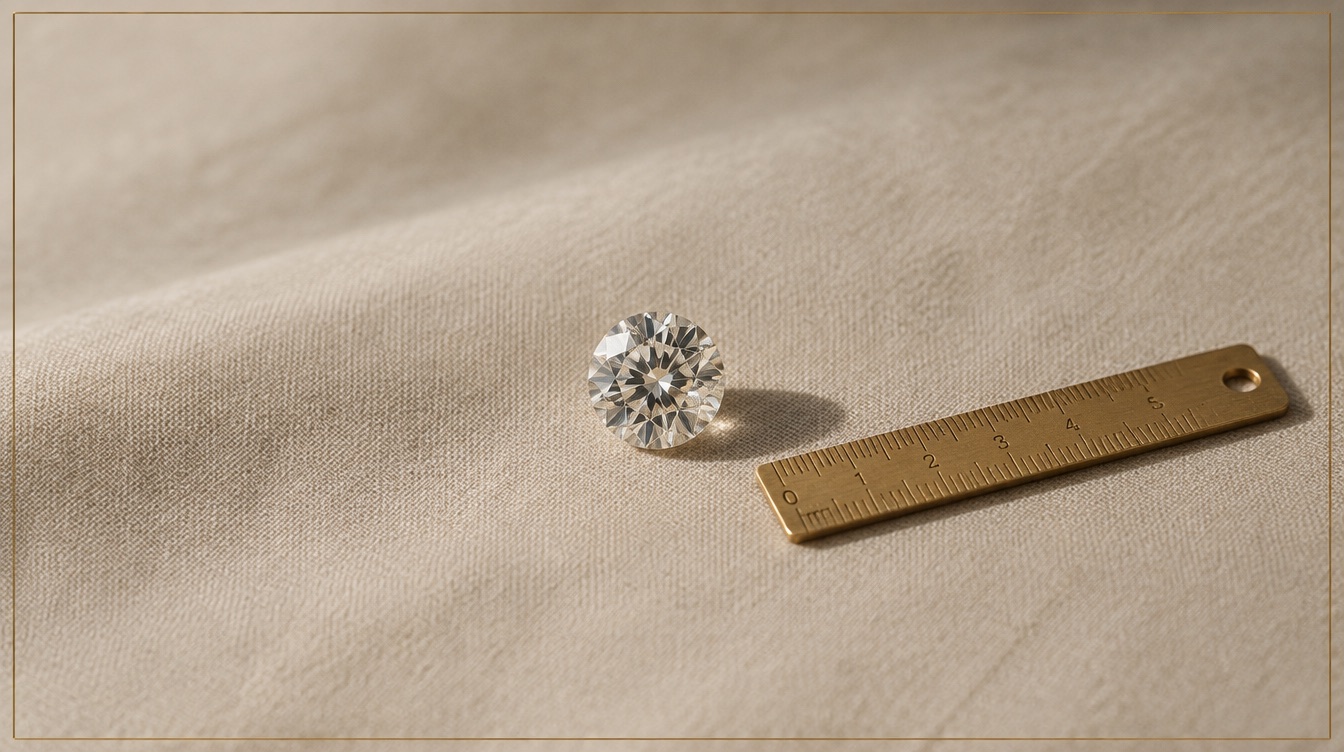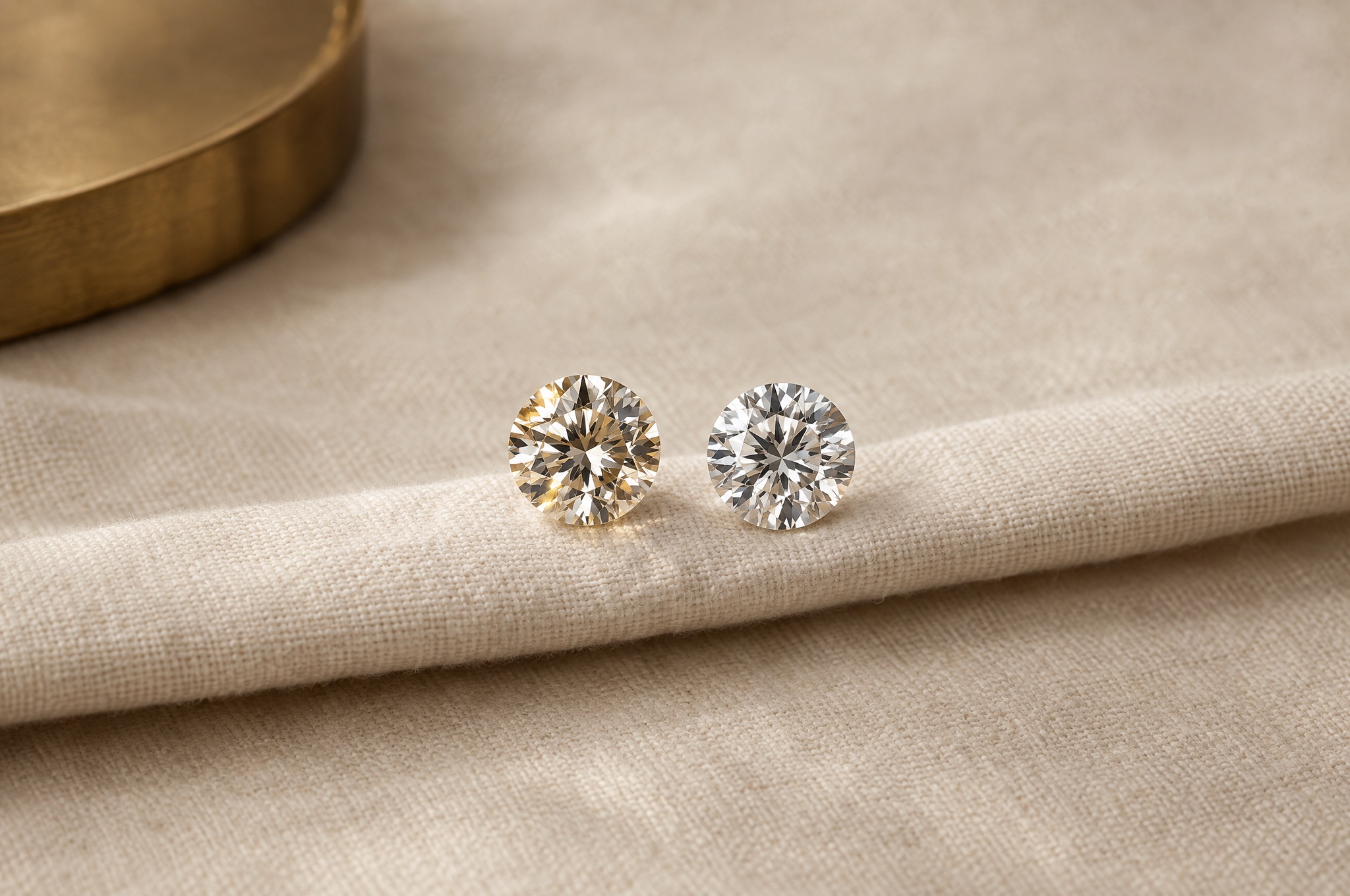
Lab-grown diamonds typically cost 60-90% less per carat than natural diamonds of comparable size and quality, and that gap widens as carat weight increases. Natural diamond prices also don't scale in a straight line — cost per carat jumps sharply at whole-carat marks like 1.00ct and 2.00ct — while lab-grown pricing has kept declining as CVD production has scaled globally.
For jewelers, that pricing dynamic isn't just a talking point for the sales floor — it's a sourcing and margin decision that shapes how a store stocks its case, what it can offer at different price points, and how it explains the difference to customers who are comparing the two categories side by side. This guide breaks down the real, general pricing mechanics behind natural and lab-grown diamonds, without a sales pitch attached, so buyers can make informed stocking decisions.
None of the figures below are a live price quote or a proprietary price list. They're general, widely-observed market ranges meant to illustrate how the two categories compare and why the gap between them behaves the way it does — useful context for anyone building a buying strategy, not a substitute for checking current pricing on a specific stone.
How Natural Diamond Prices Are Determined
Natural diamond pricing is built on scarcity. Every natural diamond formed over a billion or more years under specific geological conditions, and the supply of rough diamonds coming out of the ground each year is finite and shrinking as older mines deplete. That scarcity, combined with the four Cs — carat, cut, color, and clarity — is what drives price at every size and quality tier.
Because rough supply is fixed in the short term, natural diamond prices respond to global demand cycles, mine output, and the shrinking pipeline of new large deposits. A well-cut, eye-clean natural diamond in a popular size will almost always command a premium simply because there is a limited and non-renewable supply of it, regardless of how efficiently it's cut or distributed.
The four Cs interact with each other rather than adding up independently. A larger stone with slightly lower clarity can sometimes price similarly to a smaller stone with higher clarity, and color grade shifts matter more at certain size thresholds than others. This interplay is part of why two natural diamonds that look nearly identical to the eye can carry noticeably different price tags — the grading report is doing a lot of the pricing work, not just the visual impression of the stone.
How CVD Lab-Grown Diamond Prices Are Determined
Lab-grown diamonds are chemically, physically, and optically identical to natural diamonds, but they're produced in a controlled growing environment rather than mined. Guru Diam's lab-grown catalog is CVD (Chemical Vapor Deposition) exclusively — a process where carbon-rich gas is deposited onto a diamond seed layer by layer inside a chamber until a rough crystal forms.
Because CVD diamonds are manufactured rather than mined, their pricing behaves more like other manufactured goods: it's driven primarily by production capacity, growing chamber throughput, and manufacturing efficiency, not geological scarcity. As more growing facilities have come online globally and yields have improved, per-carat production costs have fallen — and that decline has passed through directly to wholesale and retail pricing.
Grading still matters for CVD stones — color, clarity, and cut quality are assessed the same way they are for natural diamonds, and a well-cut, high-clarity CVD stone will cost more than a lower-grade one of the same size. But because the underlying production cost curve is so much lower across the board, even top-grade lab-grown material still lands far below natural pricing at the same carat and quality combination.
Natural vs Lab-Grown Diamond Price Per Carat
The table below illustrates typical, general market price ranges per carat for a round, near-colorless, eye-clean diamond at each carat tier. These are broad, commonly cited industry ranges for context and education only — not a live quote or a Guru Diam price list. Actual pricing on any individual stone depends on cut quality, color, clarity, certification, and current market conditions at the time of purchase.
| Carat Weight | Natural Diamond (typical range, per carat) | Lab-Grown CVD Diamond (typical range, per carat) | Approximate Discount |
|---|---|---|---|
| 0.30 - 0.49ct | $800 - $1,500 | $150 - $300 | ~75-85% |
| 0.50 - 0.99ct | $1,800 - $3,500 | $250 - $500 | ~80-85% |
| 1.00 - 1.49ct | $4,500 - $7,500 | $500 - $900 | ~85-90% |
| 1.50 - 1.99ct | $6,500 - $10,000 | $700 - $1,300 | ~85-90% |
| 2.00 - 2.99ct | $9,000 - $15,000 | $900 - $1,800 | ~85-90% |
| 3.00ct+ | $15,000 - $30,000+ | $1,200 - $2,500 | ~85-92% |
The pattern to notice isn't just that lab-grown is cheaper at every tier — it's that the discount percentage grows wider as carat size increases. That's the direct result of two forces moving in opposite directions at once: natural diamond prices accelerating with size, and lab-grown prices staying comparatively flat.
Why Is There Such a Large Price Gap?
Natural Diamond Supply Constraints
Large, gem-quality rough natural diamonds are rare relative to demand, and major new mine discoveries have become increasingly infrequent. Existing mines are also aging, meaning average rough quality and output have been trending downward at several long-running sites. This constrained, non-renewable supply is the fundamental reason natural diamond prices have historically trended upward over time and remain resistant to sharp declines.
Even when overall consumer demand softens, natural diamond pricing tends to be sticky on the way down, since suppliers holding finite rough inventory have little incentive to discount sharply into a shrinking, irreplaceable supply. That stickiness is one of the clearest structural differences between how the two categories respond to a slow retail season.
Lab-Grown Production Economics
CVD production, by contrast, is a scalable manufacturing process. As more growing capacity has been built out worldwide, the cost to produce a rough CVD diamond of a given size has dropped substantially — and that cost curve is expected to keep bending downward as equipment and processes continue to improve. Unlike mined supply, lab-grown supply can expand to meet demand, which is why its pricing behaves more like electronics or other tech-manufactured goods than like a scarce natural resource.
This is also why lab-grown pricing responds faster to shifts in supply and demand than natural pricing does. When growing capacity expands faster than retail demand absorbs it, per-carat prices tend to move down relatively quickly — a dynamic natural diamond pricing essentially never experiences given how constrained its supply side is.
The Carat Weight Premium: Why Carat Size Changes Everything
One of the most important — and most misunderstood — facts about natural diamond pricing is that it does not scale linearly with weight. A 2-carat natural diamond typically costs significantly more than twice the price of a 1-carat stone of the same quality. This "carat weight premium" exists because large, high-quality rough stones are dramatically rarer than small ones, and demand is culturally concentrated around whole-carat and half-carat weights (1.00ct, 1.50ct, 2.00ct), which pushes prices for stones at or just above those thresholds even higher.
Lab-grown diamonds show a much gentler pricing curve as carat weight increases. Because CVD growing costs scale more predictably with the time and energy needed to grow a larger crystal, price per carat rises more modestly from one size tier to the next — which is exactly why the price gap between natural and lab-grown widens so noticeably at 1ct and above. For jewelers, this means the value proposition of lab-grown gets stronger, not weaker, as customers move up in carat size.
Is Lab-Grown Diamond Pricing Still Falling?
Yes, and this is a trend worth tracking rather than treating as a one-time adjustment. Since CVD lab-grown diamonds entered the mainstream jewelry market, per-carat prices have declined steadily and, in some size and quality categories, substantially — a pattern widely reported across the trade as production capacity has expanded and manufacturing processes have matured. This is a normal maturation curve for a manufactured product category, similar to price declines seen in other lab-produced materials as an industry scales.
For buyers, that means lab-grown pricing today should be understood as a snapshot, not a floor. Jewelers who stock lab-grown inventory should expect continued downward pressure on cost over time and build purchasing and pricing strategies that account for a still-declining cost basis, rather than assuming today's spread between natural and lab-grown is permanent.
Does Diamond Shape Change the Price Comparison?
Shape and cut style add another layer to the pricing conversation, and it applies to both natural and lab-grown stones. Diamond shapes generally fall into three market tiers, and each behaves differently from a price and sourcing standpoint.
| Shape Tier | Examples | General Price Behavior |
|---|---|---|
| Round / commodity | Round Brilliant | Highest demand and highest rough utilization; used as the pricing benchmark other shapes are compared against. |
| Regular fancy / mid-market | Emerald, Asscher, Cushion, Oval, Pear, Marquise, Radiant, Princess, Heart | Often priced close to or slightly below round for comparable quality, though demand spikes for specific shapes (like oval in recent years) can temporarily push prices up. |
| Antique / premium cuts | Old Mine, Old European, Hexagonal, Moval, Lozenge, Kite, Trillion, Criss-Cut, and similar specialty shapes | Command a premium in both natural and lab-grown form due to limited rough suited to these cuts and the specialized cutting expertise required — supply is far thinner than for standard shapes. |
This shape tiering matters just as much for lab-grown as it does for natural. A well-cut antique shape in CVD material still costs more to source than a commodity round in the same carat and clarity, simply because fewer suppliers carry genuine depth in those cuts. Jewelers building a differentiated case — rather than a case that looks like every other store's — often find that shape selection matters as much as the natural-versus-lab-grown decision itself.
Certification's Role in Price: IGI, GIA, and GCAL
Certification doesn't change what a diamond physically is, but it does affect buyer confidence and, in turn, price realization at retail. IGI, GIA, and GCAL are the three certifications most commonly seen across both natural and lab-grown inventory, and each grading lab has its own reputation and grading tendencies that experienced buyers factor into a purchase decision. Certified loose diamonds — natural or lab-grown — give retail customers a documented, third-party basis for the quality claims behind a stone, which matters for both insurance purposes and resale conversations down the line.
For wholesale buyers, having access to all three certifications from one source simplifies the sourcing side considerably: it means a jeweler can match certification to what a given customer segment expects, rather than being limited to whatever a single lab's reports happen to be available in.
Fancy Color Diamonds: A Different Pricing Conversation
Fancy color diamonds — both natural and lab-grown — follow pricing logic that diverges even further from standard white diamond comparisons. Natural fancy color diamonds in stronger, more saturated hues are exceptionally rare and can carry some of the highest per-carat values in the entire diamond market, often far exceeding colorless natural diamonds of the same size. Lab-grown fancy color stones, produced through CVD, offer the same visual color families at a fraction of the cost, following the same broad discount dynamic seen in white diamonds — though the specific spread varies significantly by hue and saturation.
For loose stones at 0.30ct and above, the fancy colors most commonly available and requested in the trade are yellow, pink, blue, and green. Jewelers working with clients interested in color should expect natural stones in these hues to price on a much steeper curve than their lab-grown counterparts, and should budget sourcing time accordingly since strong, well-saturated natural color in larger sizes is genuinely scarce. Browsing a dedicated fancy color loose diamond selection side by side — natural against lab-grown — is often the clearest way to see how dramatically the pricing diverges once color enters the equation.
What the Price Gap Means for Jewelers Stocking Both Categories
Margin and Price-Point Strategy
The natural-versus-lab-grown price gap gives jewelers a genuine merchandising tool rather than a problem to solve. Lab-grown inventory opens up price points that let a store serve budget-conscious shoppers, larger center stones, or upgrade conversations that wouldn't be realistic in natural material — often while preserving comparable or stronger margin percentage, since lower unit cost leaves more room between wholesale and retail. Natural diamonds, meanwhile, retain a rarity and resale narrative that a segment of customers will always pay for, regardless of what lab-grown pricing does.
Rather than treating this as an either-or decision, most successful jewelers now stock both categories side by side and let the customer's priorities — budget, size, or rarity — determine which one they walk out with.
Customer Positioning: Value vs Rarity
The two categories aren't really competing for the same customer motivation. Someone drawn to lab-grown is usually optimizing for size and budget; someone drawn to natural is usually optimizing for rarity, provenance, and long-term value perception. Framing the conversation around what the customer actually values — rather than presenting lab-grown purely as a "cheaper" substitute — tends to produce better close rates and fewer post-sale second-guessing conversations for retail jewelers.
Total Cost Considerations Beyond the Per-Carat Price
Per-carat price is the headline number, but it's not the whole cost picture for a jeweler pricing finished inventory. Certification fees, setting labor, mounting metal, and insurance appraisal costs apply to both natural and lab-grown stones in roughly similar ways, which means the percentage gap at the loose-stone level doesn't shrink much once a stone is set — it just gets diluted by a relatively fixed set of downstream costs that are the same regardless of what's in the center.
This matters for how jewelers price finished pieces. A lab-grown center stone can make a strong-margin finished ring at a lower retail price point specifically because the loose-stone cost is so much lower, while the setting, labor, and certification costs stay roughly constant. Understanding that the discount is concentrated in the stone itself — not in every line item of a finished piece — helps avoid under-pricing labor-intensive work like custom settings simply because the center stone was inexpensive to source.
Common Pricing Mistakes Jewelers Make When Stocking Both Categories
A few recurring mistakes show up when stores start carrying natural and lab-grown side by side for the first time. The first is applying the same retail markup multiple to both categories out of habit — because lab-grown wholesale cost is so much lower, a flat multiple can produce a retail price that looks suspiciously cheap to customers or leaves margin on the table if it's set too conservatively relative to what the market will bear.
The second is failing to account for the fact that lab-grown wholesale cost is still trending downward. Inventory purchased even a year or two ago at a given cost basis may no longer reflect current typical market pricing, which can distort margin calculations if pricing sheets aren't refreshed regularly.
The third is treating natural and lab-grown as a single undifferentiated "diamond" category in marketing and signage. Customers increasingly understand the distinction and often have a strong preference one way or the other — clear labeling of which stones are natural and which are lab-grown, with certification to back it up, tends to build more trust than blending the two under one generic display.
Sourcing Natural and Lab-Grown Diamonds from One Supplier
Guru Diam supplies both natural and CVD lab-grown diamonds to trade buyers — independent jewelers, designers, and manufacturers placing recurring orders — across loose stones, matched pairs, and finished jewelry. That range matters when a store is trying to stock both categories without juggling separate vendors, separate certification standards, and separate shipping schedules for what is ultimately one merchandising decision.
The catalog spans standard shapes, the antique and exotic cuts covered above (Old Mine, Old European, Hexagonal, Moval, Lozenge, Kite, Trillion, Criss-Cut, and similar), and natural fancy color stones, all available with IGI, GIA, or GCAL certification depending on the stone. In-stock loose diamonds — natural and lab-grown — are ready to ship now rather than made to order, and orders placed before 6pm EST out of New York or 4pm PST out of Los Angeles ship same day. For stores that also need finished pieces, custom engagement rings are built with cutting, setting, and polishing all handled in-house and finished in 4-6 days.
Buyers sourcing matched pairs for earrings, browsing certified inventory through the wholesale hub, or evaluating a long-term source for both natural and lab-grown stock can review account terms through the trade partner program — the goal being one vendor, one shipment, and one relationship covering both sides of the natural-versus-lab-grown decision rather than splitting sourcing across categories.
Frequently Asked Questions
Why are lab-grown diamonds so much cheaper than natural diamonds?
Lab-grown diamonds are cheaper because they're manufactured rather than mined, so their cost is driven by production capacity and process efficiency instead of geological scarcity. As CVD growing facilities have expanded worldwide, per-carat production costs have fallen and that decline has been passed through to wholesale and retail pricing, while natural diamond supply remains fixed and finite.
Do lab-grown diamond prices keep dropping over time?
Yes. Lab-grown diamond prices have declined steadily since CVD stones entered the mainstream market, and that trend is widely expected to continue as production scales and growing technology improves. Jewelers sourcing lab-grown inventory should treat current pricing as a snapshot rather than a floor.
Is a 1 carat lab-grown diamond a good deal compared to a natural 1 carat diamond?
At the 1-carat mark, lab-grown diamonds are typically priced at a steep discount to natural — often in the 85-90% range for comparable color and clarity — because natural diamond prices jump sharply right around the 1-carat threshold due to demand concentration and rarity at that size. For buyers prioritizing size and budget over rarity, 1-carat lab-grown is generally considered strong relative value.
Do natural diamonds hold their value better than lab-grown diamonds?
Natural diamonds have historically shown more price stability over time due to constrained, non-renewable supply, while lab-grown diamond values have continued to decline as production scales. Neither category should be treated as a financial investment for most buyers, but the rarity underlying natural diamonds is the primary reason it tends to hold relative value more consistently than manufactured stones.
How much of a discount should jewelers expect on lab-grown vs natural diamonds at wholesale?
General market discounts commonly cited in the trade fall in the 60-90% range depending on carat weight and quality, with the discount typically widening as carat size increases. Actual spreads vary by shape, color, clarity, and current market conditions, so it's worth checking current typical ranges before setting retail pricing on new inventory.
Does the natural vs lab-grown price gap apply the same way to fancy color diamonds?
The same general direction applies — lab-grown fancy color diamonds cost meaningfully less than natural fancy color stones — but the specific spread varies more by hue and saturation than it does for white diamonds. Natural fancy color diamonds in strong, saturated hues are especially rare and can carry very high per-carat values, making the percentage gap versus lab-grown even more pronounced in color than in colorless stones.