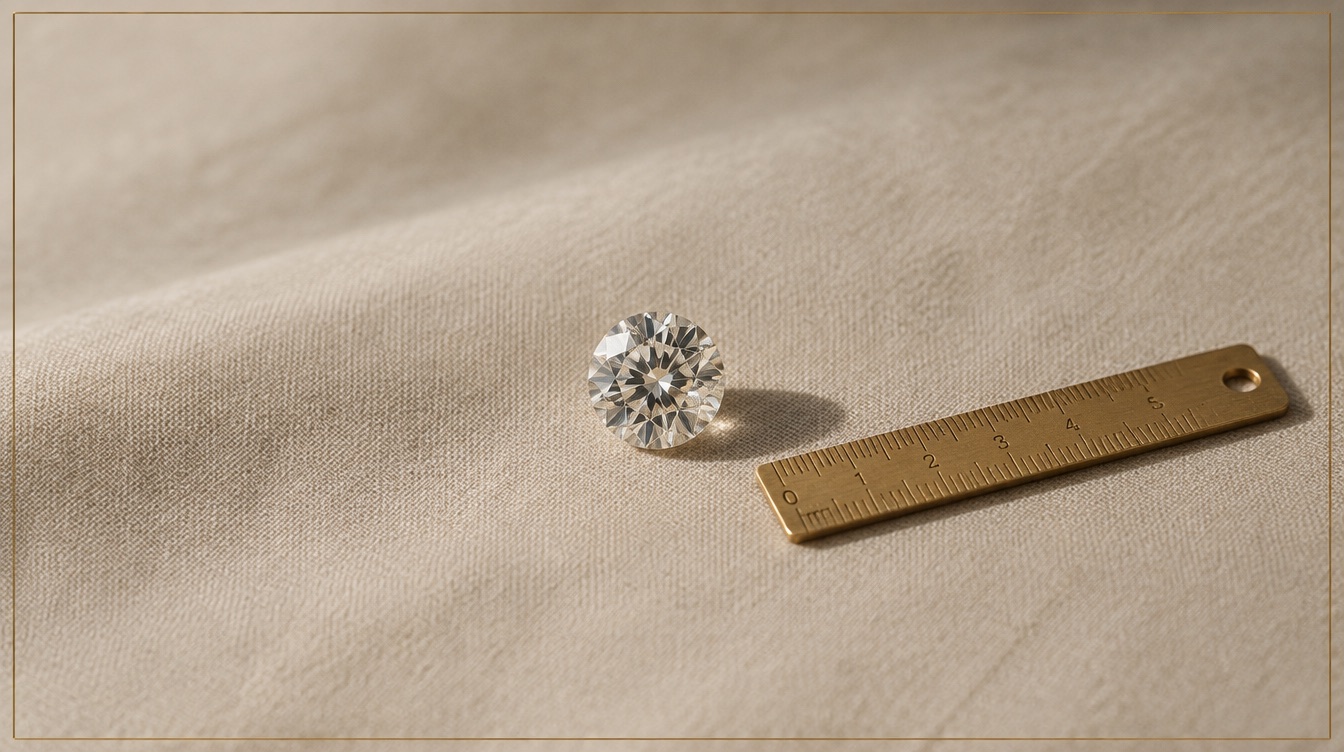
Natural diamond price per carat isn't a single number — it's the output of four interacting factors (carat weight, color, clarity, and cut) that each move price independently, plus a non-linear jump at certain carat-weight thresholds where price per carat increases faster than weight alone would suggest. A 1.00ct diamond of a given color and clarity typically costs significantly more per carat than a 0.90ct diamond of the same quality, not because the stone is meaningfully different in size, but because round-number carat weights carry their own demand premium.
This guide is written for the trade — jewelers, designers, and retailers sourcing natural, non-melee loose and certified diamonds — covering what actually drives per-carat pricing, how the 4Cs interact with price, why carat-weight thresholds create pricing jumps, how natural pricing compares to lab-grown at the same specs, and what to check before placing a wholesale order.
Why Natural Diamond Pricing Isn't Linear
A common misconception among buyers newer to natural diamond sourcing is that price scales directly with carat weight — that a 2ct diamond should cost roughly twice what a 1ct diamond of the same color and clarity costs. In practice, price per carat increases as carat weight increases, because larger natural rough is significantly rarer than smaller rough, and that rarity compounds as size increases. A well-cut natural diamond's price per carat at 2ct is typically several times higher than the same quality diamond's price per carat at 0.50ct, not merely double — this compounding rarity effect is the single most important pricing concept for a buyer new to natural diamond sourcing to internalize before requesting quotes.
The 4Cs and How Each One Moves Price Per Carat
Carat Weight
Beyond the general "bigger costs more per carat" rule above, specific carat weights carry an additional premium purely because of how they're conventionally described and shopped for. A diamond weighing 0.99ct is frequently priced noticeably lower per carat than a 1.00ct diamond of otherwise identical quality, simply because "1 carat" is the round number buyers search for and compare prices against. The same effect repeats at 1.50ct, 2.00ct, 3.00ct, and other round or half-round thresholds. A buyer willing to source a diamond just under one of these thresholds — a 0.95ct stone instead of a 1.00ct stone, for example — can often secure meaningfully better per-carat pricing for a visually indistinguishable stone.
Color
On the standard D-to-Z color scale, price per carat drops as color grade moves away from colorless (D-F) toward more noticeably tinted grades, though the drop isn't perfectly even across the scale — some grade boundaries carry a bigger price step than others depending on current market demand at each grade. Near-colorless grades (G-H) offer a common middle ground for buyers balancing visual whiteness against cost, since the color difference between G-H and D-F is difficult for most buyers to detect face-up once a stone is mounted.
Clarity
Clarity grades from Flawless/Internally Flawless down through Included move price per carat in a similar stepped pattern, with the eye-clean threshold (commonly SI1, sometimes SI2 depending on inclusion type and size) representing a meaningful pricing inflection point — clarity grades at or above that threshold, where inclusions aren't visible to the naked eye, typically carry a larger price premium than the visual difference alone would suggest, precisely because "eye-clean" is the practical quality bar most retail buyers care about.
Cut
Cut grade affects price per carat less dramatically than color or clarity in raw percentage terms, but it has an outsized effect on how a stone actually looks and performs optically — a well-cut diamond returns more light as brilliance and fire than a poorly cut stone of identical color and clarity, which is why cut quality shouldn't be traded away purely to hit a lower price point on the other three Cs.
Illustrative Price-Per-Carat Ranges by Carat Weight
The table below illustrates the general shape of how price per carat scales with carat weight at a consistent mid-range quality tier (G-H color, VS clarity, Very Good-to-Excellent cut) — actual pricing moves with the broader natural diamond market and should always be confirmed against current wholesale quotes rather than treated as a fixed reference.
| Carat Weight | Relative Price-Per-Carat Position | Note |
|---|---|---|
| 0.30–0.49ct | Lowest per-carat baseline | Smallest widely available certified sizes; melee-adjacent pricing logic starts to apply below this range |
| 0.50–0.69ct | Moderate step up from baseline | Popular accent and smaller center-stone range |
| 0.90–0.99ct | Notably lower per-carat than 1.00ct+ | The "just under a carat" pricing advantage covered above |
| 1.00–1.49ct | Significant step up at the 1.00ct threshold | Most commonly requested engagement-ring center-stone range |
| 2.00–2.99ct | Substantially higher per-carat than 1ct range | Rarity in natural rough compounds meaningfully at this size |
| 3.00ct+ | Highest per-carat tier | Increasingly rare in natural rough; per-carat pricing accelerates further |
Natural vs. CVD Lab-Grown: The Per-Carat Price Gap
At matching color, clarity, and cut specifications, CVD lab-grown diamonds price substantially below natural diamonds per carat, and that gap has continued to widen as lab-grown production capacity has scaled up over recent years. The gap is not uniform across carat weights — it tends to widen further at larger carat sizes, since natural rarity compounds with size while lab-grown production cost does not compound the same way. This makes the natural-versus-lab-grown decision an increasingly carat-weight-sensitive one: a buyer choosing between natural and lab-grown for a 0.50ct stone faces a meaningfully smaller price gap than the same buyer would face choosing between the two at 2.00ct or above.
How Wholesale Pricing Is Actually Quoted
Wholesale natural diamond pricing is typically quoted per carat against a specific combination of the 4Cs for a given stone, rather than as a flat rate applied broadly across a size range — two stones at the identical carat weight can carry meaningfully different per-carat prices if their color, clarity, or cut differ. Buyers requesting quotes should specify all four criteria clearly rather than asking for "price per carat" on carat weight alone, since a supplier quoting on carat weight alone has to make assumptions about the other three Cs that may not match what the buyer actually wants.
Shape and Its Effect on Price Per Carat
Round brilliant diamonds command the highest price per carat of any shape at matching color, clarity, and carat weight, primarily because cutting a round brilliant from rough retains a smaller percentage of the original rough's weight than most fancy shapes do — more rough is lost to achieve the round's precise proportions and optimal light performance, and that yield loss is reflected in the finished stone's price. Fancy shapes like oval, cushion, pear, and emerald typically price somewhat lower per carat than an equivalent-quality round, since they retain more of the original rough's weight during cutting. Antique cuts — Old Mine, Old European, and similar historical shapes — follow their own separate pricing logic tied to rarity and buyer demand for period-appropriate stones rather than rough-yield efficiency alone.
Certification and Its Effect on Price
A certified natural diamond — graded by GIA, IGI, or GCAL — typically commands a price premium over an uncertified stone of claimed equivalent quality, since certification provides independent, third-party verification of the 4Cs a buyer would otherwise have to take on trust. For any purchase above melee scale (roughly 0.30ct and up), sourcing certified stock is standard wholesale practice specifically because the certification cost is small relative to the pricing risk of an unverified quality claim on a stone of meaningful value.
Market Timing and Price Volatility
Natural diamond pricing moves with broader rough-supply and retail-demand cycles industry-wide, and per-carat pricing at a given quality combination can shift over months rather than staying fixed — buyers sourcing at wholesale volume should treat any price reference, including the general ranges in this guide, as a snapshot rather than a fixed number, and confirm current pricing directly with a supplier before finalizing a large order or a long-lead custom build.
Common Mistakes Buyers Make When Evaluating Price Per Carat
- Comparing price per carat across different quality combinations as if they were equivalent. A lower per-carat price on one stone versus another often reflects a real difference in color, clarity, or cut — not a better deal on the same underlying quality.
- Ignoring the carat-weight threshold effect. Buyers fixated on hitting exactly 1.00ct or 2.00ct sometimes pay a meaningful, avoidable premium versus a visually indistinguishable stone just under that threshold.
- Underweighting cut quality to optimize color and clarity numbers. A high color and clarity grade on a poorly cut stone can look less brilliant, face-up, than a slightly lower color or clarity grade cut to excellent proportions — the numbers on a certificate don't tell the whole visual story.
- Not requesting certification on stones above melee scale. An uncertified claim of quality on a stone of meaningful carat weight carries real pricing risk that a modest certification cost avoids.
Questions Worth Asking a Supplier Before Ordering
- What specific color, clarity, and cut grade is this per-carat price quoted against? A price per carat without the full 4C context is not directly comparable across different offers.
- Is the stone certified, and by which lab? Confirm before assuming a price reflects third-party-verified quality.
- How does this compare to the same specs in CVD lab-grown material? Useful context for a retailer deciding how to position both options for their own customers.
- Is pricing near a round carat-weight threshold, and is a just-under-threshold alternative available? Worth asking explicitly if the buyer has flexibility on exact carat weight.
Fancy Color Natural Diamonds: A Separate Pricing Logic Entirely
Everything covered above applies to colorless-to-near-colorless natural diamonds graded on the standard D-to-Z scale. Fancy color natural diamonds — yellow, pink, blue, green, and other genuinely colored stones — follow a fundamentally different pricing logic where hue, tone, and saturation intensity drive price per carat far more than the colorless-scale factors do, and rarity of a specific color combination can push price per carat dramatically higher than an equivalent-carat colorless stone of even top color and clarity. A buyer moving from sourcing colorless natural diamonds into fancy color natural stock should expect price-per-carat comparisons across the 4Cs framework above to be far less reliable, since fancy color pricing is driven primarily by color desirability and rarity rather than proximity to a "flawless, colorless" ideal the way standard natural diamond pricing is structured.
How Melee Pricing Logic Differs From Loose Certified Stone Pricing
Everything in this guide's pricing discussion applies to loose, individually certified natural diamonds, generally 0.30ct and above. Diamond melee — small stones below that threshold — follows a meaningfully different pricing structure: melee is typically priced and sold as graded parcel lots against a consistent commercial quality baseline (commonly DEF+/VS+) rather than certified and priced stone-by-stone against the specific 4C combination of each individual stone. A buyer sourcing both melee and larger certified stones for the same project — a halo ring with a certified center stone and melee accent stones, for example — should expect to work with two genuinely different pricing conversations with a supplier, not a single unified per-carat rate across both stone categories.
Industry Pricing Benchmarks and Why They Matter for Wholesale Buyers
The natural diamond trade relies on published industry pricing guides and benchmark lists as a common reference point for wholesale negotiation, giving buyers and sellers a shared, market-wide baseline to negotiate discounts or premiums against rather than each transaction starting from scratch with no external reference. These benchmark prices update on a regular cycle to reflect current rough supply and retail demand conditions, which is part of why the illustrative price ranges earlier in this guide are described as a snapshot rather than a fixed number — a buyer sourcing at meaningful wholesale volume should ask a supplier directly which current benchmark, if any, their quoted pricing is set against, since this makes it far easier to evaluate whether a specific quote represents a genuine discount or premium relative to the broader market at the time of purchase.
How Origin and Supply Chain Documentation Affect Pricing
Beyond the 4Cs, a growing share of wholesale and retail buyers ask for documentation of a natural diamond's country of origin and supply chain history, driven partly by retail-customer interest in sourcing transparency and partly by baseline industry compliance requirements around conflict-free sourcing. A natural diamond accompanied by clear Kimberley Process documentation and, increasingly, more granular chain-of-custody paperwork tracing the stone from mine to market doesn't typically command a large standalone price premium the way a top color or clarity grade does, but its absence can meaningfully limit which buyers are willing to transact at all, particularly larger retailers and any buyer selling into markets with stricter sourcing-disclosure expectations. A wholesale buyer should treat clean origin documentation as a baseline expectation for any natural diamond purchase rather than an optional premium feature, since the practical cost of sourcing undocumented stock — in lost buyer access, not necessarily in a directly quoted premium or discount — has grown significantly as the trade's disclosure standards have tightened.
Practical Steps for Comparing Quotes Across Suppliers
Because price per carat depends on the full 4C combination rather than carat weight alone, comparing quotes from multiple wholesale suppliers requires more than lining up per-carat numbers side by side. A buyer should request the full grading report — not just a summary — for any stone being seriously considered, confirm the certifying lab is consistent across the quotes being compared (since buyer perception and, in some cases, actual market pricing can vary modestly between labs even at matching stated grades), and confirm whether a quoted price includes or excludes any additional costs like shipping, insurance, or a returns/exchange allowance that one supplier might absorb into their quote and another might not. Building a simple, consistent comparison checklist — carat weight, color, clarity, cut grade, certifying lab, and all-in cost including any additional fees — before requesting quotes from multiple suppliers makes it far easier to identify a genuinely better offer rather than one that merely looks better due to a difference in what's actually being compared.
Antique and Fancy Shape Pricing: A Note on Rarity Beyond the 4Cs
Antique cuts — Old Mine, Old European, Kite, Hexagonal, and similar historical shapes — add a rarity dimension to natural diamond pricing that sits outside the standard 4C framework entirely. Because these shapes are no longer commonly cut from new rough at scale the way round brilliants and modern fancy shapes are, genuinely antique or antique-style natural stones in these cuts can command a pricing premium tied specifically to shape scarcity and buyer demand for period-accurate material, independent of how that premium would be predicted from carat weight, color, and clarity alone. A buyer sourcing antique-cut natural diamonds should expect this category to price less predictably against the general benchmarks covered above, and should request current, shape-specific wholesale quotes rather than extrapolating from round-brilliant pricing.
Sourcing Natural Diamonds Wholesale
Guru Diam supplies certified natural loose diamonds alongside its CVD lab-grown catalog, with IGI, GIA, and GCAL certification all available, across round brilliants and the full range of fancy and antique shapes. Because natural and lab-grown pricing differ substantially at matching specifications, offering both from a single source lets a buyer compare real, current wholesale pricing side by side rather than sourcing each origin from a separate supplier. In-stock inventory ships same-day from Guru Diam's New York and Los Angeles locations, and trade accounts can browse current certified natural stock through certified diamonds, review fancy color natural options through fancy color loose diamonds, and check matched-pair availability through matching pairs. Buyers building a custom piece around a natural center stone can start at custom jewelry, and new trade accounts can apply through trade partner, with current terms available at the wholesale hub.
Frequently Asked Questions
Why does a 1 carat diamond cost more per carat than a 0.90 carat diamond?
Round, commonly searched carat weights like 1.00ct carry an added demand premium beyond what the small weight difference alone would explain, since buyers frequently search and compare prices specifically at round-number thresholds. A 0.90-0.99ct diamond of otherwise identical quality typically prices lower per carat than a 1.00ct stone.
What are the biggest factors that affect natural diamond price per carat?
Carat weight, color, clarity, and cut (the 4Cs) all move price independently, with carat weight having the most dramatic effect due to the compounding rarity of larger natural rough. Cut quality affects visual performance more than its price impact alone would suggest, and shouldn't be minimized purely to optimize the other three Cs.
How much more expensive is natural compared to lab-grown per carat?
Natural diamonds price substantially higher than CVD lab-grown diamonds at matching color, clarity, and cut, and that gap widens further at larger carat weights, since natural rarity compounds with size in a way lab-grown production cost does not.
Does diamond shape affect price per carat?
Yes — round brilliants typically command the highest price per carat of any shape at matching quality, since cutting a round from rough retains less of the original rough's weight than most fancy shapes, which is reflected in the finished stone's price.
Should I buy a certified natural diamond?
For any stone above melee scale (roughly 0.30ct and up), yes — certification from GIA, IGI, or GCAL provides independent verification of the 4Cs, and the certification cost is small relative to the pricing risk of an unverified quality claim on a stone of meaningful value.
Does natural diamond price per carat stay stable over time?
No — pricing moves with broader rough-supply and retail-demand cycles and can shift over months. Any price reference should be treated as a snapshot, with current pricing confirmed directly with a supplier before a large or long-lead order.
Guru Diam is a trade-only wholesale diamond supplier with locations in New York and Los Angeles, supplying certified natural and CVD lab-grown loose diamonds with IGI, GIA, and GCAL certification all available. Browse certified natural inventory through certified diamonds or apply for a trade account through trade partner.