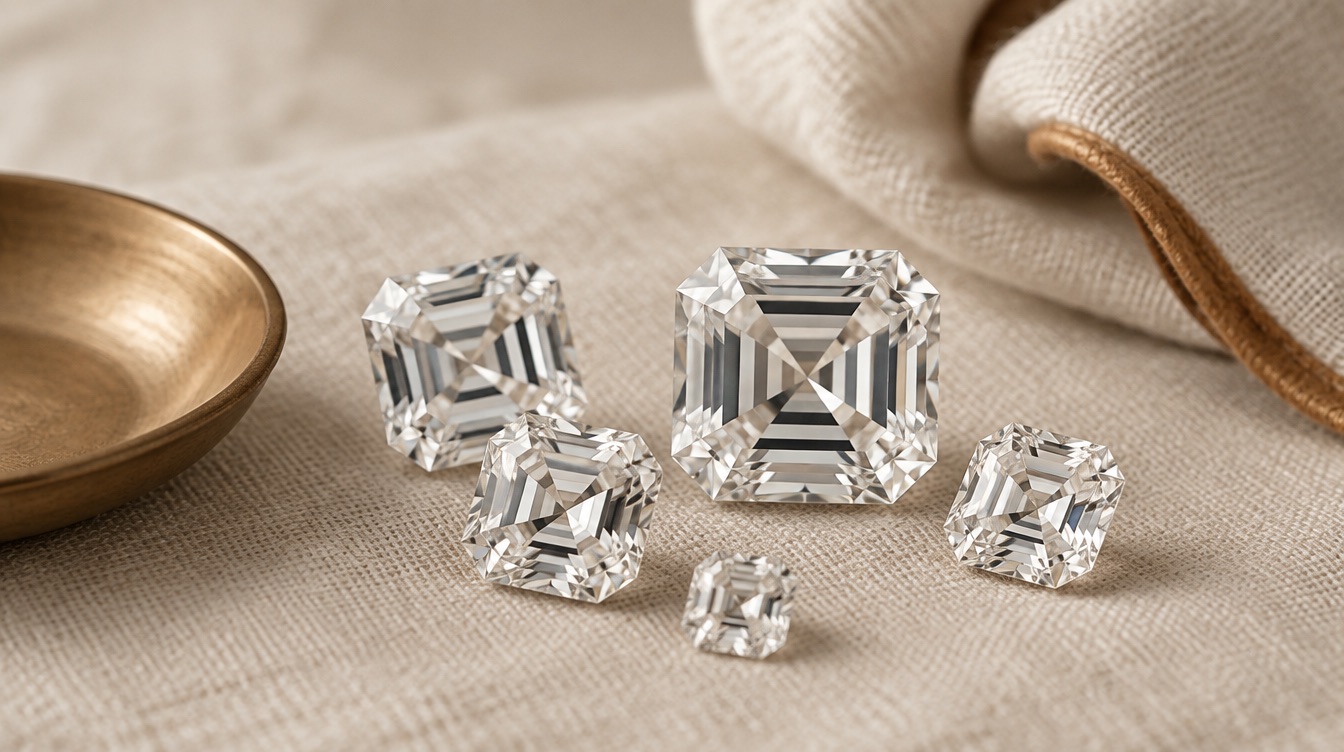
A natural asscher cut diamond is a square step-cut stone with deeply cropped corners, a large open table, and parallel concentric facets that produce a distinctive "hall of mirrors" optical effect rather than the scattered brilliance of a round or cushion cut. It is mined and formed underground over geologic time, then faceted using the same step-cut architecture the Asscher Brothers patented in 1902. For wholesale buyers, the asscher cut sits in a regular fancy tier — not antique, despite its vintage look — and it rewards careful sourcing because its open facets show clarity and cut quality more openly than almost any other shape.
This guide walks through where the cut comes from, how it differs from its closest cousin (the emerald cut), what clarity and color grades actually matter, how to read proportions specific to asscher, how carat weight translates to millimeter size, how natural asscher compares with lab-grown CVD asscher as a separate purchasing decision, which settings suit the shape, how GIA grades and certifies these stones, and what a jeweler sourcing wholesale should look for before committing to inventory.
A Brief History of the Asscher Cut
The asscher cut was patented in 1902 by the Asscher Brothers of Holland, a diamond cutting house in Amsterdam that had already built a reputation for precision cutting — the same firm later cleaved the enormous Cullinan diamond in 1908. The original asscher cut was a square step cut with a high crown, small table, and deeply cropped corners, designed to maximize the play of light through layered, mirror-like facets rather than the fire and scintillation associated with brilliant cuts.
The design fell out of mainstream fashion for much of the mid-20th century as round and brilliant cuts dominated bridal markets, but it never disappeared from estate and vintage collections. In 2001, descendants of the original Asscher family reintroduced a modernized version called the Royal Asscher cut, which added additional facets (typically bringing the total facet count to 74, compared with 58 on a standard round brilliant) and adjusted proportions for a marginally larger table and more brightness under modern lighting. Today "asscher cut" is used as a general shape category, while "Royal Asscher" refers specifically to stones cut and licensed under that modernized patent and typically carries additional certification and cost.
What Makes the Asscher Cut Distinctive
Several structural features separate an asscher from other square or rectangular cuts:
- Deeply cropped corners. The four corners are cut at a steep angle, giving the stone an octagonal outline even though it reads as square from a distance.
- Step-cut facet arrangement. Facets run in parallel, concentric rows around the stone rather than the triangular and kite-shaped facets of a brilliant cut. This is the same broad facet family as the emerald cut.
- A large, open table. The wide flat top facet acts like a window into the stone, which is part of why asscher diamonds are sometimes described as having a "hall of mirrors" effect — light bounces between the internal step facets in a way that creates broad, alternating flashes of light and dark rather than the scattered sparkle of a brilliant cut.
- A near-square outline. Classic asscher proportions target a length-to-width ratio close to 1.00–1.05, distinguishing it from the more elongated emerald cut.
The tradeoff buyers should understand up front: the same open facets that create the cut's signature optical drama also make internal characteristics more visible. This is the single most important fact to communicate to any buyer new to step cuts.
Asscher vs. Emerald Cut: How They Differ
Asscher and emerald cuts are frequently confused because both are step cuts with cropped corners, but they are not interchangeable, and buyers sourcing for a specific design brief need to know the difference.
| Feature | Asscher Cut | Emerald Cut |
|---|---|---|
| Outline shape | Square (length-to-width ~1.00–1.05) | Rectangular (length-to-width ~1.30–1.50 typical) |
| Corner crop | Deep, giving a more octagonal look | Shallower, more elongated corners |
| Facet count (standard) | Typically 58 facets; Royal Asscher up to 74 | Typically 57 or 58 facets |
| Visual effect | Concentrated, symmetrical hall-of-mirrors flash | Elongated corridors of light down the length of the stone |
| Finger coverage per carat | More compact, appears slightly smaller face-up per carat than an elongated shape | Appears larger and more elongated face-up per carat |
| Historical origin | Patented 1902, modernized 2001 (Royal Asscher) | Step-cut style dating to the 1500s, standardized in the 20th century |
Neither cut is objectively "better" — the choice comes down to the finger shape and aesthetic a customer wants. A jeweler stocking both natural asscher and natural emerald cut inventory can cover both preferences from a single step-cut category.
Clarity Considerations for Step Cuts
This is the tradeoff that most affects sourcing decisions. Because an asscher cut has a wide open table and long, flat step facets instead of the light-scattering triangular facets of a brilliant cut, inclusions and even minor polish lines are far more visible to the naked eye. A brilliant round cut of SI1 clarity can often look eye-clean because its facet pattern breaks up and hides small inclusions. The same clarity grade in an asscher cut will frequently show visible inclusions in the open table, especially under normal indoor lighting.
For that reason, most experienced buyers set a higher clarity floor for step cuts than they would for brilliant cuts:
| Clarity Grade | Typical Visibility in Asscher Cut | Wholesale Recommendation |
|---|---|---|
| FL / IF | No visible inclusions even under magnification | Premium tier; justified for large or investment-grade stones |
| VVS1 / VVS2 | Inclusions essentially invisible face-up | Strong choice for larger carat weights (2ct+) where visibility risk increases |
| VS1 | Very unlikely to be visible face-up in most sizes | Solid mid-market recommendation |
| VS2 | Usually eye-clean, but inclusion placement matters more than in brilliant cuts | Minimum recommended floor for most step-cut engagement inventory |
| SI1 / SI2 | Inclusions often visible in the open table without magnification | Only stock with a clean plot review; verify eye-cleanliness stone by stone |
The practical rule of thumb passed down in the trade is to prioritize VS2 or better for a natural asscher cut intended for a clean, eye-clear look — and to always review the actual inclusion plot rather than relying on grade alone, since placement (center-table inclusions are far more visible than ones tucked near the girdle) matters as much as the grade itself.
Color Considerations
Step cuts also handle body color differently than brilliant cuts. Because light travels in broad, flat planes rather than scattering into many small facets, a step-cut stone can show color more readily in the corners and along the length of the table, particularly in larger carat weights. A round brilliant can often mask a G or H color grade almost entirely; an asscher cut of the same color grade is more likely to show a faint warmth, especially in stones over 1.5 carats.
General color guidance for natural asscher cut diamonds:
- D–F (colorless): No visible warmth; reserved for buyers prioritizing maximum whiteness, typically at a price premium.
- G–H (near-colorless): The most common sweet spot for asscher cuts — color is not typically noticeable face-up, especially set in white metal.
- I–J: Can still read as white in smaller carat weights or warmer metal settings (yellow or rose gold), but buyers should be shown the stone under neutral lighting before committing.
- K and below: Warmth becomes increasingly visible in the open table; better suited to fancy color positioning than a "colorless" sale.
Cut Quality and Proportions Specific to Asscher
Unlike round brilliants, there is no single universal "ideal cut" grading scale for step cuts, so buyers need to evaluate proportions directly rather than relying on a single grade term. Key proportions to check on a lab report or a physical review:
- Table percentage: Typically 60–68% for a well-proportioned asscher. A table that is too large can wash out the step-facet effect; too small can make the stone appear dark in the center.
- Depth percentage: Generally 60–68% depending on the specific cutting style; overly deep stones can appear smaller face-up than their carat weight suggests and may show a dark "bowtie"-like shadow across the center.
- Crown angle and pavilion depth: These determine how much light returns to the eye. Because step cuts rely on broad flat reflections rather than dispersed brilliance, proportions slightly outside brilliant-cut norms are normal and expected — buyers should compare against step-cut-specific benchmarks, not round-cut ideal-cut charts.
- Corner crop ratio: The size of the cropped corners relative to the total outline affects how "square" versus "octagonal" the stone reads. A deeper crop is closer to the traditional 1902-patent look; a shallower crop reads closer to a squared emerald cut.
- Symmetry: Because step facets run in long parallel lines, any misalignment is far more visible to the eye than in a brilliant cut, where facet patterns disguise minor asymmetry. Excellent or very good symmetry grades matter more here than in most other shapes.
Because GIA and other major labs do not assign an overall cut grade to fancy shapes the way they do to round brilliants, a buyer evaluating a natural asscher diamond wholesale should request the full proportions section of the certificate and, ideally, view the stone in person or through high-resolution imagery before finalizing an order.
Carat Weight to Millimeter Size Reference
Because the asscher cut has a compact, near-square outline, it tends to face up smaller per carat than elongated shapes like emerald or oval. The table below gives approximate sizing for well-proportioned natural asscher cut diamonds; actual dimensions vary with depth and table percentage.
| Carat Weight | Approx. mm Size (L x W) |
|---|---|
| 0.50 ct | 4.5 x 4.5 mm |
| 0.75 ct | 5.0 x 5.0 mm |
| 1.00 ct | 5.5 x 5.5 mm |
| 1.50 ct | 6.2 x 6.2 mm |
| 2.00 ct | 6.8 x 6.8 mm |
| 3.00 ct | 7.7 x 7.7 mm |
| 5.00 ct | 9.0 x 9.0 mm |
These figures are useful for quoting expected face-up size to retail customers and for cross-checking whether a specific stone's dimensions on a certificate fall within a normal range for its carat weight, or whether it has been cut unusually deep or shallow.
Natural vs. Lab-Grown (CVD) Asscher: A Separate Purchasing Decision
Buyers frequently ask how a natural asscher cut diamond compares with a lab-grown asscher cut diamond. It is important to treat these as two distinct product lines rather than variations of the same stone — they differ in origin, price structure, and certification pathway, even when cut to identical proportions.
- Formation: A natural asscher diamond forms in the earth's mantle over roughly one to three billion years and is later mined. A lab-grown asscher diamond is created in a controlled chamber using the CVD (chemical vapor deposition) process, which typically takes a few weeks to a few months to grow a rough crystal of comparable size.
- Price: Because of the difference in production method and scarcity, natural asscher diamonds generally command a meaningfully higher price per carat than CVD lab-grown asscher diamonds of comparable clarity, color, and size — the price gap is one of the primary factors driving customer choice between the two.
- Certification: Natural diamonds are most commonly certified by GIA, with IGI and GCAL also issuing natural diamond reports. Lab-grown diamonds carry their own distinct report types from the same major labs, which explicitly identify the stone as laboratory-grown — a legitimate report will never blur this distinction.
- Optical performance: A well-cut CVD asscher and a well-cut natural asscher of the same proportions will show essentially the same optical behavior, since the step-cut facet geometry — not the origin of the carbon — determines how light moves through the stone.
For a jeweler building assortment, natural and lab-grown asscher belong in separate SKUs with separate certification on file, sold to customers as a clear origin choice rather than a single blended product.
Settings That Suit the Asscher Cut
Because the asscher cut has a bold, geometric outline and shows its clarity openly, setting choice affects both durability and visual presentation:
- Four-prong setting: The most common and protective choice — prongs placed over the corners (the strongest, least brittle points of the stone) secure the diamond without covering the step facets along the sides.
- Halo setting: A halo of smaller melee diamonds around the center stone adds perceived size and brightness, which can help balance an asscher's more subdued, less scintillating optical character compared with a brilliant cut.
- Cathedral setting: Raised shoulders that lift the stone and echo its architectural, symmetrical lines — a natural aesthetic pairing for a shape whose entire identity is built on precise geometry.
- Bezel or half-bezel setting: Offers strong corner protection for everyday-wear pieces, though a full bezel will mute some of the step-facet light play by covering the girdle edge.
Corner protection deserves particular attention regardless of setting style: the deep crop of an asscher's corners creates a point that, left unprotected, is more vulnerable to chipping than the rounded girdle of a brilliant cut. Prong or bezel coverage at the corners is a practical durability requirement, not just a style choice.
How Natural Asscher Diamonds Are Graded and Certified
GIA (the Gemological Institute of America) is the most widely referenced and expected grading authority for natural diamonds, including asscher cuts, and its reports are treated as the trade standard for natural stone verification. A GIA natural diamond grading report for an asscher cut typically includes:
- Carat weight, measured to the hundredth of a carat
- Color grade (D–Z scale)
- Clarity grade (FL to I3 scale), including an inclusion plot diagram
- Measurements (length, width, depth in millimeters)
- Proportions (table %, depth %, girdle thickness, culet size)
- Polish and symmetry grades
- Fluorescence rating, where applicable
Because fancy shapes like asscher do not receive an overall cut grade from GIA the way round brilliants do, the proportions and symmetry sections of the report carry extra weight for buyers trying to judge cut quality. IGI and GCAL also issue natural diamond certification and are recognized in the trade; for a natural asscher specifically, a GIA report is generally the most immediately trusted reference point for both wholesale buyers and retail customers researching a stone before purchase.
Sourcing a Natural Asscher Cut Diamond Wholesale
Sourcing step cuts wholesale requires more diligence than sourcing round brilliants, precisely because clarity, symmetry, and proportion issues are harder to hide. A few practical points for jewelers building or refreshing an asscher assortment:
- Request the full certificate — not just a grade summary — so the inclusion plot and proportions can be reviewed before committing to inventory.
- Ask for high-resolution imagery or video under standard lighting rather than a single studio glamour shot, since step-cut visibility issues can be easy to miss in a single well-lit photo.
- Build assortment depth across a few clarity tiers (VS1–VS2 as a clean-eye baseline, with select VVS pieces for larger carat weights) rather than stocking a single clarity grade across all sizes.
- Keep natural and lab-grown CVD asscher inventory clearly separated in both physical stock and listing metadata, with certification type visible at a glance.
- Pair loose natural asscher stones with matching-pair inventory when a customer needs two coordinated stones for earrings or a three-stone ring.
Guru Diam supplies natural asscher cut diamonds as certified loose stones with GIA, IGI, and GCAL documentation available, alongside the broader antique-cut, fancy-color, and finished jewelry catalog jewelers need to fill out a full assortment from one supplier. Certified natural stones — including step cuts like asscher and emerald — can be reviewed in the certified diamonds category, and buyers assembling earrings or side-stone sets can check matching pairs for coordinated inventory. Orders on in-stock certified stones ship same day from either the New York headquarters (before 6pm EST) or the Los Angeles office (before 4pm PST), and wholesale accounts can review current natural and lab-grown availability side by side through the wholesale hub. Retail partners building a custom piece around a natural asscher center stone can move to a finished ring through the custom jewelry program, with completed rings finished in 4-6 days once the stone and setting are confirmed — a timeline that applies to the finished piece, not the loose stone itself. Buyers new to sourcing directly can find account setup details through the trade partner page.
Frequently Asked Questions
What is a natural asscher cut diamond?
A natural asscher cut diamond is a mined diamond faceted into a square step cut with deeply cropped corners, a large open table, and parallel concentric facets. It was patented in 1902 by the Asscher Brothers of Holland and modernized in 2001 as the Royal Asscher cut. Unlike brilliant cuts, it produces a "hall of mirrors" effect rather than scattered sparkle.
Is the asscher cut considered an antique diamond cut?
No. Despite its vintage-inspired look and 1902 origin, the asscher cut is classified in the trade as a regular fancy (mid-market) cut, not an antique cut. Antique-tier cuts include shapes like Old Mine, Old European, Hexagonal, Moval, Lozenge, Kite, Trillion, Criss-Cut, and Padparadscha. Asscher is a modern step cut that happens to share visual DNA with some antique styles.
What clarity grade should I choose for a natural asscher cut diamond?
Because step cuts show inclusions more openly than brilliant cuts, most buyers target VS2 or better for a natural asscher cut intended to look eye-clean. Larger stones (2 carats and up) often benefit from VS1 or VVS clarity, since the open table becomes more visible to the eye as the stone grows. Always review the inclusion plot, since placement matters as much as the grade itself.
How is a natural asscher cut different from an emerald cut?
An asscher cut is square, with a length-to-width ratio close to 1.00–1.05 and more deeply cropped corners, giving it a compact, octagonal-influenced outline. An emerald cut is rectangular, typically 1.30–1.50 in length-to-width ratio, with a more elongated silhouette and longer corridors of light down its length. Both are step cuts and share the same facet family, but they read very differently on the hand.
Does GIA certify natural asscher cut diamonds?
Yes. GIA is the most widely recognized grading lab for natural diamonds, including asscher cuts, and issues full grading reports covering carat weight, color, clarity, measurements, proportions, polish, and symmetry. IGI and GCAL also certify natural diamonds and are accepted in the trade, but GIA reports are typically the most immediately trusted reference for natural stones specifically.
Is a natural asscher cut diamond more expensive than a lab-grown asscher cut diamond?
Generally, yes. A natural asscher cut diamond typically costs meaningfully more per carat than a CVD lab-grown asscher diamond of comparable clarity, color, and size, reflecting the difference in formation process and scarcity. The two should be treated as distinct product lines with separate certification, not interchangeable versions of the same stone.