
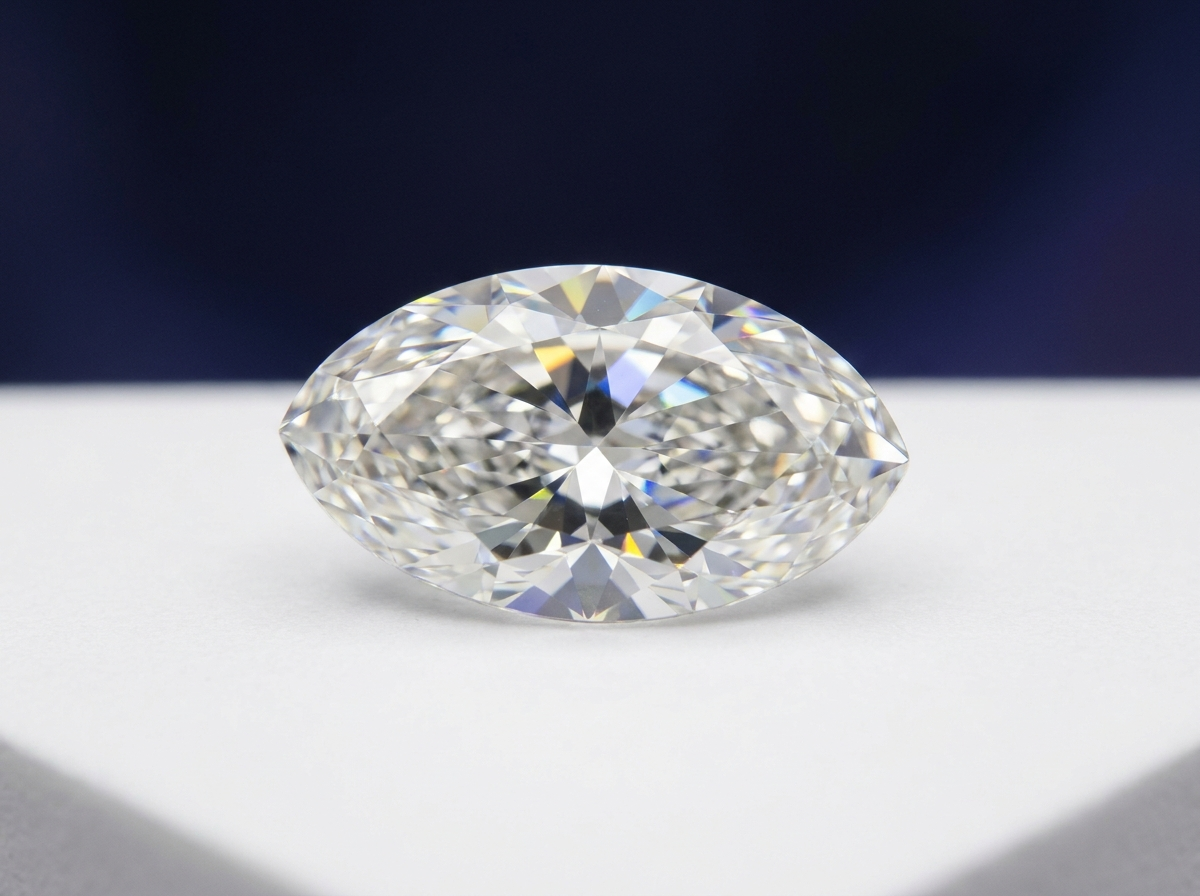
A Moval cut diamond is a hybrid center-stone shape that combines a marquise's pointed ends with an oval's softer, rounder shoulders — an elongated outline that reads less angular than a marquise and less uniform than an oval. Guru Diam stocks 176+ Moval diamonds as IGI-certified lab-grown loose inventory, cut in-house and shipped same-day from New York.
What is a Moval cut diamond?
The name is a portmanteau of "marquise" and "oval," and the outline is exactly that split down the middle: two tapered points at the ends, like a marquise, but the sides curve outward more gradually and the shoulders round off instead of running straight to the points. The result sits visually between the two parent shapes — more elongating than a plain oval, less sharply pointed than a full marquise.
That middle-ground profile is the whole appeal. A marquise's sharp points are elegant but need careful prong protection and can look severe on some hands; a plain oval is safer to wear and set but doesn't elongate the finger as dramatically. Moval keeps most of the marquise's lengthening effect while softening the points enough that the stone feels easier to live with day to day — which is a large part of why it's turned up more often in modern engagement ring design.
Trade interest in the moval diamond shape has grown alongside a broader shift toward elongated, less rigidly symmetrical fancy shapes — the same appetite that's driven demand for kite, lozenge, and hexagonal cuts over the last several ring seasons. Buyers describe the appeal in similar terms every time: a silhouette that photographs as more than a round or a cushion, without asking a client to commit to a shape as polarizing as a full marquise.
Facet structure and anatomy of the Moval cut
Moval is cut as a modified brilliant, using the same faceting logic applied to oval, marquise, and other elongated brilliant shapes rather than the step-cut arrangement used on emerald or Asscher stones. A typical Moval carries in the range of 56 to 58 facets across crown, girdle, and pavilion — a table facet, crown main and star facets, upper girdle facets, and a corresponding pavilion arrangement, adapted to an outline that isn't symmetrical along a single fixed axis the way a round or true oval is.
The two ends of the stone terminate in bezel facets that meet at a point, the same detail that makes a marquise's tips vulnerable to chipping if left unprotected — a Moval inherits that risk at a lower intensity, since the point angle is more open than on a true marquise. Along the shoulders, the facets curve rather than run in a straight taper, which is the structural reason a Moval reads softer than a marquise even before you account for length-to-width ratio. That shoulder curvature is also where cutting quality shows up first: a rushed or poorly proportioned Moval will show a visible kink or flat spot where the point facets hand off to the shoulder facets, instead of a continuous curve.
Because the shape isn't standardized the way a round brilliant is, two cutters working from the same rough can land on noticeably different Moval outlines — more marquise-forward with a longer point, or more oval-forward with a shorter, blunter tip. Guru Diam's in-house cutting holds a fixed point angle and shoulder curve across a full production run, which is what lets a wholesale buyer order several stones for a matched-pair or three-stone build and get identical outlines back.
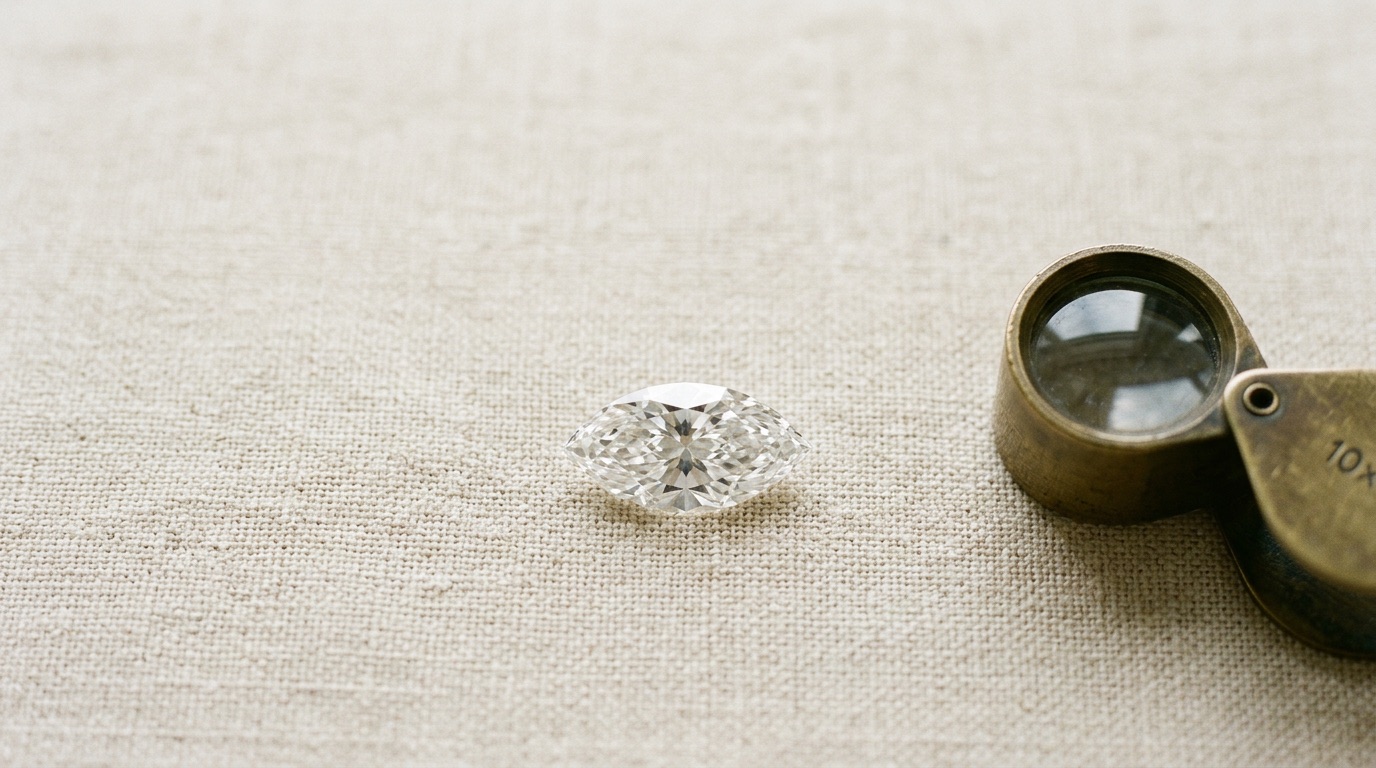
Where the moval shape comes from
Moval doesn't have its own centuries-old lineage the way old mine or old European cuts do — it's a modern hybrid, and the name only entered trade vocabulary in the last couple of decades as fancy-shape demand diversified. But the two shapes it borrows from each carry their own history, and that lineage helps explain why the hybrid works.
The marquise is the older of the two lines. Trade lore — repeated often enough in the diamond business that it's worth flagging as legend rather than verified fact — credits its elongated, pointed silhouette to an 18th-century French court commission, with the shape's name (marquise being a title of nobility) reflecting its origin as a bespoke cut rather than a standardized one. Whatever the exact origin, the marquise became the reference point for maximum finger-elongation in a fancy shape, and stayed there for two centuries.
The oval's history is shorter and better documented: the modern oval brilliant is generally credited to cutter Lazare Kaplan, who adapted round-brilliant faceting logic to an elongated outline in 1957, prioritizing brilliance and wearability over the marquise's drama. The oval became the safer, more versatile alternative — no exposed points, easier to size for a prong or bezel setting, and more forgiving across a wider range of hand shapes.
Moval sits downstream of both. As east-west settings, elongated silhouettes, and antique-adjacent fancy shapes moved from niche to mainstream over the past several bridal seasons, cutters started splitting the difference between the two established shapes rather than treating them as fixed opposites — which is how a hybrid outline with no formal grading standard of its own became common enough to need a name.
Moval vs. Marquise vs. Oval
The specs below aren't official grading-lab standards — Moval isn't a GIA or IGI shape category the way round or oval are — but they reflect how the shape is cut and sold across the wholesale trade.
| Spec | Moval | Marquise | Oval |
|---|---|---|---|
| Outline | Elongated, pointed ends, rounded shoulders | Elongated, sharp pointed ends, straight tapering sides | Elongated, no points, uniform curve |
| Point sharpness | Softened, moderate taper | Sharp, pronounced taper | None |
| Typical L:W ratio | 1.50–1.70 | 1.75–2.25 | 1.35–1.50 |
| Prong/point vulnerability | Lower than marquise, higher than oval | Highest — points need protective prongs | Lowest |
| Visual effect | Elongating with a softer silhouette | Most dramatically elongating | Elongating, most versatile setting shape |
The practical takeaway for a buyer weighing moval vs oval diamond options: an oval is the lower-risk, higher-versatility choice for a client who wants elongation without committing to anything unusual, while a Moval gets you meaningfully closer to marquise-level drama with a fraction of the prong-protection and resale-recognition tradeoffs a full marquise carries. A marquise still elongates the most and reads the most formal — the right call when a client specifically wants that silhouette and nothing else will do.
Moval and Guru Diam's Antique cut tier
Guru Diam groups its catalog into three cut tiers: commodity round brilliant, regular fancy shapes (oval, cushion, emerald, pear, marquise, and similar modern cuts), and Antique — the premium tier that includes Old Mine, Old European, Hexagonal, Lozenge, Kite, Trillion, Criss-Cut, Padparadscha, and Moval. Antique-tier cuts are the category we're most consistently asked to carry inventory for and educate buyers on, since most wholesale suppliers stock one or two of these shapes as a novelty line rather than a full range.
That distinction matters for how a buyer should think about sourcing Moval specifically: it's not a shape most lab-grown wholesalers keep meaningful depth in, cert-flexible and size-ranged the way commodity round or standard oval inventory is. A supplier carrying only one or two Moval SKUs total is signaling that the shape is an afterthought rather than a stocked category — which shows up downstream as long lead times or inconsistent outlines when a buyer needs a second stone to match the first.
Color and clarity considerations for Moval diamonds
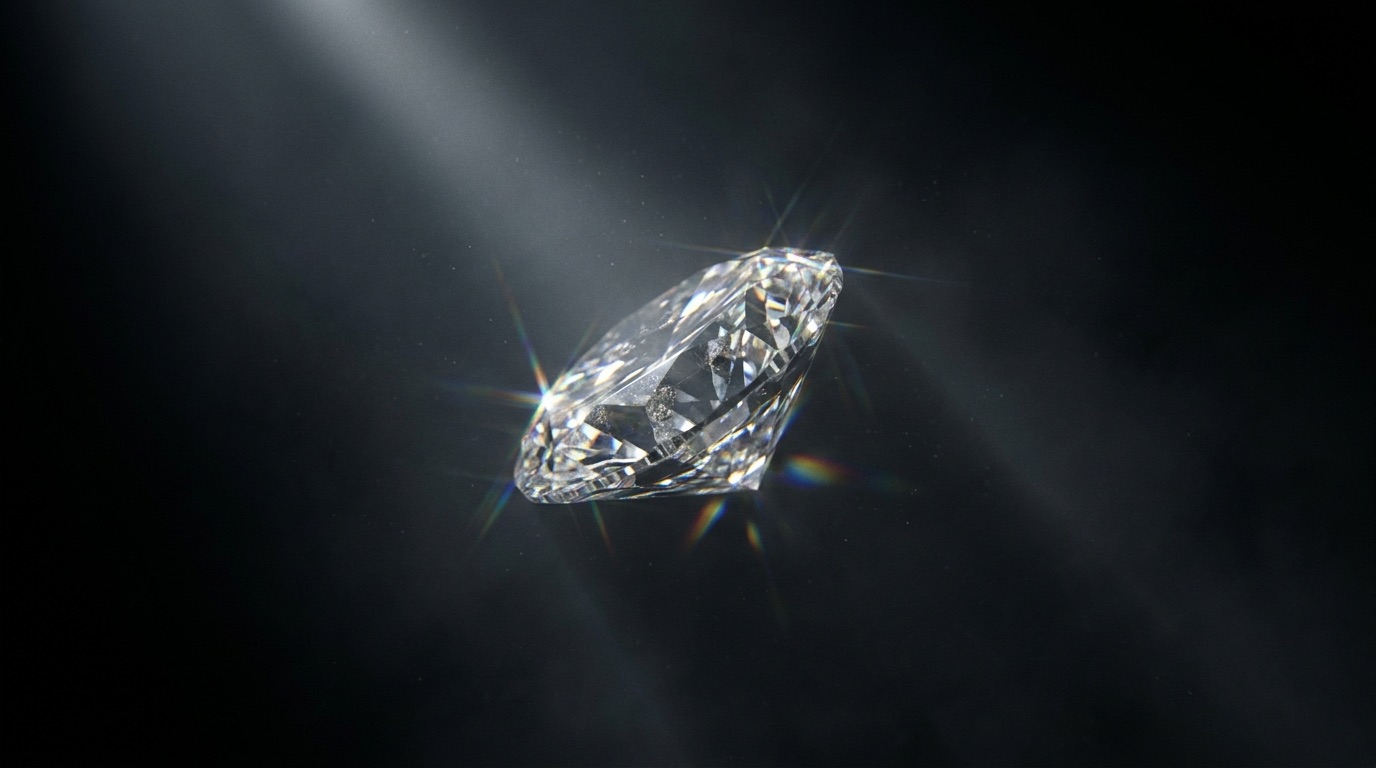
Elongated fancy shapes show color and inclusions differently than a round brilliant does, and Moval is no exception. The pavilion depth and facet pattern on an elongated cut tend to concentrate color toward the pointed ends, so a stone graded, say, H color can look slightly warmer at the tips than the same grade would look face-up on a round. That's not a defect — it's simply how light return works on an elongated outline — but it means color grade alone doesn't tell the whole story the way it might on a round brilliant, and it's worth viewing a stone (or high-resolution imagery of one) rather than buying strictly off a cert number.
Clarity works similarly: inclusions near the culet or along the pavilion can be more visible face-up on an elongated shape than the same inclusion would be on a round of equivalent clarity grade, because the facet pattern doesn't scatter light across the stone the same way. For melee or accent work this rarely matters, but for a Moval center stone — the focal point of the piece — it's worth treating clarity as something to check visually rather than relying on the grade in isolation, particularly above roughly 1 carat where inclusions have more surface area to hide, or not hide, in.
Guru Diam's Moval inventory spans a range of color and clarity combinations rather than a single fixed grade, so a buyer can match a specific budget or a specific client brief instead of being limited to one option.
Cut precision, symmetry, and the bowtie effect
The single biggest quality risk on any elongated brilliant — oval, marquise, pear, or Moval — is the bowtie effect: a dark, bowtie-shaped shadow across the center of the stone face-up, caused by pavilion facets blocking light return rather than reflecting it back through the crown. Every elongated shape shows some bowtie; the question is whether it's faint enough to read as part of the stone's character or pronounced enough to look like a flaw.
Bowtie severity comes down to cutting precision — specifically, how well the pavilion facet angles are proportioned relative to the crown and to the stone's length-to-width ratio. A well-cut Moval keeps the bowtie subtle; a rushed or poorly proportioned one can show a dark band that's visible from across a room. Because Moval isn't a standardized shape with published ideal-proportion ranges the way round brilliant has, this is one of the areas where cutting experience matters more than the cert alone — two stones with identical carat, color, and clarity grades can look meaningfully different face-up depending on how carefully the pavilion was cut.
For a wholesale buyer, the practical move is the same one that applies to any fancy shape: ask for video or high-resolution imagery of the actual stone rather than relying on the four Cs alone, especially for a center stone that's going to carry an entire ring's visual weight.
Certification: IGI, GIA, and GCAL
Guru Diam issues Moval diamonds under IGI as the trade default, with GIA and GCAL both available on request — all three internationally recognized labs, so a buyer isn't locked into one certification body regardless of what a client or a specific market prefers. Because Moval isn't a standardized shape category, the cert itself won't specify "Moval" the way it would specify "Oval" or "Marquise" — labs grade and describe the stone by its measured proportions and outline rather than by a trade nickname, so the certificate will typically read as a fancy modified-brilliant with the stone's actual length, width, and depth measurements listed.
That's exactly why the length-to-width ratio matters more here than the shape name on any given listing: two stones both marketed as "Moval" can carry different ratios depending on which cutter produced them and how marquise-forward or oval-forward they leaned. Always confirm the L:W ratio and the point-and-shoulder proportions against the cert's stated measurements rather than assuming a fixed standard, and compare color and clarity grades only across stones certified by the same lab — grading standards vary enough between IGI, GIA, and GCAL that a side-by-side color comparison across labs isn't reliable.
What drives Moval pricing at wholesale
Moval pricing follows the same core levers as any fancy-shape diamond — carat weight, color, clarity, and cut quality — with a few shape-specific factors layered on top.
Length-to-width ratio affects price because it affects yield: a more marquise-forward Moval (higher L:W ratio, sharper points) generally requires more rough to produce the same face-up carat weight than an oval-forward Moval does, since more of the rough gets cut away to form the points. That's part of why ratio is worth specifying rather than leaving to the cutter's discretion — it changes both the look and the cost basis of the finished stone.
Cutting precision carries a real premium too. A Moval cut to hold a consistent point angle and shoulder curve — the kind that keeps the bowtie subtle and avoids visible kinks where the facets transition — takes more cutting time and more rough loss than a faster, looser interpretation of the shape. Buyers sourcing Moval purely on price per carat, without specifying proportions, tend to end up with the faster cut.
Certification and grade combination move price the way they do on any fancy shape: higher color and clarity, and a choice of lab, all shift cost. And because lab-grown production lets a cutter hold consistent geometry across a full size run rather than sorting from mixed rough, ordering a matched set — a center stone plus Moval side stones, for example — doesn't carry the same scarcity premium it would sourcing natural stones one at a time from unrelated parcels, which is a real cost advantage for a jeweler building a full piece around the shape rather than a single stone.
Styling and setting guidance for Moval center stones
Moval's core selling point in a finished piece is the same one that drives marquise and oval demand generally: elongation. A Moval center stone reads longer on the finger than a round or cushion of the same carat weight, which is the main reason it turns up in engagement ring briefs from clients who want a stone that photographs as larger than its weight without going full marquise.
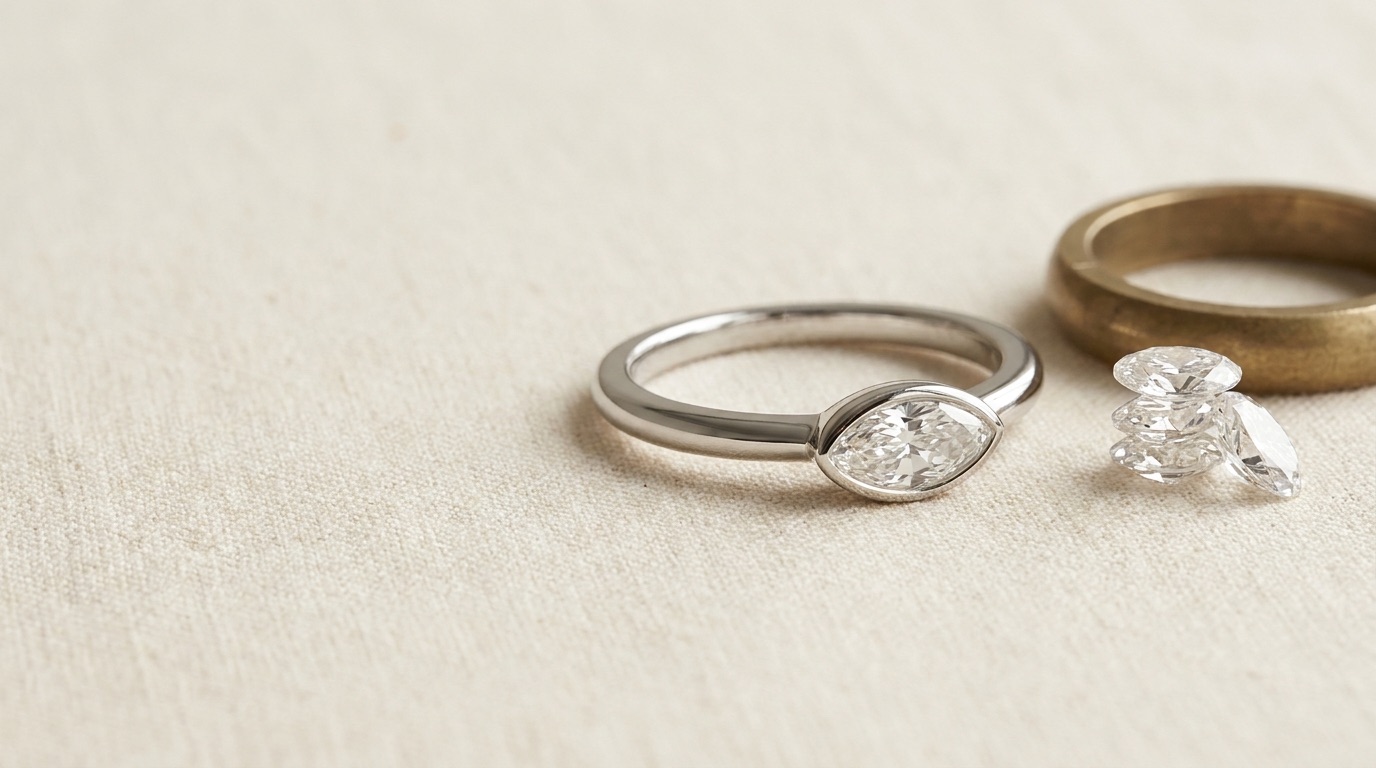
East-west setting — mounting the stone horizontally across the finger rather than point-to-point vertically — has become one of the more requested ways to set an elongated shape generally, and Moval takes to it well because the softened shoulders read cleanly from either orientation, unlike a marquise where the points create one obvious "correct" axis. A traditional north-south setting still works and remains the more conservative, easier-to-resize choice.
For prong protection, a Moval's points are less exposed than a marquise's but still benefit from V-tip or double-prong protection at each end rather than a single point prong — the same logic that applies to marquise and pear settings. Bezel settings are increasingly requested for Moval specifically, since a full or partial bezel protects the points entirely while emphasizing the elongated outline rather than breaking it up with visible prongs.
Moval also works well as a side-stone shape for a three-stone build with a round, oval, or cushion center, or as a matched pair flanking a larger Antique-tier center stone like an Old Mine or Old European cut — a combination that leans into Guru Diam's broader Antique catalog rather than treating Moval as a standalone shape.
Sourcing Moval diamonds wholesale
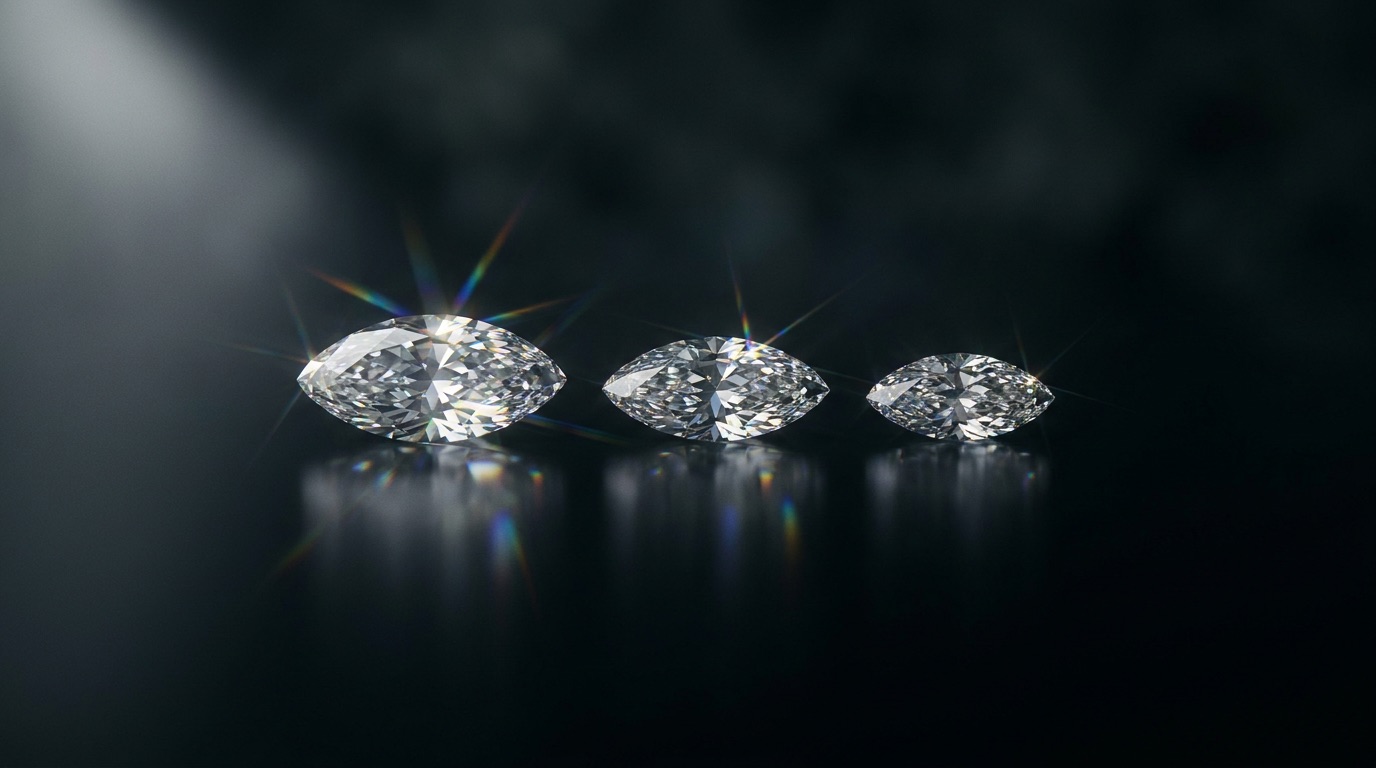
Moval is still uncommon enough in the wholesale market that most dealers who carry it treat it as a single SKU rather than a shape worth stocking in depth or explaining to buyers. Because lab-grown rough is cut to spec rather than sorted from whatever a parcel happens to contain, a cutter can hold a consistent L:W ratio and point/shoulder geometry across a full size and color run — which matters if a Moval engagement ring sells and you need to reorder the same look, or if a client wants Moval side stones to match a Moval center.
Guru Diam holds 176+ Moval pieces on hand across the size and color range, cut in-house and IGI-certified as the trade default (GIA and GCAL available on request), CVD-grown. In-stock pieces ship same-day from New York; a size or color outside current stock moves through made-to-order cutting, with custom jewelry — CAD to finished piece — running 4–6 days from our New York and Los Angeles desks.
That in-house control extends past the loose stone: cutting, setting, and polishing all happen under one roof, so a Moval center stone and its matching mount don't pass through a separate jewelry vendor with its own lead time and its own quality standard.
How to order Moval diamonds wholesale
Ordering Moval at wholesale works the same way as any other shape in Guru Diam's catalog, with a couple of extra specifics worth confirming up front given how unstandardized the shape still is.
Start with an account. Wholesale pricing and inventory access require a trade account — open one at /signup — after which loose Moval inventory, current size and color range, and certification options are visible directly rather than requiring a quote request for every stone.
Specify ratio and orientation before ordering, not after. Because "Moval" covers a range of L:W ratios rather than one fixed proportion, tell us whether you want the stone more marquise-forward or more oval-forward, and whether it's going into an east-west or north-south setting — that affects which in-stock pieces are the right match, and how a made-to-order piece gets cut.
For anything outside current inventory — an unusual size, a specific ratio, or a matched set beyond what's on hand — book time with a gemologist at /book-appointment to review options and place a made-to-order cutting request. Made-to-order Moval stones follow the same in-house cutting process as in-stock inventory, so proportions and point geometry stay consistent with what's already in the catalog rather than being a one-off.
For a finished piece rather than a loose stone, the process folds into Guru Diam's custom jewelry pipeline: CAD approval through finished ring runs 4–6 days once the stone and setting are confirmed, unbranded by default so it can be resold under a jeweler's own name.
FAQ
What is a Moval cut diamond? A Moval is a hybrid center-stone shape combining a marquise's pointed ends with an oval's rounder, softer shoulders. It elongates the finger more than a plain oval while looking less sharply pointed than a full marquise.
Is Moval the same as a marquise or an oval? No — it's a distinct hybrid outline between the two. It keeps the pointed ends associated with a marquise but curves the shoulders more like an oval, rather than tapering in a straight line to the points the way a true marquise does.
Why has Moval become more common in engagement ring design? It offers a middle ground: most of a marquise's elongating effect with fewer of the sharp points that need careful prong protection and can look severe on some hands. That balance of drama and wearability is the main reason it shows up more often in modern ring design.
Does a Moval diamond show a bowtie effect? Some — every elongated brilliant shape does to a degree. On a well-cut Moval the bowtie reads as subtle shading rather than a dark band; how visible it is comes down to cutting proportions more than carat weight or grade, which is why it's worth viewing the actual stone, or detailed imagery of it, rather than buying on the four Cs alone.
Can I get Moval diamonds as lab-grown, and are they certified? Yes. Guru Diam's Moval inventory is CVD-grown and cut in-house, IGI-certified as the trade default with GIA and GCAL available on request. Lab-grown production also makes it possible to hold a consistent length-to-width ratio and point geometry across a full size run, which matters for reorders and matched work.
How fast can I get a Moval stone or a finished custom piece? In-stock pieces ship same-day from New York. Made-to-order cutting plus a finished custom piece (CAD to jewelry) runs 4–6 days from our New York and Los Angeles desks.