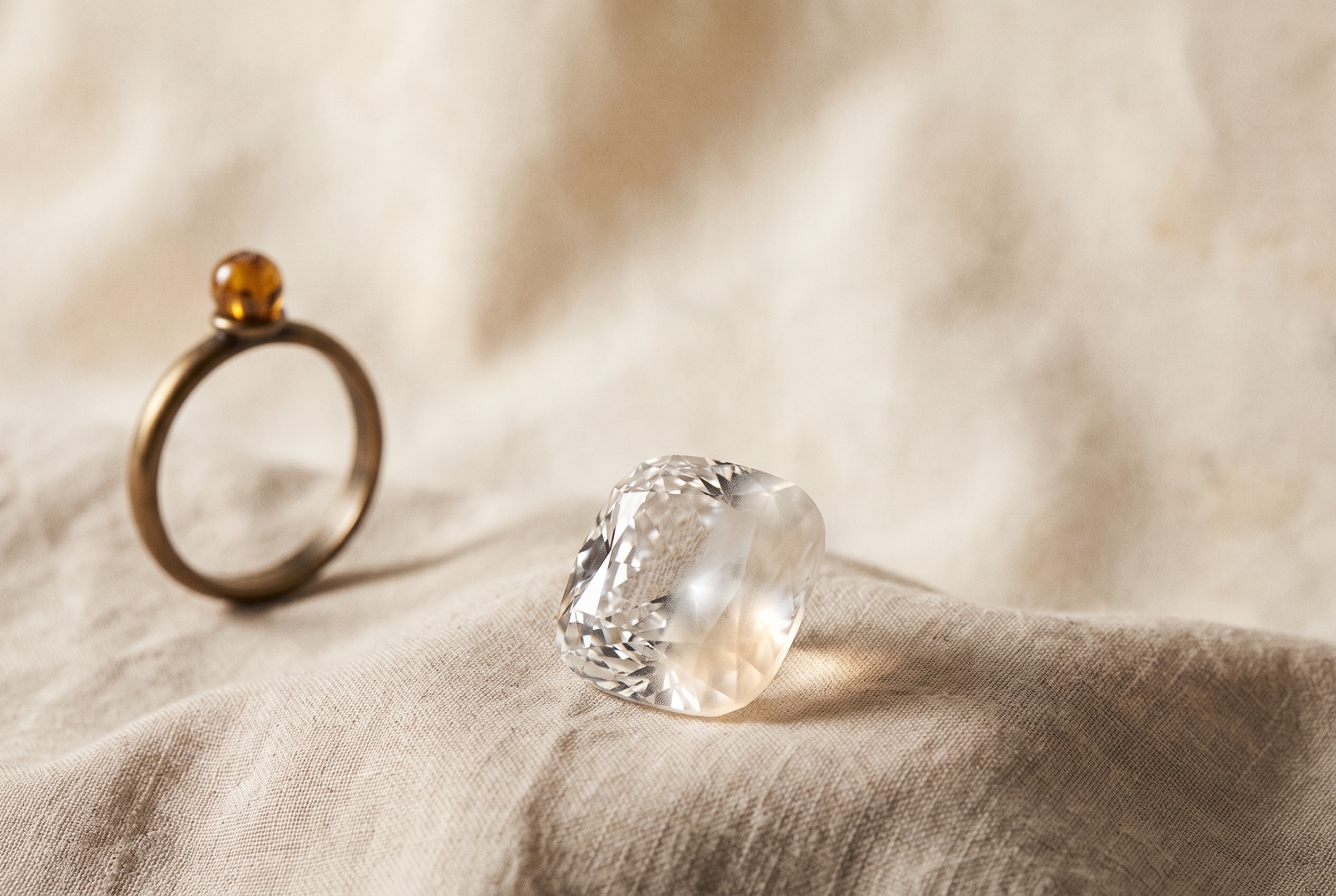
A milky diamond is a stone that appears cloudy, hazy, or lacking in transparency and brilliance, even when its clarity grade on paper (SI1, VS2, or even higher) suggests it should look clean. The haziness comes from a high density of microscopic inclusions — usually clouds of pinpoints or tiny crystals too small and diffuse to individually affect the clarity grade much, but numerous enough collectively to scatter light and reduce the stone's transparency and sparkle. This is one of the more important buying traps in the diamond trade specifically because it isn't reliably predicted by clarity grade alone, which is why in-person or video inspection matters more here than for almost any other visual characteristic, and why a jeweler who screens for it consistently builds more client trust than one who sources purely off certificates.
Milky vs. Frosty: Clearing Up Overlapping Trade Terms
Buyers sometimes encounter related terms — "frosty," "sugary," or "sleepy" — used somewhat interchangeably with "milky" in trade conversation, and while they overlap conceptually, they aren't always describing the identical cause. "Frosty" or "sugary" more specifically describes a rough or naturals-related surface texture issue on an uncut or partially cut stone, while "milky" in a finished, polished diamond almost always refers to the internal cloud-inclusion transparency issue covered throughout this guide. Knowing which term a supplier or colleague is actually using, and asking for clarification when it's ambiguous, avoids miscommunication when discussing a specific stone's visual quality over email or phone before it's been physically reviewed.
What Actually Causes a Diamond to Look Milky
Milkiness is typically caused by a dense concentration of extremely small inclusions — most often clouds (clusters of pinpoint-sized crystals or growth-related particles too tiny to resolve individually under standard 10x magnification) spread broadly through the stone rather than concentrated in one visible spot. Because clarity grading assesses the overall visual impact of inclusions rather than counting them individually, a stone can carry a clarity grade like SI1 or even VS2 — technically defined by inclusion visibility under magnification — while still looking milky face-up, if the grade-qualifying characteristic happens to be a diffuse cloud rather than a single localized inclusion. This is the single most important thing to understand about milkiness: it's a transparency and light-performance problem, not strictly a clarity-grade problem, and the two don't always move together the way buyers assume they should.
Why Clarity Grade Alone Doesn't Predict Milkiness
| Scenario | Clarity grade | Likely appearance |
|---|---|---|
| Single small feather or crystal, localized | SI1 | Eye-clean, no haze — a typical, unremarkable SI1 stone |
| Dense cloud formation spread through the stone | SI1 (same grade) | Can appear hazy or milky despite an identical clarity grade to the stone above |
| Isolated pinpoints, well-distributed | VS2 | Eye-clean, no haze |
| Dense pinpoint cloud concentrated under the table | VS2 (same grade) | Can show visible haze despite a clarity grade most buyers would assume guarantees clean appearance |
This table is the core practical lesson of milkiness: two stones can carry the identical clarity grade and look completely different face-up, because the grade reflects overall visual impact under magnification, not the specific type or distribution pattern of the inclusions causing it. A grading report alone can't fully substitute for direct visual inspection when cloud-type inclusions are involved.
How to Spot a Milky Diamond Before Buying
Because a certificate alone doesn't reliably flag milkiness, a few direct inspection steps matter more here than for most other characteristics: view the stone face-up in bright, even lighting and check specifically for a hazy, oily, or "sleepy" quality that dulls its brilliance compared to a similarly graded stone; ask for a loupe close-up photo or video showing the stone from multiple angles, not just a single beauty shot; and, where possible, compare the stone directly against another of the same or similar grade, since milkiness is often easier to identify by contrast than in isolation. A grading report's inclusion notes sometimes mention "clouds" explicitly, which is worth treating as a flag warranting closer visual review, though the absence of that note doesn't guarantee a stone is clean — not every lab report calls out cloud density with the same level of specificity.
Milky Diamonds vs. Other Clarity Issues
| Issue | What it is | How it differs from milkiness |
|---|---|---|
| Milkiness / haze | Dense, diffuse cloud inclusions reducing overall transparency | Affects the whole stone's clarity and light performance broadly, not one localized spot |
| Visible single inclusion | A localized feather, crystal, or other characteristic visible to the naked eye | Confined to one area; the rest of the stone remains clean and transparent |
| Fluorescence-related "overblue" haze | A hazy look tied to strong fluorescence reacting with UV-rich light, mainly in high-color stones | Lighting-dependent and tied to fluorescence grade, not inclusion density |
| Poor cut proportions | Light leakage or a dull, lifeless look from a poorly cut stone | A cut-quality issue, unrelated to inclusion type or clarity grade entirely |
Distinguishing between these is worth doing carefully, since the fix (or the buying decision) differs for each: a fluorescence-related haze is lighting-dependent and tied to a specific grade combination covered in a separate part of the buying process, while a cut-quality issue has nothing to do with clarity at all and instead points to poor proportions or symmetry. True milkiness from cloud inclusions is the one of these four that's hardest to catch from a certificate alone, which is exactly why it deserves its own dedicated inspection step.
Does Milkiness Affect Value?
Yes, meaningfully — a milky stone typically trades at a discount to a non-milky stone of the identical clarity grade, reflecting the real difference in visual appeal even though both carry the same letter grade on paper. This is a case where relying purely on the certified grade without direct inspection can lead a buyer to either overpay for a hazy stone (assuming the grade guarantees a clean look) or, conversely, miss a legitimately good-value opportunity on a well-priced, non-milky stone that happens to share a grade with pricier, cleaner-looking stones in the same tier. For buyers and jewelers sourcing at scale, this is one of the strongest arguments for direct visual review, video, or working with a supplier who screens inventory for this specific issue before it reaches the certificate stage.
Milkiness in Lab-Grown vs. Natural Diamonds
Milkiness can occur in both CVD lab-grown and natural diamonds, though the underlying cause differs somewhat between the two. In CVD lab-grown stones, milkiness is most commonly tied to growth-process irregularities that produce dense clusters of pinpoint-type inclusions during crystal formation — a known quality variable in lab-grown production that reputable growers and cutters actively screen against. In natural stones, milkiness more often traces to dense clouds of microscopic mineral inclusions formed during the diamond's geological history. In both cases, the practical buying guidance is identical: clarity grade alone doesn't reliably predict it, and direct visual inspection remains the most reliable check regardless of origin.
Milkiness by Shape
| Shape | Milkiness visibility consideration |
|---|---|
| Round brilliant | Many small facets can somewhat mask mild haze better than step cuts, though a truly milky stone is still visible |
| Emerald / Asscher (step cuts) | Large, open facets make haze considerably more visible — step cuts are the least forgiving shape for a milky stone |
| Cushion, oval, pear, radiant | Generally intermediate; moderate visibility, worth the same direct-inspection step as any shape |
Step-cut shapes are worth particular caution here: the same open, mirror-like facet structure that makes step cuts show localized inclusions more readily also makes diffuse haze considerably more visible than it would be in a brilliant cut. A buyer specifically considering an emerald or asscher-cut stone should weight direct visual inspection even more heavily than for a round or cushion of the same clarity grade.
Can a Milky Diamond Be Fixed?
Generally, no — milkiness caused by internal cloud inclusions is a structural characteristic of the stone as grown or formed, and there's no cutting or polishing process that removes internal inclusions without significant weight loss, and even then only if the inclusions happen to be positioned near the surface, which is rarely the case for diffuse cloud formations spread through the stone's body. This is different from a surface-level haze caused by residue or a dirty setting, which cleaning resolves completely — a distinction worth checking first, since what looks like milkiness in a worn ring is sometimes just an oil or lotion film rather than a genuine internal characteristic. A professional cleaning is always worth trying before assuming a stone is genuinely milky.
How Grading Labs Handle Cloud Inclusions
GIA, IGI, and GCAL reports typically note cloud-type inclusions on the plotting diagram using a specific symbol, and the accompanying clarity characteristics section may describe them as "clouds" explicitly. The challenge for buyers is that the plotting diagram shows the presence and rough position of a cloud but doesn't fully convey its density or the resulting visual effect — a lightly scattered cloud contributing to an SI1 grade and a dense, tightly packed cloud contributing to the identical SI1 grade can look completely different face-up, even though both are technically documented the same way. This gap between what a report documents and what a stone actually looks like is precisely why experienced buyers and jewelers treat any certificate noting cloud inclusions as a prompt for closer visual review rather than a green light based on the grade alone.
Milkiness and Carat Weight
| Carat range | Milkiness consideration |
|---|---|
| Under 1.00ct | Cloud inclusions are harder to detect even when present; milkiness less commonly a major concern but still worth a quick visual check |
| 1.00-2.50ct | Larger facets make any haze more apparent; visual inspection becomes more important at this range |
| 2.50ct+ | Milkiness, if present, is typically quite noticeable given facet size; direct inspection is essential before committing at this price point |
The pattern mirrors clarity and fluorescence generally: larger stones with larger facets make any optical inconsistency, whether an inclusion, haze, or fluorescence-related effect, proportionally more visible. A buyer purchasing a larger center stone has more reason, not less, to insist on direct visual confirmation before finalizing a purchase.
Common Misconceptions About Milky Diamonds
- "A high clarity grade guarantees a clean-looking stone." Clarity grade reflects overall visual impact under magnification, but doesn't specifically flag diffuse cloud density the way it would flag a single, more visually consequential inclusion.
- "Milkiness only happens in low clarity grades." A milky stone can carry a grade as high as VS2 or even VVS2 in some cases, since the grade doesn't penalize diffuse, hard-to-resolve clouds as heavily as it does more visually significant, localized characteristics.
- "Milky diamonds are always cheap, low-quality stones." Milkiness is an appearance issue tied to a specific inclusion pattern, not an indicator of overall stone quality or origin — a milky stone can otherwise have excellent color, cut, and carat weight.
- "All haze in a diamond is milkiness." A hazy look can also stem from a dirty setting, a fluorescence-related overblue effect, or poor cut proportions — each has a different cause and a different (or nonexistent) fix.
Milkiness in Type IIa and Other Special Diamond Types
Type IIa diamonds — chemically the purest diamond type, containing no measurable nitrogen and prized for exceptional transparency and, often, the highest color grades — occasionally still show milkiness when growth or formation conditions produce dense cloud inclusions, despite this type's reputation for exceptional clarity of appearance. This is worth flagging specifically because buyers sometimes treat "Type IIa" as a shorthand guarantee of superior visual quality; while Type IIa stones are statistically more likely to grade at the top of the color and clarity scales, the type classification itself says nothing about cloud density, and a Type IIa stone can still be milky in the rarer case where dense cloud inclusions are present. The same direct-inspection guidance applies regardless of type classification.
Why Milkiness Matters More for B2B Buyers Than Consumers Realize
For a jeweler sourcing inventory at scale, milkiness carries a specific business risk beyond the individual sale: a client who receives a hazy-looking stone that technically matches its certified grade often blames the jeweler, not the grading system, for the mismatch between expectation and appearance — even though the jeweler may have sourced entirely in good faith based on the certificate alone. This makes direct visual screening, or working with a supplier who screens proactively, a meaningful risk-reduction step for trade buyers specifically, not just a nice-to-have for individual stone selection. A supplier relationship built around pre-screened, visually confirmed inventory reduces the chance of this exact customer-trust problem recurring across multiple transactions.
A Practical Sourcing Checklist to Avoid Milky Stones
- Request a loupe-close video or high-resolution photo of any stone before purchase, not just a certificate.
- Read the certificate's inclusion notes carefully for mentions of "clouds" or diffuse inclusion patterns, and treat these as a flag for closer visual review.
- Compare candidate stones side by side under the same lighting when sourcing multiple options at a similar grade.
- For step-cut shapes specifically, weight visual inspection more heavily than for brilliant cuts, given how readily haze shows through open facets.
- Work with a supplier who screens inventory for milkiness before it reaches the certificate stage, rather than relying solely on the grade to catch it.
How Cut Quality Interacts With Milkiness
Cut quality and milkiness are independent issues, but they interact in how a stone ultimately presents to a buyer. A well-cut diamond's facet arrangement is engineered to maximize light return and scintillation, which can, to a limited degree, help a mildly milky stone read as more lively than the identical inclusion pattern would in a poorly cut stone — though this only goes so far, and a genuinely dense cloud formation will still produce visible haze regardless of how well the stone is cut. The reverse is also true: a poorly cut stone with no milkiness at all can still look dull and lifeless, which is sometimes mistaken for haziness when the actual cause is light leakage from incorrect proportions rather than any internal characteristic. Distinguishing between these two causes matters because the fix, or the buying decision, is completely different — a poorly cut stone's dullness is a proportions issue evident from its cut grade, while true milkiness is an inclusion-density issue that no amount of good cutting fully resolves.
Talking to Clients About Milkiness
For jewelers fielding a client question about why one SI1 or VS2 stone looks noticeably livelier than another of the identical grade, milkiness is often the honest answer, and it's worth explaining directly rather than letting a client assume something is wrong with the grading itself. Framing it plainly — "clarity grade measures overall visual impact, but doesn't always capture how diffuse, cloud-type inclusions affect transparency, which is why we physically review stones rather than buying purely off a certificate" — builds real trust and positions a jeweler's hands-on sourcing process as a genuine value-add rather than an unnecessary extra step. Clients who understand this distinction are also less likely to assume every stone at a given grade should look identical, which helps manage expectations across an entire collection or matched set.
Frequently Asked Questions
What makes a diamond look milky?
A dense concentration of microscopic inclusions, most often cloud-type inclusions spread through the stone, scatters light and reduces transparency. This can happen even in stones with a clarity grade that would otherwise suggest a clean appearance.
Can a diamond be milky and still have a good clarity grade?
Yes — clarity grading reflects overall visual impact under magnification, not the specific distribution pattern of inclusions, so a diffuse cloud can produce the same grade as a small, localized inclusion that doesn't cause any haze at all.
How can I tell if a diamond is milky before buying it?
Request a loupe-close photo or video showing the stone from multiple angles under bright, even light, and compare it directly against another stone of a similar grade if possible. A certificate alone doesn't reliably flag this issue.
Does a milky diamond cost less than a clean one of the same grade?
Typically yes — milky stones trade at a discount to non-milky stones of the identical clarity grade, reflecting the real visual difference between them despite the shared letter grade.
Can a milky diamond be cleaned or fixed?
Surface haze from residue or a dirty setting cleans away completely. Genuine internal milkiness from cloud inclusions is a structural characteristic that generally can't be removed without significant weight loss, if at all.
Are lab-grown diamonds more likely to be milky than natural diamonds?
Milkiness can occur in both, tied to different underlying causes — growth-process irregularities in CVD lab-grown stones versus geological mineral clouds in natural stones. Reputable growers and cutters actively screen against it in both cases.
Is a milky diamond the same as a "sleepy" diamond?
The terms are often used interchangeably in the trade to describe a stone that looks dull, hazy, or lacking in life despite an otherwise reasonable clarity grade. Both point to the same underlying cause: dense, diffuse inclusions reducing transparency and light performance.
Sourcing Screened, Non-Milky Diamonds from Guru Diam
Guru Diam screens inventory across our certified loose diamond range for exactly this kind of visual quality issue before it reaches a client quote, rather than relying purely on the certificate's letter grade — CVD lab-grown with IGI, GIA, and GCAL certification available, alongside natural stones and finished jewelry. Our team can provide loupe-close photos or video on request for any stone under consideration, particularly useful for step-cut shapes where haze visibility matters most. In-stock inventory ships same-day from New York or Los Angeles, and trade accounts can review full inventory, including matched pairs and antique-cut options, through the wholesale hub or a trade partner account.
Our custom jewelry program finishes rings in 4-6 days from CAD approval, and for jewelers sourcing at scale, we can pull a short list of pre-screened options at a target clarity grade, saving the time and risk of ordering sight-unseen against a certificate that doesn't fully capture how a specific stone actually looks face-up. Our sourcing team can also flag comparable, non-milky alternatives at the same grade and price point when a specific stone under review doesn't meet the visual standard a client expects, keeping a commission on schedule without compromising on appearance.