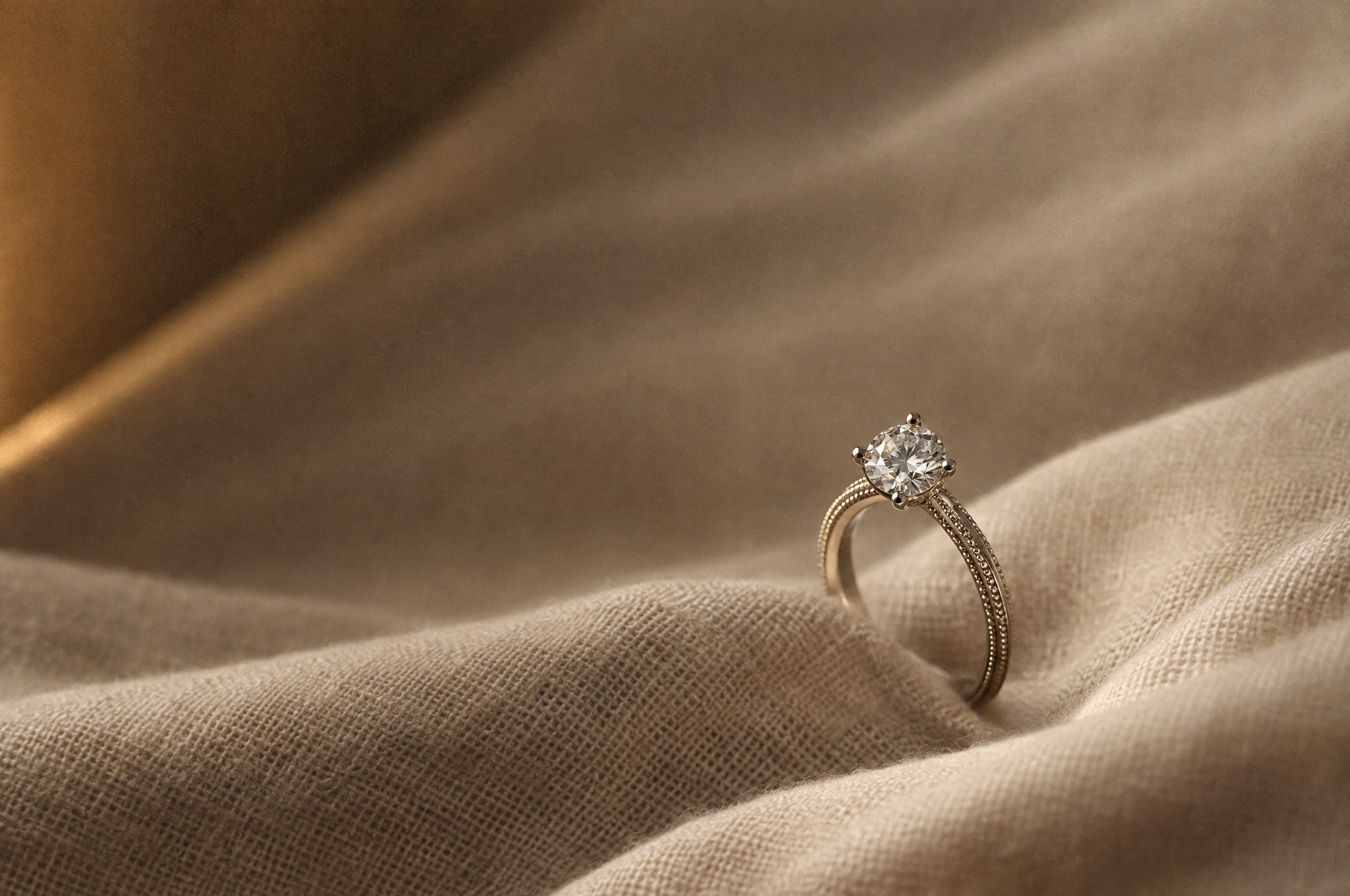
A milgrain diamond ring is a ring where the metal edge along the band, bezel, or gallery is finished with a fine row of tiny beads or dots — either hand-applied with a rolling wheel or rendered in the casting itself. The detail reads as texture rather than sparkle, and it is the fastest visual signal a piece sends for "antique" or "Art Deco-revival" without a single word of marketing copy attached to it. For a retail jeweler, that signal is inventory-worthy on its own — but sourcing it well requires understanding what separates a milgrain edge that holds up under a loupe (and a decade of wear) from one that reads fine in a product photo and disappoints on the bench.
This is a sourcing guide, not a shopping guide. It's written for the independent jeweler, designer, or manufacturer deciding how to build milgrain-detail rings into a retail line or custom program — what the detail actually is, which diamond shapes and settings it pairs with, how to decide between finished-custom, semi-mount, and build-to-order sourcing paths, what separates a well-executed milgrain edge from a cast shortcut, and how to price the work so it earns its keep on the case.
What Milgrain Edging Actually Is
Milgrain (from the French mille grain, "a thousand grains") is a decorative metal-finishing technique that lines an edge — most often the outer or inner rail of a band, the perimeter of a bezel, or the border of a gallery — with a continuous row of small raised beads. It has no structural function; it is purely a surface-finishing detail, applied after the shank or setting has been fabricated.
There are two production paths that produce visually similar results but very different quality outcomes:
- Hand-rolled milgrain — a bench jeweler runs a serrated steel wheel (a millgrain tool) along the metal edge under controlled pressure, physically displacing metal into a row of beads. This is done after casting, usually after stone-setting, and requires a steady hand and a properly work-hardened edge to avoid crushing or skipping beads.
- Cast-in milgrain — the beaded texture is carved into the wax or CAD model and reproduced directly by the casting process. This is faster and cheaper, but the beads tend to be softer, less uniform, and shallower than hand-rolled work, because casting can't replicate the metal-compression effect of a physical rolling tool.
Both methods show up across the wholesale market, and neither is inherently "wrong" — the right choice depends on price point, order volume, and how much edge durability the piece needs to deliver. What matters for a buyer is knowing which one you're looking at, because the difference shows up on the sales floor eventually, usually as a customer complaint about a ring that looked crisp on day one and "faded" within a year or two.
Why Milgrain Is Having a Retail Moment
Search demand for milgrain-detail rings tracks a broader consumer pull toward vintage and Art Deco-revival bridal styling — filigree galleries, hand-engraved shoulders, and stepped profiles that read as "old" even on a brand-new mounting. Milgrain fits that aesthetic language cheaply relative to filigree or hand engraving, because a single rolling pass around a band edge delivers a strong visual cue for very little added labor time compared to piercing or engraving an entire gallery.
That makes it an efficient way for a retail jeweler to add antique-inspired SKUs to a case without committing to full period-reproduction pieces, which typically require more specialized labor and carry correspondingly higher price points. Milgrain bridges the gap: a customer gets the "grandmother's ring" feeling at a price point that still moves off a case reliably.
Which Diamond Shapes Pair Best With Milgrain
Milgrain is a period-styling cue, and it reads most naturally alongside center stones and melee that share that same period language. It is not exclusive to any one shape, but some pairings are far more common in the antique and antique-revival market than others, and for good reason — both the visual proportions and the sourcing logic line up.
| Diamond shape | Why it pairs with milgrain | Typical sourcing tier |
|---|---|---|
| Old Mine Cut | The cushion-shaped, high-crown, small-table silhouette is the historical companion to hand-rolled milgrain — both come out of the same late-19th/early-20th-century toolkit, so the pairing reads as authentic rather than reproduction. | Antique / premium |
| Old European Cut | Round with a small table and high crown; the softer, warmer light return complements the tactile texture of a beaded edge better than a modern brilliant's sharper scintillation. | Antique / premium |
| Hexagonal / Kite / Lozenge | Geometric step-cut shapes common in Art Deco-revival work; milgrain along a bezel or channel edge reinforces the deco line without competing with the stone's angular facets. | Antique / premium |
| Cushion | Rounded-corner outline echoes Old Mine proportions closely enough to carry a vintage-inspired mounting even when the stone itself is a modern cut. | Regular fancy / mid-market |
| Emerald / Asscher | Clean step-cut lines pair well with a milgrain-edged bezel or channel — the beading softens what would otherwise be a very architectural, minimal setting. | Regular fancy / mid-market |
| Round Brilliant | Works fine with milgrain but doesn't carry the same period narrative — most common when a customer wants "vintage-inspired" detailing without committing to an antique-cut center stone. | Commodity |
For a retail buyer, this table is really a merchandising map: Old Mine and Old European centers with milgrain-edged mountings sell a genuine antique story and typically carry the pricing power to match. Cushion, emerald, and asscher centers with milgrain detailing sell a "vintage-inspired" story at a more accessible price point. Round-brilliant-with-milgrain is the volume play — approachable, familiar, and still visually distinct from a plain-edge band.
Settings That Showcase Milgrain Well
Milgrain is a finishing detail, not a setting type, so it can technically be applied to almost any mounting — but it earns its place best on settings where there's an actual metal edge for it to trace. A few pairings dominate the wholesale antique-inspired category:
- Bezel settings — a milgrain border around the bezel rim is one of the most classic applications, softening what is otherwise a solid, modern-reading metal collar around the stone. This is arguably the single most common milgrain application in the antique and antique-revival category.
- Channel settings — milgrain along the outer edges of a channel-set row of melee gives the row visual definition without needing prongs, and it reads distinctly more finished than a bare channel edge.
- Gallery rails on solitaires — a milgrain edge along the underside gallery of a solitaire mounting is a detail almost nobody sees on the customer's hand but that plays extremely well in macro product photography — a real consideration for a jeweler building an e-commerce or social catalog.
- Filigree shoulders — milgrain frequently traces the edges of pierced filigree work on antique-reproduction shanks, reinforcing the period detailing at every visible edge.
- Eternity and wedding bands — milgrain along both rails of a diamond wedding band (full, three-quarter, or half eternity, or a plain band with a milgrain-only edge and no stones) is a straightforward way to differentiate an otherwise commodity SKU.
Where milgrain tends to underperform is on very thin shanks or very high-polish, ultra-modern mountings — a thin band doesn't leave the bench jeweler enough metal to roll a durable bead line into, and a high-polish minimalist design usually reads as intentionally clean, making an added texture line feel like an afterthought rather than a design choice.
Milgrain vs. Plain-Edge vs. Hand-Engraved: A Sourcing Comparison
When a jeweler is deciding how to differentiate a mounting line, milgrain is one of three common edge-finishing paths, each with a different labor cost, durability profile, and shelf story. Here's how they compare for wholesale sourcing purposes.
| Detail type | Labor / production | Typical durability | Retail story | Relative cost impact |
|---|---|---|---|---|
| Plain edge | None — as-cast or as-polished edge, no additional finishing step | Highest — nothing to wear down | Modern, minimal; no period narrative | Baseline |
| Milgrain (hand-rolled) | Bench step after fabrication; requires a skilled hand and a workable metal edge | Good on properly proportioned, adequately thick metal; can wear flat over years on thin shanks or soft alloys | Antique / Art Deco-revival; strong visual cue for low added cost | Low-to-moderate premium over plain edge |
| Milgrain (cast-in) | Built into the wax/CAD model; no separate bench step | Lower — shallower, less uniform beading, more prone to reading "soft" or uneven even when new | Vintage-inspired at volume price points | Minimal premium over plain edge |
| Hand engraving | Skilled engraver working freehand or with a graver on each individual piece; not reproducible by casting | High if done at sufficient depth into solid metal; unique per piece | True antique/heirloom narrative; strongest story but slowest production | Significant premium; priced per piece, not per style |
The practical takeaway for a buyer: plain edge is the safe, durable default; hand-rolled milgrain is the sweet spot for antique styling at a scalable price point; cast-in milgrain is the budget path but needs to be disclosed and priced accordingly, since it will not hold up to the same wear expectations; and hand engraving is a different tier entirely, usually reserved for top-of-line or fully bespoke pieces.
Durability and Metal Considerations Jewelers Should Flag
Milgrain is a genuinely good design tool, but it comes with tradeoffs a jeweler should be upfront about — both when specifying an order and when setting customer expectations at the point of sale.
- Metal thickness matters. Milgrain needs enough metal mass at the edge to roll beads into without thinning the shank to a failure point. A band that's already sized thin for a low price point is a poor candidate for milgrain — the beading can end up more decorative suggestion than durable texture.
- Alloy hardness matters. Platinum holds a rolled bead edge longer than softer 18k yellow or rose gold alloys under everyday wear; 14k tends to perform better than 18k for exactly this reason, since a slightly harder alloy resists the edge-softening that comes from years of contact with countertops, tools, and other jewelry.
- Finger-side wear is uneven. Milgrain on the top and sides of a ring wears far more slowly than milgrain on the underside or inner rail, which takes constant friction. A jeweler quoting a full-eternity milgrain band should expect the inner-facing beading to soften first.
- Hand-rolled edges can be re-rolled; cast edges generally can't. This is a genuine after-sale service differentiator — a bench jeweler can refresh a worn hand-rolled milgrain line years later, but a cast-in texture that's worn flat usually can't be restored without recasting the piece.
None of this makes milgrain a bad choice — it makes it a detail that should be spec'd deliberately rather than defaulted into every SKU, and disclosed honestly to the end retail customer so a worn edge ten years out reads as normal wear rather than a manufacturing defect.
Sourcing Models: Finished Custom, Semi-Mount, or Build-to-Order
Once a jeweler has decided milgrain detailing fits their line, the next decision is how to source it. There are three practical paths, and most trade buyers end up using a mix of all three depending on the SKU.
Finished Custom Rings
A fully finished, ready-to-sell ring built to a specific spec — shape, carat weight, metal, and milgrain placement all locked in before production. This is the fastest path to a sellable unit and works well for line-building or replenishing a fast-moving style. Guru Diam finishes custom engagement rings in 4-6 days on this model, which matters for a retailer who needs to refill a case style without a multi-week wait — though that turnaround applies to the finished piece, not to sourcing loose stones separately.
Semi-Mount Sourcing
A semi-mount is a finished setting — milgrain edge, bezel or channel work, and shoulder detailing all complete — sold without a center stone, so the jeweler (or the end customer, in a design-your-own retail model) drops in a stone afterward. This is the most flexible model for a retailer who wants to offer milgrain styling across a range of center-stone sizes and shapes without committing to a fixed combination up front, and it pairs naturally with a loose-stone inventory sourced separately and kept in stock, ready to ship rather than built to a lead time.
Build-to-Order / Fully Custom
For a designer or manufacturer with a specific CAD or hand-sketch concept — a particular bead size, spacing, or milgrain placement not available off a standard semi-mount line — build-to-order lets the buyer control every detail of the finished piece, including exactly how the milgrain is executed relative to the stone and setting. This path takes longer than pulling from an existing semi-mount catalog but is the only route to a genuinely differentiated, hard-to-copy SKU.
For a jeweler running both a bridal case and a custom-order counter, the practical advantage of working with one supplier across all three models — rather than splitting sourcing across separate vendors for loose stones, semi-mounts, and custom builds — is fewer handoffs, fewer shipments, and one relationship to manage quality and turnaround against. Guru Diam's catalog spans certified loose stones, antique and fancy shapes, and finished custom jewelry under a single account, which is the practical version of that consolidation.
Vetting a Milgrain Supplier: Craftsmanship Checks That Actually Matter
Because milgrain is easy to fake badly and hard to fake well, it's one of the more useful details for judging a supplier's overall bench quality — a weak milgrain line is often a tell for weak finishing throughout a piece. When evaluating samples or a first order, look for:
- Bead uniformity. Under 10x loupe magnification, hand-rolled beads should be evenly spaced and consistently sized along the entire run. Gaps, flattened sections, or beads that trail off toward a corner point to a rushed or under-skilled application.
- Edge continuity around curves and corners. Milgrain that has to turn a corner — around a cushion or a bezel — is harder to execute cleanly than a straight run along a shank. Check specifically at these transition points, since that's where cast-in shortcuts and rushed hand work both tend to show their weaknesses.
- Depth and crispness of the beading. Beads should have a genuine three-dimensional roundness, not just a shallow texture pressed into the surface. Run a fingernail lightly along the edge — a well-executed line has real tactile texture; a weak one feels almost smooth.
- Consistency across a repeat order. A single well-made sample doesn't guarantee consistency at volume. Ask for (or check) a few units from the same production run to confirm the supplier's milgrain quality doesn't degrade when they're filling a larger order.
- Whether the edge was finished before or after stone-setting. Milgrain rolled after stones are set risks stress on prongs or bezels if not done carefully; ask suppliers about their sequencing, since it affects both quality and the risk of loosened stones in transit.
A supplier who can speak fluently to these points — rather than treating milgrain as an interchangeable checkbox spec — is generally a supplier whose broader finishing quality (setting, polishing, prong work) will hold up as well. Guru Diam handles cutting, setting, and polishing in-house, which is the kind of production control that tends to produce the edge consistency described above, since the same team accountable for the stone work is accountable for the finishing.
Pricing Milgrain Into a Retail Line
Milgrain is inexpensive to add relative to its visual and narrative payoff, which is exactly why it's worth pricing deliberately rather than folding it invisibly into a base mounting price. A few practical approaches trade buyers use:
- Price it as a styling tier, not a line item. Rather than itemizing "milgrain: +$X" on a customer quote, position milgrain-detailed mountings as a distinct product tier — "vintage collection" or "antique-inspired" — priced against comparable plain-edge mountings, since the styling story (not the labor cost alone) is what the customer is paying for.
- Reflect the hand-rolled vs. cast-in distinction in cost basis. Because hand-rolled milgrain carries real bench labor and cast-in milgrain essentially doesn't, the wholesale cost difference between the two should be reflected in retail pricing — selling a cast-in piece at a hand-finished price point erodes trust the first time a customer compares it to a competitor's piece under a loupe.
- Bundle with the center stone story, not against it. A milgrain-edged bezel around an Old Mine or Old European cut center justifies a premium built on both the setting detail and the stone's rarity — price the two together as "antique styling," rather than pricing the setting detail as an isolated add-on.
- Account for repair and refresh service. If a jeweler is willing to offer periodic milgrain re-rolling as an after-sale service (a genuine differentiator versus a competitor who can't), that service has its own cost basis and should be quoted separately rather than assumed to be free lifetime maintenance.
For a jeweler assembling an antique-inspired case from scratch, working from a supplier who carries the full range — antique-cut centers, matching melee for channel or pavé work, and finished custom mountings — makes it easier to price a cohesive collection rather than reverse-engineering margin across pieces sourced from several different vendors at different markups.
Certification and Documentation for Milgrain-Detail Pieces
Milgrain itself isn't a graded or certified attribute — certification applies to the center stone, not the setting detail — but a jeweler selling antique-inspired, milgrain-edged rings built around Old Mine, Old European, or other premium antique cuts should be especially deliberate about stone documentation, since these cuts carry more grading nuance than a standard round brilliant. IGI, GIA, and GCAL certification are all standard options to request depending on the buyer's market and price point, and having all three available from a single stone supplier simplifies matching documentation standards to what a given retail customer expects.
For jewelers building a program specifically around certified diamonds, pairing certified antique-cut centers with well-executed milgrain settings is a straightforward way to justify premium pricing with paperwork the end customer can independently verify — which matters more, not less, at higher price points where a customer is likely to shop the appraisal against the receipt.
Building a Cohesive Antique-Inspired Line
A single milgrain SKU rarely moves the needle on a case; a coherent small collection does. Jewelers building out an antique-inspired or Art Deco-revival line typically want a supplier who can support the whole assortment — Old Mine and Old European centers, complementary fancy shapes like emerald and cushion, matched melee pairs for channel and pavé detailing, and finished mountings that carry the milgrain and filigree detailing consistently across the line. Sourcing all of it from one place — rather than piecing together centers from one vendor, melee from another, and finished mountings from a third — reduces the number of shipments, invoices, and quality standards a buyer has to reconcile before a collection ever reaches the case.
This is also where a wholesale sourcing hub that spans loose stones, fancy colors, and finished jewelry under one account becomes a practical time-saver rather than a nice-to-have — a retailer restocking a milgrain-detail bridal case needs centers, melee, and finished mountings on a predictable cadence, and consolidating that sourcing is one of the more underrated margin protections available to an independent jeweler.
Working With a Wholesale Partner on Custom Milgrain Orders
For jewelers who want to offer milgrain detailing as a genuine custom option rather than a fixed catalog spec — letting a retail customer choose bead size, placement, or pairing with a specific antique-cut center — a build-to-order relationship with a custom jewelry supplier matters more than a semi-mount catalog does. A supplier able to execute custom milgrain specs to a CAD file or hand sketch, finish the piece in-house, and turn a finished ring around in days rather than weeks gives a retail jeweler the ability to sell true custom bridal work without carrying that production capability themselves.
Guru Diam's custom engagement rings are unbranded by default, which lets a jeweler resell finished, milgrain-detailed pieces under their own name rather than a manufacturer's — a meaningful distinction for a retailer building their own brand identity around an antique-inspired collection rather than reselling someone else's labeled product. Jewelers evaluating a new supplier relationship for this kind of work can review trade account terms through Guru Diam's trade partner program.
Logistics: Same-Day Shipping and Turnaround Planning
Milgrain-detail pieces sourced as semi-mounts or finished goods from in-stock inventory ship same-day when ordered before cutoff — 6pm EST from the New York office, 4pm PST from Los Angeles — which matters for a jeweler filling a last-minute custom order or restocking a fast-selling case style without a multi-day wait on top of production time. Loose antique-cut centers intended to pair with a milgrain setting are typically held in stock and ready to ship rather than made to order, so the lead time a jeweler needs to plan around is almost always on the finished-mounting side, not the stone side.
Frequently Asked Questions
What is a milgrain diamond ring?
A milgrain diamond ring is a ring where the metal edge of the band, bezel, or gallery is finished with a fine row of small beads, either rolled in by hand with a serrated wheel or reproduced through casting. It's a decorative finishing detail rather than a structural feature, most commonly used to give a mounting an antique or Art Deco-revival appearance.
Does milgrain wear down over time?
Yes, milgrain can soften or flatten with years of everyday wear, particularly on thin shanks, softer gold alloys, or the inner-facing rail of an eternity band that takes constant friction. Hand-rolled milgrain on adequately thick, harder-alloy metal (platinum or 14k tend to hold up better than thin 18k) generally wears more slowly, and can often be re-rolled by a bench jeweler years later — cast-in milgrain typically cannot be restored the same way.
What diamond shapes look best with milgrain detailing?
Old Mine Cut and Old European Cut diamonds pair most naturally with milgrain because both come from the same historical design period, but cushion, emerald, and asscher cuts also work well in antique-inspired settings. Round brilliant centers can be paired with milgrain too, though the combination reads more "vintage-inspired" than genuinely antique.
Is hand-rolled milgrain worth the extra cost over cast-in milgrain?
For pieces meant to hold up to years of daily wear, hand-rolled milgrain generally is worth the added labor cost, since it produces deeper, more uniform beading that resists flattening better than cast-in texture. Cast-in milgrain is a reasonable choice for lower price-point, volume-driven SKUs, provided the cost and durability difference is reflected honestly in how the piece is priced and represented to the end customer.
Can milgrain be added to a channel or bezel setting?
Yes — bezel and channel settings are two of the most common places milgrain appears, since both provide a continuous metal edge for the beading to trace. A milgrain border around a bezel softens what would otherwise be a solid modern-reading metal collar, and milgrain along a channel's outer edges gives a row of melee more visual definition without adding prongs.
How should a jeweler source milgrain-detail rings for their inventory?
Most retail jewelers use a mix of three sourcing paths: finished custom rings built to a fixed spec for fast case turnover, semi-mounts (finished settings sold without a center stone) for flexibility across stone sizes, and full build-to-order for unique custom bridal work. Which path makes sense depends on how much control over the final design a jeweler or their customer needs, and how quickly the piece needs to reach the case.