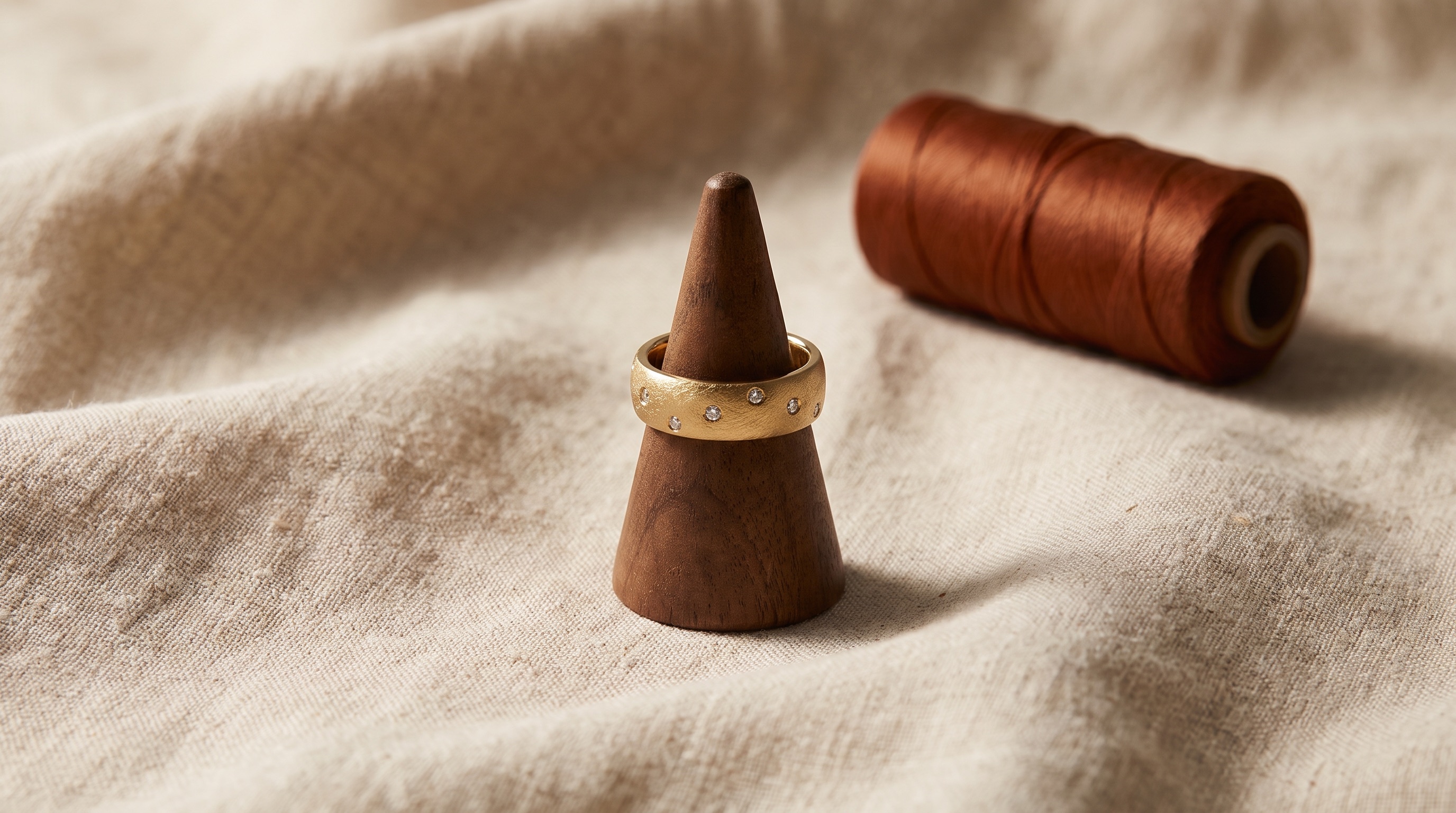
A men's diamond wedding band is a wedding ring set with one or more diamonds, worn daily and typically subjected to more physical wear than most other diamond jewelry categories — manual work, gym use, and general daily activity all take a toll on a ring worn every day for decades. For a jeweler or manufacturer sourcing diamonds for this category, durability considerations weigh more heavily than they do almost anywhere else in the diamond trade, which shapes both setting-style and stone-selection decisions from the start.
This guide covers men's diamond wedding band sourcing from a trade perspective — durability-focused setting styles, typical stone specs and counts, metal hardness considerations, black diamond options, and what to ask a wholesale supplier when sourcing for this specific, wear-intensive category.
Why Men's Wedding Band Sourcing Is Different
A men's wedding band sees more daily physical contact than almost any other piece of diamond jewelry a person owns — it's worn during manual tasks, sports, and general daily activity in a way an engagement ring or pendant typically isn't. This changes the sourcing priority: rather than maximizing brilliance or stone size the way a solitaire engagement ring might, men's band sourcing prioritizes setting security and stone durability, favoring styles and specs that hold up to years of daily contact over styles that show the most possible sparkle. A supplier who understands this distinction will proactively flag setting and stone choices that are a poor fit for daily-wear durability, rather than simply fulfilling whatever spec a buyer requests without comment.
Durability-Focused Setting Styles
Channel Setting
Stones sit fully recessed between two parallel metal rails with no exposed prongs, making channel setting the most common and most durable choice for men's diamond bands. Because nothing protrudes above the metal surface, channel-set stones are highly resistant to snagging and impact — an important property for a ring worn during manual work or athletic activity.
Bezel Setting
A full metal rim surrounds each stone, offering strong protection similar to channel setting while allowing a slightly different visual style — often used for a single center stone or a small number of stones rather than a full channel of diamonds.
Flush (Gypsy) Setting
Stones are set directly into holes drilled into the metal band itself, with the stone's surface sitting flush or nearly flush with the metal. This is arguably the most durable setting style available for a men's band, since there's no raised setting element at all to catch or wear down — a common choice for a minimal, low-profile look that prioritizes durability above all else.
Pavé and Prong Settings
Pavé and traditional raised-prong settings are used in men's bands but less often than channel, bezel, or flush styles, since exposed prongs are more vulnerable to catching and wear over years of daily use. When a buyer specifically wants a pavé or prong look, it's worth flagging the durability tradeoff clearly so the choice is an informed one.
| Setting Style | Durability | Best For |
|---|---|---|
| Channel | Very High | Full-diamond-line bands, manual work/active lifestyles |
| Flush (Gypsy) | Highest | Minimal, low-profile designs, heaviest daily wear |
| Bezel | High | Single or few-stone designs, modern aesthetic |
| Pavé / Prong | Moderate | Buyers prioritizing maximum sparkle over durability |
Typical Stone Specs and Counts
Men's diamond wedding bands typically use smaller individual stones than a comparable women's band — commonly in the 0.02ct to 0.10ct range per stone — set in a channel or flush pattern along part or all of the band's circumference. Total carat weight for a full men's band commonly ranges from about 0.25ct to 1.00ct TW depending on band width, stone size, and how much of the band's circumference is set with diamonds (a half-set or quarter-set band uses proportionally fewer stones than a fully set band). Because these stones sit at melee size for most of this range, they're typically sourced and sold as graded parcel goods against a DEF+/VS+ or similar commercial standard rather than individually certified, the same as melee sourcing for any other line-set jewelry category.
Diamond Color and Clarity Considerations
Because men's band diamonds are typically smaller stones viewed at a glance rather than closely inspected the way a center stone might be, a DEF+/VS+ commercial standard is generally sufficient for this category without the need to step up to a premium grading tier the way a buyer might for a larger, more prominently displayed stone. Some manufacturers offer a black diamond option specifically for this category — natural or treated black diamonds set against a dark metal like black rhodium-plated white gold or tungsten offer a more understated, masculine aesthetic that some buyers specifically request as an alternative to traditional white diamonds, and sourcing black diamond melee follows a similar consistency logic to white melee, matching for uniform depth of color across the line rather than the standard 4Cs.
Metal Choices and Hardness Considerations
Metal choice matters more for men's bands than for most other diamond jewelry categories, because the ring needs to withstand more daily impact. Platinum and 14k-18k white, yellow, or rose gold remain the most common choices and pair well with channel or bezel-set diamonds, while harder alternative metals like tungsten carbide and cobalt chrome have grown in popularity specifically for their scratch resistance, though they require different fabrication techniques for setting diamonds securely and not every setting partner works with them. A manufacturer sourcing diamonds for a men's band program should confirm early which metals the finished-jewelry program will offer, since it affects which setting styles are practical and how a channel or flush setting is actually fabricated.
Milgrain and Edge Detailing
Milgrain — a fine beaded texture applied along the edge of a channel or band — is a common detailing option in men's bands, adding visual interest and a slightly more traditional or vintage-influenced look without affecting the diamonds themselves. Because milgrain sits at the edge of a channel setting, it can be applied in a way that doubles as extra structural support along the channel wall, which some manufacturers specify specifically for that added durability benefit rather than purely for appearance. This is a finishing and fabrication decision made with a setting partner rather than a diamond-sourcing choice, but it's worth being aware of when planning a men's band product line, since it's a frequently requested option at the point of custom design.
Diamond Placement Patterns
Beyond a fully set band (diamonds around the entire circumference), partial patterns are common and popular in men's bands specifically because they reduce cost while still delivering a visible diamond accent: a half-set pattern (diamonds across the visible top half, plain metal underneath for comfort) and a center-stripe pattern (a single line of diamonds running down the center of a wider band, flanked by plain metal on either side) are both frequently requested. These patterns change the stone count and TCW math directly — a half-set band needs roughly half the stones of a fully set band at the same width and stone size — and should be confirmed with a buyer before finalizing a diamond order, since the difference is meaningful for both cost and lead time.
Matching a Men's Band to a Women's Bridal Set
Men's bands are frequently sold as part of a coordinated bridal purchase alongside a women's engagement ring and wedding band, and retailers increasingly merchandise them together as a matched set — same metal tone, same overall diamond quality tier, and sometimes a shared design motif (a matching channel-set line, for instance) across both rings. Sourcing diamonds for a men's band as part of a coordinated set benefits from being ordered alongside the women's pieces from the same supplier and quality tier, rather than sourced separately, so metal color and diamond color both read as consistent when the two rings are compared side by side at the counter or worn together.
Sourcing for a Men's Band Program: What to Ask a Supplier
- Is this melee sold as a matched, graded lot suitable for a continuous channel or line pattern, or general mixed inventory? Consistency across a visible line of stones matters here the same way it does for a tennis bracelet or necklace.
- What's the size tolerance across the lot, and can the supplier reliably reproduce it on reorder for an ongoing men's band program?
- Does the supplier offer black diamond melee at a consistent depth of color, if that's part of the planned product line?
- Can the supplier advise on setting-style durability tradeoffs, or does it simply fulfill whatever spec is requested without flagging wear-related concerns specific to this category?
Lab-Grown vs. Natural Diamonds for Men's Bands
Because men's bands typically use smaller melee stones rather than a large center stone, the overall cost difference between lab-grown and natural material is smaller in absolute terms for this category than for, say, an engagement ring center stone — but it's still meaningful at production volume for a retailer running a standing men's band program. CVD lab-grown diamonds let a manufacturer offer a slightly larger stone size or a fuller diamond placement pattern at the same price point as a natural-diamond equivalent. Both materials meet the same DEF+/VS+ commercial standard and look identical once set — the origin decision is a pricing choice, not a durability or appearance difference.
Wholesale Pricing Structure
Men's wedding band diamonds are typically quoted per total carat weight at a specified quality standard, consistent with how other line-set melee categories are priced, since the finished piece is designed around a TCW target for the chosen placement pattern (full, half-set, or center-stripe). Buyers ordering at production volume for a standing men's band program should expect per-carat pricing to improve with order size, the same as with any other melee category.
Band Width and Its Effect on Diamond Count
Men's wedding bands are generally produced in wider profiles than women's bands — commonly 4mm to 8mm compared to 2mm to 4mm on the women's side — and band width has a direct, proportional effect on how many diamonds a channel or flush pattern can hold per row. A wider band can accommodate either a single row of larger stones or multiple parallel rows of smaller stones, both of which change the TCW math meaningfully at the same band length. Manufacturers should settle on target band width early in the design process, since it determines both the diamond order quantity and which setting styles are structurally practical — a very narrow band, for instance, has limited room for a secure channel setting and may be better suited to a single center stone or flush-set pattern instead.
Alternative and Mixed-Metal Diamond Bands
Beyond a single-metal band, mixed-metal designs — a diamond channel set into a contrasting metal inlay, such as a rose gold band with a platinum diamond channel, or a two-tone combination — have grown as a distinct style option in the men's category, offering visual contrast without requiring a larger diamond investment to stand out. Sourcing for a mixed-metal design doesn't change the diamond specs themselves, but manufacturers should confirm with their setting partner that the fabrication process for combining two metals is compatible with the chosen setting style before finalizing a diamond order, since not every metal-combination technique accommodates every setting style equally well.
Wedding-Season Lead Time Planning
Wedding band orders cluster heavily around the wedding-planning calendar, with a pronounced ordering spike roughly 3-6 months ahead of peak wedding months (commonly late spring through early fall in the US market), as couples finalize rings well before the ceremony date. Because assembling consistent melee lots and fabricating channel or flush-set bands both take real production time, retailers and manufacturers should place diamond orders for men's band inventory ahead of this planning window rather than waiting for in-season demand to arrive, since a supplier's own lead times typically lengthen during the industry's busiest months. A men's band program built on standing reorders, rather than one-off seasonal orders, gives a retailer more flexibility to respond to late, urgent requests without being caught short during peak season.
Comfort-Fit Band Profiles
Beyond diamond placement, the band's interior profile is a significant factor in men's wedding band comfort specifically, since these rings are worn for the longest continuous daily stretches of any ring category. A comfort-fit interior — a gently rounded, domed profile on the inside of the band rather than a flat interior — allows the ring to rotate and slide on and off more easily and reduces pressure points during activities like gripping tools or exercise equipment. This is a band-fabrication decision rather than a diamond-sourcing one, but it's worth confirming with a setting and fabrication partner as part of the overall product spec, since comfort fit affects how a channel or flush setting needs to be executed along the band's curve.
Common Manufacturing and Durability Issues to Screen For
Men's bands see more return and repair claims tied to daily wear than most other diamond jewelry categories, which makes pre-production quality screening especially important. Common issues to check for in a finished sample include stones set slightly proud of the metal surface in a channel or flush setting (defeating the durability purpose of the style), inconsistent channel depth causing some stones to sit looser than others, and edges or facets on the metal itself that aren't sufficiently rounded or polished for comfortable daily wear against skin and gloves. Requesting a physical sample under magnification, and ideally a short break-in wear test, before approving a full production run is worthwhile specifically for this category given how much daily contact the finished product will see.
Repair and Warranty Considerations
Given the daily wear this category sees, retailers should plan for a real, expected level of long-term repair and resizing requests — a men's band is more likely to need resizing over the years (weight changes are common) and more likely to need occasional stone replacement from wear than a piece worn more occasionally. Keeping a small reserve of matching replacement melee from the original production lot, and communicating a clear resizing and repair policy at the point of sale, helps retailers manage this category's naturally higher lifetime service rate without it becoming a source of customer frustration.
Sourcing Men's Wedding Band Diamonds Wholesale
Guru Diam supplies calibrated diamond melee and certified loose stones for jewelers and manufacturers building men's wedding band lines, across natural and CVD lab-grown material — CVD only in the lab-grown catalog, with no HPHT stones anywhere. Melee is available in round brilliant and calibrated fancy shapes at DEF+/VS+ and tighter tiers, sold as consistent, gradable lots suited to the channel and line-set patterns most common in this category. As with the rest of Guru Diam's lab-grown catalog, CVD stones are cut and polished at the company's India workshop before final grading and shipment from the New York and Los Angeles locations. In-stock inventory ships same-day from both locations, and trade accounts can review current melee stock in matching pairs or certified stones in certified diamonds. Manufacturers building a custom men's band design can start at custom jewelry, and new trade accounts can apply through trade partner, with current terms at the wholesale hub.
Frequently Asked Questions
What is the most durable setting for a men's diamond wedding band?
Flush (gypsy) setting is generally the most durable, since the stone sits recessed into the metal with no raised element to catch or wear down. Channel setting is a close second and is the most common choice for a full diamond line across the band.
How many carats are typical for a men's diamond wedding band?
Total carat weight commonly ranges from about 0.25ct to 1.00ct TW, depending on band width, individual stone size, and whether the design is fully set, half-set, or uses a center-stripe pattern.
Are men's wedding band diamonds individually certified?
Most men's band diamonds are melee-sized and sold as graded parcel goods against a stated quality standard, commonly DEF+/VS+, rather than individually certified. A larger single center stone, if the design includes one, could be certified individually at 0.30ct and above.
Can men's wedding bands be set with black diamonds?
Yes. Black diamonds, natural or treated, are a well-established option for men's bands, typically set against a dark metal for a more understated, masculine look. Sourcing focuses on consistent depth of color across the line rather than the standard color/clarity 4Cs.
Should men's wedding bands use natural or lab-grown diamonds?
Either meets the same quality standard and looks identical once set. CVD lab-grown diamonds let a manufacturer offer a slightly larger stone size or fuller diamond pattern at the same price point as natural material, making the choice primarily about pricing rather than appearance or durability.
What metal is best for a men's diamond wedding band?
Platinum and 14k-18k gold remain the most common choices and work well with channel or bezel settings. Harder alternative metals like tungsten carbide and cobalt chrome offer more scratch resistance but require different, more specialized setting techniques.
How wide should a men's diamond wedding band be?
Men's bands are typically produced in 4mm to 8mm widths, wider than the 2mm to 4mm typical of women's bands. Width directly affects how many diamonds a channel or flush pattern can hold, so it should be settled early alongside stone size and placement pattern.
Guru Diam is a trade-only wholesale diamond supplier with locations in New York and Los Angeles, supplying calibrated diamond melee and certified loose stones — natural and CVD lab-grown — for jewelers and manufacturers producing men's wedding bands and other finished jewelry. Browse current melee inventory in matching pairs or apply for a trade account through trade partner.