
Melee pricing works differently because melee isn’t graded or sold the way certified stones are. A loose diamond at 0.30ct and up is priced and documented individually — it carries its own IGI or GIA report, and you’re buying that specific stone’s cut, color, clarity, and carat weight. Melee is priced as a matched parcel: a batch of small stones sorted to a shape, size range, color grade, and clarity grade, then quality-checked against a tolerance baseline rather than certified stone by stone. For a jeweler, that means melee needs to be budgeted and ordered by parcel weight and spec — not by counting or grading individual stones — and once you order that way, accent-heavy pieces like eternity bands and halo settings actually get cheaper to build, not more complicated.
Two Products, Two Pricing Models
Certified diamonds and melee aren’t the same product wearing different price tags. They’re priced under two different systems because they’re used for two different jobs.
Certified stones are priced one at a time
A 0.30ct+ loose diamond sold for a center stone or a solitaire setting is an individual asset. It has its own IGI or GIA report tied to its own cut, color, clarity, and carat weight, and it’s priced against that specific combination. Buyers are paying for a documented, singular stone — that’s the whole point of a certified purchase, and it’s why certified pricing moves stone by stone.
Melee is priced as a matched parcel
Melee — the small, CVD-grown accent stones used in pavé, halo, and eternity work — is bought and sold as a batch matched to a spec: a shape, a size range (by millimeter), a color grade, and a clarity grade. Instead of a report per stone, the parcel is quality-controlled against a tolerance baseline before it ships:
- Dimension tolerance: ±0.10mm
- Weight tolerance: ±0.10ct (parcel total, not per stone)
- Color match: within one grade of the ordered baseline
- Clarity match: within one grade of the ordered baseline
Any parcel that misses that tolerance gets recut before it ships — it never goes out off-spec. That QC step is what makes parcel goods a reliable substitute for individual grading: the consistency is built in at the sorting and cutting stage, not verified after the fact on paper.
Certified vs. Parcel Pricing, Side by Side
| Certified Diamonds (0.30ct+) | Melee (Parcel Goods) | |
|---|---|---|
| Sold as | Individual stone | Matched parcel by weight |
| Documentation | IGI/GIA report per stone | QC’d to color/clarity/dimension tolerance, no per-stone report |
| Priced by | Per-stone 4Cs | Per-carat parcel rate against a spec |
| Ordering unit | Stone count | Total carat weight (ct TW) |
| Consistency check | Third-party lab grading | In-house tolerance QC before shipping |
| Typical use | Center stones, solitaires | Pavé, halo, channel, eternity/wedding bands |
| Off-spec handling | Individually re-graded or returned | Recut before shipping — never sent off-spec |
The distinction matters for how you should be pricing and ordering, not just for how the goods are made.
Budget Melee by Parcel Weight, Not Stone Count
The habit that trips up jewelers used to certified sourcing is counting stones. A pavé band or a halo setting has a stone count on the CAD — 40 stones, 90 stones, whatever the design calls for — but that count is a manufacturing detail, not a purchasing unit. Melee doesn’t get invoiced per stone; it gets invoiced per carat of a parcel matched to your spec. Order and budget it accordingly:
- Convert stone count to carat weight first. Take the average stone size the setting calls for (by mm, tied to its approximate carat weight) and multiply by the stone count to get total carat weight (ct TW). That ct TW figure — not the stone count — is what you’re actually pricing.
- Specify shape, size range, color grade, and clarity grade upfront, the same way you’d specify a spec sheet for a casting run. That’s the parcel spec; it replaces the four Cs you’d otherwise be checking stone by stone.
- Order a small overage, not a stone-for-stone match. Bench setters lose and swap a handful of stones on any pavé or halo job — a slight carat-weight buffer covers that without a change order mid-project.
- Treat re-orders as parcel top-ups against the same spec, not a new certified purchase. If you’re running the same eternity band SKU across multiple ring sizes, you’re re-ordering against one spec, not sourcing new stones each time.
This is also the reason melee sourcing scales cleanly for repeat SKUs: once a parcel spec is set, reordering is a weight calculation, not a fresh grading exercise.
Melee Size-to-Carat Reference: Converting MM to Carat Weight
Every parcel quote starts with the same conversion: stone size in millimeters to carat weight. Melee is cut across a range from roughly 0.8mm up through 9.0mm, but the sizes that show up in most pavé, halo, and eternity work cluster in a much narrower band. The figures below are standard round-brilliant approximations used across the trade — actual weight per stone shifts slightly with cut proportions, so treat this as a planning reference, not a certificate-grade number.
| Approx. Diameter (Round) | Approx. Weight Per Stone | Typical Use |
|---|---|---|
| 1.0mm | ~0.005–0.006ct | Fine pavé, micro-set channels |
| 1.3mm | ~0.01ct | Standard pavé |
| 1.5mm | ~0.015ct | Pavé, halo accents |
| 1.7mm | ~0.02ct | Halo, three-stone side accents |
| 2.0mm | ~0.03ct | Halo, eternity bands |
| 2.5mm | ~0.05ct | Eternity bands, statement halos |
| 3.0mm | ~0.08–0.10ct | Larger halos, tennis-adjacent accents |
Fancy calibrated shapes — Emerald, Radiant, Pear, Marquise, and other shapes cut to size on request — follow a similar logic, but their weight-per-millimeter ratio isn't identical to round, since an elongated or step-cut outline distributes weight differently than a round brilliant of the same diameter. When a design mixes round and fancy-shape melee, price each shape's carat weight separately before combining them into one parcel line item.
Worked Example: Pricing a Pavé Eternity Band as a Parcel
The math is simpler than it looks once you stop counting stones. Here's the sequence, using illustrative numbers only — not a real quote:
- Step 1 — Pull the stone count and size from the CAD. Say the design calls for 70 stones at approximately 1.5mm each.
- Step 2 — Convert to total carat weight. Using the reference above, 1.5mm stones run roughly 0.015ct each. Seventy stones at 0.015ct is about 1.05ct TW before any buffer.
- Step 3 — Add a carat buffer. Bench setters typically lose or swap a small percentage of stones on any pavé job. Rounding up to roughly 1.10–1.15ct TW covers that without triggering a mid-project reorder.
- Step 4 — Price against the parcel spec, not the stone count. The quote line reads as "~1.10ct TW, round melee, [color grade]/[clarity grade], 1.5mm" priced at the applicable per-carat parcel rate — not "70 stones at $X each."
- Step 5 — Keep the center stone (if any) as a separate line. A certified center stone is priced per-stone against its own report; the melee halo or band is priced per-carat against its parcel spec. The two never merge into one blended number.
That's the entire calculation. The only inputs that change from job to job are stone count, average size, and the color/clarity spec — the conversion logic stays the same whether the piece uses 40 stones or 400.
Common Melee Pricing Mistakes to Avoid
Most melee pricing confusion traces back to a handful of repeatable habits carried over from certified-stone sourcing:
- Quoting melee like a per-stone certified good. Asking a supplier to itemize 80 individual stone prices for a pavé band isn't just unnecessary — it signals the quote is being built on the wrong pricing model, which usually means it's about to come back inflated.
- Forgetting the carat buffer. Ordering the exact carat weight the CAD calls for, with no cushion, is what causes a mid-project scramble when a setter loses a stone or two on the bench.
- Mislabeling melee grading as certification. Melee is QC'd to a color and clarity baseline, not individually graded. Calling a parcel "VS1 certified melee" on a customer-facing quote overstates what's actually being delivered and can create a paperwork expectation the parcel model was never built to meet.
- Leaving shape and size range unspecified. A vague request for "small round melee" without a millimeter range or a color/clarity target invites substitution. Specify the same way you'd specify a casting alloy — precisely, every time.
- Blending certified and parcel pricing into one number. When a piece mixes a certified center stone with melee accents, keeping them as two separate line items isn't just cleaner bookkeeping — it's the only way the math on either side stays correct.
Melee Shapes and Color Options Beyond Round
Round brilliant is the default mental image most jewelers have for melee, but the category covers more ground than that:
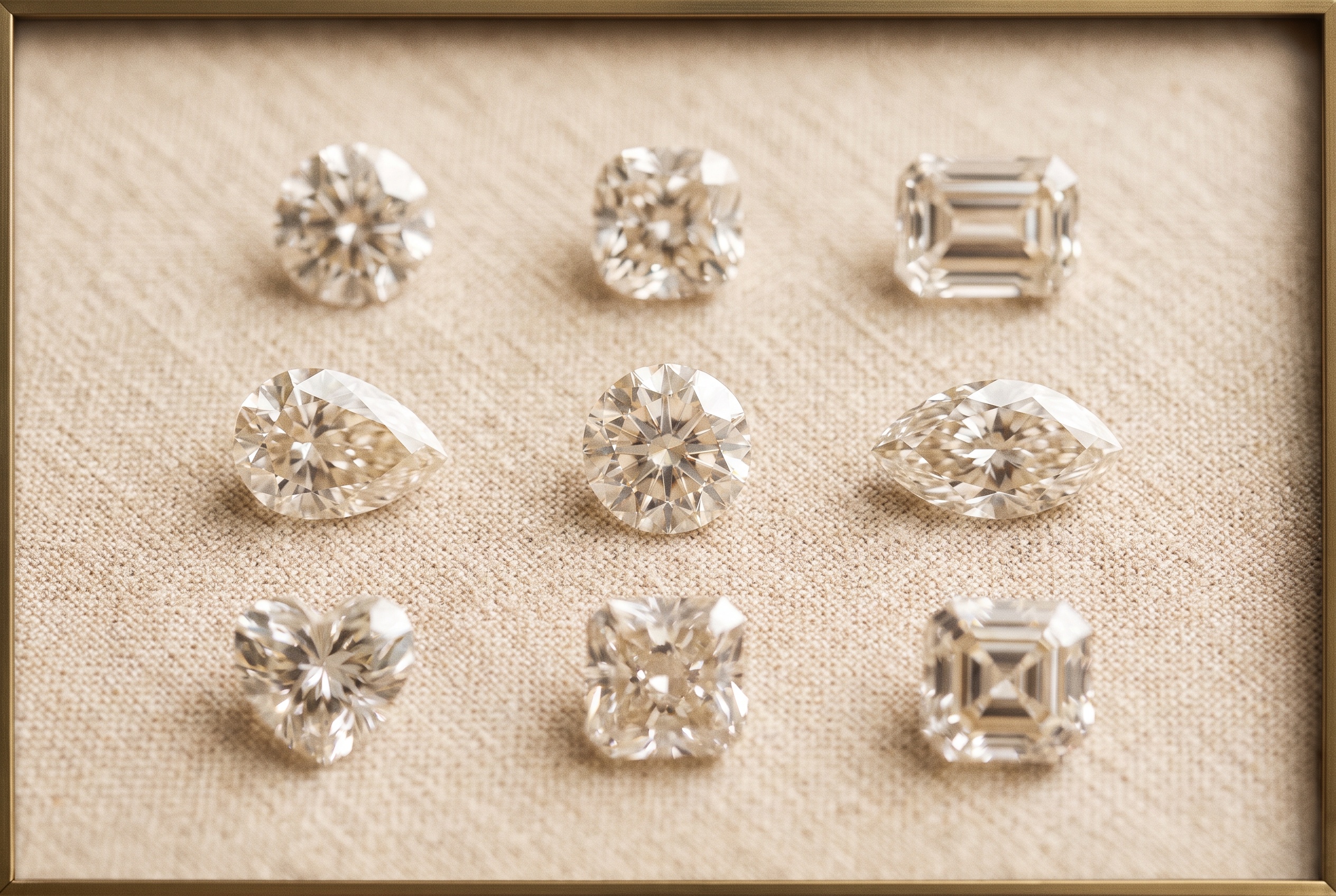
- Shapes. Round Brilliant is the baseline, alongside Fancy Calibrated Shapes — Emerald, Radiant, Pear, Marquise, and other calibrated shapes cut to size on request. Any of these can be specified for a parcel the same way round is, with its own size range and spec.
- Color and clarity baseline. Standard melee is QC'd in-house to a DEF+ color / VS+ clarity baseline across both round and fancy calibrated shapes — that's the floor spec for what ships, not a ceiling on what's available.
- Fancy color melee. Melee is also available in fancy colors — Yellow, Pink, Blue, and Green — across both round and fancy shapes, for jewelers building color-accent pieces (a yellow melee halo around a white center stone, for example). Champagne and Cognac are not currently part of the fancy color melee range.
- Growth method. All melee, in every shape and color, is CVD lab-grown — consistent with the certified loose-stone catalog, so a piece that mixes a certified center stone with melee accents doesn't cross growth methods.
Pricing follows the same parcel logic regardless of shape or color: total carat weight against a spec, quality-checked before it ships, not graded stone by stone.
Why This Is More Cost-Efficient for Accent-Heavy Work
Eternity bands, wedding bands (the same product family), and halo settings live and die on accent-stone cost, because they use dozens of small stones instead of one center stone. Pricing that stone-by-stone the way certified goods are priced would stack a documentation and per-stone handling cost across every single stone in the piece — for a project that might use 60, 90, or more melee stones, that adds up fast for zero benefit to the finished piece. Parcel pricing collapses all of that into one per-carat rate against a spec, which is the only pricing model that makes an accent-heavy design commercially sane at wholesale volume.
It’s also worth being direct about the underlying cost structure jewelers are already used to from certified goods: lab-grown diamonds, as an industry-wide fact independent of any one supplier, cost meaningfully less than natural diamonds of comparable size and quality — that gap is what’s made lab-grown viable for accent-heavy work in the first place. For illustration only, not a real quote: if a size 7 eternity band calls for roughly 60–90 melee stones in the 1–1.5mm range, pricing that as one parcel against a single color/clarity spec avoids stacking a per-stone certification and handling cost across each of those 60–90 stones individually. The parcel model is what makes that math work.
There’s a structural piece to Guru Diam’s cost position here too, and it’s worth naming plainly rather than dressing up as a discount claim: certification flexibility (certified center stones and uncertified parcel melee sourced under one roof), one-vendor consolidation (center stone, melee, and finished setting from a single supplier instead of three), and made-to-order sourcing (parcels cut to your spec instead of drawn down from generic stock) are what keep melee costs predictable project to project. None of that is a claim about being cheaper than any other supplier — it’s just how the parcel model is structured to work.
Keeping Melee Consistent Across Reorders
A single parcel order is a snapshot; a production SKU is a running relationship. If you're building the same eternity band or halo style across multiple orders — different customers, different ring sizes, spread over months — the melee needs to match not just its own spec sheet, but the parcel you approved the first time.
- Reorder against the original spec, not a fresh interpretation of it. "DEF+/VS+ round, 1.5mm" should mean the same thing on order five as it did on order one. Keeping the spec written down — shape, size range, color grade, clarity grade — rather than relying on memory is what prevents slow drift across a product line.
- Keep a reference sample from the approved parcel when a design is going into repeat production. A small retained sample gives you (and your supplier) something physical to match future parcels against, which catches drift that a written spec alone can miss.
- Batch-to-batch consistency is a sourcing discipline, not a certificate. Because melee isn't individually graded, the thing standing between "matches the original" and "close enough" is the QC process at the sorting and cutting stage — which is exactly why it matters who's doing that sorting, and why switching suppliers mid-SKU is worth a second look before you commit to it.
- Flag color-sensitive reorders explicitly. Fancy color melee in particular can drift parcel to parcel more than white DEF+ melee, since hue and saturation have more room to vary than a color grade does. If a repeat SKU uses fancy color melee, say so on the reorder and ask for the match to be verified against the original approved parcel before it ships.
None of this changes the pricing model — a reorder is still priced by carat weight against the spec, not by stone count. It's a sourcing and QC discipline layered on top of the same parcel logic covered above, and it's the difference between a product line that stays consistent and one that slowly drifts from what the client approved the first time.
Where Certification Still Matters
Parcel pricing is a melee thing, not a blanket policy. Center stones and any loose diamond at 0.30ct and up on a project should still come with an IGI or GIA report — that’s the tier where individual grading is the right tool, and where a customer expects to see paper. The two systems sit side by side on the same project: a certified center stone from the certified inventory, and a parcel of accent melee matched to spec for everything around it. Check current certified stock in cert diamonds, and current melee specs and availability in the wholesale melee line.
If you’re quoting a design that mixes both — a certified center stone with a pavé or halo of melee — price them as two separate line items using two separate logics: per-stone for the center, per-carat-parcel for the accent work. Trying to force one pricing model onto both tiers is where quotes go wrong.
Putting It Into a Quote
When you’re building a customer quote or an internal cost sheet for an accent-heavy piece, the order of operations is:
- Pull the stone count and average size from the CAD or setting spec.
- Convert to total carat weight (ct TW) for the melee portion.
- Price the melee portion as one parcel rate against your color/clarity spec, plus a small carat buffer.
- Price any certified center or accent stones separately, per stone, against their own reports.
- Combine the two line items into the finished quote.
That’s it — no per-stone melee math, no grading a batch of 1mm rounds individually. If you want a walkthrough of how sourcing and QC fit into the broader production flow, how it works covers the process end to end, and the trade partner page has the account setup details for ordering parcels against a running spec.
Frequently Asked Questions
Why isn’t melee individually certified the way 0.30ct+ diamonds are?
Melee stones are small enough, and used in high enough quantity per piece, that individual lab certification for each one would add cost and paperwork with no real benefit to the finished piece — a pavé band doesn’t get better for having 80 separate lab reports. Instead, melee is matched to a color and clarity baseline and quality-checked as a parcel against dimension and weight tolerances before it ships, which delivers consistency without the per-stone documentation overhead.
What tolerances does a melee parcel actually have to meet?
Every melee parcel is checked against a dimension tolerance of ±0.10mm, a weight tolerance of ±0.10ct on the parcel total, a color match within one grade of the ordered baseline, and a clarity match within one grade of the ordered baseline. A parcel that misses any of those gets recut before it ships — it’s never sent out off-spec.
How do I figure out how much melee to order for a setting?
Start from the stone count and average stone size on the CAD or setting spec, convert that to a total carat weight, and order against that carat figure — not the stone count — specifying shape, size range, color grade, and clarity grade. Add a small carat buffer to cover normal stone loss and swaps during setting, so you’re not placing a second order mid-project.
Can I request certification on melee if a customer specifically asks for it?
Melee, by definition, is priced and QC’d as parcel goods rather than individually certified stones — that’s the tier it operates at. If a design needs individually certified small stones, that request shifts the piece into certified loose diamond sourcing rather than the melee parcel model, which is a different conversation on cost and lead time.
Is parcel-priced melee actually cheaper than sourcing certified stones for the same accent work?
Pricing accent stones through the parcel model avoids stacking per-stone certification and handling costs across dozens of small stones in a single piece, which is inherently more efficient for pavé, halo, and eternity work than treating every accent stone like an individual certified purchase. It’s also worth noting as general industry fact that lab-grown diamonds cost meaningfully less than natural diamonds of comparable size and quality, which is part of why lab-grown melee has become the standard choice for accent-heavy designs.
Do eternity bands and wedding bands get sourced differently for melee?
No — eternity bands and wedding bands are the same product family, and their melee is sourced and priced the same way: as a parcel matched to the design’s shape, size, color, and clarity spec. Any pricing difference between specific pieces comes down to total carat weight and stone count on the design, not a different sourcing category.
What does DEF+/VS+ mean on a melee parcel?
It's the standard in-house QC baseline melee is checked against: D, E, or F color and VS1 or better clarity, verified at the parcel level rather than certified stone by stone. It's a quality floor, not a grading report — treat it as the spec you're ordering against, the same way you'd specify a metal alloy.
Is melee available in fancy colors?
Yes. Fancy color melee is available in Yellow, Pink, Blue, and Green, across both round and fancy calibrated shapes. Champagne and Cognac are not currently part of the fancy color melee range.
What melee shapes are available besides round?
Round Brilliant is the default, alongside Fancy Calibrated Shapes — Emerald, Radiant, Pear, Marquise, and other calibrated shapes cut to size on request. Each shape is priced and ordered the same way: total carat weight against a spec, not per stone.