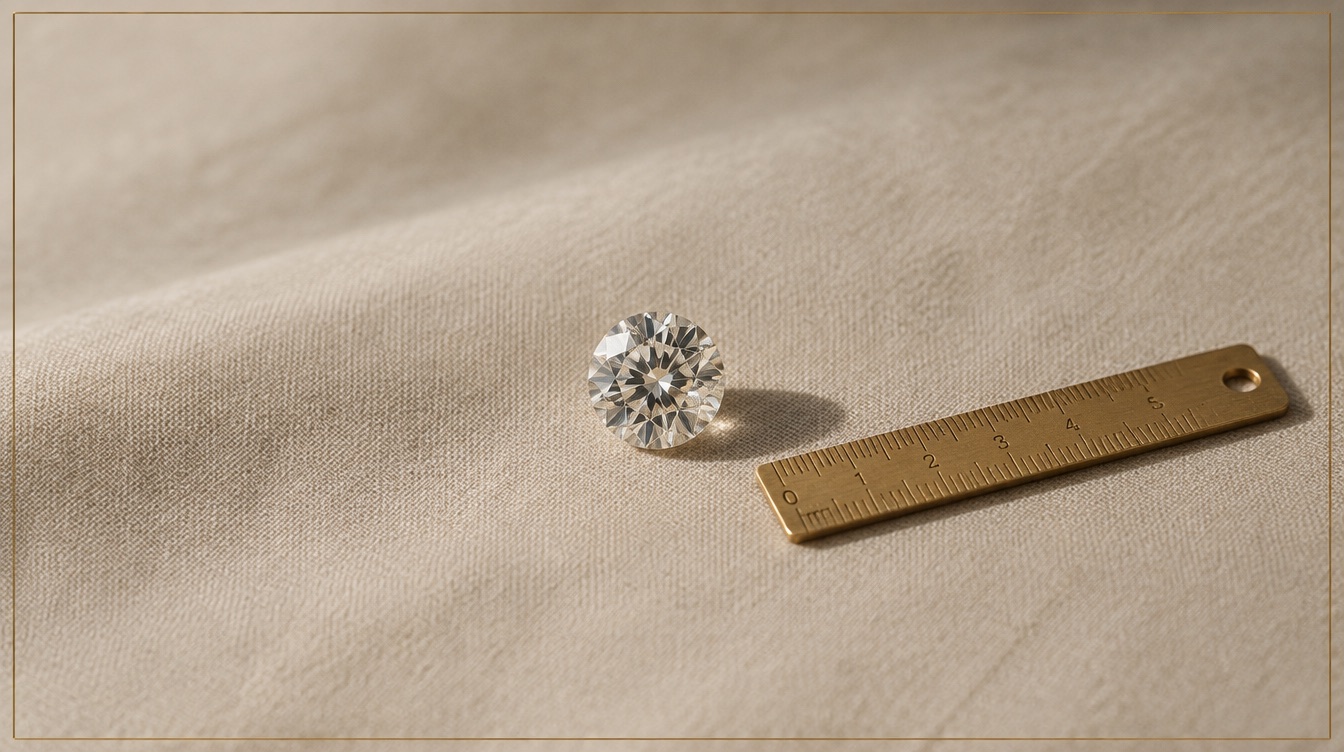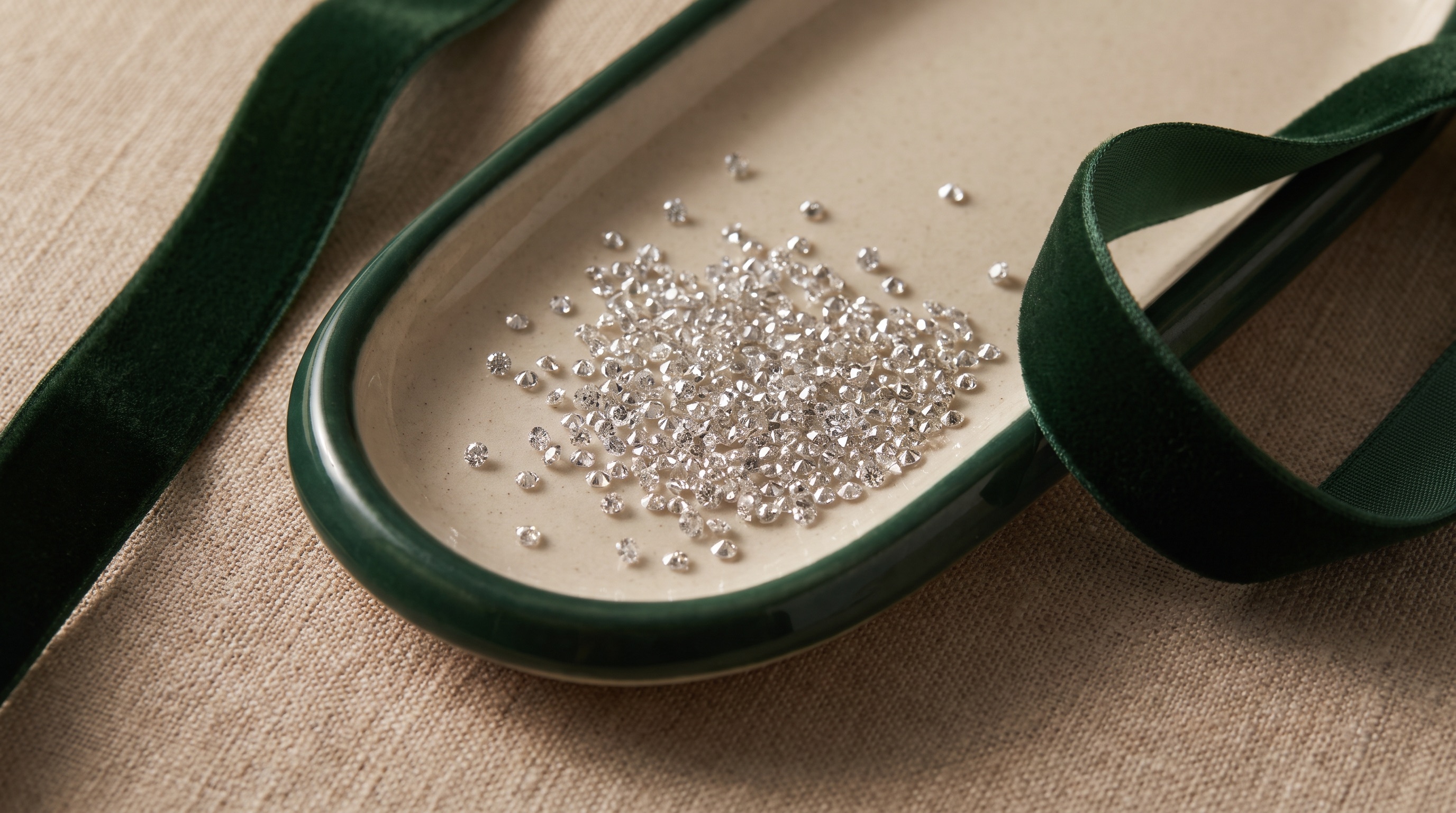
Melee diamond prices are quoted per carat, per lot, rather than per stone — a function of millimeter size, color, clarity, shape, and whether the goods are natural or lab-grown, with lab-grown CVD melee typically running a fraction of natural melee at the same visual quality. There is no single "melee price" that applies across the category, since a 1.3mm SI-clarity round lot and a 2.5mm VS-clarity fancy-shape lot sit at entirely different points on the pricing spectrum despite both being "melee."
This guide covers how melee pricing actually works, what drives the per-carat rate up or down, how natural and lab-grown melee compare, how fancy color melee is priced differently, and what jewelers should check before committing to a wholesale melee order.
Why Melee Is Priced Per Carat, Per Lot — Not Per Stone
Unlike a certified center stone, which is priced and sold as an individual, uniquely identified piece, melee is bought and sold in graded lots — a batch of stones sorted to a consistent size, color range, and clarity range, quoted as a single per-carat rate applied to the lot's total carat weight. This makes sense economically: individually grading and pricing a 0.02-carat stone the way a 1-carat stone is graded would cost more than the stone itself is worth. Instead, melee suppliers sort stones into size and quality bands and price each band as a unit, letting a buyer order "500 stones, 1.3mm, DEF color, VS+ clarity" and receive a consistent, pre-sorted lot rather than negotiating stone by stone.
What Drives Melee Price Per Carat
| Factor | Effect on Price |
|---|---|
| Size (mm) | Larger melee sizes command a meaningfully higher per-carat rate than smaller sizes, since fewer stones are needed to reach a given carat total and cutting larger melee wastes proportionally less rough |
| Color | DEF (colorless) commands a premium over GH, which commands a premium over IJ and lower — melee color bands are typically quoted in ranges (DEF, GH, IJ+) rather than individual grades |
| Clarity | VS+ commands a premium over SI, which commands a premium over lower clarity — most trade melee is quoted against a DEF+/VS+ baseline, since melee isn't individually certified |
| Shape | Round brilliant melee typically commands the highest per-carat price; fancy calibrated shapes (emerald, radiant, pear, marquise) run at varying premiums or discounts depending on cutting complexity and demand |
| Origin (natural vs. lab-grown) | The single largest price lever — natural melee commands a substantial premium over CVD lab-grown melee at the same size and quality baseline |
Melee Is Not Individually Certified — What That Means for Price
A key structural fact that shapes melee pricing: melee is not individually or parcel-certified the way a center stone at 0.30ct and above is. Instead, melee ships as uncertified parcel goods sold against a quality baseline — commonly DEF+/VS+ in the trade — rather than each stone carrying its own grading report. This is a major reason melee pricing runs so much lower per carat than certified loose stones at the same color and clarity range: the cost of individual certification, which is baked into a certified stone's price, simply doesn't apply to melee. Buyers should never expect or ask for "IGI parcel certified" melee — that framing doesn't reflect how the category is actually graded and sold; the correct expectation is a lot-quality guarantee against a stated color/clarity baseline, not a per-stone certificate.
This distinction is worth explaining clearly to a retail customer who may be used to seeing certification language attached to their center stone and reasonably wonders why the small accent stones surrounding it don't carry the same paperwork. Framing it as standard, universal trade practice — not a shortcut specific to one supplier — tends to resolve the question quickly and accurately.
Lab-Grown vs. Natural Melee: The Biggest Price Gap
Natural and CVD lab-grown melee are priced on entirely separate scales, and the gap between them is the single largest factor in melee pricing — larger, proportionally, than the gap between natural and lab-grown at center-stone weights. Natural melee draws from mined rough, which carries the same geological scarcity constraints as larger natural stones, while CVD melee production scales with manufacturing capacity. A buyer pricing out a pavé or halo design against both natural and lab-grown melee at the same DEF+/VS+ baseline should expect a dramatic per-carat price difference, often multiples apart, making this the first and most consequential sourcing decision a jeweler makes before drilling into size or shape specifics.
Natural and CVD melee claims should also never be blended on the same product or listing — a natural melee piece should never carry lab-grown language, and a CVD melee piece should never claim natural origin. Keeping the two catalogs clearly separated in pricing, listings, and disclosure protects both the buyer and the eventual retail customer from confusion about what they're actually purchasing.
Fancy Color Melee Pricing
Fancy color melee — yellow, pink, blue, and green, in both round and fancy shapes — prices on a different scale entirely from white melee, generally commanding a premium reflecting the rarity of consistently colored, well-matched small stones at scale. Champagne and cognac shades are not part of the standard fancy color melee category and are priced and sourced separately when available at all. A buyer sourcing fancy color melee for a design should expect longer lead times and less depth of readily available inventory than white melee, given how much smaller and more specialized the fancy color melee supply chain is relative to white DEF+/VS+ goods.
Melee Size and Carat-Per-Stone Reference
| Approx. Round Melee Size | Approx. Carat Per Stone | Typical Relative Per-Carat Price |
|---|---|---|
| 0.9mm-1.1mm | ~0.005-0.007ct | Lower end of the melee range |
| 1.3mm-1.5mm | ~0.010-0.015ct | Common mid-range, high-volume size |
| 1.9mm-2.1mm | ~0.03-0.04ct | Higher per-carat than smaller sizes |
| 2.5mm-2.9mm | ~0.07-0.10ct | Approaching the upper edge of typical melee range |
| 3mm+ (up to 9mm) | ~0.10ct and up | Highest per-carat melee pricing, edges toward loose-stone territory |
These figures are approximate and vary slightly by cutting style and shape; a buyer specifying an order should confirm the exact millimeter size and carat-per-stone figure with a supplier rather than assuming a round number applies precisely across every lot.
How Lot Consistency Affects Effective Price
Two melee lots quoted at the same per-carat rate aren't necessarily equal value if one is more tightly sorted than the other. A lot with wide variance in size, color, or clarity within its stated range effectively delivers less consistent finished results once set — visible color or size mismatches across a pavé line or halo ring are far more noticeable to an end customer than the same variance would be in a single larger stone. Buyers should ask suppliers directly about sorting tolerance, not just the headline size and quality band, since tighter sorting is a real cost driver that a lower-priced, loosely-sorted lot may be cutting corners on.
Common Buyer Mistakes When Pricing Melee
- Comparing per-carat rates without confirming identical size, color, and clarity bands. A lower per-carat quote often reflects a smaller size or lower quality baseline, not a genuinely better deal.
- Expecting individual certification. Melee is sold as uncertified parcel goods against a quality baseline — asking for per-stone certification reflects a misunderstanding of how the category works, not a reasonable request a supplier is failing to meet.
- Blending natural and lab-grown melee pricing expectations. These are separate catalogs with dramatically different cost structures; pricing them as interchangeable leads to inaccurate budgeting.
- Underestimating lead time for fancy shapes or fancy colors. Round white melee is the deepest, most readily available category; calibrated fancy shapes and fancy colors require more sourcing time and carry different pricing dynamics.
- Ignoring sorting tolerance. A cheaper lot with loose sorting tolerance can produce a visibly inconsistent finished piece, costing more in rework or customer dissatisfaction than the initial savings.
How Melee Pricing Fits Into a Finished Piece's Total Cost
For a halo ring, pavé band, or tennis bracelet, melee often represents a meaningful share of total stone cost even though no individual melee stone is expensive on its own — the cumulative carat weight across dozens or hundreds of small stones adds up. A jeweler pricing a finished piece should calculate melee cost as total carat weight required for the design multiplied by the per-carat rate for the chosen size, color, clarity, and origin combination, rather than treating melee as a rounding error relative to the center stone's cost. For a piece with substantial melee coverage — a full-eternity band or a dense pavé halo — melee can rival or exceed the center stone's cost, making accurate per-carat pricing on the melee side just as important to get right as the center stone quote.
Melee Pricing Trends Over Time
CVD lab-grown melee pricing has followed the same broad downward trend seen across lab-grown production generally as manufacturing capacity has scaled, making lab-grown melee an increasingly cost-effective choice for high-melee-count designs relative to a few years ago. Natural melee pricing has moved more with broader natural diamond market conditions — mine supply, demand shifts, and competitive pressure from lab-grown pulling price-sensitive volume away from natural melee specifically. A jeweler who priced a melee-heavy design a year or more ago should treat that figure as stale and reconfirm current pricing before quoting a customer, given how much movement has occurred on the lab-grown side in particular.
A Sample Melee Cost Calculation
Working through a concrete example illustrates how melee pricing actually flows into a project quote. Take a halo ring design calling for 40 round melee stones at approximately 1.3mm each (roughly 0.012ct per stone), for a total of about 0.48 carats. If that DEF+/VS+ CVD lab-grown melee is quoted at a given per-carat rate, the melee line item cost is simply that rate multiplied by 0.48 — a modest figure relative to a typical center stone cost, but one that scales quickly on a denser design. Compare that to a full-eternity band calling for 30-40 melee stones at a larger 2mm size (roughly 0.035ct per stone each), totaling well over a full carat of melee alone — at that point the melee line item can approach or exceed a modest center stone's cost, which is exactly why treating melee as a rounding error in a quote is a common and costly mistake. Running this kind of calculation explicitly, rather than eyeballing an estimate, is worth building into a standard quoting workflow for any design with meaningful melee coverage.
Where Melee Pricing Meets Loose-Stone Pricing
The boundary between melee and a certified loose stone isn't a hard physical line — it's a trade convention that sits around 0.18ct-0.30ct depending on supplier and shape, and pricing logic shifts meaningfully as a stone approaches that boundary from either side. A 0.15ct stone still prices and trades as melee: parcel-quoted, uncertified, sold by lot. A 0.30ct stone of the same visual quality crosses into individually certified loose-stone territory, with pricing quoted per stone rather than per carat by lot, and a real jump in effective cost driven by the certification and individual-handling overhead that doesn't apply to melee. Buyers designing pieces that call for accent stones near this boundary — a three-stone setting with meaningful but not massive side stones, for instance — should be clear with themselves and their supplier about which side of that line their stones fall on, since the pricing structure, not just the per-carat rate, changes at that threshold.
Retail Markup Considerations for Melee-Heavy Pieces
A retailer pricing a finished piece with substantial melee coverage should account for melee cost as its own explicit line item rather than folding it into a single blended "stone cost" figure alongside the center stone. This matters for two practical reasons: it makes repricing easier when melee costs shift independently of center-stone costs (which happens often, given how differently lab-grown melee and natural melee pricing have moved over time), and it gives sales staff a clearer story to tell a customer asking why a heavily-paved design costs meaningfully more than a similar-looking piece with less melee coverage. Retailers who understand and can articulate the actual cost driver — carat-weight-equivalent melee cost, not just "more diamonds" — are better positioned to justify pricing on denser designs without resorting to vague value language.
Melee Pricing for Recurring vs. One-Off Orders
Jewelers and manufacturers placing recurring melee orders — a production line running the same halo design repeatedly, for instance — are generally in a stronger position to negotiate favorable per-carat pricing and secure priority lead times than a one-off buyer sourcing melee for a single custom commission. Establishing a standing order or a committed recurring volume with a single supplier also reduces lot-to-lot variance risk, since a supplier filling repeat orders for the same buyer has a direct incentive to maintain consistent sourcing and sorting for that account specifically. Buyers anticipating ongoing melee needs are better served thinking in terms of an ongoing supply relationship and negotiated standing terms than treating every order as an independent one-off price negotiation.
What to Ask a Melee Supplier Before Ordering
- What is the exact color and clarity baseline? Confirm the specific range (e.g., DEF+/VS+) rather than a vague "high quality" description.
- What is the sorting tolerance within the lot? A tighter tolerance costs more but delivers a more consistent finished appearance.
- Is this natural or CVD lab-grown? Confirm explicitly and in writing — the two should never be ambiguous on an order or invoice.
- What is the minimum order quantity or carat weight? Melee is often sold in minimum lot sizes rather than individual stones.
- What is current lead time for this size, shape, and quality combination? Common round white sizes typically ship faster than fancy shapes or fancy colors.
Comparing Melee Quotes Across Suppliers
Comparing per-carat melee rates across suppliers only produces a meaningful answer when every specification is held constant: identical millimeter size, identical color band, identical clarity band, identical shape, and identical origin (natural or CVD lab-grown). A quote that looks cheaper on its face may reflect a wider color band (GH-IJ instead of a tighter DEF-GH), a looser sorting tolerance, or a smaller actual millimeter size than advertised. Requesting a physical sample lot before committing to a large order is standard, reasonable practice in the melee trade specifically because visual and tactile inspection catches inconsistencies that a written specification sheet alone can miss — sorting tolerance and cut quality within a stated size and color band are genuinely difficult to fully convey on paper. Buyers placing recurring melee orders benefit from establishing this sample-first relationship with a supplier early, rather than reordering sight-unseen once initial trust is established, since even a reliable supplier's lot-to-lot consistency is worth periodic spot-checking.
Packaging, QC, and What It Means for Price
Melee lots typically arrive packaged in sealed, labeled parcels specifying stone count or approximate carat weight, size, color band, clarity band, and origin — a supplier's packaging and internal QC rigor is itself a real, if less visible, cost driver behind the quoted price. A supplier that hand-sorts and double-checks lot consistency before shipping incurs more labor cost than one that ships a looser, less-verified parcel, and that difference shows up in price even when the headline size and quality band specifications look identical on paper. Buyers who've been burned by inconsistent melee lots in the past often find that paying a modest premium for a supplier with a strong, verifiable QC process is a better long-term value than chasing the lowest quoted per-carat rate, particularly for a jeweler running a recurring production line where lot-to-lot consistency affects finished-piece quality at scale.
Sourcing Melee Diamonds at Wholesale
Guru Diam supplies CVD lab-grown melee — no HPHT anywhere in the catalog — and natural round melee as a separate, distinct product line, spanning roughly 0.8mm to 9.0mm in round brilliant and fancy calibrated shapes (emerald, radiant, pear, marquise, and other calibrated shapes on request), graded against a DEF+/VS+ baseline. Fancy color lab-grown melee is available in yellow, pink, blue, and green, in both round and fancy shapes. In-stock melee inventory ships same-day from New York (before 6pm EST) and Los Angeles (before 4pm PST).
Buyers can browse certified loose stones alongside melee sourcing through the certified diamonds category, source matched melee lots for a specific design through matching pairs, and access fancy color melee through the fancy color loose diamonds category. Jewelers building a full piece around a melee-heavy design can work through custom jewelry for a setting finished in 4-6 days. Trade accounts can review terms at the wholesale hub or apply through trade partner.
Frequently Asked Questions
How much do melee diamonds cost?
Melee is priced per carat by lot rather than per stone, and the rate depends heavily on size, color, clarity, shape, and whether the goods are natural or CVD lab-grown. Lab-grown melee runs a fraction of natural melee at the same visual quality, and larger melee sizes command a higher per-carat rate than smaller sizes.
Are melee diamonds individually certified?
No — melee ships as uncertified parcel goods sold against a stated color and clarity baseline (commonly DEF+/VS+), not with individual grading reports. Loose stones at 0.30ct and above are the tier that receives individual certification.
Why is lab-grown melee so much cheaper than natural melee?
Lab-grown melee production scales with manufacturing capacity, while natural melee draws from mined rough subject to the same geological scarcity that affects larger natural stones. The resulting price gap is one of the largest in the entire diamond trade, proportionally larger than the gap at center-stone weights.
Can I get fancy color melee at the same price as white melee?
No — fancy color melee (yellow, pink, blue, and green) commands a premium over white melee, reflecting the rarity of consistently colored, well-matched small stones at scale, along with generally longer lead times and thinner available inventory.
What size melee is most commonly used?
Sizes in the roughly 1.0mm-1.5mm range see the highest volume in halo, pavé, and accent-stone applications, representing a practical balance of visible presence and cost. Larger sizes above 2.5mm approach loose-stone pricing territory.
Does melee price change based on the shape?
Yes — round brilliant melee typically commands the highest per-carat price due to demand and cutting yield, while calibrated fancy shapes like emerald, radiant, pear, and marquise price at varying premiums or discounts depending on cutting complexity for that specific shape.